Archives
CCJ 26561
A paradigm is a boundary or parameter that outlines a rule is based on experience. a. True b. False The following statements are true about both torts and crimes, except: a. Both could result from the same single act. b. […]

Chapter 1 The first written agreement among the colonies to stand together
1. Formal ties between Great Britain and the United States were severed: a. when the American Declaration of Independence was signed. b. when the colonists boarded British ships and threw tea overboard. c. through the drafting of the Magna Carta. […]

Chapter 10 Act Congress Quot The Court Went Assert
LEARNING OBJECTIVES: CLCJ.HAHE.14.20 – 3 ANSWER: d REFERENCES: 340-341 1. Which of the following is not guaranteed or prohibited by the Fifth Amendment? a. right against self–incrimination b. trial by jury c. double jeopardy d. just compensation ANSWER: b REFERENCES: […]

Chapter 11 The case establishing that indigent defendants accused of
REFERENCES: 390 LEARNING OBJECTIVES: CLCJ.HAHE.14.5 – 9 ANSWER: d 1. The first prong of the two–pronged test to establish a claim of ineffective counsel requires the defendant to show: a. representation falling below an objective standard of reasonableness. b. representation […]

Chapter 12 The general rule under the Eighth Amendment is that
1. At the end of 2010, all 36 states with the death penalty authorized as a method of execution. a. the gas chamber b. lethal injection c. the electric chair d. hanging 2. The Supreme Court held that any amount […]

Chapter 13 In, the Supreme Court upheld the Fair Labor Standards
1. The Third Amendment: a. addresses suits at common law. b. deals with lawsuits exceeding $20. c. prohibits the quartering of soldiers in homes during times of peace. d. has been challenged numerous times throughout the history of America. 2. […]

Chapter 2 Law does all of the following, except that it does not
1. A basic purpose of the American legal system is to: a. remove power from the government. b. develop a living law. c. ensure fairness in balancing individual and societal rights and needs. d. create a system that, while not […]

Chapter 3 allow the ruling of the lower court to stand
1. The framework for the federal judiciary is: a. based on common law. b. found in the Declaration of Independence. c. outlined in The Federalist Papers, issue V d. found in Article 3 of the U.S. Constitution. 2. The first […]

Chapter 4 Which of the following was not one of the pressing
1. The Thirteenth Amendment: a. deals with the right to due process of law. b. abolished slavery. c. established prohibition. d. guarantees equal protection. 2. Among other things, the Fourteenth Amendment: a. permitted blacks to be citizens of the United […]

Chapter 5 The ‘Lemon’ test regarding separation of church
1. The First Amendment specifically prohibits Congress from making any laws that restrict freedom of religion, speech, press, assembly, and: a. privacy. b. to petition the government. c. the presumption of innocence. d. travel. 2. Protected forms of speech include […]

Chapter 6 Violent Crime Control And Law Enforcement Act
1. In , a federal circuit court ruled in Stevens v. United States that there was no express Constitutional right of an individual to keep and bear arms. a. 1801 b. 1871 c. 1921 d. 1971 2. A critical question […]

Chapter 7 The Law Stop And Frisk Deals With
1. The law of stop and frisk deals with that time frame during which officers follow up on their suspicions but before the time that the requisite is established to justify an arrest. a. probable cause b. reasonable suspicion c. […]

Chapter 8 Students Should articulate The Various Levels Force Contained
1. Which of the following, by itself, can be used as reasonable suspicion to conduct a stop? a. anonymous tip b. flight from police c. general suspicion d. existence of a wanted poster 2. The “fleeing felon” rule that allowed […]

Chapter 9 Recording phone conversations with consent of one of
1. The Supreme Court ruled that unannounced cell searches or shakedowns did not require warrants, did not violate inmates’ Fourth Amendment rights, and were justified by the need to maintain order in: a. Morrissey v. Brewer b. Bell v. Wolfish […]
CRIM 41192
The minimum number of justices required to vote in favor or granting certiorari to review a case is: a. 2 b. 4 c. 3 d. 1 In a civil case, the party bringing suit is represented by: a. the prosecutor […]
CRIM 87133
When a court is determining the amount of procedural due process owed an individual, it will look at: a. the significance of the affected interest. b. whether additional safeguards would reduce the risk of error. c. the public interest in […]
EDU 69050
Since a stop is a seizure within the meaning of the Fourth Amendment, it requires a. police involvement. b. reasonableness. c. adverse possession. d. clear and convincing evidence. An officer’s hot pursuit of a suspect cannot legally continue past the […]
EDUC 41879
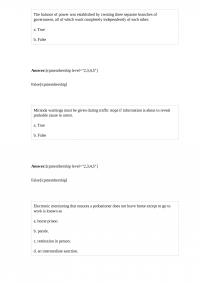
The balance of power was established by creating three separate branches of government, all of which work completely independently of each other. a. True b. False Miranda warnings must be given during traffic stops if information is about to reveal […]
EDUC 50661
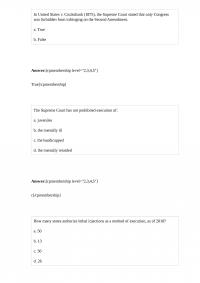
In United States v. Cruikshank (1875), the Supreme Court stated that only Congress was forbidden from infringing on the Second Amendment. a. True b. False The Supreme Court has not prohibited execution of: a. juveniles b. the mentally ill c. […]
EDUC 75833
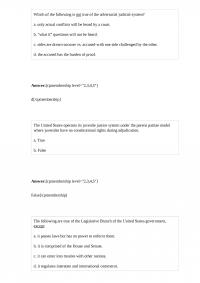
Which of the following is not true of the adversarial judicial system? a. only actual conflicts will be heard by a court. b. “what if” questions will not be heard. c. sides are drawn-accuser vs. accused-with one side challenged by […]
LAWS 14354
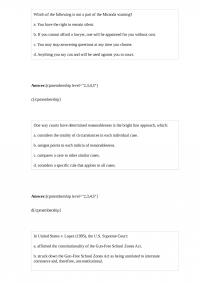
Which of the following is not a part of the Miranda warning? a. You have the right to remain silent. b. If you cannot afford a lawyer, one will be appointed for you without cost. c. You may stop answering […]
LAWS 15646
In the Heller decision, the Supreme Court specifically refrained from voicing an opinion on whether the Second Amendment applied to: a. illegal immigrants. b. the states. c. private individuals. d. certain misdemeanants. The circumstances in which officers leave their jurisdiction […]
LAWS 30743
Usually, officers cannot make a lawful arrest: a. for any crime committed in their presence. b. for any felony if they have probable cause. c. with an arrest warrant. d. for a misdemeanor committed outside their presence. Which of the […]
LAWS 41218
The Durkheimian perspective saw punishment as revenge and a means to restore and solidify the social order. a. True b. False The Supreme Court, powerful as it is, cannot override the will of the majority expressed in acts of Congress. […]
LAWS 83307
Which of the following would be considered a violation of a subject’s reasonable expectation of privacy, requiring a warrant? a. Police put a “beeper” on a vehicle to monitor its location. b. Undercover officer converses with suspects and uses information […]
MET CJ 27718
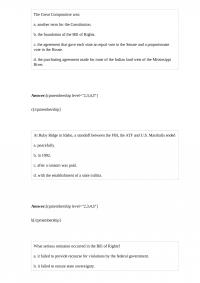
The Great Compromise was: a. another term for the Constitution. b. the foundation of the Bill of Rights. c. the agreement that gave each state an equal vote in the Senate and a proportionate vote in the House. d. the […]
MET CJ 46278
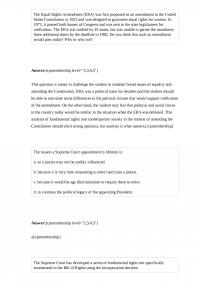
The Equal Rights Amendment (ERA) was first proposed as an amendment to the United States Constitution in 1923 and was designed to guarantee equal rights for women. In 1972, it passed both houses of Congress and was sent to the […]
MET UA 67776
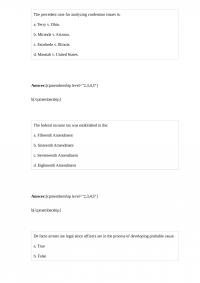
The precedent case for analyzing confession issues is: a. Terry v. Ohio. b. Miranda v. Arizona. c. Escobedo v. Illinois. d. Massiah v. United States. The federal income tax was established in the: a. Fifteenth Amendment b. Sixteenth Amendment c. […]
MET UA 82947
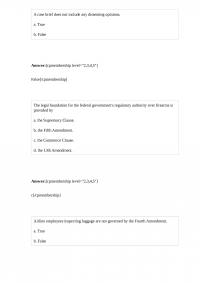
A case brief does not include any dissenting opinions. a. True b. False The legal foundation for the federal government’s regulatory authority over firearms is provided by a. the Supremacy Clause. b. the Fifth Amendment. c. the Commerce Clause. d. […]
MET UA 88501
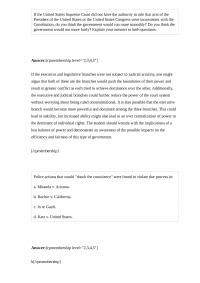
If the United States Supreme Court did not have the authority to rule that acts of the President of the United States or the United States Congress were inconsistent with the Constitution, do you think the government would run more […]
SED LR 61301
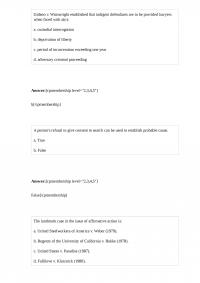
Gideon v. Wainwright established that indigent defendants are to be provided lawyers when faced with a(n): a. custodial interrogation b. deprivation of liberty c. period of incarceration exceeding one year d. adversary criminal proceeding A person’s refusal to give consent […]
SESP 17104
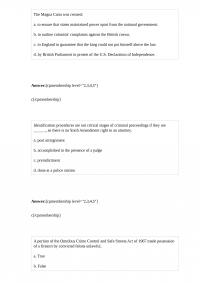
The Magna Carta was created: a. to ensure that states maintained power apart from the national government. b. to outline colonists’ complaints against the British crown. c. in England to guarantee that the king could not put himself above the […]
SESP 55103
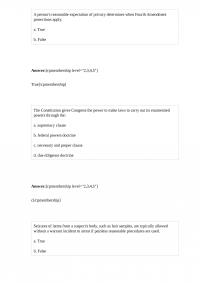
A person’s reasonable expectation of privacy determines when Fourth Amendment protections apply. a. True b. False The Constitution gives Congress the power to make laws to carry out its enumerated powers through the: a. supremacy clause b. federal powers doctrine […]