Archives
978-1259870552 Chapter 1
Communication Research: Asking Questions, Finding Answers, 5e (Keyton) Chapter 1 Introduction to Communication Research 1) Communication research from the social science perspective A) is the discovery of answers to questions through the application of scientific and systematic procedures. B) uses […]
978-1259870552 Chapter 10
Communication Research: Asking Questions, Finding Answers, 5e (Keyton) Chapter 10 Testing for Differences 1) Inferential statistics are used to: A) describe the basic properties of scores. B) determine the normality of the data. C) draw conclusions about a population by […]
978-1259870552 Chapter 11
Communication Research: Asking Questions, Finding Answers, 5e (Keyton) Chapter 11 Testing for Relationships 1) If the data for the variables being tested are not normally distributed, the statistical test: A) cannot be used. B) is not affected. C) provides only […]
978-1259870552 Chapter 12
Communication Research: Asking Questions, Finding Answers, 5e (Keyton) Chapter 12 Quantitative Analysis of Text 1) Content analysis and interaction analysis are similar in that: A) each is considered a quantitative method. B) each codes ongoing interaction. C) each is an […]
978-1259870552 Chapter 13
Communication Research: Asking Questions, Finding Answers, 5e (Keyton) Chapter 13 Reading and Writing the Quantitative Research Report 1) After reading the method section of a quantitative research report, you should know: A) what the researcher did to collect the data. […]
978-1259870552 Chapter 14
Communication Research: Asking Questions, Finding Answers, 5e (Keyton) Chapter 14 Introduction to Qualitative Research 1) Which of the following statements is not true? A) Qualitative research preserves the form and content of human interaction. B) Qualitative research is not empirically […]
978-1259870552 Chapter 15
Communication Research: Asking Questions, Finding Answers, 5e (Keyton) Chapter 15 Designing Qualitative Research 1) In qualitative research, the researcher: A) is the primary data collector. B) is likely to be in the research context for extended periods of time. C) […]
978-1259870552 Chapter 16
1 Communication Research: Asking Questions, Finding Answers, 5e (Keyton) Chapter 16 Qualitative Methods of Data Collection 1) Field notes: A) are a continuous or sequential record of what was observed. B) are created while the interaction occurs. C) can be […]
978-1259870552 Chapter 17
Communication Research: Asking Questions, Finding Answers, 5e (Keyton) Chapter 17 Analyzing Qualitative Data 1) Analyzing qualitative data: A) begins only after all of the observations are completed. B) is accomplished by reading through the field notes several times. C) is […]
978-1259870552 Chapter 18
1 Communication Research: Asking Questions, Finding Answers, 5e (Keyton) Chapter 18 Reading and Writing the Qualitative Research Report 1) Authorial voice: A) is the decision authors make about which author will be listed first on the research report. B) is […]
978-1259870552 Chapter 2
Communication Research: Asking Questions, Finding Answers, 5e (Keyton) Chapter 2 The Research Process: Getting Started 1) Both the deductive and inductive research models begin with A) reviewing and building from existing theory. B) collecting data. C) identifying the research problem. […]
978-1259870552 Chapter 3
Communication Research: Asking Questions, Finding Answers, 5e (Keyton) Chapter 3 Research Ethics 1) Beneficence is achieved when: A) researchers’ rights are protected. B) the results of a research project benefit the public. C) the well-being of research participants is protected. […]
978-1259870552 Chapter 4
Communication Research: Asking Questions, Finding Answers, 5e (Keyton) Chapter 4 Introduction to Quantitative Research 1) A hypothesis is A) necessary for quantitative research. B) an educated guess or a presumption based on the review of the research literature. C) the […]
978-1259870552 Chapter 5
Communication Research: Asking Questions, Finding Answers, 5e (Keyton) Chapter 5 Measurement 1) Measurement is: A) the same as evaluation. B) identifying variables as independent or dependent. C) collecting data through a questionnaire, or counting the number of instances a particular […]
978-1259870552 Chapter 6
1 Communication Research: Asking Questions, Finding Answers, 5e (Keyton) Chapter 6 Populations, Samples, and Sample Size 1) A population is: A) selected from the sample. B) selected from the sampling frame. C) determined by identifying the characteristics the researcher wants […]
978-1259870552 Chapter 7
Communication Research: Asking Questions, Finding Answers, 5e (Keyton) Chapter 7 Quantitative Research Designs 1) Experimental research: A) most often occurs in the lab or other simulated environment controlled by the researcher. B) produces data that are examined by statistical tests. […]
978-1259870552 Chapter 8
Communication Research: Asking Questions, Finding Answers, 5e (Keyton) Chapter 8 Surveys and Questionnaires 1) A socially desirable response is: A) the answer the researcher is looking for. B) the answer the participants wants to give, but feels uncomfortable sharing. C) […]
978-1259870552 Chapter 9
Communication Research: Asking Questions, Finding Answers, 5e (Keyton) Chapter 9 Descriptive Statistics, Significance Levels, and Hypothesis Testing 1) The normal curve is: A) a theoretical distribution of scores. B) characterized by the majority of cases at one end of the […]
Speech Chapter 1 Keyton Communication Research Introduction Communication Research Activity Learning About The Research
IM-1 Keyton: Communication Research, 5e Chapter 1 Introduction to Communication Research Activity: Learning About the Research of Others in the Department One way to generate interest in, and respect for, research methods is to demonstrate that faculty and graduate students […]
Speech Chapter 10 Keyton Communication Research Testing For Differences Activity Determining Expected Cell Frequencies
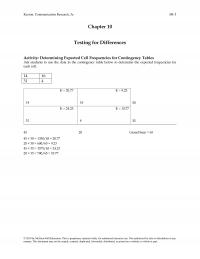
Keyton: Communication Research, 5e IM–1 Chapter 10 Testing for Differences Activity: Determining Expected Cell Frequencies for Contingency Tables Ask students to use the data in the contingency table below to determine the expected frequencies for each cell. © 2019 by […]
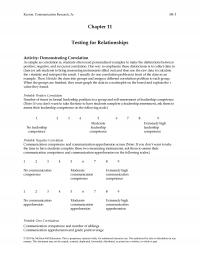
Speech Chapter 11 Keyton Communication Research Testing For Relationships Activity Demonstrating Correlation Simple Correlation
Keyton: Communication Research, 5e IM–1 Chapter 11 Testing for Relationships Activity: Demonstrating Correlation As simple as correlation is, students often need personalized examples to make the distinctions between positive, negative, and no (zero) correlation. One way to emphasize these distinctions […]
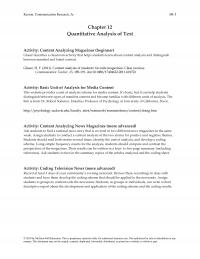
Speech Chapter 12 Keyton Communication Research Quantitative Analysis Text Activity Content Analyzing Magazines Beginner
Keyton: Communication Research, 5e IM–1 Chapter 12 Quantitative Analysis of Text Activity: Content Analyzing Magazines (beginner) Glaser describes a classroom activity that helps students learn about content analysis and distinguish between manifest and latent content. Glaser, H. F. (2011). Content […]
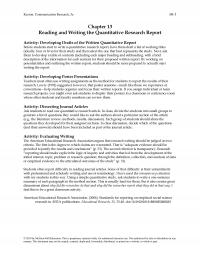
Speech Chapter 13 Keyton Communication Research Reading And Writing The Quantitative Research Report Activity
Keyton: Communication Research, 5e IM–1 Chapter 13 Reading and Writing the Quantitative Research Report Activity: Developing Drafts of the Written Quantitative Report Before students start to write a quantitative research report, have them draft a list of working titles (ideally, […]
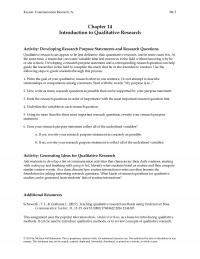
Speech Chapter 14 Keyton Communication Research Introduction Qualitative Research Activity Developing Research Purpose Statements
Keyton: Communication Research, 5e IM–1 Chapter 14 Introduction to Qualitative Research Activity: Developing Research Purpose Statements and Research Questions Qualitative research can appear to be less definitive than quantitative research, and in some cases it is. At the same time, […]
Speech Chapter 15 Keyton Communication Research Designing Qualitative Research Activity Designing Qualitative Study Ask
Keyton: Communication Research, 5e IM–1 Chapter 15 Designing Qualitative Research Activity: Designing a Qualitative Study Ask students to write the purpose statement for a qualitative study, according to the following script (Creswell, 1994). Script for a Qualitative Study The purpose […]
Speech Chapter 16 Keyton Communication Research Qualitative Methods Data Collection Activity Using Stimulated Recall
Keyton: Communication Research, 5e IM–1 Chapter 16 Qualitative Methods of Data Collection Activity: Using Stimulated Recall in Interviewing At least 3 days prior to this classroom exercise, tell students that they will be interviewed about one of their school experiences. […]
Speech Chapter 17 Keyton Communication Research Analyzing Qualitative Data Activity Developing Drafts The Written
Keyton: Communication Research, 5e IM–1 Chapter 17 Analyzing Qualitative Data Activity: Developing Drafts of the Written Quantitative Report Use one of the data collection activities identified in assignments described for Chapters 16. Students need data from at least one set […]
Speech Chapter 18 Keyton Communication Research Reading And Writing The Qualitative Research Report Activity
Keyton: Communication Research, 5e IM–1 Chapter 18 Reading and Writing the Qualitative Research Report Activity: Dissecting Journal Articles Ask students to read one qualitative research article. In class, divide the students into small groups to generate a list of questions […]
Speech Chapter 2 Keyton Communication Research The Research Process Getting Started Activity Examining The
Keyton: Communication Research, 5e IM-1 Chapter 2 The Research Process: Getting Started Activity: Examining the Deductive and Inductive Research Models Ask students to review the deductive and inductive research models presented in Chapter 2 (Figures 2.1 and 2.2). Students should […]
Speech Chapter 3 Keyton Communication Research Research Ethics Activity Discussing Plagiarism Bring Copies Your
Keyton: Communication Research, 5e IM–1 Chapter 3 Research Ethics Activity: Discussing Plagiarism Bring copies of your university’s plagiarism policy to class. Put students into groups to review the policy and discuss the similarities and differences between student plagiarism of scholarly […]
Speech Chapter 4 Keyton Communication Research Introduction Quantitative Research Activity Introducing Quantitative Research Introduce
Keyton: Communication Research, 5e IM–1 Chapter 4 Introduction to Quantitative Research Activity: Introducing Quantitative Research To introduce students to the standard form of quantitative research, I bring stacks of journals to class and ask students to choose one copy of […]
Speech Chapter 5 Keyton Communication Research Measurement Activity Recognizing That Statistics Are Part Everyday
Keyton: Communication Research, 5e IM–1 Chapter 5 Measurement Activity: Recognizing That Statistics Are Part of Everyday Life Divide the class into groups to generate a list of statistics with which the students are familiar. If a group is having trouble […]
Speech Chapter 6 Keyton Communication Research Populations Samples And Sample Sizeactivity Selecting Sample The
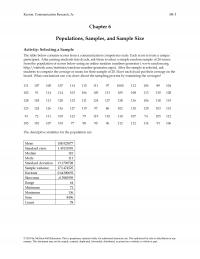
Keyton: Communication Research, 5e IM–1 Chapter 6 Populations, Samples, and Sample Size Activity: Selecting a Sample The table below contains scores from a communication competence scale. Each score is from a unique participant. After pairing students into dyads, ask them […]
Speech Chapter 7 Keyton Communication Research Quantitative Research Designs Activity Designing Quantitative Study Assign
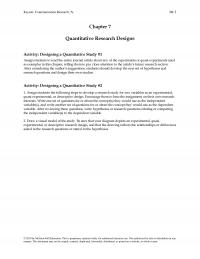
Keyton: Communication Research, 5e IM–1 Chapter 7 Quantitative Research Designs Activity: Designing a Quantitative Study #1 Assign students to read the entire journal article about any of the experiments or quasi-experiments used as examples in this chapter, telling them to […]
Speech Chapter 8 Keyton Communication Research Surveys And Questionnaires Activity News Polls Polls Are
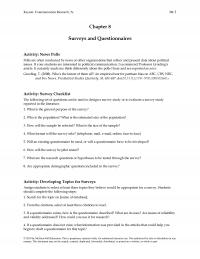
Keyton: Communication Research, 5e IM–1 Chapter 8 Surveys and Questionnaires Activity: News Polls Polls are often conducted by news or other organizations that collect and present data about political issues. If your students are interested in political communication, I recommend […]
Speech Chapter 9 Keyton Communication Research Descriptive Statistics Significance Levels And Hypothesis Testing Activity
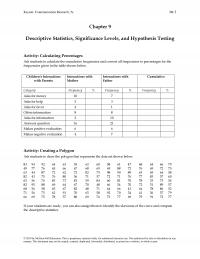
Keyton: Communication Research, 5e IM–1 Chapter 9 Descriptive Statistics, Significance Levels, and Hypothesis Testing Activity: Calculating Percentages Ask students to calculate the cumulative frequencies and convert all frequencies to percentages for the frequencies given in the table shown below. © […]