Archives
Chapter 1 Chapter 1 None These Answers Correct 16 The Following
1 CHAPTER 1. Introduction to Technical Communication True/False Questions 1. feelings. Technical communication rarely focuses on the author’s personal thoughts or 2. Technical documents are almost always designed for expert readers. 3. Phone calls, conversations, and meetings have largely replaced […]
Chapter 10 Chapter 10 When Researching The Job Market
1 CHAPTER 10. Résumés and Other Employment Materials True/False Questions 1. To increase your employment chances, apply for the broadest possible jobs. 2. Send a thank-you email immediately after an interview. 3. The career-objective statement should be tailored to the […]
Chapter 11 Chapter 11 The You Perspective Letter Most Appropriate A
1 CHAPTER 11. Memos and Letters True/False Questions 1. The most typical form of everyday workplace communication is a letter. 2. Headings and bullets are not needed in memos because they are typically short communications. 3. An email “signature” is […]
Chapter 12 Chapter 12 None These Answers Correct 17 Determine The
1 CHAPTER 12. Definitions True/False Questions 1. Parenthetical definitions are often synonyms. 2. Definitions can be as long as several pages. 3. Definitions can have legal implications. 4. Hyperlinked definitions are difficult for readers to use. 5. Circular definitions help […]
Chapter 13 Chapter 13 Visuals Descriptions A Are Rarely Needed Facilitate
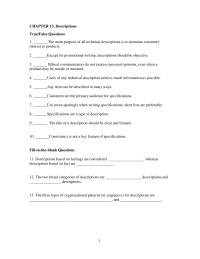
1 CHAPTER 13. Descriptions True/False Questions 1. The main purpose of all technical descriptions is to stimulate consumer interest in products. 2. Except for promotional writing, descriptions should be objective. 3. Ethical communicators do not express personal opinions, even when […]
Chapter 14 Chapter 14 Instructions And Procedures Truefalse Questions
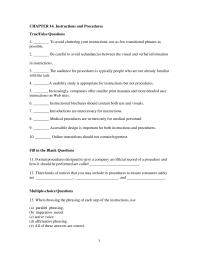
1 CHAPTER 14. Instructions and Procedures True/False Questions 1. possible. 2. To avoid cluttering your instructions, use as few transitional phrases as Be careful to avoid redundancies between the visual and verbal information in instructions. 3. The audience for procedures […]
Chapter 15 Chapter 15 All These Make The Process 16 Which
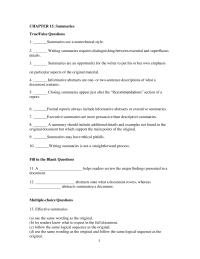
1 CHAPTER 15. Summaries True/False Questions 1. Summaries use a nontechnical style. 2. details. 3. Writing summaries requires distinguishing between essential and superfluous Summaries are an opportunity for the writer to put his or her own emphasis on particular aspects […]
Chapter 16 Chapter 16 For Meeting Minutes All The Following Except
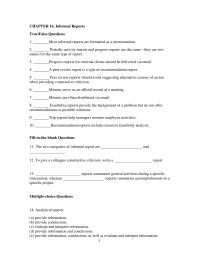
1 CHAPTER 16. Informal Reports True/False Questions 1. Most informal reports are formatted as a memorandum. 2. Periodic activity reports and progress reports are the same—they are two names for the same type of report. 3. Progress reports for external […]
Chapter 17 Chapter 17 Front Matter Includes The A Introduction B
1 CHAPTER 17. Formal Reports True/False Questions 1. Among the typical questions answered by formal reports are “Why does X happen” and “How do I do X?” 2. A formal report may address two or more categories of approaches— comparative, […]
Chapter 18 Chapter 18 When Writing The Proposal A Adopt Confident
1 CHAPTER 18. Proposals True/False Questions 1. Whether solicited or unsolicited, all research proposals are formal. 2. The logical flow of proposals, regardless of type, should move from problem/situation to solution/resolution. 3. Formal proposals have the same format as formal […]
Chapter 19 Chapter 19 Which The Following Scenarios Calls For Sending
1 CHAPTER 19. Email and Text Messages True/False Questions 1. For most simple correspondence, email is the correct format to use. 2. like email. Use of bullets, headings, and italics is inappropriate in short communications 3. Text messages are more […]
Chapter 2 Chapter 2 Dictate Advice The Team E Evaluate The
1 CHAPTER 2. Teamwork and Global Issues in Technical Communication True/False Questions 1. In collaborating to produce a document, all members of a collaborative team participate in the actual “writing.” 2. “Reviewing” is a more precise term for “editing.” 3. […]
Chapter 20 Chapter 20 Social Networks Are Used A Companies B
1 CHAPTER 20. Blogs, Wikis, and Social Networks True/False Questions 1. External corporate blogs can help enhance relationships with customers. 2. The word “wiki” is derived from a Hawaiian phrase meaning “quick.” 3. Social networking sites are not useful means […]
Chapter 21 Chapter 21 For Emphasizing Specific Words Phrases Web Sites
1 CHAPTER 21. Web Pages and Online Videos True/False Questions 1. A storyboard provides a detailed sketch of a Web page. 2. Most online videos are used for instructional purposes. 3. Readers expect more visuals on Web pages than they […]
Chapter 22 Chapter 22 Oral Presentations True false Questions Memorized
1 CHAPTER 22. Oral Presentations True/False Questions 1. A memorized delivery style is usually most effective for a formal report. 2. Flip charts are no longer appropriate now that we have more technological solutions such as PowerPoint. 3. You should […]
Chapter 3 Chapter 3 Informational Interviews A Not Require Clear Purpose
1 CHAPTER 3. The Research Process in Technical Communication True/False Questions 1. A survey is an example of secondary research. 2. Subject directories are indexes of information that are maintained by computer programs. 3. Sometimes the most reliable material resides […]
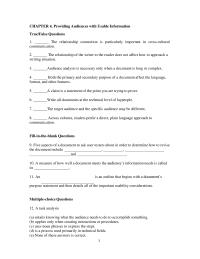
Chapter 4 Chapter 4 The Preferred Strategy Use A The Power
1 CHAPTER 4. Providing Audiences with Usable Information True/False Questions 1. The relationship connection is particularly important in cross-cultural communication. 2. The relationship of the writer to the reader does not affect how to approach a writing situation. 3. Audience […]
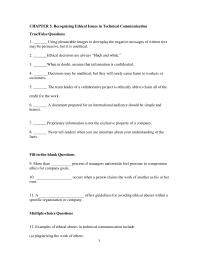
Chapter 5 Chapter 5 Which Statement Below Least Accurate A Because
1 CHAPTER 5. Recognizing Ethical Issues in Technical Communication True/False Questions 1. Using pleasurable images to downplay the negative messages of written text may be persuasive, but it is unethical. 2. Ethical decisions are always “black and white.” 3. When […]
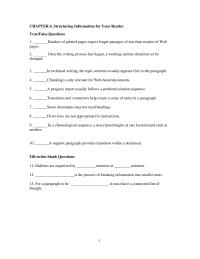
Chapter 6 Chapter 6 All These Answers Are Correct 17 Which
1 CHAPTER 6. Structuring Information for Your Reader True/False Questions 1. pages. 2. changed. Readers of printed pages expect longer passages of text than readers of Web Once the writing process has begun, a working outline should never be 3. […]
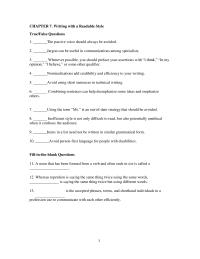
Chapter 7 Chapter 7 Writing With Readable Style Truefalse Questions
1 CHAPTER 7. Writing with a Readable Style True/False Questions 1. The passive voice should always be avoided. 2. Jargon can be useful in communications among specialists. 3. Whenever possible, you should preface your assertions with “I think,” “In my […]
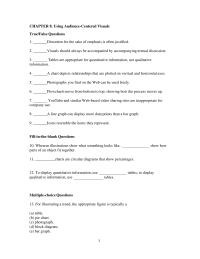
Chapter 8 Chapter 8 Which The Statements Below Most Accurate A
1 CHAPTER 8. Using Audience-Centered Visuals True/False Questions 1. Distortion for the sake of emphasis is often justified. 2. Visuals should always be accompanied by accompanying textual discussion. 3. Tables are appropriate for quantitative information, not qualitative information. 4. A […]
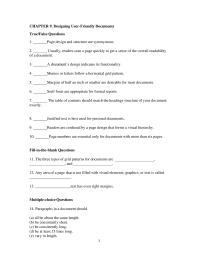
Chapter 9 Chapter 9 None The Answers Correct 17 Bulleted Lists
1 CHAPTER 9. Designing User-Friendly Documents True/False Questions 1. Page design and structure are synonymous. 2. Usually, readers scan a page quickly to get a sense of the overall readability of a document. 3. A document’s design indicates its functionality. […]