
1
CHAPTER 8. Using Audience-Centered Visuals
True/False Questions
1. Distortion for the sake of emphasis is often justified.
2. Visuals should always be accompanied by accompanying textual discussion.
3. Tables are appropriate for quantitative information, not qualitative
information.
4. A chart depicts relationships that are plotted on vertical and horizontal axes.
5. Photographs you find on the Web can be used freely.
6. Flowcharts move from bottom to top, showing how the process moves up.
7. YouTube and similar Web-based video sharing sites are inappropriate for
company use.
8. A line graph can display more data points than a bar graph.
9. Icons resemble the items they represent.
Fill-in-the-blank Questions
10. Whereas illustrations show what something looks like,
parts of an object fit together.
11. charts are circular diagrams that show percentages.
show how
12. To display quantitative information, use
qualitative information, use
tables. tables; to display
Multiple-choice Questions
13. For illustrating a trend, the appropriate figure is typically a
(a) table.
(b) pie chart.
(c) photograph.
(d) block diagram.
(e) bar graph.
2
14. Organization charts
(a) depict the breakdown of a project.
(b) use lines and graphs to show the economic trend of a company.
(c) show processes within an organization.
(d) show a hierarchy of relationships among departments.
(e) None of these answers is correct.
15. Photographs
(a) are always preferable to illustrations if available.
(b) can provide too much detail, confusing the user.
(c) no longer need professionals to create them since digital photography and photo
editing are so easily available.
(d) when available are preferable to illustrations , but they can provide too much detail
and confuse the user. Also, they are no longer produced by professionals with the advent
of digital photograph and home computer editing.
(e) are preferable to illustrations when available, but they can provide too much detail,
confusing the user.
16. Which of the statements below is most accurate?
(a) Stand-alone visuals are appropriate when they make the point more clearly than text
can.
(b) Visual elements can appear anywhere in the text, not necessarily near the text they
support.
(c) The right kind of visual can replace essential discussion in the text.
(d) Figures do not need to be referred to in the text.
(e) The right kind of visual can replace essential discussion in the text, and stand-alone
visuals are appropriate when they make the point more clearly than text can.
17. To be readable, tables should
(a) include footnotes, as necessary, to clarify information.
(b) use ample white space between items.
(c) abbreviate numbers of more than three digits
(d) include footnotes, as necessary, to clarify information; use ample white space between
items; and abbreviate numbers of more than three digits.
(e) include footnotes, as necessary, to clarify information and use ample white space
between items.
3
18. When constructing bar graphs,
(a) vary widths of the bars for emphasis.
(b) avoid tick marks.
(c) use numbers or gradations that are evenly divided.
(d) use the same colors or shades for multiple bar graphs.
(e) do not include a title.
19. Which of the following statements is least accurate?
(a) Provide a sense of scale in videos.
(b) Use simplified clip art liberally.
(c) Label the important parts of illustrations.
(d) Use directional markers in diagrams when necessary.
(e) In photographs, simulate the viewer’s angle of vision.
4
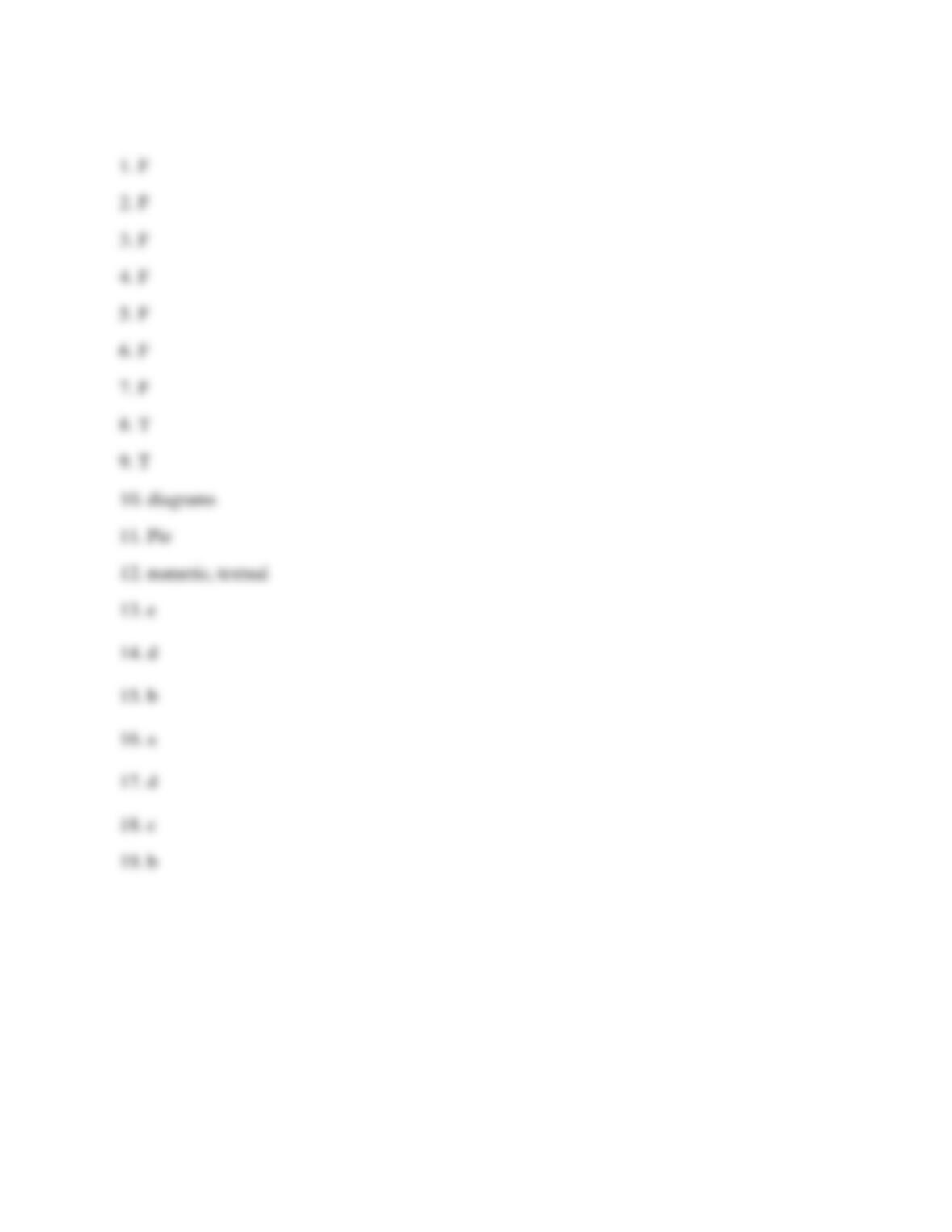
CHAPTER 8 ANSWER KEY