Archives
978-0073534343 Chapter 1
1. Which of the following is NOT one of the important ideas about groups offered by your authors? 2. Schutz described three types of human needs for which small groups are a major source of satisfaction. These are: A. Inclusion, […]
978-0073534343 Chapter 10
1. Which problem would likely rank highest in solution multiplicity? 2. All of the following are steps in PMOPs, except: A. Problem description B. Generation of solutions C. Evaluation of solutions D. Decision making E. Agreement on principles for discussion […]
978-0073534343 Chapter 11
1. The purpose of starting a task conflict is to 2. A struggle for power and status in a small group would be classified as a(n) ______________ conflict. A. process B. intrinsic C. extrinsic D. task E. inequity Galanes – […]
978-0073534343 Chapter 12
1. A content analysis of a discussion can be made of 2. An observer who helps participants in a discussion think of and apply beneficial small group communication principles and techniques is called a(n) ______________ observer. A. participant B. consultant […]
978-0073534343 Chapter 2
1. Communication is ______________ implies that participants in communication must cooperate and work together to achieve mutual meaning and understanding. 2. Every spoken message indicates meanings of two types (levels): A. verbal and reciprocal. B. signals and sign. C. small […]
978-0073534343 Chapter 3
1. General systems theory was developed from an analysis of 2. If a small group is an open system, then A. members are open-minded toward new ideas. B. nonmembers, such as reporters, may attend meetings. C. the group interacts freely […]
978-0073534343 Chapter 4
1. “Culture” was defined in Effective Group Discussion as 2. A grouping that sees itself as distinct, yet part of a larger culture is termed which of the following? A. subculture. B. plural culture. C. monoculture. D. co-culture. E. none […]
978-0073534343 Chapter 5
1. “Forgetting” to carry out assignments and failing to come to meetings is often a form of ______________ behavior. 2. Rhetorically sensitive people A. express whatever is on their minds. B. try to say what they think others want to […]
978-0073534343 Chapter 6
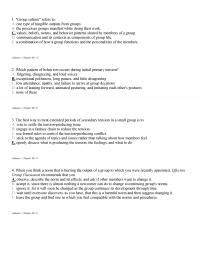
1. “Group culture” refers to: 2. Which pattern of behaviors occurs during initial primary tension? A. fidgeting, disagreeing, and loud voices B. exceptional politeness, long pauses, and little disagreeing C. low attendance, apathy, and failure to arrive at group decisions […]
978-0073534343 Chapter 7
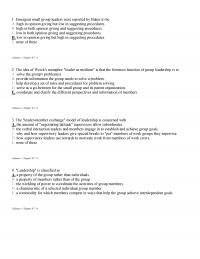
1. Emergent small group leaders were reported by Baker to be 2. The idea of Weick’s metaphor “leader as medium” is that the foremost function of group leadership is to A. solve the group’s problem(s). B. provide information the group […]
978-0073534343 Chapter 8
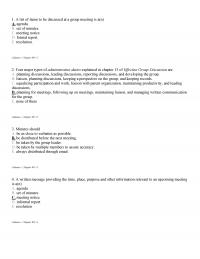
1. A list of items to be discussed at a group meeting is a(n) 2. Four major types of administrative duties explained in chapter 13 of Effective Group Discussion are A. planning discussions, leading discussions, reporting discussions, and developing the […]
978-0073534343 Chapter 9
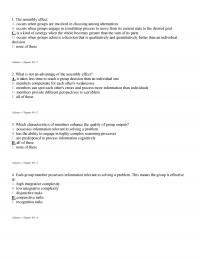
1. The assembly effect: 2. What is not an advantage of the assembly effect? A. it takes less time to reach a group decision than an individual one B. members compensate for each other’s weaknesses C. members can spot each […]