Archives: Quiz
978-0133914689 Chapter 9 Part 1
9 The Media and U.S. Politics Multiple–Choice Questions 1. The Internet began as a(n) __________. a. bet between two math professors b. outgrowth of IBM’s interest in computers c. military project in the 1960s d. project by Google Topic: […]
978-0133914689 Chapter 8 Part 5
Answer: An ideal response will: 1. Highlight the strategy of ignoring/skipping early state contests (Iowa) and focusing on states where the candidate’s strength lies (often a result of party control of the state). 2. Discuss the role of strategy in […]
978-0133914689 Chapter 8 Part 4
Answer: winner-take-all Test Bank Item Title: TB_Q8.4.79 Topic: Running for President Learning Objective: LO 8.4: Describe the stages in U.S. presidential elections and the diferences in elections at each stage. Page Reference: 241 Skill Level: Remember the Facts Diiculty Level: […]
978-0133914689 Chapter 8 Part 3
50. The project “Americans Elect,” launched in 2012, would best be described as __________. a. an successful efort to increase voter turnout b. a failed experiment in online politics c. an example of the power of money in elections d. […]
978-0133914689 Chapter 8 Part 2
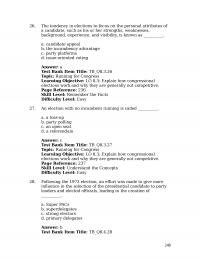
26. The tendency in elections to focus on the personal attributes of a candidate, such as his or her strengths, weaknesses, background, experience, and visibility, is known as __________. a. candidate appeal b. the incumbency advantage c. party platforms d. […]
978-0133914689 Chapter 8 Part 1
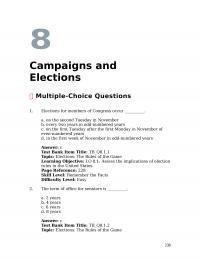
8 Campaigns and Elections Multiple–Choice Questions 1. Elections for members of Congress occur __________. a. on the second Tuesday in November b. every two years in odd-numbered years c. on the irst Tuesday after the irst Monday in November […]
978-0133914689 Chapter 7 Part 5
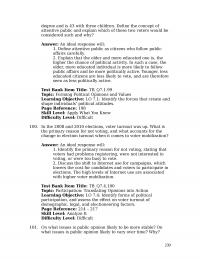
degree and is 43 with three children. Deine the concept of attentive public and explain which of these two voters would be considered such and why? Answer: An ideal response will: 1. Deine attentive public as citizens who follow public […]
978-0133914689 Chapter 7 Part 4
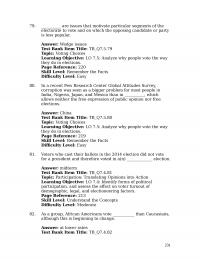
79. __________ are issues that motivate particular segments of the electorate to vote and on which the opposing candidate or party is less popular. Topic: Voting Choices Learning Objective: LO 7.5: Analyze why people vote the way they do in […]
978-0133914689 Chapter 7 Part 3
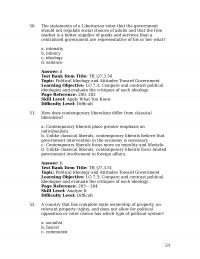
50. The statements of a Libertarian voter that the government should not regulate social choices of adults and that the free market is a better supplier of goods and services than a centralized government are representative of his or her […]
978-0133914689 Chapter 7 Part 2
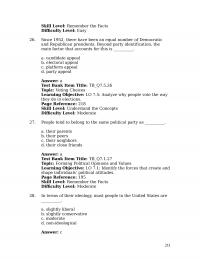
Skill Level: Remember the Facts Diiculty Level: Easy 26. Since 1952, there have been an equal number of Democratic and Republican presidents. Beyond party identiication, the main factor that accounts for this is __________. a. candidate appeal b. electoral appeal […]
978-0133914689 Chapter 7 Part 1
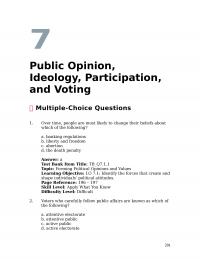
7 Public Opinion, Ideology, Participation, and Voting Multiple–Choice Questions 1. Over time, people are most likely to change their beliefs about which of the following? a. banking regulations b. liberty and freedom c. abortion d. the death penalty Topic: […]
978-0133914689 Chapter 6 Part 5
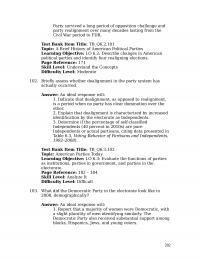
Party survived a long period of opposition challenge and party realignment over many decades lasting from the Civil War period to FDR. Test Bank Item Title: TB_Q6.2.101 Topic: A Brief History of American Political Parties Learning Objective: LO 6.2: Describe […]
978-0133914689 Chapter 6 Part 4
81. Multiparty systems are almost always found in countries that have a __________ government, in contrast to our presidential system. Topic: What Parties Do for Democracy Learning Objective: LO 6.1: Identify the primary functions of parties in democracies and distinguish […]
978-0133914689 Chapter 6 Part 3
Topic: Are the Political Parties Dying? Learning Objective: LO 6.5: Assess the efects of recent party reforms and the long-term prospects for the current party system. Page Reference: 185 – 186 Skill Level: Analyze It Diiculty Level: Diicult 51. Historically, […]
978-0133914689 Chapter 6 Part 2
a. Men were more likely Democratic in 1964 than in 2008. b. Men were more likely Democratic in 2008 than in 1964. c. Women were more likely Republican in 1964 than in 2008. d. Women were more likely Republican in […]
978-0133914689 Chapter 6 Part 1
6 Political Parties Multiple–Choice Questions 1. One of the various ways in which parties contribute to democratic governance is by __________. a. dividing the electorate b. narrowing voter choice c. nominating candidates d. reducing accountability mechanisms Topic: What Parties […]
978-0133914689 Chapter 5 Part 5
1. Explain that lobbyists seek to gain access to and the support of members of Congress on key legislation. 2. Explain that members of Congress grant access to lobbyists because lobbyists provide them with campaign contributions and can ofer them […]
978-0133914689 Chapter 5 Part 4
80. In a __________ state, workers may be required to join a union to be hired at a particular company if most employees at that company vote to unionize. Topic: Types of Interest Groups Learning Objective: LO 5.2: Categorize American […]
978-0133914689 Chapter 5 Part 3
b. political information c. substantive information d. volunteers for campaign activities Answer: a Test Bank Item Title: TB_Q5.4.50 Topic: The Inluence of Lobbyists Learning Objective: LO 5.4: Describe lobbyists and the activities through which they seek to inluence policy. Page […]
978-0133914689 Chapter 5 Part 2
Topic: The Inluence of Lobbyists Learning Objective: LO 5.4: Describe lobbyists and the activities through which they seek to inluence policy. Page Reference: 147 – 148 Skill Level: Understand the Concepts Diiculty Level: Moderate 26. How do interest groups lobby […]
978-0133914689 Chapter 5 Part 1
5 Interest Groups Multiple–Choice Questions 1. In The Federalist, No. 10, James Madison described how a government could be designed to control the efects of __________. a. monarchies b. factions c. political parties d. trade associations Topic: Interest Groups […]
978-0133914689 Chapter 4 Part 5
100. What is the gross domestic product (GDP)? Discuss how it has changed in the United States in the last 50 years. Do you believe the GDP will continue on this trajectory? Why or why not? 1. Deine gross domestic […]
978-0133914689 Chapter 4 Part 4
Diiculty Level: Easy 82. America’s isolation, relative prosperity, and sense of destiny all contributed to the development of the idea of __________. Topic: An Exceptional America Learning Objective: LO 4.1: Understand the origins and efects of American exceptionalism. Page Reference: […]
978-0133914689 Chapter 4 Part 3
Diiculty Level: Diicult 51. Regions of the United States with above-average population growth from 2000 to 2010 were __________. a. the Midwest and the West b. the Northeast and the South c. the Paciic Northwest and the Northeast d. the […]
978-0133914689 Chapter 4 Part 2
a. the West b. the Midwest c. the Northeast d. the South Answer: d Test Bank Item Title: TB_Q4.3.26 Topic: Where We Live Learning Objective: LO 4.3: Evaluate the importance of where we live on American politics. Page Reference: 107 […]
978-0133914689 Chapter 4 Part 1
4 The American Political Landscape Multiple–Choice Questions 1. The study of the characteristics of populations is known as __________. a. demography b. geography c. political science d. population studies Topic: Introduction Learning Objective: Introduction Page Reference: 104 Skill Level: […]
978-0133914689 Chapter 3 Part 5
1. Explain that the privileges and immunities clause is part of the Constitution. 2. Explain that individual states must give citizens of all other states the privileges and immunities they grant to their own citizens, including the protection of law, […]
978-0133914689 Chapter 3 Part 4
Diiculty Level: Easy 82. Before interstate compacts can take efect, __________ must approve them. Topic: The Constitutional Structure of American Federalism Learning Objective: LO 3.2: Diferentiate the powers the Constitution provides to national and state governments. Page Reference: 86 Skill […]
978-0133914689 Chapter 3 Part 3
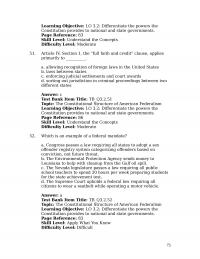
Learning Objective: LO 3.2: Diferentiate the powers the Constitution provides to national and state governments. Page Reference: 83 Skill Level: Understand the Concepts Diiculty Level: Moderate 51. Article IV, Section 1, the “full faith and credit” clause, applies primarily to […]
978-0133914689 Chapter 3 Part 2
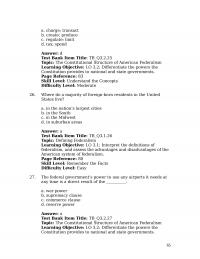
a. charge; transact b. create; produce c. regulate; limit d. tax; spend Answer: d Test Bank Item Title: TB_Q3.2.25 Topic: The Constitutional Structure of American Federalism Learning Objective: LO 3.2: Diferentiate the powers the Constitution provides to national and state […]
978-0133914689 Chapter 3 Part 1
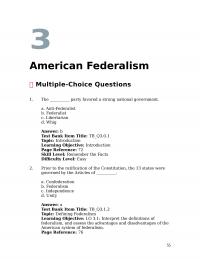
3 American Federalism Multiple–Choice Questions 1. The __________ party favored a strong national government. a. Anti-Federalist b. Federalist c. Libertarian d. Whig Topic: Introduction Learning Objective: Introduction Page Reference: 72 Skill Level: Remember the Facts Diiculty Level: Easy 2. […]
978-0133914689 Chapter 1 Part 3
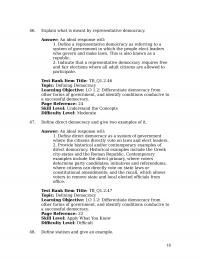
46. Explain what is meant by representative democracy. 1. Deine a representative democracy as referring to a system of government in which the people elect leaders who govern and make laws. This is also known as a republic. 2. Indicate […]
978-0133914689 Chapter 1 Part 2
c. Trying to come to an agreement on what rights to include would tear the new country apart. d. All states currently had their own bills of rights. Answer: a Test Bank Item Title: TB_Q1.5.25 Topic: To Adopt or Not […]
978-0133914689 Chapter 1 Part 1
1 Constitutional Democracy Multiple–Choice Questions 1. __________ was the primary author of the Declaration of Independence and a champion of constitutional democracy. a. Thomas Jeferson b. George Washington c. John Adams d. John Locke Topic: U.S. Government and Politicians […]
978-0133875829 Chapter 17 Part 2
Chapter Seventeen: Human Agency: Individuals and Groups in Society Changing Social Structures As Naples noted in 1998, “In communities across the country, _____ fight against the abuse of women, against corporate poisoning of their neighborhoods, against homophobia and racism, and […]
978-0133875829 Chapter 17 Part 1
Eitzen, In Conflict and Order: Understanding Society, 14th Edition, Test Bank Chapter Seventeen: Human Agency: Individuals and Groups in Society Changing Social Structures Multiple Choice Questions TB_Q17.1.1 Peter Berger’s comment, “Society penetrates us as much as it envelopes us,” is […]
978-0133875829 Chapter 16 Part 2
Chapter Sixteen: Structural Sources of Social Change: Economic and Demographic Immigrants from _____ countries have had to confront considerable hostility and suspicion since the terrorist acts of September 11, 2001. a. Muslim b. Latin American c. Eastern European d. all […]
978-0133875829 Chapter 16 Part 1
Eitzen, In Conflict and Order: Understanding Society, 14th Edition, Test Bank Chapter Sixteen: Structural Sources of Social Change: Economic and Demographic Multiple Choice Questions TB_Q16.1.1 The chapter cites two fundamental turning points in human history. What and when was the […]
978-0133875829 Chapter 15 Part 2
Chapter Fifteen: Religion Women are denied the role of minister, priest, or rabbi in many Protestant denominations, the Catholic and Orthodox churches, and Orthodox Judaisim, among others. This indicates that the _____ tradition in religion continues to this day. a. […]
978-0133875829 Chapter 15 Part 1
Eitzen, In Conflict and Order: Understanding Society, 14th Edition, Test Bank Chapter Fifteen: Religion Multiple Choice Questions TB_Q15.1.1 Which of the following is the chapter’s definition of religion? a. An organized system of beliefs, ceremonies, and rules used to worship […]
978-0133875829 Chapter 14 Part 2
Chapter Fourteen: Education Difficulty Level: Moderate Skill Level: Remember the Facts TB_Q14.2.32 Janie is a fifth-grader in New Hampshire whose family is moving to Nevada in the middle of the school year. Which scenario is most likely, based on the […]
978-0133875829 Chapter 14 Part 1
Eitzen, In Conflict and Order: Understanding Society, 14th Edition, Test Bank Chapter Fourteen: Education Multiple Choice Questions TB_Q14.1.1 The formal system of education in all societies is _____, because the avowed function of the schools is to teach newcomers the […]
978-0133875829 Chapter 13 Part 2
Chapter Thirteen: Families Jane and Mary are in their senior year of college. They have decided to forego dorm life and rent an apartment of their own. When the census-taker appears at their door, he records them as a(n) a. […]
978-0133875829 Chapter 13 Part 1
Eitzen, In Conflict and Order: Understanding Society, 14th Edition, Test Bank Chapter Thirteen: Families Multiple Choice Questions TB_Q13.1.1 Many people think of families in the past as better adjusted, more stable, and happier than today. Researchers have found that a. […]
978-0133875829 Chapter 12 Part 2
Chapter Twelve: Power and Politics Which of the following is NOT one of the circumstances cited by Domhoff as showing the impact of individuals and subgroups within the elite on the decision-making structure of the United States? a. Control of […]
978-0133875829 Chapter 12 Part 1
Eitzen, In Conflict and Order: Understanding Society, 14th Edition, Test Bank Chapter Twelve: Power and Politics Multiple Choice Questions TB_Q12.1.1 The _____ model views power as broadly distributed among a number of organizations, special interests, and the voters. a. elitist […]
978-0133875829 Chapter 11 Part 2
Chapter Eleven: The Economy When researchers from the UC–Berkeley’s Human Rights Center and a Washington D.C.-based group stated that “New federal laws have been passed to combat these crimes … but much more needs to be done, especially at the […]
978-0133875829 Chapter 11 Part 1
Eitzen, In Conflict and Order: Understanding Society, 14th Edition, Test Bank Chapter Eleven: The Economy Multiple Choice Questions TB_Q11.1.1 One condition of true capitalism is a government policy of _____ that allows the marketplace to operate without intervention. a. laissez-faire […]
978-0133875829 Chapter 10 Part 2
Chapter Ten: Gender Inequality The chapter makes the case that it is difficult to find female _____ because men continue to occupy the more powerful positions. a. drivers b. nurses c. teachers d. role models Answer: d. role models Source […]
978-0133875829 Chapter 10 Part 1
Eitzen, In Conflict and Order: Understanding Society, 14th Edition, Test Bank Chapter Ten: Gender Inequality Multiple Choice Questions TB_Q10.1.1 The term _____ refers to the biological differences between females and males determined by chromosomes, hormones, and external and internal anatomy. […]