Archives: Quiz
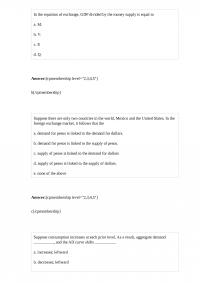
ECB 822 In the equation of exchange
In the equation of exchange, GDP divided by the money supply is equal to a. M. b. V. c. P. d. Q. Suppose there are only two countries in the world, Mexico and the United States. In the foreign exchange […]
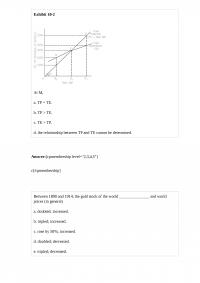
MicroEconomic 404 Midterm 2
Exhibit 10-2 At M, a. TP = TE. b. TP > TE. c. TE > TP. d. the relationship between TP and TE cannot be determined. Between 1890 and 1914, the gold stock of the world _______________ and world prices […]
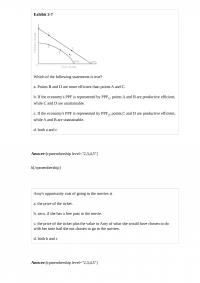
MicroEconomic 524
Exhibit 2-7 Which of the following statements is true? a. Points B and D are more efficient than points A and C. b. If the economy’s PPF is represented by PPF1, points A and B are productive efficient, while C […]
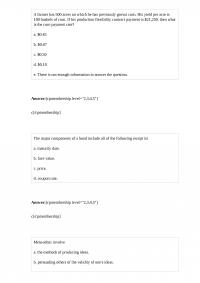
ECON E 844 Midterm
A farmer has 500 acres on which he has previously grown corn. His yield per acre is 100 bushels of corn. If his production flexibility contract payment is $21,250, then what is the corn payment rate? a. $0.45 b. $0.67 […]
MicroEconomic 578
In the short run following a depreciation of the dollar, the United States may move downward along the J-curve since it is likely that the United States a. spends more dollars on imports. b. spends fewer dollars on imports. c. […]
ECB 815 Quiz 2
Suppose Congress increases income taxes. This is an example of a. expansionary fiscal policy. b. expansionary monetary policy. c. contractionary fiscal policy. d. contractionary monetary policy. When we speak of expansionary fiscal policy, we are talking about policymakers __________ government […]
ECON A 584 Test 2
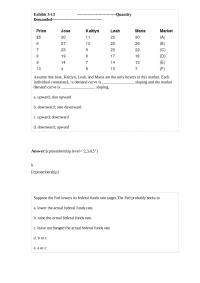
Exhibit 3-13 —————————–Quantity Demanded————————————- Assume that Jose, Kaitlyn, Leah, and Maria are the only buyers in this market. Each individual consumer€s demand curve is ________________ sloping and the market demand curve is _________________ sloping. a. upward; also upward b. downward; […]
Economics 506
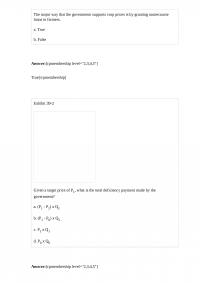
The major way that the government supports crop prices is by granting nonrecourse loans to farmers. a. True b. False Exhibit 39-2 Given a target price of P1, what is the total deficiency payment made by the government? a. (P1 […]
MicroEconomic 232 Midterm 2
As the U.S. dollar appreciates and the Japanese yen depreciates, a. U.S.-produced goods become more expensive for the Japanese and Japanese-produced goods become cheaper for Americans. b. U.S.-produced goods become cheaper for the Japanese and Japanese-produced goods become more expensive […]
MicroEconomic 708
The simple deposit multiplier is a. the reciprocal of the required reserve ratio. b. always 1. c. the same as the required reserve ratio. d. different from bank to bank even if the required reserve ratio is the same for […]
ECON E 432 Midterm
When the government decides to increase income taxes, this is an example of contractionary fiscal policy. a. True b. False If the economy is in a recessionary gap, a. Real GDP is greater than Natural Real GDP. b. Real GDP […]
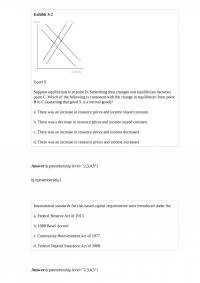
ECON 402
Exhibit 3-2 Good X Suppose equilibrium is at point B. Something then changes and equilibrium becomes point C. Which of the following is consistent with the change in equilibrium from point B to C (assuming that good X is a […]
ECON 851 If government removes two
If government removes two people from a prisoner’s dilemma setting (and, in the process, requires that the two persons pay taxes for the service that government provides), it holds that on net a. each of the two persons is better […]
BUS 842 Quiz
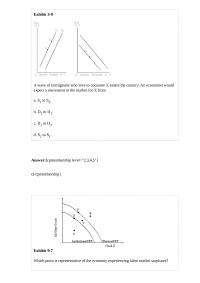
Exhibit 3-9 A wave of immigrants who love to consume X enters the country. An economist would expect a movement in the market for X from a. S1 to S2. b. D2 to D1. c. D1 to D2. d. S2 […]
ECB 316 Midterm
The demand for seats in 10 a.m. classes at the university is higher than the demand for seats in 8 a.m. classes. The supply of seats is fixed. If the university can only charge a single price and wishes to […]
ECB 309 Final
The term after the bell means after the closing of the stock market. a. True b. False Can a change in the Japanese price level cause the United States to move downward along its J-curve? a. Yes, if the Japanese […]
ECON A 113 Quiz 2
A three-word synonym for the term ceteris paribus is a. “nothing else changes.” b. “in my opinion.” c. “it is proved.” d. “under this assumption.” Government can overcome the free rider problem by collecting taxes and using the funds to […]
ECB 332 Midterm 2 Which of the
Which of the following statements represents a correct and sequentially accurate economic explanation? a. Goods X and Y are substitutes. The price of X falls, the quantity demanded of X rises, and the demand for Y rises. b. Goods X […]
ECON 383 Test 1
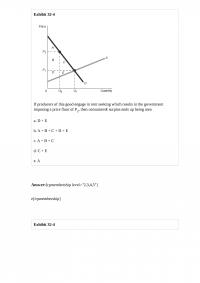
Exhibit 32-4 If producers of this good engage in rent seeking which results in the government imposing a price floor of P2, then consumers€ surplus ends up being area a. D + E b. A + B + C + […]
ECON 448 Homework
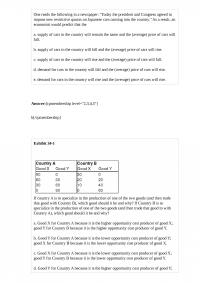
One reads the following in a newspaper: “Today the president and Congress agreed to impose new restrictive quotas on Japanese cars coming into the country.” As a result, an economist would predict that the a. supply of cars in the […]
MicroEconomic 146
Which of the following statements is true? a. A person who buys a bond always pays the face value for the bond. b. If a corporation issues a bond and Dennis buys it, Dennis becomes one of the owners of […]
ECON 691 Midterm 2
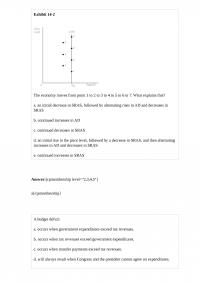
Exhibit 14-2 The economy moves from point 1 to 2 to 3 to 4 to 5 to 6 to 7. What explains this? a. an initial decrease in SRAS, followed by alternating rises in AD and decreases in SRAS b. […]
ECB 154
Suppose the economy goes from a point on its production possibilities frontier (PPF) to a point directly to the left of it. Assuming that the PPF has not shifted, this could be due to a. a gain of resources. b. […]
ECB 110 Test
The routes or channels that ripple effects created in the money market travel to impact the goods-and-services market are known as a. the transmission lag. b. monetary policy. c. the liquidity trap. d. the transmission mechanism. If GDP is $12,000 […]
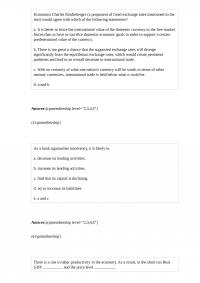
MicroEconomic 872 Quiz
Economist Charles Kindleberger (a proponent of fixed exchange rates mentioned in the text) would agree with which of the following statements? a. It is better to leave the international value of the domestic currency to the free market forces than […]
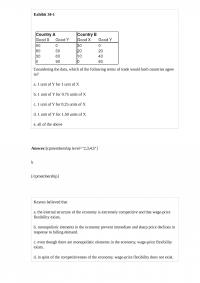
ECON E 771 Midterm 2
Exhibit 34-1 Considering the data, which of the following terms of trade would both countries agree to? a. 1 unit of Y for 1 unit of X b. 1 unit of Y for 0.75 units of X c. 1 unit […]
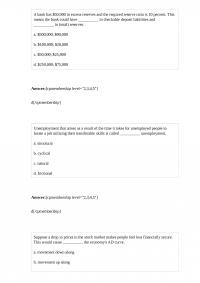
ECON 550 A bank has 50000 in excess
A bank has $50,000 in excess reserves and the required reserve ratio is 10 percent. This means the bank could have __________ in checkable deposit liabilities and __________ in (total) reserves. a. $500,000; $90,000 b. $100,000; $20,000 c. $50,000; $25,000 […]
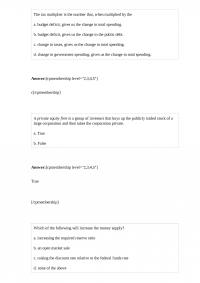
MicroEconomic 138 Final
The tax multiplier is the number that, when multiplied by the a. budget deficit, gives us the change in total spending. b. budget deficit, gives us the change in the public debt. c. change in taxes, gives us the change […]
ECON A 800 Quiz 2
In 2013, the U.S. federal government spent approximately ___________ trillion. a. $4.9 b. $7.3 c. $3.7 d. $2.1 Suppose the real exchange rate of 115 Japanese yen to the dollar changes to 105 yen to the dollar. In this situation, […]
Economics 767 Quiz 2
Underground activities are not counted in GDP because a. some underground activities are illegal and the government doesn’t want to place, for instance, drug dealers on an equal footing with small businesses. b. there are no written records of underground […]
ECB 609 Quiz 1
Which of the following is not an aspect of Keynesian economics? a. Wages and prices tend to be inflexible downward. b. Supply does not necessarily generate its own demand. c. The interest rate is important in determining the level of […]
BUS 107 Midterm 1
If an economy’s exports are $600 billion and its imports are $750 billion, its net exports are a. $1,550 billion b. $150 billion c. -$150 billion d. 1.07. The more institutional constraints that exist in a particular society, a. the […]
ECON E 865 Quiz 1
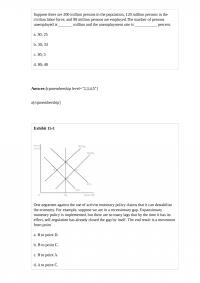
Suppose there are 200 million persons in the population, 120 million persons in the civilian labor force, and 90 million persons are employed.The number of persons unemployed is _______ million and the unemployment rate is ___________ percent. a. 30; 25 […]
BUS 158 Midterm 1 At the time of
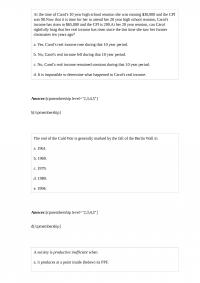
At the time of Carol’s 10 year high school reunion she was earning $30,000 and the CPI was 90.Now that it is time for her to attend her 20 year high school reunion, Carol’s income has risen to $65,000 and […]
ECON A 139
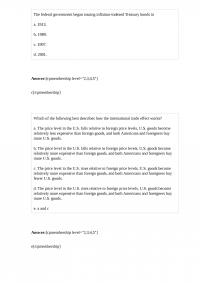
The federal government began issuing inflation-indexed Treasury bonds in a. 1913. b. 1989. c. 1997. d. 2001. Which of the following best describes how the international trade effect works? a. The price level in the U.S. falls relative to foreign […]
ECON E 159 Midterm
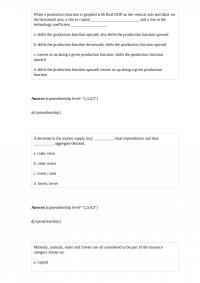
When a production function is graphed with Real GDP on the vertical axis and labor on the horizontal axis, a rise in capital________________________, and a rise in the technology coefficient __________________. a. shifts the production function upward; also shifts the […]
BUS 829 Midterm 1
In a situation where two goods can be produced by two different people, it is possible for one person to have a comparative advantage in the production of both goods and the other person to have the comparative advantage in […]
ECON E 461
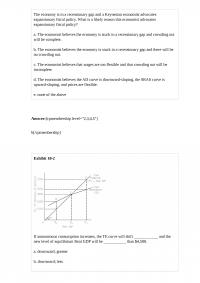
The economy is in a recessionary gap and a Keynesian economist advocates expansionary fiscal policy. What is a likely reason this economist advocates expansionary fiscal policy? a. The economist believes the economy is stuck in a recessionary gap and crowding […]
ECON 864
If the economy is on the production possibilities frontier (PPF), the economy is a. productive inefficient. b. operating with no unemployed resources. c. productive efficient. d. b and c e. none of the above According to J-curve theory, imports initially […]
ECON A 538 Quiz 1
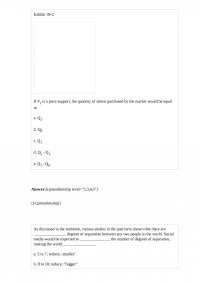
Exhibit 39-2 If P1 is a price support, the quantity of wheat purchased by the market would be equal to a. Q2. b. Q0. c. Q1. d. Q2 – Q1. e. Q1 – Q0. As discussed in the textbook, various […]
ECB 409 Homework
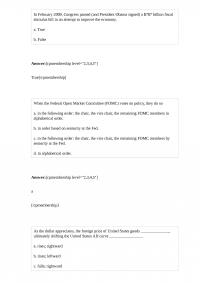
In February 2009, Congress passed (and President Obama signed) a $787 billion fiscal stimulus bill in an attempt to improve the economy. a. True b. False When the Federal Open Market Committee (FOMC) votes on policy, they do so a. […]
BUS 250 Quiz
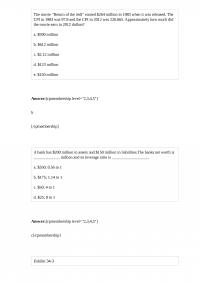
The movie “Return of the Jedi” earned $264 million in 1983 when it was released. The CPI in 1983 was 97.8 and the CPI in 2012 was 226.665. Approximately how much did the movie earn in 2012 dollars? a. $590 […]
ECON A 294 Midterm 1
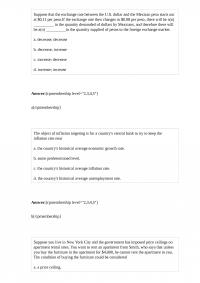
Suppose that the exchange rate between the U.S. dollar and the Mexican peso starts out at $0.11 per peso.If the exchange rate then changes to $0.08 per peso, there will be a(n) __________ in the quantity demanded of dollars by […]
ECON E 870
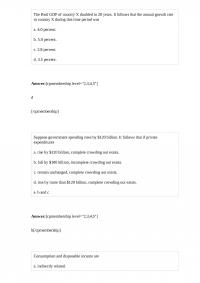
The Real GDP of country X doubled in 20 years. It follows that the annual growth rate in country X during this time period was a. 4.0 percent. b. 5.0 percent. c. 2.8 percent. d. 3.5 percent. Suppose government spending […]
ECB 337 Quiz 2
Which of the following will decrease the money supply? a. an increase in the discount rate (relative to the federal funds rate) b. an increase in the required reserve ratio c. an open market purchase by the Fed d. a […]
ECON A 622 Midterm 2
Every time the Fed buys or sells on the open market, the __________ changes. a. budget deficit b. income tax rate c. money supply d. a and b e. a, b, and c A characteristic of a 45-degree line is […]
ECON 463
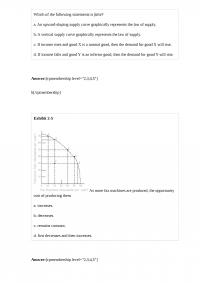
Which of the following statements is false? a. An upward-sloping supply curve graphically represents the law of supply. b. A vertical supply curve graphically represents the law of supply. c. If income rises and good X is a normal good, […]
BUS 563 Quiz
An increase in supply is graphically represented by a leftward shift of the supply curve. a. True b. False If the demand for a particular agricultural product is highly elastic and bad weather causes the supply to decrease, then we […]
ECON A 101 Test 2
Which of the following statements is false? a. Consumers receive more consumers’ surplus when tariffs do not exist. b. Producers receive more producers’ surplus when tariffs do exist. c. A tariff results in a net loss to society. d. With […]
ECON 598 Test
The economist who won the Nobel Prize in Economics in 1995, and whose name is closely connected with rational expectations theory, is a. Robert Solow. b. Paul Samuelson. c. Milton Friedman. d. Robert Lucas. e. John Maynard Keynes. The government […]