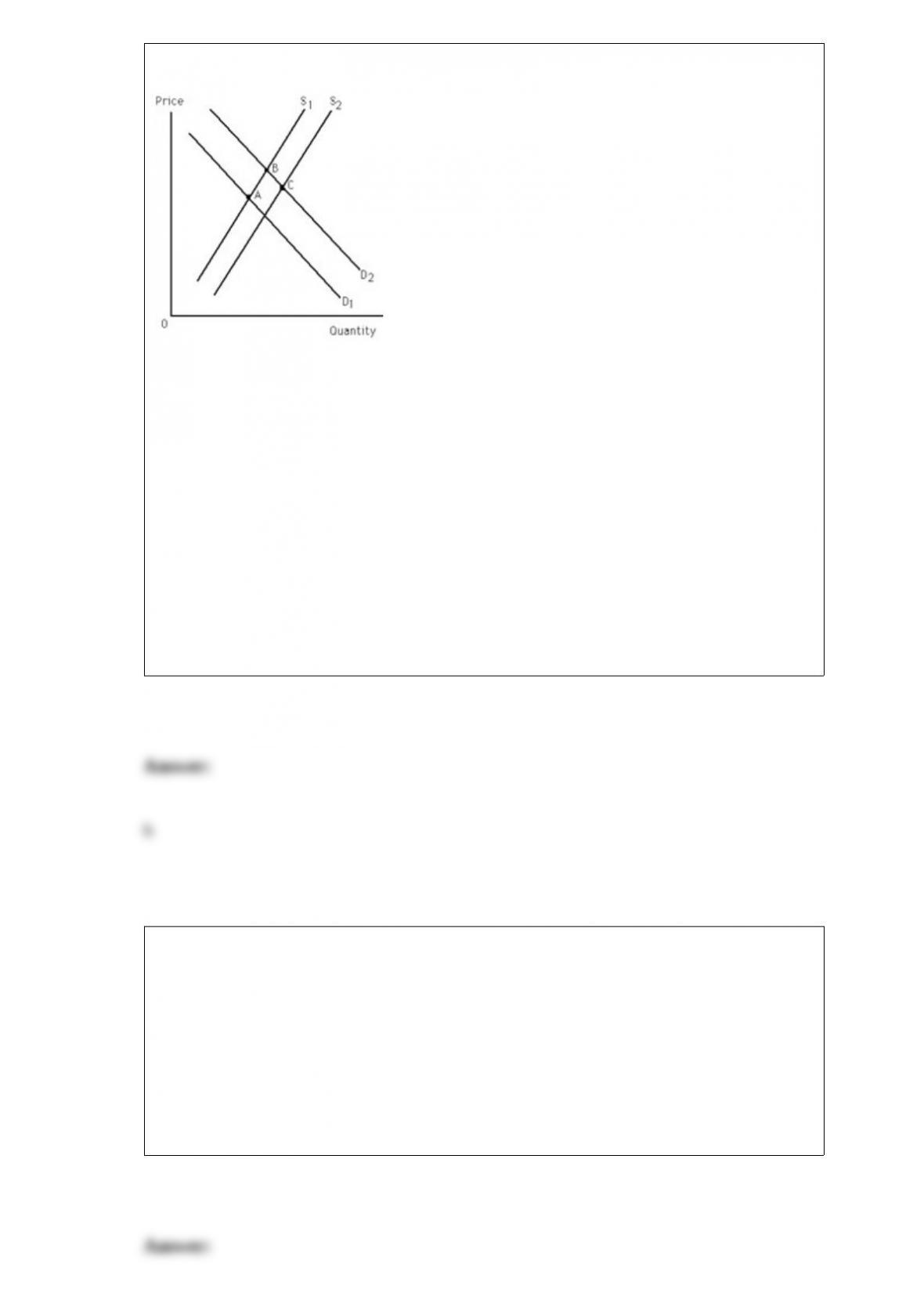
Exhibit 3-2
Good X
Suppose equilibrium is at point B. Something then changes and equilibrium becomes
point C. Which of the following is consistent with the change in equilibrium from point
B to C (assuming that good X is a normal good)?
a. There was an increase in resource prices and income stayed constant.
b. There was a decrease in resource prices and income stayed constant.
c. There was an increase in resource prices and income decreased.
d. There was an increase in resource prices and income increased.
International standards for risk-based capital requirements were introduced under the
a. Federal Reserve Act of 1913.
b. 1988 Basel Accord
c. Community Reinvestment Act of 1977.
d. Federal Deposit Insurance Act of 2008.
The Taylor Rule is an example of
a. discretionary monetary policy.
b. rule-based monetary policy.
c. a monetary policy measure that always sets the money supply growth rate at 3
percent.
d. contractionary monetary policy.
e. none of the above
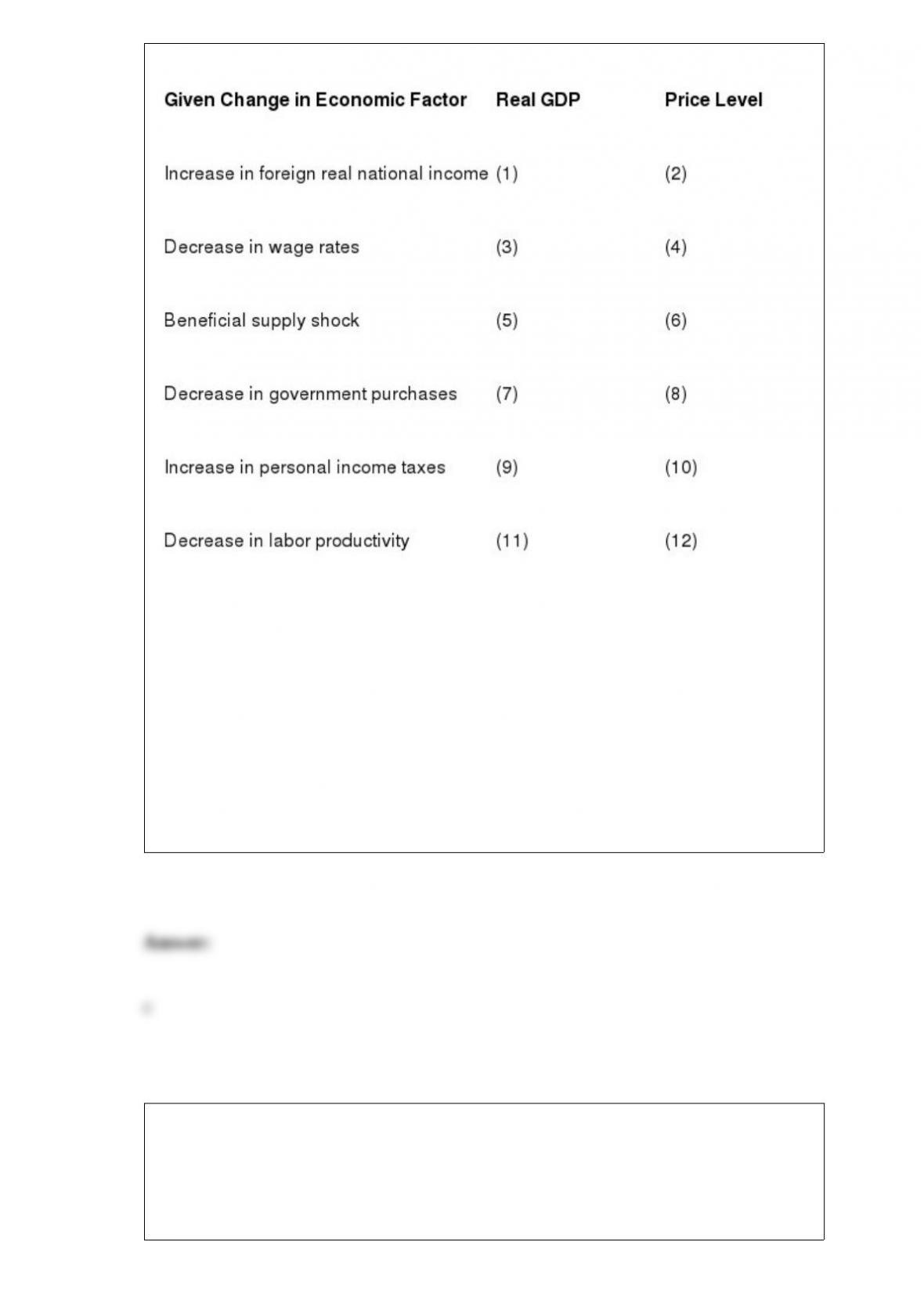
Based on the given change, what word (rises or falls) should go in blank (5) and blank
(6), respectively, to summarize the resulting impact on short run equilibrium?
a. rises; rises
b. falls; falls
c. rises; falls
d. falls; rises
Which of the following statements is true?
a. To a large degree, Keynesians focus on the spending components of total
expenditures when they seek to understand what determines GDP; monetarists focus on
the money supply and velocity when their objective is the same.
b. To a large degree, monetarists focus on the spending components of total
expenditures when they seek to understand what determines GDP; Keynesians focus on
the money supply and velocity when their objective is the same.
c. Both Keynesians and monetarists focus on the spending components of total
expenditures when they seek to understand what determines GDP; neither group
focuses on the money supply and velocity.
d. Neither Keynesians nor monetarists focus on the spending components of total
expenditures when they seek to understand what determines GDP; both focus on the
money supply and velocity.
In the early 19th century, the main lobbyists behind passage of the Factory Acts were
the women and children who were being exploited.
a. True
b. False
If Smith believes the economy is self-regulating, then Smith
a. is less likely to advocate expansionary fiscal policy when the economy is in a
recessionary gap than Jones, who believes the economy is not self-regulating.
b. is more likely to advocate expansionary fiscal policy when the economy is in a
recessionary gap than Jones, who believes the economy is not self-regulating.
c. will believe that there is zero crowding out, too.
d. will believe that wages are inflexible downward, too.
e. b and d
Mutually beneficial trade between buyers and sellers drives a market to equilibrium.
a. True
b. False
The interest rate that a commercial bank pays when it borrows from the Fed is the
__________ rate.
a. discount
b. exchange
c. federal
d. bank

A decrease in the interest rate due to an increase in the supply of loanable funds is
referred to as the __________ effect.
a. expectations
b. liquidity
c. income
d. a and c
e. a, b and c
The sale of government securities by the Fed
a. decreases the supply of money.
b. increases the supply of money.
c. decreases the demand for money.
d. increases the demand for money.
Classical macroeconomists assert that €saving€ is the same as €not spending at all€.
a. True
b. False

Economist A says that the economy is self-regulating.This economist most likely
believes that
a. the economy can get stuck in a recessionary gap.
b. wages and prices are inflexible downward.
c. wages and prices are flexible.
d. government should enact expansionary fiscal policy when the economy is in a
recessionary gap.
e. none of the above
An American computer is priced at $1,200. If the exchange rate between the U.S. dollar
and the Japanese yen is $0.01 per yen, the equivalent price of the computer in yen is
approximately __________ yen.
a. 12,000
b. 12
c. 1,200,000
d. 120,000

Producers’ surplus is the difference between the price
a. sellers receive for a good and the maximum price they would have paid for the good.
b. sellers receive for a good and the minimum price for which they could have sold the
good.
c. buyers pay for a good and the maximum price they would have paid for the good.
d. buyers pay for a good and the minimum price for which they would have sold the
good.
After an adverse supply shock occurs, the____________ curve shifts _____________
resulting in a(n) _________________ in the price level and a(n) ________________ in
Real GDP.
a. AD; leftward; decrease; decrease
b. AD; rightward; increase; increase
c. SRAS; rightward; decrease; increase
d. SRAS; leftward; increase; decrease

When income taxes are lowered in a given economy, it causes the supply of labor curve
to shift __________which ___________ the equilibrium quantity of labor employed.In
terms of the production function (graphed with labor on the horizontal axis and Real
GDP on the vertical axis) this then causes _______________, which makes the LRAS
curve shift ____________ resulting in ______________________.
a. rightward; raises; the production function to shift upward; rightward; economic
growth
b. leftward; lowers; the production function to shift downward; leftward; a shrinking
economy
c. rightward; raises; a movement up along a given production function; rightward;
economic growth
d. rightward; raises; a movement down along a given production function; leftward; a
shrinking economy