
Underground activities are not counted in GDP because
a. some underground activities are illegal and the government doesn’t want to place, for
instance, drug dealers on an equal footing with small businesses.
b. there are no written records of underground activities.
c. of a decision made in the 1930s and no one has gotten around to changing it yet.
d. although it is possible to accurately measure underground activities, it is harder than
measuring above-ground activities because with the latter, one doesn’t have to dig as
deep.
There is an increase in the money supply and the interest rate does not change. This is
what happens if
a. investment is interest-insensitive.
b. a liquidity trap exists.
c. activist monetary policy is used instead of nonactivist monetary policy.
d. wages and prices are flexible.
e. none of the above
In general, a dry cleaner in a small town is ______________ likely to be unethical in
his business practices than a dry cleaner in a large city.This is because the larger a
percentage of the population one person is, the _____________likely that person will
have to further engage with people he encounters.

a. more; less
b. less; less
c. more; more
d. less; more
If the absolute price of a new car is $40,000 and the relative price of a laptop computer
in terms of cars is 1/40 of a car, it follows that the absolute price of the laptop is
a. $10,000.
b. $1,000.
c. $4,000.
d. $2,000.
e. $1,500.
Exhibit 34-4
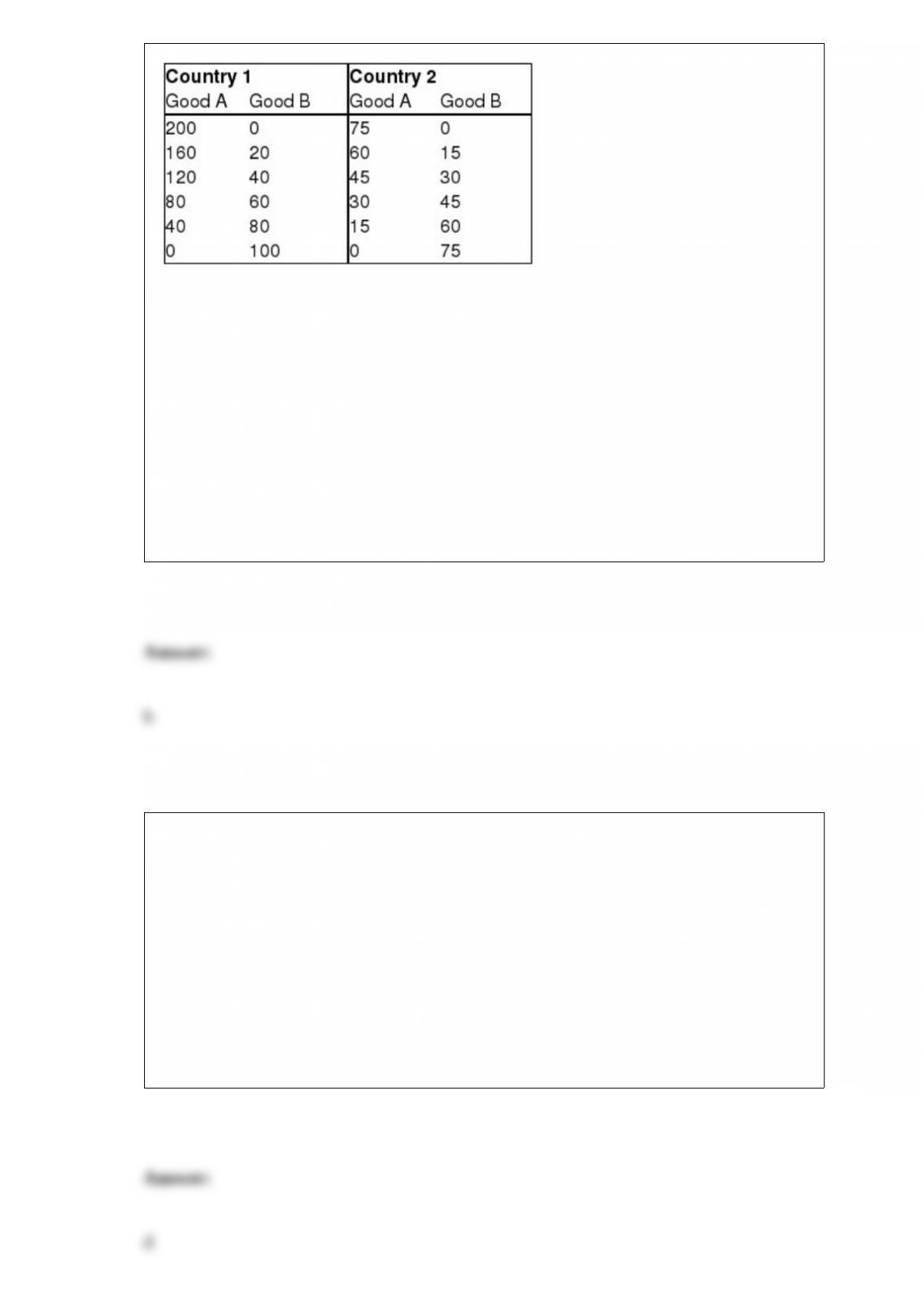
The opportunity cost of one unit of good B is __________ for country 1 and
__________ for country 2.
a. 20A; 15A
b. 2A; 1A
c. 40A; 15A
d. 1/2A; 1A
e. 1/40A; 1/15B
An increase in productivity in the agricultural sector in conjunction with an income
inelastic demand for farm products
a. causes prices to fall.
b. causes prices to rise.
c. causes prices to remain constant.
d. may cause prices to rise, fall, or remain the same, depending upon the relative shifts
in the supply and demand curves.

Exhibit 34-3
The world price is PW. If a tariff is imposed, the price rises to PW + T. Because of the
tariff, producers’ surplus is __________ by an amount equal to the area of __________.
a. increased; 1 + 2
b. decreased; 1
c. increased; 3 + 4
d. increased; 1
e. decreased; 3
Exhibit 2-6
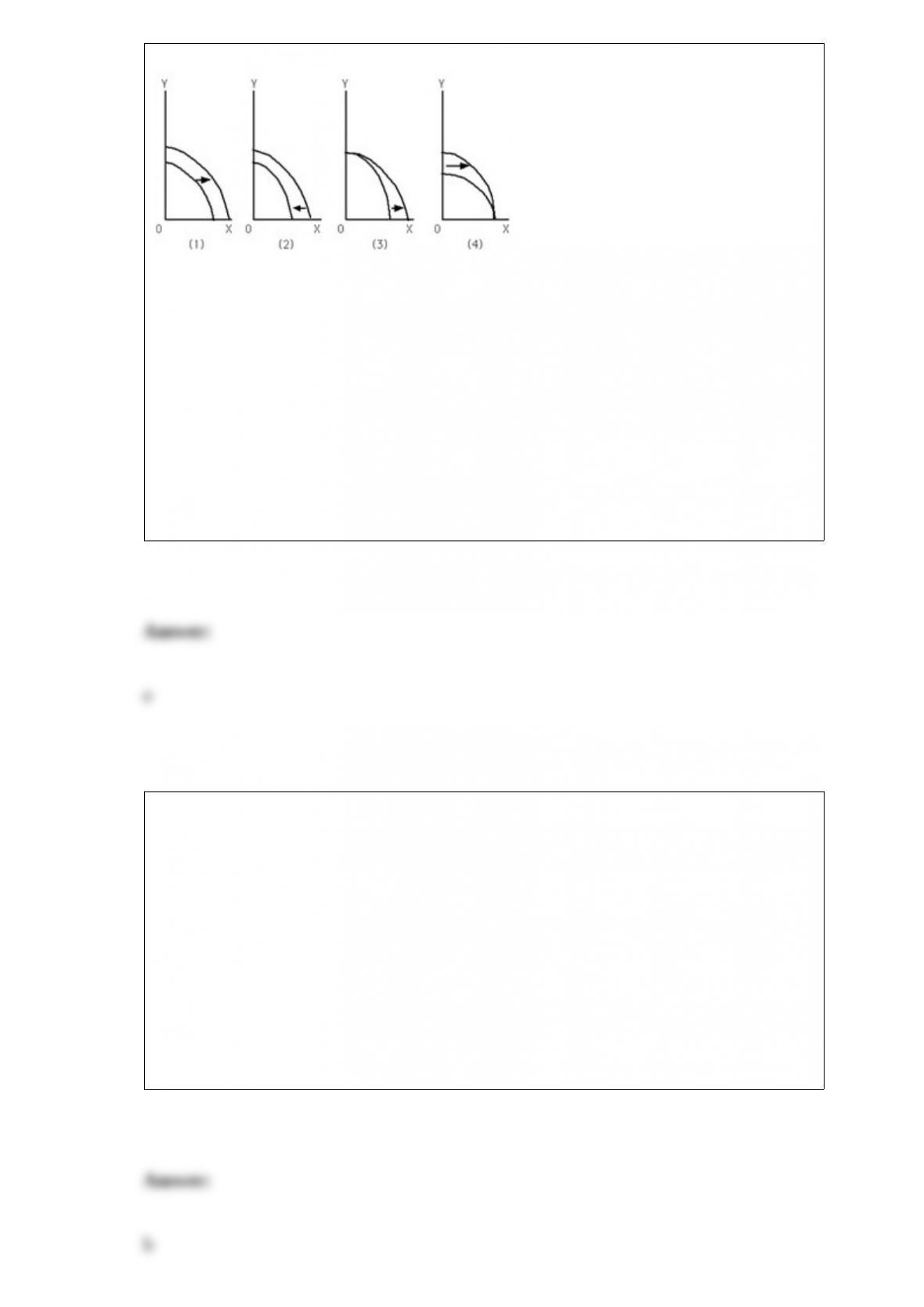
Which graph depicts the result of a decrease in the unemployment rate?
a. (1)
b. (2)
c. (3)
d. (4)
e. none of the above
Which of the following points would not be used as an argument in support of the
current international monetary system?
a. It allows nations to pursue independent monetary policies.
b. It results in stable exchange rates.
c. It helps solve trade problems without trade restrictions.
d. It is flexible and can easily adjust to shocks.
e. All of the above could be used as arguments supporting the current system.
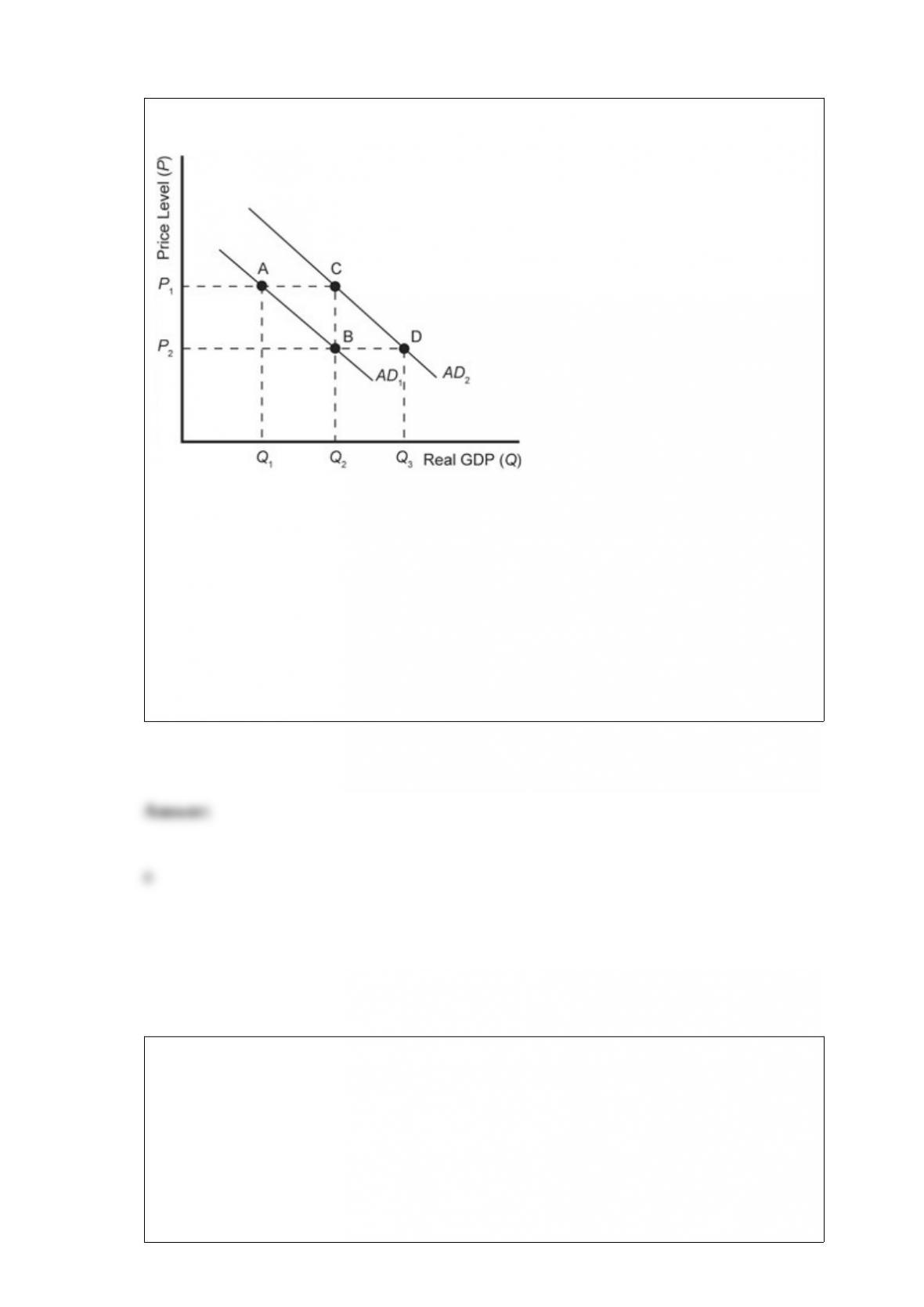
Exhibit 8-3
A movement from point A to point B on AD1 would have been the result of
a. a decrease in the price level.
b. an increase in the price level.
c. an increase in income taxes.
d. a decrease in income taxes.
Situation 32-1
In the early 1980s, the U.S. automobile industry managed to influence the government
to negotiate a voluntary export restraint agreement with Japan that was in effect from
1981 until 1985. The predictable result was an average increase in the price of Japanese
cars by about $1,000 and of U.S. cars by about $370. Also, as a result of the import
quotas, 26,000 new jobs were “created” in the U.S. automobile industry.

This episode can be seen as an instance of
a. rational ignorance.
b. logrolling.
c. special interest politics.
d. a zero sum game.
The chief difference between one-shot inflation and continued inflation is that
a. Keynesians believe all inflations are one-shot inflations and monetarists believe all
inflations are continued inflations.
b. one-shot inflation is long and continued inflation is short.
c. one-shot inflation is a single increase in the price level and continued inflation is a
sustained increase in the price level.
d. monetarists believe all inflations are one-shot inflations and Keynesians believe all
inflations are continued inflations.
Which of the following statements is true?
a. The long-run aggregate supply (LRAS) curve shows the Real GDP the economy is
prepared to supply at different price levels, assuming wage rates and all other resource
prices have fully adjusted to eliminate a recessionary or inflationary gap.
b. Laissez-faire is a government policy of raising aggregate demand in order to
eliminate a recessionary gap.
c. An economy can operate beyond its physical PPF, but not beyond its institutional
PPF.
d. If the economy is self-regulating, it is always in long-run equilibrium.
e. a and c
In Keynes’ view, labor unions would resist wage cuts, but individual employees would
go along with wage cuts initiated by his/her employer.
a. True
b. False