
The movie “Return of the Jedi” earned $264 million in 1983 when it was released. The
CPI in 1983 was 97.8 and the CPI in 2012 was 226.665. Approximately how much did
the movie earn in 2012 dollars?
a. $590 million
b. $612 million
c. $2.12 million
d. $123 million
e. $150 million
A bank has $200 million in assets and $150 million in liabilities.The banks net worth is
_____________ million and its leverage ratio is __________________.
a. $350; 0.56 to 1
b. $175; 1.14 to 1
c. $50; 4 to 1
d. $25; 8 to 1
Exhibit 34-3

The world price is PW. If a tariff is imposed the price rises to PW + T. Because of the
tariff, consumers’ surplus is reduced by an amount equal to the area of
a. 1 + 2 + 3.
b. 1 + 2.
c. 1 + 2 + 3 + 4.
d. 3 + 4.
e. 2 + 3 + 4.
Suppose the government increases spending on public education by $700 million and
individual spending on private education drops by $700 million. This is an example of
a. incomplete crowding out.
b. complete crowding out.
c. zero crowding out.
d. a and c

e. none of the above
The higher the cost of talking on a cell phone in public (in terms of being perceived by
others as rude) the less likely one is to do so.
a. True
b. False
A mandatory seatbelt law ends up raising the number of traffic fatalities if it lowers
fatalities per accident from 0.12 to 0.08 while raising the number of accidents per
period from 400,000 to any more than
a. 480,000.
b. 600,000.
c. 660,000.
d. 770,000.

Economists often evaluate a theory in terms of how consistently and accurately it
predicts what happens.Implicit in this position is the belief that
a. if the theory’s predictions are consistently accurate, then there is a fairly good chance
that the theory is a good explanation of how things work.
b. if the theory’s predictions are consistently accurate, then there is a fairly good chance
that the theory will be accepted by others.
c. if the theory’s predictions are consistently accurate, then there is a fairly good chance
thatthe theory’s assumptions (even if they initially seem unrealistic) capture something
that is essential to explaining what it is that the theory is trying to explain.
d. all of the above
Which piece of evidence is consistent with zero crowding out?
a. Government purchases rise and Real GDP does not change.
b. Government purchases rise and investment spending declines.
c. Government purchases rise and net exports decline.
d. Government purchases rise and consumption declines.
e. none of the above
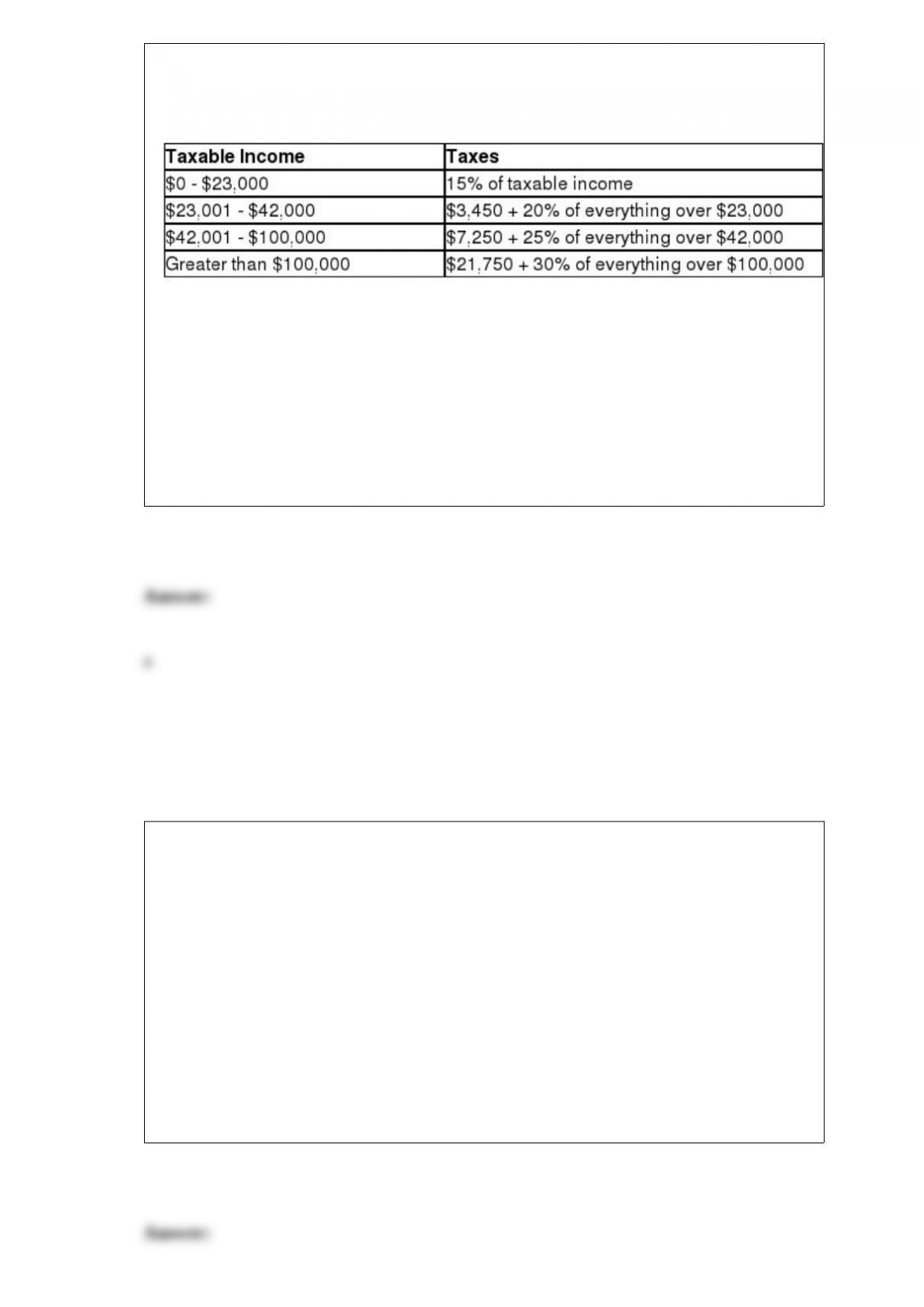
Exhibit 11-4
If a person’s taxable income is $50,000, how much does he pay in taxes?
a. $9,250
b. $8,500
c. $24,150
d. $12,500
Both country 1 and country 2 are located on their respective production possibilities
frontiers (PPFs) for consumer goods and capital goods, but country 1 produces twice
the output of both types of goods compared to country 2. It follows that
a. country 1’s PPF lies further to the right than country 2’s PPF.
b. country 1 has a smaller population than country 2.
c. country 1 has a bigger population than country 2.
d. country 1 is efficient and country 2 is inefficient.
e. none of the above

When the economy is in a recessionary gap, the labor market is experiencing a
_____________.In a self-regulating economy, wage rates will then ___________ and
the ______________ curve will shift __________________.
a. shortage; rise; AD; rightward
b. shortage; fall; SRAS; leftward
c. surplus; rise; AD; rightward
d. shortage; fall; SRAS; rightward
e. surplus; fall; SRAS; rightward
Autonomous spending rises by $10 billion and Real GDP rises by $50 billion. What
does the marginal propensity to save equal?
a. 0.10
b. 0.20
c. 0.80
d. 0.90
e. 0.50