One reads the following in a newspaper: “Today the president and Congress agreed to
impose new restrictive quotas on Japanese cars coming into the country.” As a result, an
economist would predict that the
a. supply of cars in the country will remain the same and the (average) price of cars will
fall.
b. supply of cars in the country will fall and the (average) price of cars will rise.
c. supply of cars in the country will rise and the (average) price of cars will fall.
d. demand for cars in the country will fall and the (average) price of cars will rise.
e. demand for cars in the country will rise and the (average) price of cars will rise.
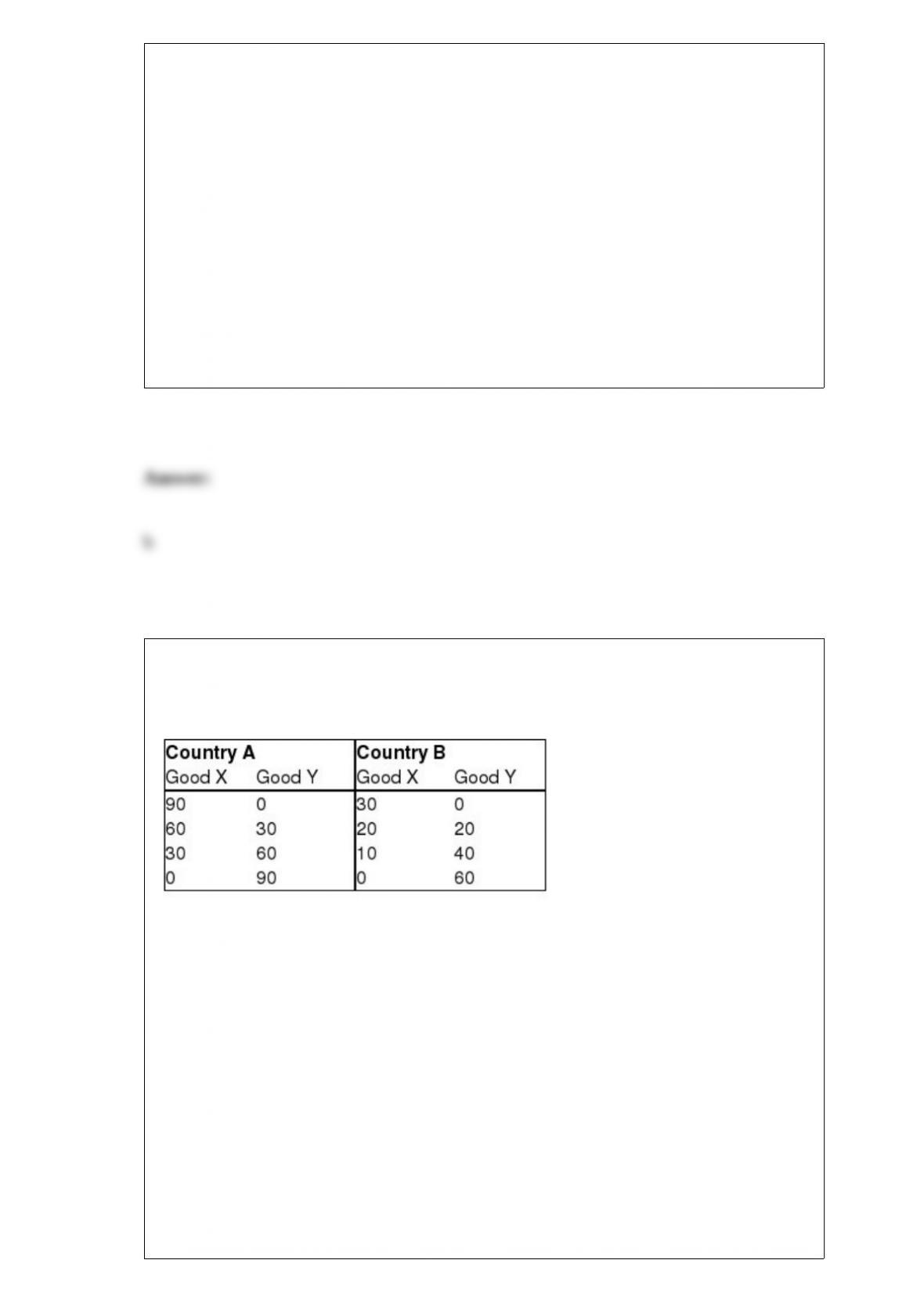
Exhibit 34-1
If country A is to specialize in the production of one of the two goods (and then trade
that good with Country B), which good should it be and why? If Country B is to
specialize in the production of one of the two goods (and then trade that good to with
Country A), which good should it be and why?
a. Good X for Country A because it is the higher opportunity cost producer of good X;
good Y for Country B because it is the higher opportunity cost producer of good Y.
b. Good Y for Country A because it is the lower opportunity cost producer of good Y;
good X for Country B because it is the lower opportunity cost producer of good X.
c. Good X for Country A because it is the lower opportunity cost producer of good X;
good Y for Country B because it is the lower opportunity cost producer of good Y.
d. Good Y for Country A because it is the higher opportunity cost producer of good Y;
good X for Country B because it is the higher opportunity cost producer of good X.
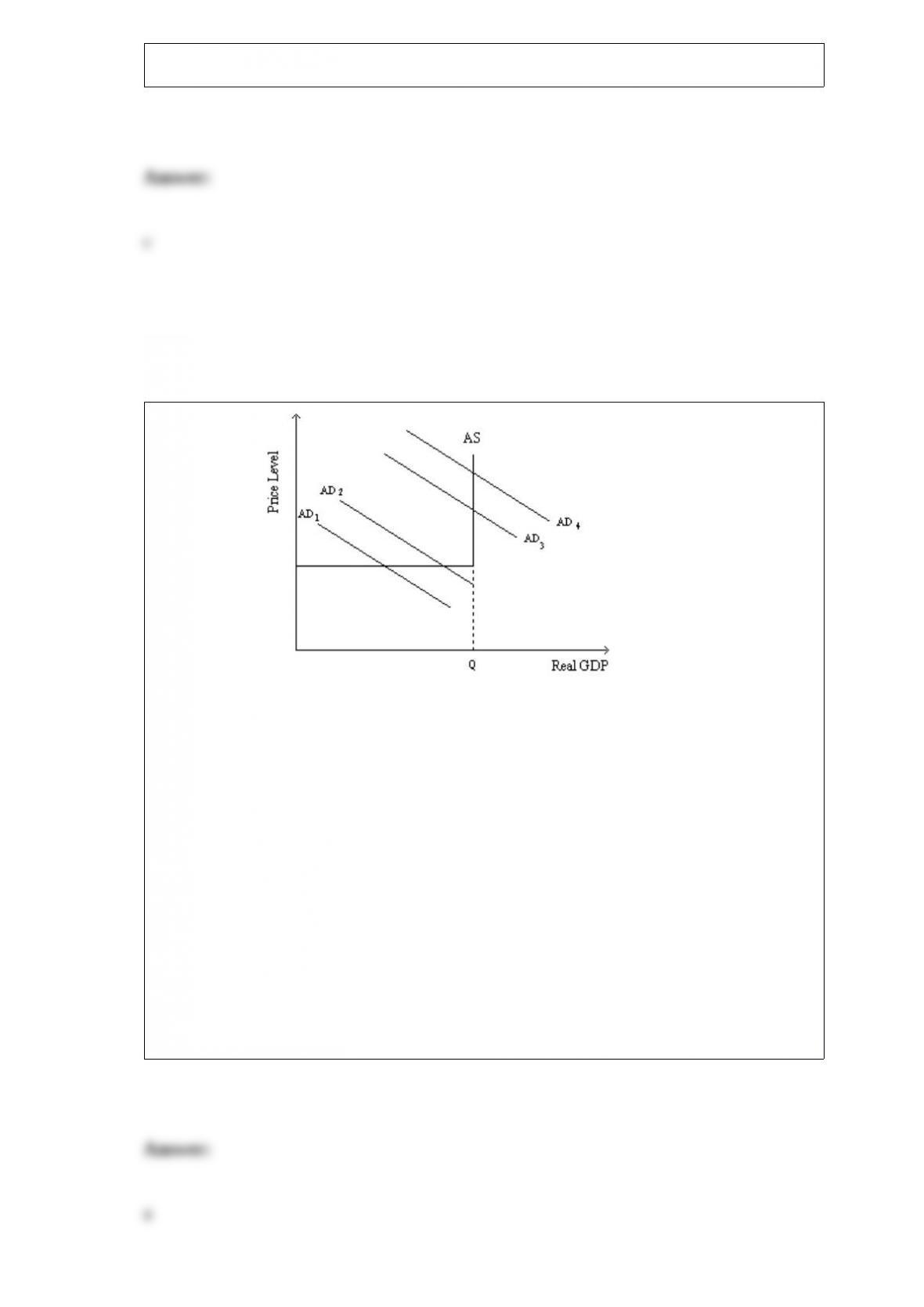
Exhibit 10-7
If autonomous consumption increases, which of the following is possible?
a. The AD curve will shift rightward from AD1 to AD2, the price level will remain
constant, and Real GDP will rise.
b. The AD curve will shift leftward from AD4 to AD3, the price level will fall, and Real
GDP will remain constant.
c. The AD curve will shift rightward from AD3 to AD4, the price level will remain
constant, and Real GDP will rise.
d. The AD curve will shift rightward from AD1 to AD2, the price level will rise, and
Real GDP will remain constant.

The difference between the amount a seller receives for a good and the lowest amount
for which he would sell the good is called
a. producers’ surplus.
b. windfall gain.
c. consumers’ surplus.
d. excess profit.
According to the simple quantity theory of money in the AD-AS framework, the AD
curve is
a. vertical.
b. downward sloping.
c. horizontal.
d. upward sloping.
Government provides a nonexcludable public good that the public demands and can€t
seem to acquire through the market.This is government
a. acting as a transfer mechanism.
b. being non-productive.
c. engaging in rent-seeking activities.
d. being productive.
e. a and c
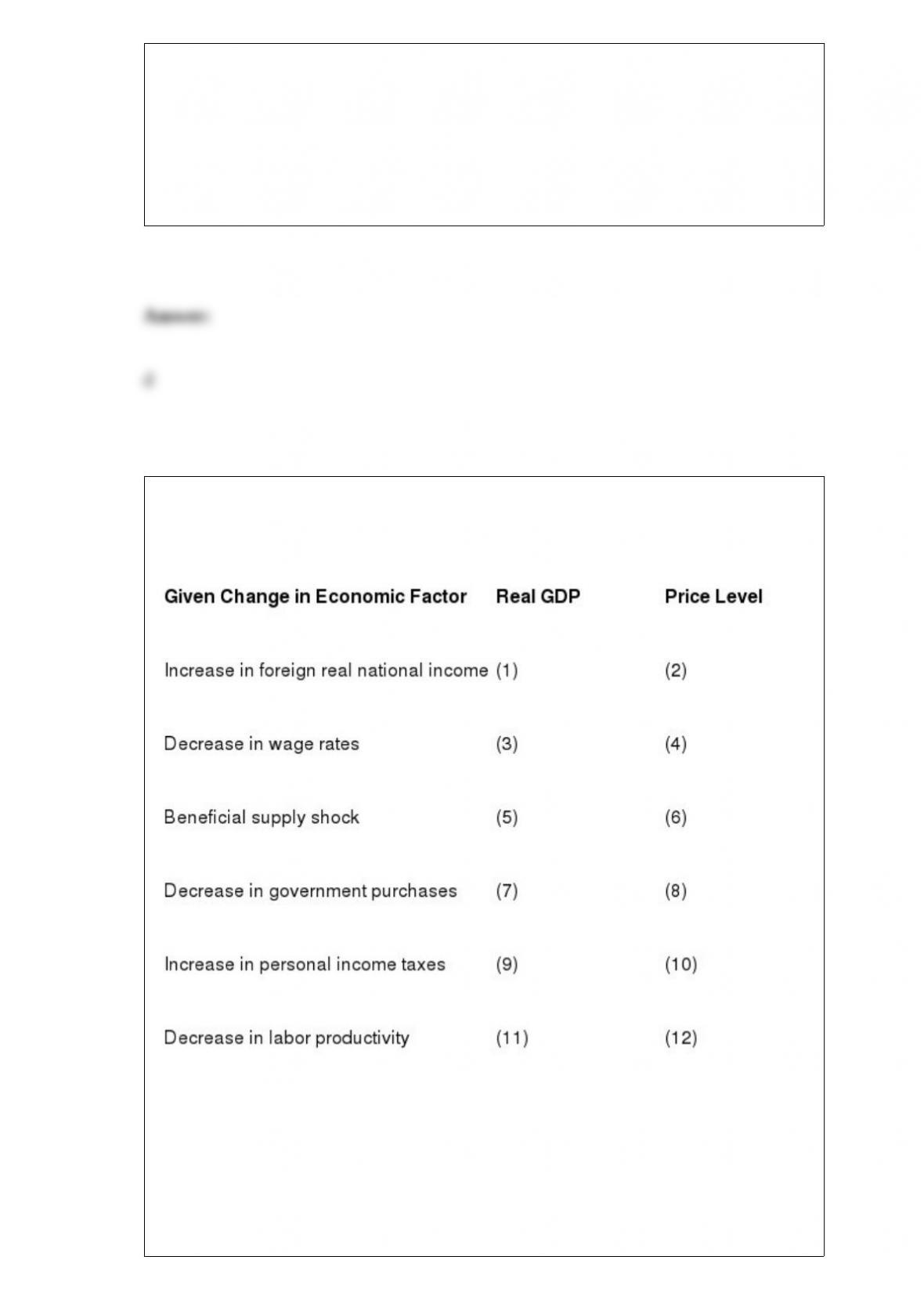
Based on the given change, what word (rises or falls) should go in blank (3) and blank
(4), respectively, to summarize the resulting impact on short run equilibrium?
a. rises; rises
b. falls; falls

c. rises; falls
d. falls; rises
Arguments made against free trade include all of the following except
a. national defense considerations justify producing certain goods domestically whether
the country has a comparative advantage in their production or not.
b. infant industries should be protected from free trade so that they may have time to
develop and compete on an even basis with older, more established foreign industries.
c. dumping is an unfair trade practice that puts domestic producers of substitute goods
at a disadvantage that they should be protected against.
d. free trade is inflationary and should be restricted in the domestic interest.
e. if foreign governments subsidize their exports, foreign firms that export are given an
unfair advantage that domestic producers should be protected against.
When you purchase a share of stock, you are
a. borrowing funds from the corporation.
b. lending funds to the corporation.
c. selling an ownership right in the corporation.
d. acquiring an ownership right in the corporation.

e. b and d
Suppose the government spending multiplier is 1.5.This means that
a. a $1 decline in government spending will raise Real GDP by $1.50.
b. a $1 rise in government spending will raise both total spending and Real GDP
(assuming prices are constant) by $1.50.
c. a $1 rise in government spending will raise investment spending by $1.50.
d. a $1 rise in government spending will change interest rates by 1.50 times what it was
before the $1 rise in government spending.
e. none of the above