
A bank has $50,000 in excess reserves and the required reserve ratio is 10 percent. This
means the bank could have __________ in checkable deposit liabilities and
__________ in (total) reserves.
a. $500,000; $90,000
b. $100,000; $20,000
c. $50,000; $25,000
d. $250,000; $75,000
Unemployment that arises as a result of the time it takes for unemployed people to
locate a job utilizing their transferable skills is called __________ unemployment.
a. structural
b. cyclical
c. natural
d. frictional
Suppose a drop in prices in the stock market makes people feel less financially secure.
This would cause __________ the economy’s AD curve.
a. movement down along
b. movement up along

c. a rightward shift of
d. a leftward shift of
Exhibit 4-8
Suppose that wheat producerslobby the government for a price floor and receive
one.This price floor is set at PF.How many fewer units of wheat will be sold at the price
floor than at the equilibrium price?
a. Q2 – Q1
b. Q3 – Q2
c. Q3 – Q1
d. Q2

Starting with an exchange rate of $1 =¥110, and a price tag of ¥5,000 for a Japanese
good, what happens to the dollar price of the good if the yen depreciates by 4 percent?
a. the dollar price of the good rises from $45.45 to $47.72
b. the dollar price of the good falls from $45.45 to $43.64
c. the dollar price of the good falls from $550,000 to $522,500
d. the dollar price of the good rises from $550,000 to $577,500
e. the dollar price of the good rises falls from $450 to $427.50
From the Patterns of Sustainable Specialization and Trade (PSST) perspective,
expansionary monetary and fiscal policies that are designed to boost aggregate demand
a. will not work if the money market is in disequilibrium, and may end up making the
economy worse.
b. will not work unless alternative sources of energy are employed.
c. may not work if buyers and sellers are out of sync with one another, and may end up
making the economy worse.
d. are always successful in pushing the economy to full-employment.

Exhibit 9-5
Assume that the economy starts off at point A on graph (2) with an effective minimum
wage law in place. After inflation erodes the purchasing power of the minimum wage
and eliminates the constraining influence of the minimum wage law on the unskilled
labor market, the economy is likely to move to a point such as
a. B.
b. G.
c. F.
d. C.
e. None of the above, because the minimum wage has no influence on the amount of
goods produced.
Look at the following data: durable goods = $200 billion; nondurable goods = $350
billion; services = $600 billion; fixed investment + inventory investment = $200 billion;
government purchases = $400 billion; exports = $30 billion; imports = $79 billion. GDP
is equal to
a. $1,701 billion.
b. $1,201 billion.
c. $1,859 billion.
d. $1,010 billion.
e. There is not enough information to answer the question.
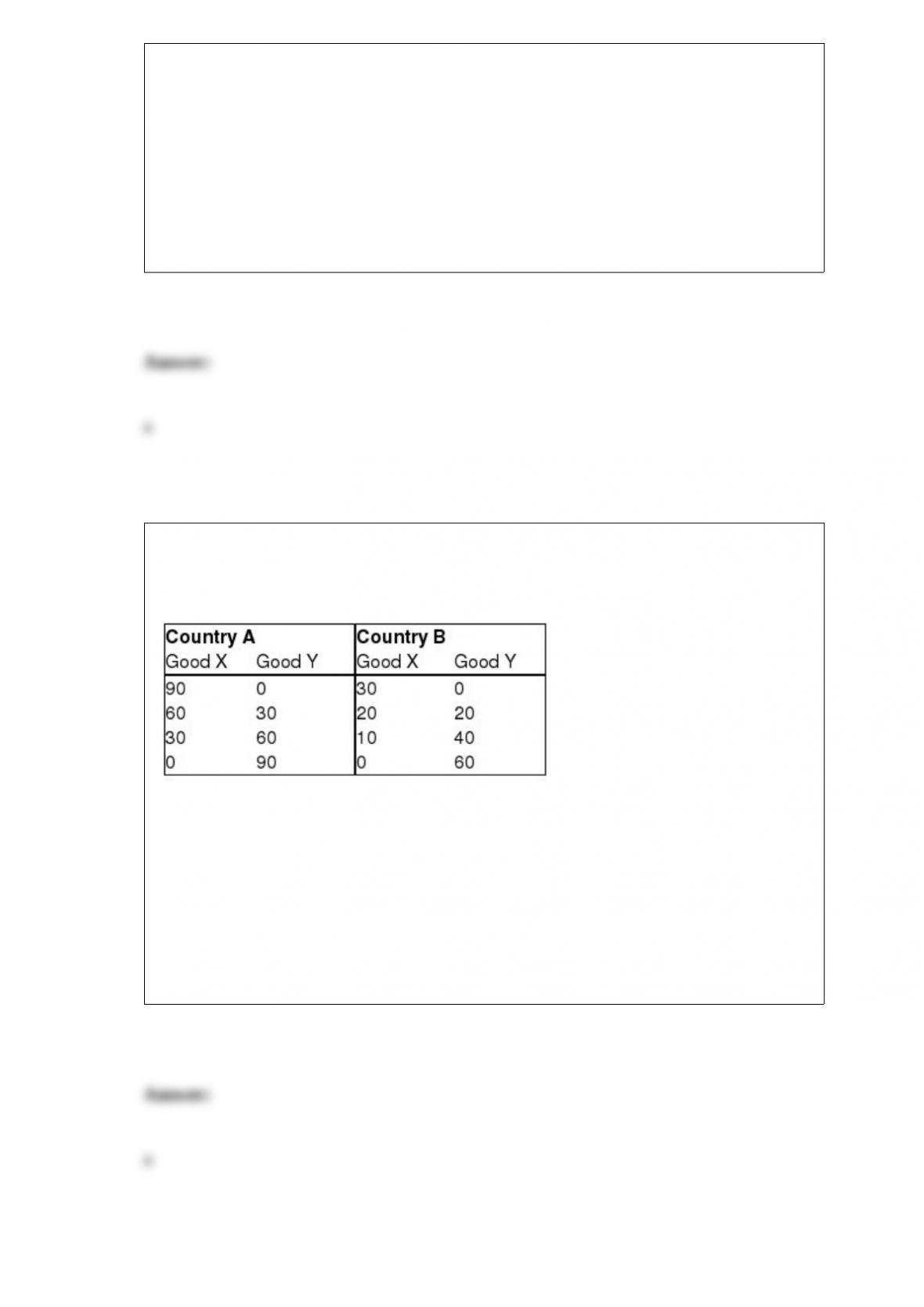
Exhibit 34-1
The opportunity cost of one unit of X in country A is
a. 1 unit of Y.
b. 2 units of Y.
c. 10 units of Y.
d. 0.50 units of Y.

Country A has a higher GDP than country B. What does this mean?
a. It means that on a per-capita basis the residents of country A are relatively better off
(in terms of the goods and services they have available to them) than the residents of
country B.
b. It means that on a per-capita basis the residents of country A are richer than the
residents of country B.
c. It means that more goods and services were produced in country A than country B.
d. It means that the total market value of the final goods and services produced in
country A is greater than the total market value of the final goods and services produced
in country B.
e. a and d
Why does the president of the Federal Reserve Bank of New York hold a permanent
seat on the FOMC?
a. The New York Fed is responsible for executing open market operations.
b. A substantial amount of financial activity takes place in New York City.
c. The Fed Board of Governors holds its regularly scheduled meetings in New York
City.
d. The Federal Reserve Bank of New York is the original Fed district; the other eleven
districts were formed later by the Banking Act of 1935
e. a and b

Exhibit 14-1
What sequence of points shows the short- and long-run consequences of a rise in
velocity under monetarist assumptions?
a. A-E-B
b. B-D-A
c. A-D-B
d. B-A
Which of the following statements is false?
a. A corporate bond typically has face value of $1,000.
b. Corporate bonds typically sell for a price that is equal to the bond’s face value.
c. The interest that corporate bonds pay is fully taxable.
d. State and local governments issue municipal bonds.