Archives: Quiz
ECON E 170
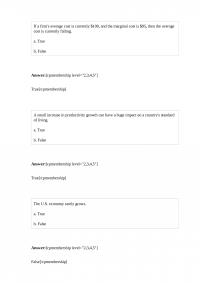
If a firm’s average cost is currently $100, and the marginal cost is $95, then the average cost is currently falling. a. True b. False A small increase in productivity growth can have a huge impact on a country’s standard […]
ECON A 501 Midterm 1
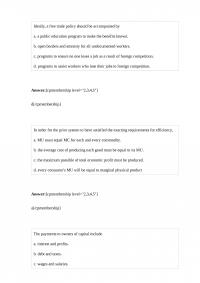
Ideally, a free trade policy should be accompanied by a. a public education program to make the benefits known. b. open borders and amnesty for all undocumented workers. c. programs to ensure no one loses a job as a result […]
MicroEconomic 136 Homework
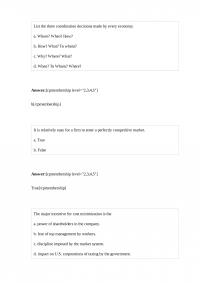
List the three coordination decisions made by every economy. a. Where? When? How? b. How? What? To whom? c. Why? Where? What? d. When? To Whom? Where? It is relatively easy for a firm to enter a perfectly competitive market. […]
BUS 197 Quiz 2
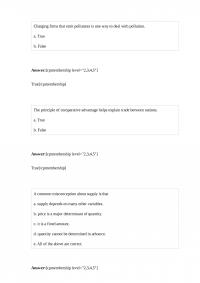
Charging firms that emit pollutants is one way to deal with pollution. a. True b. False The principle of comparative advantage helps explain trade between nations. a. True b. False Answer: True A common misconception about supply is that a. […]
MicroEconomic 587
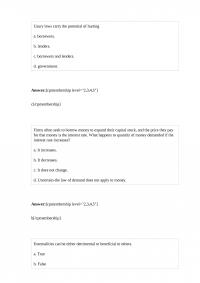
Usury laws carry the potential of hurting a. borrowers. b. lenders. c. borrowers and lenders. d. government. Firms often seek to borrow money to expand their capital stock, and the price they pay for that money is the interest rate. […]
BUS 885
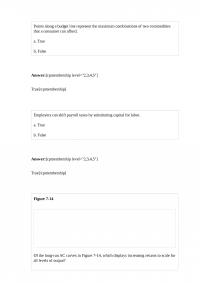
Points along a budget line represent the maximum combinations of two commodities that a consumer can afford. a. True b. False Employers can shift payroll taxes by substituting capital for labor. a. True b. False Answer: True Figure 7-14 Of […]
ECB 694 Homework
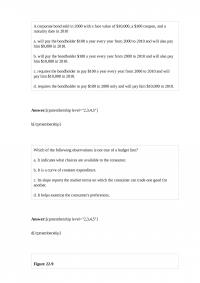
A corporate bond sold in 2000 with a face value of $10,000, a $100 coupon, and a maturity date in 2010 a. will pay the bondholder $100 a year every year from 2000 to 2010 and will also pay him […]
Economics 816 Midterm 1
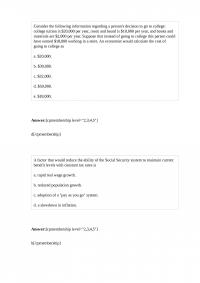
Consider the following information regarding a person’s decision to go to college: college tuition is $20,000 per year, room and board is $10,000 per year, and books and materials are $2,000 per year. Suppose that instead of going to college […]
ECON 417 Quiz 1
Externalities affect only the buyer and seller involved in an exchange. a. True b. False Rising prices help control the process of resource depletion by a. discouraging consumption and waste. b. stimulating more efficient use of the depletable resource. c. […]
ECON 422 Test 1
Recycling rates for aluminum, paper, and glass have been increasing in the United States. a. True b. False Annual incomes of James, Jack, and Stanley are $30,000, $50,000, and $80,000 and their tax rates are 10%, 20%, and 30% respectively. […]
ECB 857 Test
In the short run, a. all of the firm’s input quantities, including plant size, become adjustable. b. firms are not constrained by past decisions. c. firms have relatively little opportunity to change production processes. d. all of the firm’s current […]
ECON E 366 Test 2
Figure 14-1 In Figure 14-1, a technological breakdown in calculator production would cause which movement? a. B to E b. B to C c. B to D d. A to D There is no way that externalities can be corrected. […]
Economics 450 Final
The short-run equilibrium of the firm under monopolistic competition has excess capacity. a. True b. False Using prices to promote efficiency in the utilization of bridges, a. higher prices should be charged for the use of the most crowded bridges. […]
ECON A 887 Midterm 1
People generally purchase less of a commodity as its price increases. This implies that the relationship between quantity purchased and the price of the commodity must have a a. slope always equal to one. b. positive slope. c. zero slope. […]
ECON E 880 Test
The payroll tax receipts a. are used to reduce the national debt. b. are invested in private business for future payments. c. pay off current recipients of Social Security payments. d. go directly into a trust fund for investment in […]
ECB 676
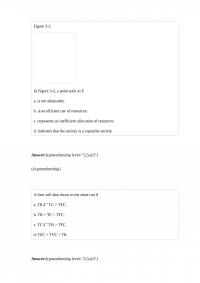
Figure 3-2 In Figure 3-2, a point such as E a. is not obtainable. b. is an efficient use of resources. c. represents an inefficient allocation of resources. d. indicates that the society is a capitalist society. A firm will […]
Economics 215 Midterm
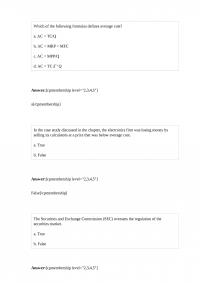
Which of the following formulas defines average cost? a. AC = TC/Q b. AC = MRP = MFC c. AC = MPP/Q d. AC = TC − Q In the case study discussed in the chapter, the electronics firm was […]
MicroEconomic 147 Midterm 2
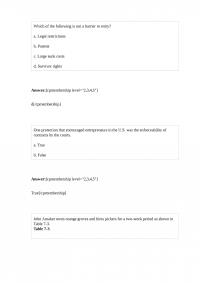
Which of the following is not a barrier to entry? a. Legal restrictions b. Patents c. Large sunk costs d. Survivor rights One protection that encouraged entrepreneurs in the U.S. was the enforceability of contracts by the courts. a. True […]
ECON 137 Test
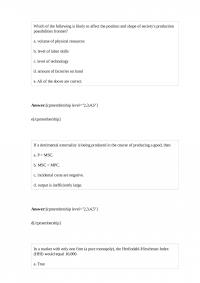
Which of the following is likely to affect the position and shape of society’s production possibilities frontier? a. volume of physical resources b. level of labor skills c. level of technology d. amount of factories on hand e. All of […]
ECB 818
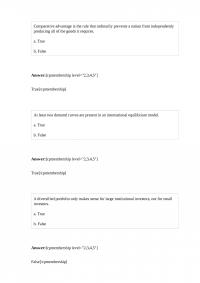
Comparative advantage is the rule that ordinarily prevents a nation from independently producing all of the goods it requires. a. True b. False At least two demand curves are present in an international equilibrium model. a. True b. False Answer: […]
ECB 123
If the price falls below minimum SRAVC, the quantity supplied by the firm will be a. the quantity at minimum MC. b. zero. c. the quantity at the point where MC intersects AC. d. the quantity at minimum AC. The […]
ECON A 136 Test
In a properly functioning economy, money costs approximate opportunity costs. a. True b. False A positive aspect of monopolies is that they may aid innovation in the marketplace. a. True b. False Answer: True Which of the following makes invention […]
Economics 681 Quiz
As the rate of interest on borrowed funds increases, the quantity of investment funds demanded diminishes. a. True b. False If the United States imposed a 25 percent tariff on imports of minivans, the effect would be to a. raise […]
MicroEconomic 795 Quiz 3
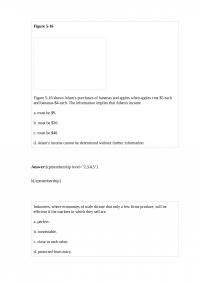
Figure 5-16 Figure 5-16 shows Adam’s purchases of bananas and apples when apples cost $5 each and bananas $4 each. The information implies that Adam’s income a. must be $9. b. must be $20. c. must be $40. d. Adam’s […]
BUS 547 Quiz 3
Profits a. are what remains from the selling price after factors have been paid. b. accrue to entrepreneurs. c. are lower than most people think. d. All of the above are correct. A lottery promises a $250,000 prize. But the […]
MicroEconomic 788
The Industrial Revolution refers to the stream of new technology and the resulting growth of output than began in England toward the end of the eighteenth century. a. True b. False The marginal revenue curve for a monopolist is a. […]
ECON E 383 Test
If there are many close substitutes available for a good, its elasticity of demand will be higher. a. True b. False Wages are comparatively low in markets where demand for labor is low and supply is high. a. True b. […]
ECON 392 Midterm 1
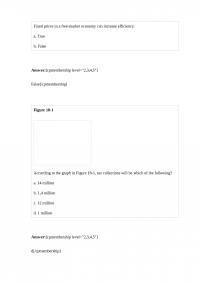
Fixed prices in a free-market economy can increase efficiency. a. True b. False Figure 18-1 According to the graph in Figure 18-1, tax collections will be which of the following? a. 14 million b. 1,4 million c. 12 million d. […]
MicroEconomic 269 Midterm 2
The price for labor is the wage rate. What happens to the supply of labor if wages increase? a. It increases. b. It decreases. c. It does not change. d. Uncertain-economic theory has no answer to this question. According to […]
ECON E 633
Capitalism is an economic system in which the production process is controlled primarily by private firms operating in markets. a. True b. False The federal income tax is an example of a a. progressive tax. b. regressive tax. c. proportional […]
ECB 118 Midterm
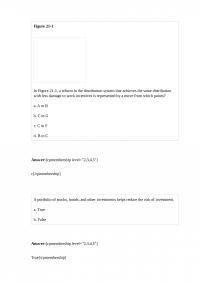
Figure 21-1 In Figure 21-1, a reform in the distribution system that achieves the same distribution with less damage to work incentives is represented by a move from which points? a. A to B b. C to G c. C […]
Economics 180 Midterm 2
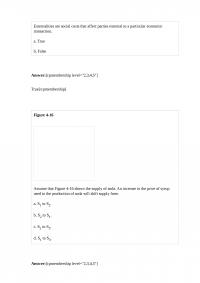
Externalities are social costs that affect parties external to a particular economic transaction. a. True b. False Figure 4-16 Assume that Figure 4-16 shows the supply of soda. An increase in the price of syrup used in the production of […]
Economics 646
A firm is operating with an optimal combination of inputs. Suddenly the price of one input rises. The firm should a. buy less of that input and more of the other input. b. change its input mix so that the […]
ECON 331 Quiz 1
The major coordination tasks can be summarized with the questions a. who, what, when, where? b. how, what, for whom? c. how, what, why? d. how, why, for whom? e. who, how, what? Low interest rates will persuade corporations to […]
ECON A 478 If corporations have
If corporations have their choice, they will prefer to invest using a. revenue from the sale of stocks. b. revenue from the sale of bonds. c. plowback. d. money borrowed from the bank. A relatively large increase in the cost […]
MicroEconomic 702
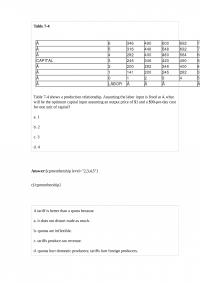
Table 7-4 Table 7-4 shows a production relationship. Assuming the labor input is fixed at 4, what will be the optimum capital input assuming an output price of $1 and a $90-per-day cost for one unit of capital? a. 1 […]
ECB 662 Quiz 1
The law of diminishing marginal utility holds that at some point consumption of additional units of a commodity adds less to total utility. a. True b. False Elasticity of demand is another way to measure slope. a. True b. False […]
MicroEconomic 860 Quiz 1
Which of the following is most likely to reduce the consumption of an exhaustible natural resource? a. a decrease in monopoly control of the market for the resource b. government tax policies that give tax breaks to entrepreneurs who search […]
MicroEconomic 724 Quiz 3
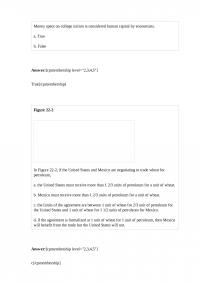
Money spent on college tuition is considered human capital by economists. a. True b. False Figure 22-2 In Figure 22-2, if the United States and Mexico are negotiating to trade wheat for petroleum, a. the United States must receive more […]
ECB 358
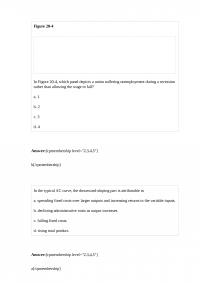
Figure 20-4 In Figure 20-4, which panel depicts a union suffering unemployment during a recession rather than allowing the wage to fall? a. 1 b. 2 c. 3 d. 4 In the typical AC curve, the downward-sloping part is attributable […]
ECON 382 Quiz
Perfect central planning is nearly impossible for all of these reasons except: a. production processes between industries are often interdependent. b. some processes must be decided together, and not individually, because of their interdependence. c. if the output target for […]
ECON A 358 Midterm 1
A contour map illustrates which of the following? a. the cause-effect relationship between two variables b. the cause-effect relationship between three variables c. the way that three variables are correlated d. the way that one variable affects another, which in […]
ECON 342 Midterm 2
The invention of machinery that can double the amount of gold extracted from raw ore will likely lead mining companies to a. raise the world price of gold to pay for the new machinery. b. lower the world price of […]
ECON 352
The market demand curve shows how the quantity demanded of a product, during a specified time period, changes as the price of that product changes. a. True b. False A bond’s price is sensitive to changes in a. the interest […]
ECON 586 Midterm 2
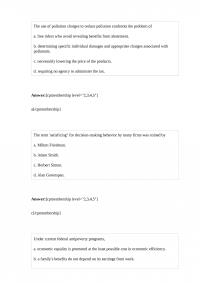
The use of pollution charges to reduce pollution confronts the problem of a. free riders who avoid revealing benefits from abatement. b. determining specific individual damages and appropriate charges associated with pollutants. c. necessarily lowering the price of the products. […]
BUS 442 Quiz 3
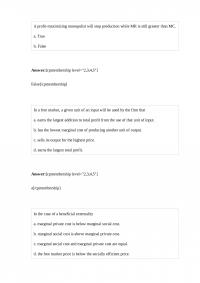
A profit-maximizing monopolist will stop production while MR is still greater than MC. a. True b. False In a free market, a given unit of an input will be used by the firm that a. earns the largest addition to […]
BUS 669
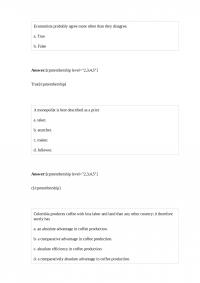
Economists probably agree more often than they disagree. a. True b. False A monopolist is best described as a price a. taker. b. searcher. c. maker. d. follower. Answer: c Colombia produces coffee with less labor and land than any […]
ECON E 896 Midterm
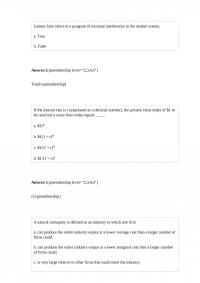
Laissez faire refers to a program of minimal interference in the market system. a. True b. False If the interest rate is r (expressed as a decimal number), the present value today of $1 to be received n years from […]
ECB 366 Quiz
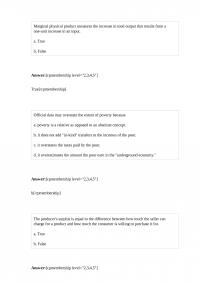
Marginal physical product measures the increase in total output that results from a one-unit increase in an input. a. True b. False Official data may overstate the extent of poverty because a. poverty is a relative as opposed to an […]
ECB 652 If one country has an
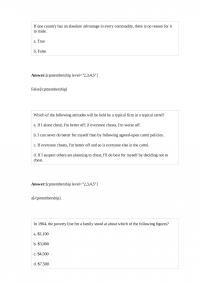
If one country has an absolute advantage in every commodity, there is no reason for it to trade. a. True b. False Which of the following attitudes will be held by a typical firm in a typical cartel? a. If […]