
If the price falls below minimum SRAVC, the quantity supplied by the firm will be
a. the quantity at minimum MC.
b. zero.
c. the quantity at the point where MC intersects AC.
d. the quantity at minimum AC.
The relationship between professional basketball players and the owners’ association is
an example of a bilateral monopoly.
a. True
b. False
Marginal profit is the additional profit that accrues to the firm when the output rises by
one unit.
a. True
b. False

Which of the following might be a goal of a union?
a. increasing the size of the union
b. increasing the income while holding the size of the union constant
c. increasing both the size and income of the union
d. all of the above
Figure 4-20
If there are empty seats at the university basketball game when the price per ticket is
P*, then this situation can best be represented by which graph in Figure 4-20?
a. 1
b. 2
c. 3
d. 4

An “opportunity cost” may be described as:
a. the value of what must be gtiven up
b. the opporrtunity foregone
c. the value of the next best alternative
d. the correct measure of cost
e. all of these are correct
By tradition, Japanese employers cannot “lay off” workers. As a result they have goods
that they cannot sell on the domestic market without driving down prices. To minimize
losses, they sell goods such as steel and televisions in foreign markets at prices well
below those in Japan. This is called
a. beggar my neighbor.
b. helpfulism.
c. strategic trade policy.
d. dumping.
Firms should stop borrowing funds
a. as soon as the bank raises the interest rate.
b. when the MRP of borrowed funds is equal to the cost of borrowing.
c. whenever the future of the firm looks gloomy.
d. if their debts are more than 25 percent of the value of the firm.
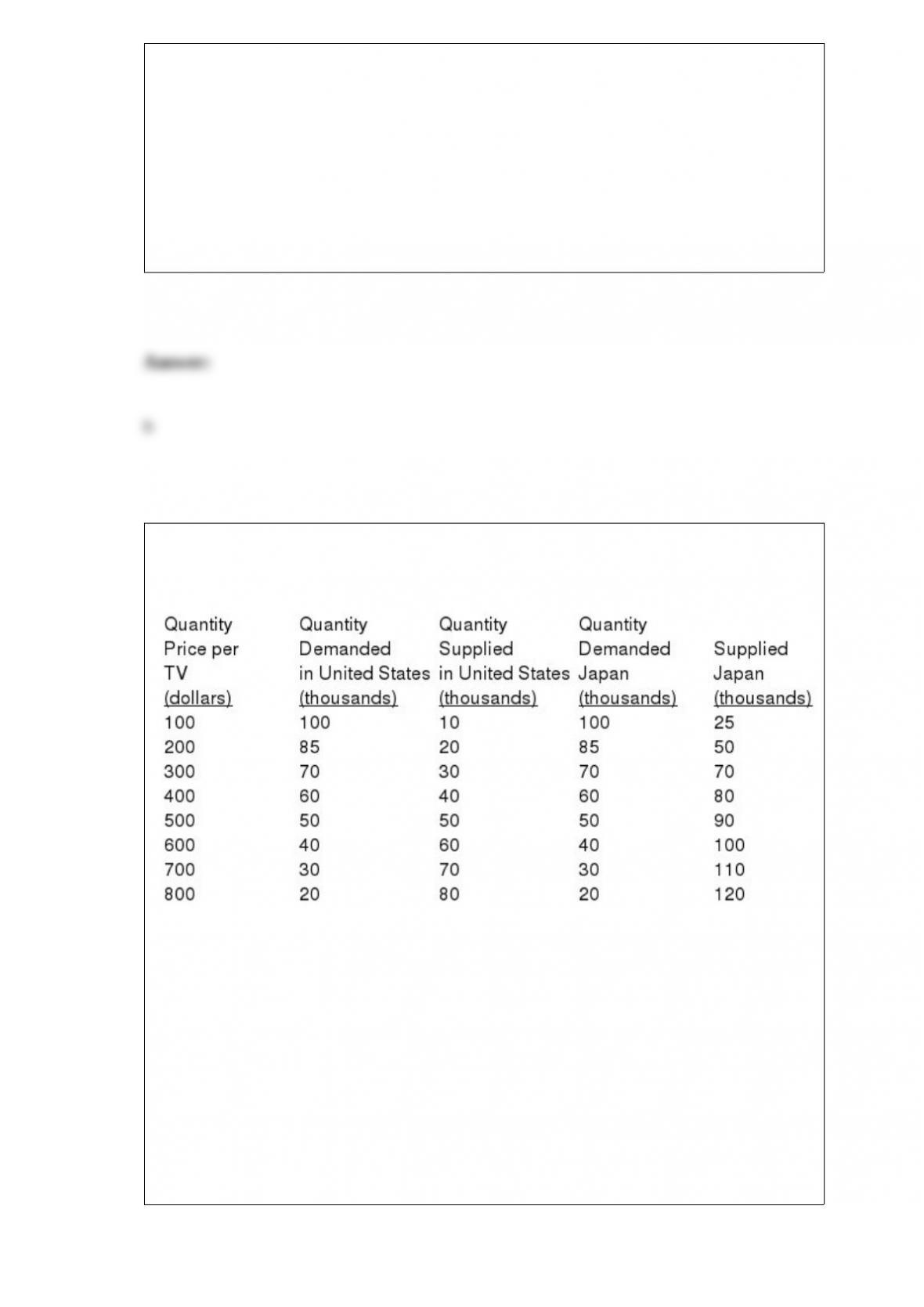
Table 22-4
Table 22-4 presents the demand and supply schedules for television sets in Japan and
the United States. If there is no trade between these countries, what are the equilibrium
price and quantity in Japan?
a. P = $100, Q = 100
b. P = $200, Q = 85
c. P = $300, Q = 70
d. P = $400, Q = 60

Economic theory is necessary and extremely important because of its relationship to
economic policy.
a. True
b. False
Abstract economic theory can be used by academicians, but not by politicians or
business people.
a. True
b. False
Before the Industrial Revolution, per capita income in the U.S. was about:
a. $4,000
b. $2,000
c. $1,000

d. $0
Firms often seek to borrow money to expand their capital stock, and the price they pay
for that money is the interest rate. What happens to the demand for money if the interest
rate increases?
a. It increases.
b. It decreases.
c. It does not change.
d. The quantity of money demanded will increase.
The lure of ____ directs resources to optimally efficient activities and time periods.
a. future consumption
b. present consumption
c. market share growth
d. profits

The United States has greater inequality of income than
a. Japan.
b. Germany and Australia.
c. most industrialized nations.
d. all of the above.
When a tax is imposed on an item, it can generally be said that the incidence of the tax
is
a. entirely on the buyer.
b. entirely on the seller.
c. on both the buyer and seller.
d. not determined in this manner.
American households spend more of their incomes on goods than on services.
a. True
b. False

How extensively does the United States use quotas?
a. Very little; there are few quotas on imports.
b. Selectively; there are more quotas than most people realize.
c. Widely; quotas are extensive and cover a wide range of goods.
d. Widely; although the United States prefers to use tariffs, which cover a wide range of
goods.
The impact of an increase in oil prices stemming from the growth of demand is
probably going to ____ the wages of petroleum engineers.
a. decrease
b. increase
c. leave unaffected
d. be impossible to predict

Demand for inputs is a derived demand because
a. it is derived from the need for income.
b. it corresponds to the derived supply of the inputs.
c. producers want the input to produce the finished good.
d. it is downward sloping.
The distribution of income in a market economy is determined by the minimum wage
laws.
a. True
b. False
Innovation tends to be an extremely competitive activity that allows few opportunities
for firms to share information with one another.
a. True
b. False