Archives
Counseling Chapter 1 Counseling Groups For Children Counseling Groups For
1. A major difference between group therapy and group counseling lies in a. the techniques employed to facilitate the process of interaction. b. the group’s goals. c. the age of the participants. d. the theoretical orientation of the group leader. […]
Counseling Chapter 10 Describe the role and functions of the group counselor
1. The basic assumption underlying the person-centered approach is a. members are prone to faulty thinking. b. members need guidance from an expert to resolve their problems. c. members need a structured learning experience to benefit from a group. d. […]
Counseling Chapter 11 Understand The Fundamental Difference Between Experiments
1. A primary function of the Gestalt leader is to a. make interpretations for the members. b. serve as a blank screen to foster transference. c. suggest experiments that will lead to heightening experiencing. d. confront clients’ irrational thoughts. 2. […]
Counseling Chapter 12 Be able to define and describe the key concepts
1. Transactional analysis (TA) is all of the following EXCEPT a. a theory of personality. b. a language of behavior. c. an organized system of interactional therapy. d. grounded on the assumption that our current decisions are not based on […]
Counseling Chapter 13 Both Cognitive Therapy And Rational Emotive Behavior
1. Cognitive behavioral practitioners use all of the following EXCEPT a. a brief, active, directive, collaborative, present-focused, and didactic approach. b. a psychoeducational model of therapy. c. a therapeutic model that relies on empirical validation of its concepts and techniques. […]
Counseling Chapter 14 The Group Leader Likely Begin Group By
1. According to REBT, people develop psychological disturbances because of a. a traumatic event. b. failure to receive love from significant others. c. their irrational beliefs about certain events. d. unfinished business from their past. 2. The rational emotive behavior […]
Counseling Chapter 15 To compare and contrast reality therapy with some
1. According to reality therapy a. insight is essential for change to occur. b. people create their own disturbances by accepting irrational beliefs. c. involvement is considered the core of therapy. d. self-rating is necessary for mental health. 2. What […]
Counseling Chapter 16 Understand The Basic Principles
1. According to solution-focused therapy in groups a. insight is essential for change to occur. b. members need to understand the cause of a problem in order to arrive at a solution. c. change occurs mainly through the advice given […]
Counseling Chapter 2 Recognizing the importance of developing one’s own
1. Opening up clear and direct communication among the participants and helping them assume increasing responsibility for the group’s direction is defined as a. suggesting. b. facilitating. c. goal setting. d. giving feedback. 2. Appraising the ongoing group process and […]
Counseling Chapter 3 Member Has Right Expect All The Following
1. A member has a right to expect all of the following before making the decision of whether or not to join a particular group EXCEPT a. a discussion of the rights and responsibilities of group members b. a clear […]
Counseling Chapter 4 Pregroup Issues Formation The Group learning Objectives
1. A group that is composed of people who are similar in age, type of problem, and personality characteristics can be called a. a homogeneous group. b. a heterogeneous group. c. an endogenous group. d. an androgynous group. 2. This […]
Counseling Chapter 5 Interpreting The Meaning Behavior Patterns Appropriate Times
1. Interpreting the meaning of behavior patterns at appropriate times so that members will be able to engage in a deeper level of self-exploration and consider alternative behaviors is most critical at the a. initial stage of a group. b. […]
Counseling Chapter 6 The Goal The Analytic Process Isa Adequate
1. The goal of the analytic process is a. adequate social adjustment. b. restructuring the client’s character and personality system. c. uncovering early experiences. d. achieving intense feelings in the here and now. 2. The key to understanding personality problems […]
Counseling Chapter 7 Adler Developed His Approach Froma The Psychoanalytic
1. Adler developed his approach from a. the psychoanalytic approach. b. the behavioral approach. c. the rational-oriented therapies. d. all of these answers. 2. The Adlerian approach stresses a. unconscious factors. b. ego center. c. irrational impulses. d. inferiority and […]
Counseling Chapter 8 The Mirror Technique The Magic Shop The
1. Which statement is FALSE as applied to psychodrama? a. The therapy is an action-oriented method. b. The therapy is characterized by a here-and-now focus. c. Emphasis is on catharsis and insight. d. Emphasis is on identifying ego states. 2. […]
Counseling Chapter 9 Which Technique Considered Essential The Existential Group
1. A basic assumption of the existential approach is a. that humans are free but not responsible for their actions. b. that humans tend to be determined by external forces. c. that early influences shape and determine the contemporary person. […]
EDU 70045
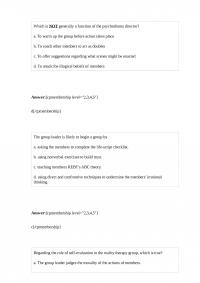
Which is NOT generally a function of the psychodrama director? a. To warm up the group before action takes place b. To coach other members to act as doubles c. To offer suggestions regarding what scenes might be enacted d. […]
EDU 92844
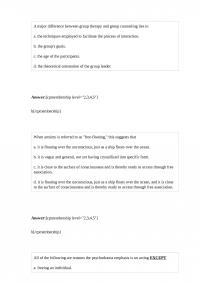
A major difference between group therapy and group counseling lies in a. the techniques employed to facilitate the process of interaction. b. the group’s goals. c. the age of the participants. d. the theoretical orientation of the group leader. When […]
EDUC 59109
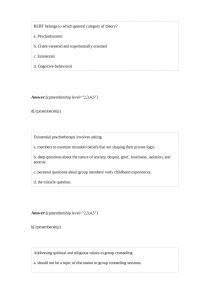
REBT belongs to which general category of theory? a. Psychodynamic b. Client-centered and experientially oriented c. Existential d. Cognitive-behavioral Existential psychotherapy involves asking a. members to examine mistaken beliefs that are shaping their private logic. b. deep questions about the […]
EDUK 27308
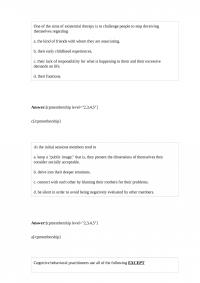
One of the aims of existential therapy is to challenge people to stop deceiving themselves regarding a. the kind of friends with whom they are associating. b. their early childhood experiences. c. their lack of responsibility for what is happening […]
EDUK 81055
In Gestalt therapy, awareness is best described as a. introspection. b. intellectual presence. c. recognition of current feelings, actions, and sensations. d. recognition of why one struggles with a certain problem. Glasser believed schools should be structured in ways to […]
SED AP 52831
One method used to teach coping skills is a_____________________, which is a shaping strategy in which clients are encouraged to perform small sequential steps leading to a goal. a. graded task assignment b. cognitive behavioral baby step c. coping sequence […]
SED AP 62330
_______________ may exhibit defensive behaviors, and unless these behaviors are recognized and explored, defensiveness can seriously interfere with the group process. a. Trusting members b. Reluctant members c. Members willing to share and open up d. Non-group members Staying in […]
SED AP 97624
All of the following describe adanger of utilizing psychodrama EXCEPT a. participants being left without adequate closure. b. use of power on the part of the leader appropriately. c. pushing people beyond the level to which they want to work. […]
SED DS 22079
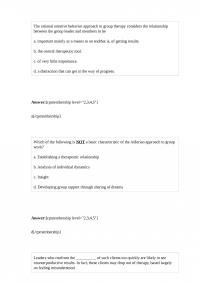
The rational emotive behavior approach to group therapy considers the relationship between the group leader and members to be a. important mainly as a means to an endthat is, of getting results. b. the central therapeutic tool. c. of very […]
SED DS 96199
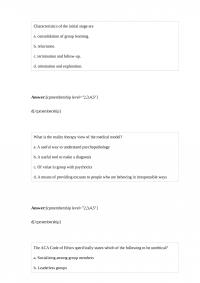
Characteristics of the initial stage are a. consolidation of group learning. b. reluctance. c. termination and follow-up. d. orientation and exploration. What is the reality therapy view of the medical model? a. A useful way to understand psychopathology b. A […]
SED EM 78378
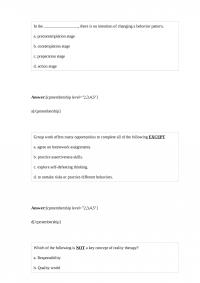
In the _________________, there is no intention of changing a behavior pattern. a. precontemplation stage b. contemplation stage c. preparation stage d. action stage Group work offers many opportunities to complete all of the following EXCEPT a. agree on homework […]
SED LR 63413
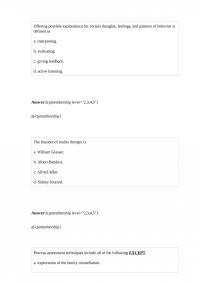
Offering possible explanations for certain thoughts, feelings, and patterns of behavior is defined as a. interpreting. b. evaluating. c. giving feedback. d. active listening. The founder of reality therapy is a. William Glasser. b. Albert Bandura. c. Alfred Adler. d. […]
SED LR 68855
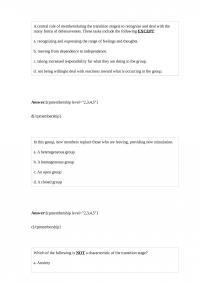
A central role of membersduring the transition stageis to recognize and deal with the many forms of defensiveness. These tasks include the following EXCEPT a. recognizing and expressing the range of feelings and thoughts. b. moving from dependence to independence. […]