Archives
ANT 31970
Human ABO blood types are a. determined by regulatory genes. b. controlled by multiple alleles. c. controlled by multiple genes. d. none of the above. The earliest australopithecines first show up in the fossil record more than a. 1 mya. […]
ANT 75547
Relative to other primates, prosimian adaptations include a. an enlarged olfactory bulb and enlarged scent glands. b. larger brains. c. reduced number of teeth. d. smaller eye orbits. Which of the following is not one of the main methods for […]
ANT 84615
In which of the following extinct primates would you expect to find a 2/1/2/3 dental formula? a. Adapis b. Notharctus c. Branisella d. Proconsul The nose structure in all primates a. is projecting (similar to dogs) and contributed to a […]
ANT 87807
The Paleoindian skull from Kennewick, in Washington State, a. was recovered from an elaborate burial. b. represents an early Eskimo population. c. looks quite different from modern Native Americans’ skulls. d. is about 3,000 years old. The ratio of C3 […]
CGS SS 31945
In his work on pea plants, Mendel found that plant height was inherited independently of the type or color of the seed coat. This finding a. applies to genes on the same chromosome. b. applies to the law of independent […]

CGS SS 33228
When geneticists talk about the gene pool, they refer specifically to variation at a genetic a. chromosome. b. nucleus. c. address. d. locus. Solitary primates and those in small groups suffer higher rates of predation by what predator compared to […]

CGS SS 42677
Primates’ enhanced sense of vision stems from a. eyes rotated forward. b. tendency toward nocturnality. c. color vision. d. both a and c. Homo erectus fossils date to a. 3″1 mya. b. 2.5 mya”500,000 yBP. c. 1.8 mya”300,000 yBP. d. […]
CGS SS 51446
Gametes are a. diploid. b. haploid. c. produced during mitosis. d. none of the above. Using direct radiometric dating of ________ provides very accurate ages for many East African Rift Valley hominid sites. a. volcanic rocks b. trees c. pottery […]
CGS SS 64059
Race is not a valid biological concept because a. races account for only a small amount of biological variation. b. the distribution of biological traits follow a cline. c. traits do not agree with their frequency and distribution. d. all […]
CGS SS 82915
Cereal grains such as rice that make up a significant portion of human diet today are known as a. good-for-you foods. b. high-energy foods. c. superfoods. d. genetically modified foods. Infancy ends a. at 36 months. b. before deciduous dentition […]
CGS SS 86899
Chimpanzees in the wild have been observed to a. use two rocks as a hammer and anvil to crack open nuts. b. teach their offspring how to flake stone tools. c. use stick tools to scoop termites from nests. d. […]
CGS SS 88248
Fossil and living apes exhibit a distinctive cusp pattern on the chewing surfaces of their molar teeth known as a. Y-5 b. Y-6 c. silodont d. Carabelli’s cusp The earliest australopithecines probably lived in which kind of environment? a. dense […]
SOC 22942
While conducting research with a small population in South America you note that an overwhelming majority of individuals exhibit signs of a specific genetic abnormality. This is most likely the result of a. natural selection. b. founder effect. c. extinction. […]
SOC 27404
During the Miocene epoch of the Cenozoic era, there was an adaptive radiation of which kind of primate? a. prosimians b. monkeys c. apes d. humans The following are complementary bases in DNA a. adenine and thymine. b. adenine and […]
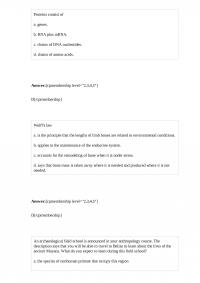
SOC 57117
Proteins consist of a. genes. b. RNA plus mRNA. c. chains of DNA nucleotides. d. chains of amino acids. Wolff’s law a. is the principle that the lengths of limb bones are related to environmental conditions. b. applies to the […]
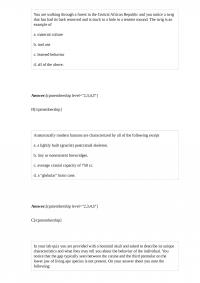
SSCI 32150
You are walking through a forest in the Central African Republic and you notice a twig that has had its bark removed and is stuck in a hole in a termite mound. The twig is an example of a. material […]
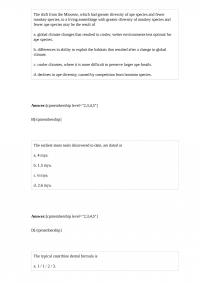
SSCI 42372
The shift from the Miocene, which had greater diversity of ape species and fewer monkey species, to a living assemblage with greater diversity of monkey species and fewer ape species may be the result of a. global climate changes that […]
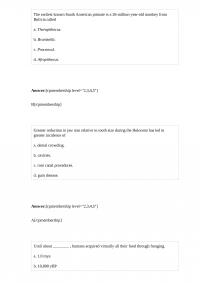
SSCI 56587
The earliest known South American primate is a 26-million-year-old monkey from Bolivia called a. Theropithecus. b. Branisella. c. Proconsul. d. Afropithecus. Greater reduction in jaw size relative to tooth size during the Holocene has led to greater incidence of a. […]
SSCI 72383
Analysis of Homo erectus teeth found at Zhoukoudian suggests that controlled use of fire allowed this species to a. ward off predators. b. expand into more temperate environments. c. make foods easier to chew. d. none of the above. Modern […]