Archives
Media Studies Chapter 1 Introducing Electronic Media Learning Objectives After Reading This Students Should
CHAPTER 1 Introducing Electronic Media ____________________________________________________________ LEARNING OBJECTIVES After reading this chapter students should be able to understand the following concepts: Convergence: Understand how media is coming together, blurring the lines of previously distinct communication forms such as broadcast, cable, […]
Media Studies Chapter 1 The coming together of and blurring of lines between, discrete communications forms
CHAPTER 1 TEST ITEMS __________________________________________ Multiple-Choice Questions 1. The coming together of and blurring of lines between, discrete communications forms such as broadcast, cable, telephone, computers, and mail is known as a. transparency. b. seamlessness. 2. Two concepts on which […]
Media Studies Chapter 10 Media consumers pay attention to communication that fits their established opinions
CHAPTER 10 TEST ITEMS ______________________________________________________________________ Multiple-Choice Questions 1. Media consumers pay attention to communication that fits their established opinions and attitudes but ignore messages that challenge or contradict that mind-set. This reinforcement of existing views is known as a. boomerang […]
Media Studies Chapter 10 Media Theory And Effects Learning Objectives After Reading This Students
CHAPTER 10 Media Theory and Effects ____________________________________________________________ LEARNING OBJECTIVES After reading this chapter students should be able to understand the following concepts: Media effects research: Understand key terms relevant to the study of media effects such as media, effects, and […]
Media Studies Chapter 11 The Communications Act Licensing And Structural Regulation Learning Objectives After Reading
CHAPTER 11 The Communications Act, Licensing, and Structural Regulation ____________________________________________________________ LEARNING OBJECTIVES After reading this chapter students should be able to understand the following concepts: Federal jurisdiction: Understand why Congress has power to regulate electronic media and that authority is […]
Media Studies Chapter 11 What specific constitutional phrase justifies broadcasting coming under congressional jurisdiction
CHAPTER 11 TEST ITEMS ______________________________________________________________________ Multiple-Choice Questions 1. What specific constitutional phrase justifies broadcasting coming under congressional jurisdiction? a. Economic necessity b. Fair use 2. This standard, created by Congress, limits FCC discretion. a. PICON* b. PUCs c. Title VI […]
Media Studies Chapter 12 Constitutional Issues And Content Regulation Learning Objectives After Reading This
CHAPTER 12 Constitutional Issues and Content Regulation __________________________________________________________________ LEARNING OBJECTIVES After reading this chapter students should be able to understand the following concepts: First Amendment rights: Outline protections found in the First Amendment for freedom of expression, freedom of assembly, […]
Media Studies Chapter 12 The First Amendment was designed to provide protection from
CHAPTER 12 TEST ITEMS ______________________________________________________________________ Multiple-Choice Questions 1. The First Amendment was designed to provide protection from a. false ideas. 2. One of the main arguments justifying additional regulations imposed on broadcasting (as opposed to print) is a. channel scarcity.* […]
Media Studies Chapter 13 A primarily commercial marketplace with strong government regulations
CHAPTER 13 TEST ITEMS ______________________________________________________________________ Multiple-Choice Questions 1. A primarily commercial marketplace with strong government regulations best describes the media system in a. China. b. France. 2. Which of the following would best describe a libertarian approach to broadcasting? a. […]
Media Studies Chapter 13 Global View Learning Objectives After Reading This Students Should Able
CHAPTER 13 A Global View __________________________________________________________________ LEARNING OBJECTIVES After reading this chapter students should be able to understand the following concepts: National character: Note how electronic media reflect each nation’s character. Political philosophies: Differentiate among authoritarian, libertarian, communist, social responsibility, […]
Media Studies Chapter 2 From Radio Television Learning Objectives After Reading This Students Should
CHAPTER 2 From Radio to Television _________________________________________________________________ LEARNING OBJECTIVES After reading this chapter students should be able to understand the following concepts: Precedents: Describe what happened—or existed—before radio broadcasting Broadcasting’s beginnings: Recount early broadcast experiments and initial broadcast operations Monopoly: […]
Media Studies Chapter 2 One technical antecedent for America’s broadcasting system is
CHAPTER 2 TEST ITEMS ____________________________________________________________ Multiple-Choice Questions 1. One technical antecedent for America’s broadcasting system is a. urbanization. b. railroads. 2. Who first proved James Clerk Maxwell’s theory about the existence of sound waves? a. Lee de Forest b. Heinrich […]
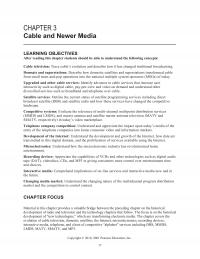
Media Studies Chapter 3 Cable And Newer Media Learning Objectives After Reading This Students
CHAPTER 3 Cable and Newer Media ____________________________________________________________ LEARNING OBJECTIVES After reading this chapter students should be able to understand the following concepts: Cable television: Trace cable’s evolution and describe how it has changed traditional broadcasting. Domsats and superstations: Describe how […]
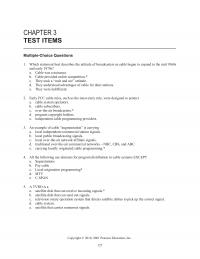
Media Studies Chapter 3 Which statement best describes the attitude of broadcasters as cable began to expand
CHAPTER 3 TEST ITEMS ______________________________________________________________________ Multiple-Choice Questions 1. Which statement best describes the attitude of broadcasters as cable began to expand in the mid 1960s and early 1970s? a. Cable was a nuisance. 2. Early FCC cable rules, such as […]
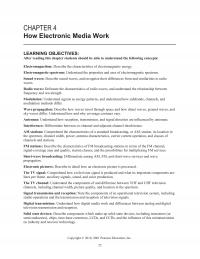
Media Studies Chapter 4 How Electronic Media Worklearning Objectives After Reading This Students Should
CHAPTER 4 How Electronic Media Work ____________________________________________________________ LEARNING OBJECTIVES: After reading this chapter students should be able to understand the following concepts: Electromagnetism: Describe the characteristics of electromagnetic energy. Electromagnetic spectrum: Understand the properties and uses of electromagnetic spectrum. Sound […]
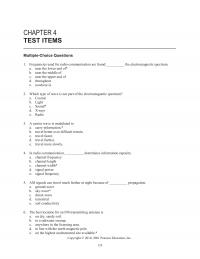
Media Studies Chapter 4 Which type of wave is not part of the electromagnetic spectrum
CHAPTER 4 TEST ITEMS ______________________________________________________________________ Multiple-Choice Questions 1. Frequencies used for radio communication are found __________ the electromagnetic spectrum. d. throughout e. nowhere in 2. Which type of wave is not part of the electromagnetic spectrum? a. Cosmic b. Light […]
Media Studies Chapter 5 Distribution Wired Relays Wireless Relays And Over The Internet Learning Objectives
CHAPTER 5 Distribution by Wired Relays, Wireless Relays, and over the Internet __________________________________________________________ LEARNING OBJECTIVES After reading this chapter students should be able to understand the following concepts: Role of storage: Understand why programmers and electronic media executives are concerned […]
Media Studies Chapter 5 will eventually replace most of the conventional copper telephone wires
CHAPTER 5 TEST ITEMS ______________________________________________________________________ Multiple-Choice Questions 1. __________ will eventually replace most of the conventional copper telephone wires. d. Microwaves e. Quadruplex 2. One advantage of fiber-optic cable is that a. its high capacity makes it perfect for handling […]
Media Studies Chapter 6 Commercial Operationslearning Objectives After Reading This Students Should Able Understand
CHAPTER 6 Commercial Operations ____________________________________________________________ LEARNING OBJECTIVES After reading this chapter students should be able to understand the following concepts: Commercial broadcast stations: Outline the organizational structure of commercial radio and television broadcast stations and understand the influence of group-ownership […]
Media Studies Chapter 6 Which of the following statements about commercial broadcast stations is false
CHAPTER 6 TEST ITEMS ______________________________________________________________________ Multiple-Choice Questions 1. Which of the following statements about commercial broadcast stations is false? a. They are licensed by the federal government to serve a specific community. 2. The head of a station’s technical functions […]
Media Studies Chapter 7 Noncommercial Services Learning Objectives After Reading This Students Should Able
CHAPTER 7 Noncommercial Services ____________________________________________________________ LEARNING OBJECTIVES After reading this chapter students should be able to understand the following concepts: Economics of public broadcasting: Describe the diverse ways public broadcasting receives funding. Programming and program sources: Outline program sources available […]
Media Studies Chapter 7 Which radio facilities are currently reserved to meet educational needs
CHAPTER 7 TEST ITEMS ____________________________________________________________________________ Multiple-Choice Questions 1. Which radio facilities are currently reserved to meet educational needs? a. Ten channels at the high end of the AM band. 2. The FCC first reserved channels for noncommercial stations a. in […]
Media Studies Chapter 8 In which daypart is stripping not a common practice for broadcast television networks
CHAPTER 8 TEST ITEMS ______________________________________________________________________ Multiple-Choice Questions 1. The strategy of __________ is used to choose programs that appeal to the subsets of the mass audience most likely to buy the advertisers’ products. a. parsimony principle b. shared use 2. […]
Media Studies Chapter 8 Programs And Programming Basics Learning Objectives After Reading This Students
CHAPTER 8 Programs and Programming Basics ____________________________________________________________ LEARNING OBJECTIVES After reading this chapter students should be able to understand the following concepts: Economic constraints: Understand ways commercial programmers find themselves constrained and how they cope with limitations. Scheduling practices: Comprehend […]
Media Studies Chapter 9 Audience Measurement Learning Objectives After Reading This Students Should Able
CHAPTER 9 Audience Measurement ________________________________________________________________________ LEARNING OBJECTIVES After reading this chapter students should be able to understand the following concepts: The ratings business: Understand how and why Arbitron, Nielsen, and their competitors collect and use data on audiences for local, […]
Media Studies Chapter 9 Ratings reports for syndicated television shows are provided by
CHAPTER 9 TEST ITEMS ______________________________________________________________________ Multiple-Choice Questions 1. Television ratings in all local markets take place 2. Ratings reports for syndicated television shows are provided by a. Nielsen.* b. Arbitron. c. RADAR. d. Gallup. e. SRI. 3. Data used in […]