Archives
978-0134292380 Chapter 1
1 TEST QUESTIONS – CHAPTER #1 Short Answer Questions 1. Define specific heat. Ans. The amount of energy required to raise the temperature of a substance by 1oC. 2. Define cavitation. Ans. Cavitation is rapid water vaporization that occurs in […]
978-0134292380 Chapter 10
93 TEST QUESTIONS & PROBLEMS – CHAPTER #10 Short Answer Questions 1. Define dimensional analysis. Ans. Assessment of the appropriate physical quantities and fundamental hydraulic relationships (both static and dynamic) involved in the performance of the structure. 2. (T or […]
978-0134292380 Chapter 11
TEST QUESTIONS & PROBLEMS – CHAPTER #11 Short Answer Questions 1. Identify the difference between hydrology and hydraulics. 2. (T or F) Hydraulics is a science dealing with the properties, distribution, and circulation of the earth’s water. Ans. False. This […]
978-0134292380 Chapter 12
122 TEST QUESTIONS & PROBLEMS – CHAPTER #12 Short Answer Questions 1. Identify two changes in a watershed that would affect the hydrologic homogeneity of a data set containing annual maximum stream flows. Ans. Hydrologic homogeneity would be affected by […]
978-0134292380 Chapter 2 Part 1
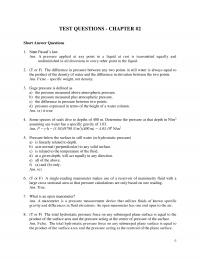
6 TEST QUESTIONS – CHAPTER #2 Short Answer Questions 1. State Pascal’s law. Ans. A pressure applied at any point in a liquid at rest is transmitted equally and undiminished in all directions to every other point in the liquid. […]
978-0134292380 Chapter 2 Part 2
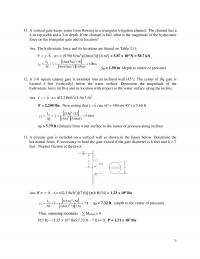
9 11. A vertical gate keeps water from flowing in a triangular irrigation channel. The channel has a 4-m top width and a 3-m depth. If the channel is full, what is the magnitude of the hydrostatic force on the […]
978-0134292380 Chapter 3
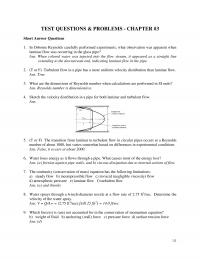
18 TEST QUESTIONS & PROBLEMS – CHAPTER #3 Short Answer Questions 1. In Osborne Reynolds carefully performed experiments, what observation was apparent when laminar flow was occurring in the glass pipe? Ans. When colored water was injected into the flow […]
978-0134292380 Chapter 4 Part 1
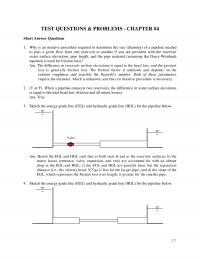
27 TEST QUESTIONS & PROBLEMS – CHAPTER #4 Short Answer Questions 1. Why is an iterative procedure required to determine the size (diameter) of a pipeline needed to pass a given flow from one reservoir to another if you are […]
978-0134292380 Chapter 4 Part 2
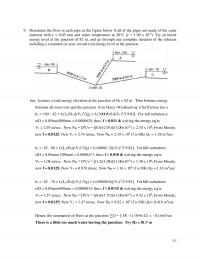
36 9. Determine the flow in each pipe in the figure below if all of the pipes are made of the same material with e = 0.05 mm and water temperature at 20°C (ν = 1.00 x 10⁻⁶). Try an […]
978-0134292380 Chapter 5 Part 1
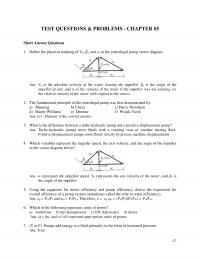
42 TEST QUESTIONS & PROBLEMS – CHAPTER #5 Short Answer Questions 1. Define the physical meaning of Vo, βo, and υo in the centrifugal pump vector diagram. Ans. Vo is the absolute velocity of the water leaving the impellor, βo […]
978-0134292380 Chapter 5 Part 2
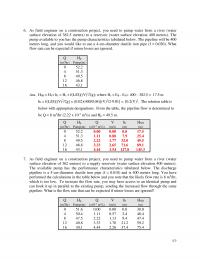
49 6. As field engineer on a construction project, you need to pump water from a river (water surface elevation of 382.5 meters) to a reservoir (water surface elevation 400 meters). The pump available to you has the pump characteristics […]
978-0134292380 Chapter 6 Part 1
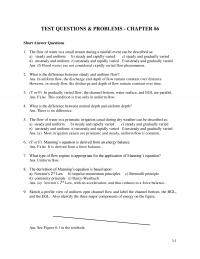
54 TEST QUESTIONS & PROBLEMS – CHAPTER #6 Short Answer Questions 1. The flow of water in a small stream during a rainfall event can be described as: a) steady and uniform b) steady and rapidly varied c) steady and […]
978-0134292380 Chapter 6 Part 2
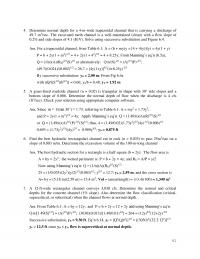
61 49.7 m3/sec. The excavated earth channel is a well-maintained (clean) with a flow slope of 0.2% and side slopes of 4:1 (H:V). Solve using successive substitution and Figure 6.4. Ans. For a trapezoidal channel, from Table 6.1: A = […]
978-0134292380 Chapter 7 Part 1
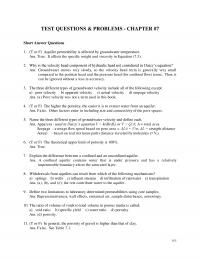
66 TEST QUESTIONS & PROBLEMS – CHAPTER #7 Short Answer Questions 1. (T or F) Aquifer permeability is affected by groundwater temperature. Ans. True. It affects the specific weight and viscosity in Equation (7.3). 2. Why is the velocity head […]
978-0134292380 Chapter 7 Part 2
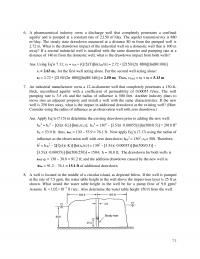
73 6. A pharmaceutical industry owns a discharge well that completely penetrates a confined aquifer and is pumped at a constant rate of 2,150 m3/day. The aquifer transmissivity is 880 m2/day. The steady state drawdown measured at a distance 80 […]
978-0134292380 Chapter 8
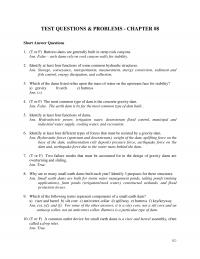
80 TEST QUESTIONS & PROBLEMS – CHAPTER #8 Short Answer Questions 1. (T or F) Buttress dams are generally built in steep rock canyons. Ans. False – arch dams rely on rock canyon walls for stability. 2. Identify at least […]
978-0134292380 Chapter 9
88 TEST QUESTIONS & PROBLEMS – CHAPTER #9 Short Answer Questions 1. Define liquid pressure. Ans. The normal force exerted by a liquid on a unit surface area. 2. Which of the following devices are used to measure liquid pressure? […]