Archives
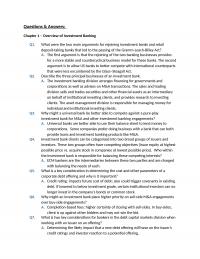
978-0128047231 Chapter Chapter 1 Overview of Investment Banking
Questions & Answers: Chapter 1 – Overview of Investment Banking Q1. What were the two main arguments for rejoining investment banks and retail deposit-taking banks that led to the passing of the Gramm-Leach-Bliley Act? A. The !rst argument is that […]

978-0128047231 Chapter Chapter 10 Investment Banking Careers Opportunities and Issues
Chapter 10 – Investment Banking Careers, Opportunities, and Issues Q1. What are core differences between Investment Banking and Sales & Trading career paths? A. IB typically involves longer working hours than Sales & Trading, but o en slightly Q2. Describe […]
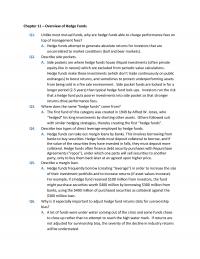
978-0128047231 Chapter Chapter 11 Overview of Hedge Funds
Chapter 11 – Overview of Hedge Funds Q1. Unlike most mutual funds, why are hedge funds able to charge performance fees on top of management fees? Q2. Describe side pockets. A. Side pockets are where hedge funds house illiquid investments […]
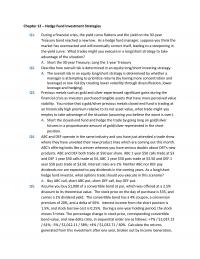
978-0128047231 Chapter Chapter 12 Hedge Fund Investment Strategies
Chapter 12 – Hedge Fund Investment Strategies Q1. During a financial crisis, the yield curve flattens and the yield on the 30-year Treasury bond reached a new low. As a hedge fund manager, suppose you think the market has overreacted […]
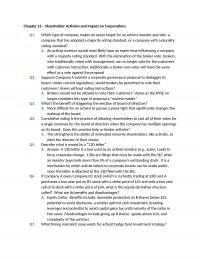
978-0128047231 Chapter Chapter 13 Shareholder Activism and Impact on Corporations
Chapter 13 – Shareholder Activism and Impact on Corporations Q1. Which type of company makes an easier target for an activist investor and why: a company that has adopted a majority voting standard, or a company with a plurality voting […]
978-0128047231 Chapter Chapter 14 Risk Regulation and Organizational Structure
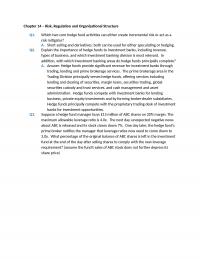
Chapter 14 – Risk, Regulation and Organizational Structure Q1. Which two core hedge fund activities can either create incremental risk or act as a risk mitigator? A. Short selling and derivatives: both can be used for either speculating or hedging. […]
978-0128047231 Chapter Chapter 15 Hedge Fund Issues and Performance
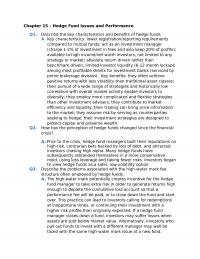
Chapter 15 – Hedge Fund Issues and Performance Q1. Describe the key characteristics and benefits of hedge funds A. Key characteristics: lower registration/reporting requirements compared to mutual funds; act as an investment manager Q2. How has the perception of hedge […]
978-0128047231 Chapter Chapter 16 Overview of Private Equity
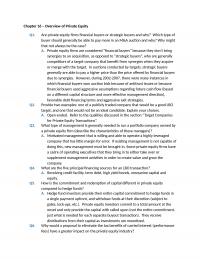
Chapter 16 – Overview of Private Equity Q1. Are private equity firms financial buyers or strategic buyers and why? Which type of buyer should generally be able to pay more in an M&A auction and why? Why might that not […]
978-0128047231 Chapter Chapter 17 LBO Financial Model
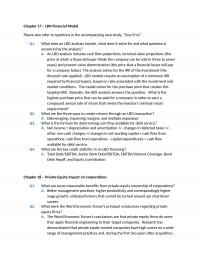
Chapter 17 – LBO Financial Model Please also refer to questions in the accompanying case study, “Toys R Us” Q1. What does an LBO analysis include, what does it solve for and what question is answered by the analysis? A. […]
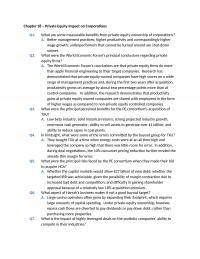
978-0128047231 Chapter Chapter 18 Private Equity Impact on Corporations
Chapter 18 – Private Equity Impact on Corporations Q1. What are some measurable benefits from private equity ownership of corporations? A. Better management practices; higher productivity and correspondingly higher Q2. What were the World Economic Forum’s principal conclusions regarding private […]
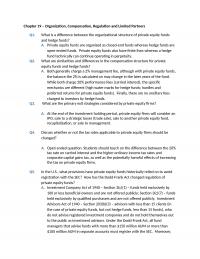
978-0128047231 Chapter Chapter 19 Organization Compensation Regulation and Limited Partners
Chapter 19 – Organization, Compensation, Regulation and Limited Partners Q1. What is a difference between the organizational structure of private equity funds and hedge funds? A. Private equity funds are organized as closed-end funds whereas hedge funds are Q2. What […]
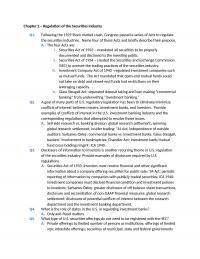
978-0128047231 Chapter Chapter 2 Regulation of the Securities Industry
Chapter 2 – Regulation of the Securities Industry Q1. Following the 1929 Stock market crash, Congress passed a series of Acts to regulate the securities industries. Name four of these Acts and brie!y describe their purpose. A. The four Acts […]
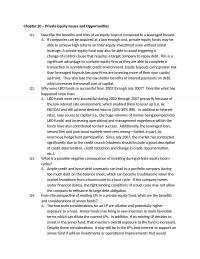
978-0128047231 Chapter Chapter 20 Private Equity Issues and Opportunities
Chapter 20 – Private Equity Issues and Opportunities Q1. Describe the benefits and risks of an equity buyout compared to a leveraged buyout. A. If companies can be acquired at a low enough cost, private equity funds may be able […]

978-0128047231 Chapter Chapter 3 Financings
Chapter 3 – Financings Q1. What type of securities offerings do not need to be registered with the SEC? A. 144A private placements to QIBs Q2. List the three types of bank participants in an underwriting syndicate and their core […]
978-0128047231 Chapter Chapter 4 M&A
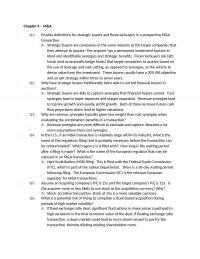
Chapter 4 – M&A Q1. Provide definitions for strategic buyers and financial buyers in a prospective M&A transaction. A. Strategic buyers are companies in the same industry as the target companies that they aempt to acquire. The acquirer has a […]
978-0128047231 Chapter Chapter 5 Trading
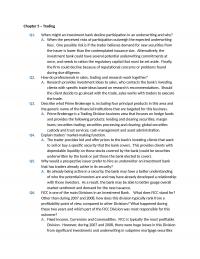
Chapter 5 – Trading Q1. When might an investment bank decline participation in an underwriting and why? A. When the perceived risks of participation outweigh the expected underwriting fees. One possible risk is if the trader believes demand for new […]
978-0128047231 Chapter Chapter 6 Asset Management Wealth Management and Research
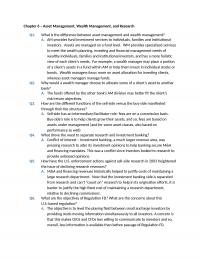
Chapter 6 – Asset Management, Wealth Management, and Research Q1. What is the difference between asset management and wealth management? A. AM provides fund investment services to individuals, families and institutional investors. Assets are managed on a fund level. WM […]
978-0128047231 Chapter Chapter 7 Credit Rating Agencies Exchanges and Clearing and Settlement
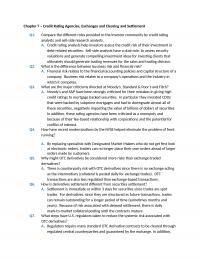
Chapter 7 – Credit Rating Agencies, Exchanges and Clearing and Selement Q1. Compare the different roles provided to the investor community by credit rating analysts and sell-side research analysts. A. Credit rating analysts help investors assess the credit risk of […]
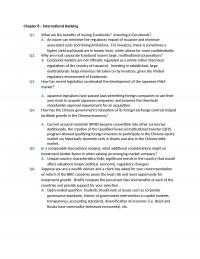
978-0128047231 Chapter Chapter 8 International Banking
Chapter 8 – International Banking Q1. What are the benefits of issuing Eurobonds? Investing in Eurobonds? A. An issuer can minimize the regulatory impact of issuance and minimize Q2. Why are most corporate Eurobond issuers large, multinational corporations? A. Eurobond […]
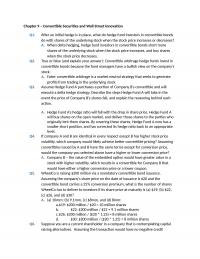
978-0128047231 Chapter Chapter 9 Convertible Securities and Wall Street Innovation
Chapter 9 – Convertible Securities and Wall Street Innovation Q1. Aer an initial hedge is in place, what do hedge fund investors in convertible bonds do with shares of the underlying stock when the stock price increases or decreases? A. […]
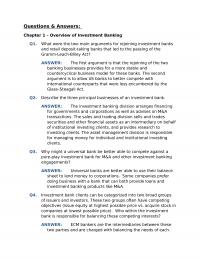
978-0128047231 Part 1
Questions & Answers: Chapter 1 – Overview of Investment Banking Q1. What were the two main arguments for rejoining investment banks and retail deposit-taking banks that led to the passing of the Gramm-Leach-Bliley Act? Q2. Describe the three principal businesses […]