Chapter 12 – Hedge Fund Investment Strategies
Q1. During a financial crisis, the yield curve flattens and the yield on the 30-year
Treasury bond reached a new low. As a hedge fund manager, suppose you think the
market has overreacted and will eventually correct itself, leading to a steepening in
the yield curve. What trades might you execute in a long/short strategy to take
advantage of the situation?
Q2. Describe how overall risk is determined in an equity long/short investing strategy.
A. The overall risk in an equity long/short strategy is determined by whether a
Q3. Precious metals such as gold and silver experienced significant gains during the
financial crisis as investors purchased tangible assets that have more perceived value
stability. You notice that a gold/silver precious metals closed end fund is trading at
an historically high premium relative to its net asset value, what trade might you
employ to take advantage of the situation (assuming you believe the worst is over).
A. Short the closed-end fund and hedge the trade by going long on gold/silver
Q4. ABC and DEF operate in the same industry and you have just attended a trade show
where they have unveiled their new product lines which are coming out this month.
ABC’s offering looks like a winner whereas you have serious doubts about DEF’s new
products. ABC and DEF both trade at $50 per share. ABC 1 year $50 calls trade at $3
and DEF 1 year $50 calls trade at $4. ABC 1 year $50 puts trade at $3.50 and DEF 1
year $50 puts trade at $3.50. Interest rates are 2%. Neither ABC nor DEF pay
dividends nor are expected to pay dividends in the coming years. As a long/short
hedge fund investor, what options trade should you execute in this scenario?
Q5. Assume you buy $1,000 of a convertible bond at par, which was offered at a 2.5%
discount to its theoretical value. The stock price on the day of purchase is $35, and
carries a 1% dividend yield. The convertible bond has a 4% coupon, a conversion
premium of 20%, and a delta of 56%. Interest income from the short position is
1.5%, and stock borrow cost is 0.25%. During a one-year holding period, the stock
moves 3 times. The percentage change in stock price, corresponding convertible
bond value, and new delta ratio, in sequential order are as follows: +7% / $1,037.12
/ 61%; -5% / $1,012.11 / 58%; +4% / $1,032.71 / 60%. Calculate the returns
generated from this investment after one year, broken out by Income Generation,
Monetizing Volatility, and Purchasing an Undervalued Convertible. Ignore
transaction costs for the purposes of this exercise.
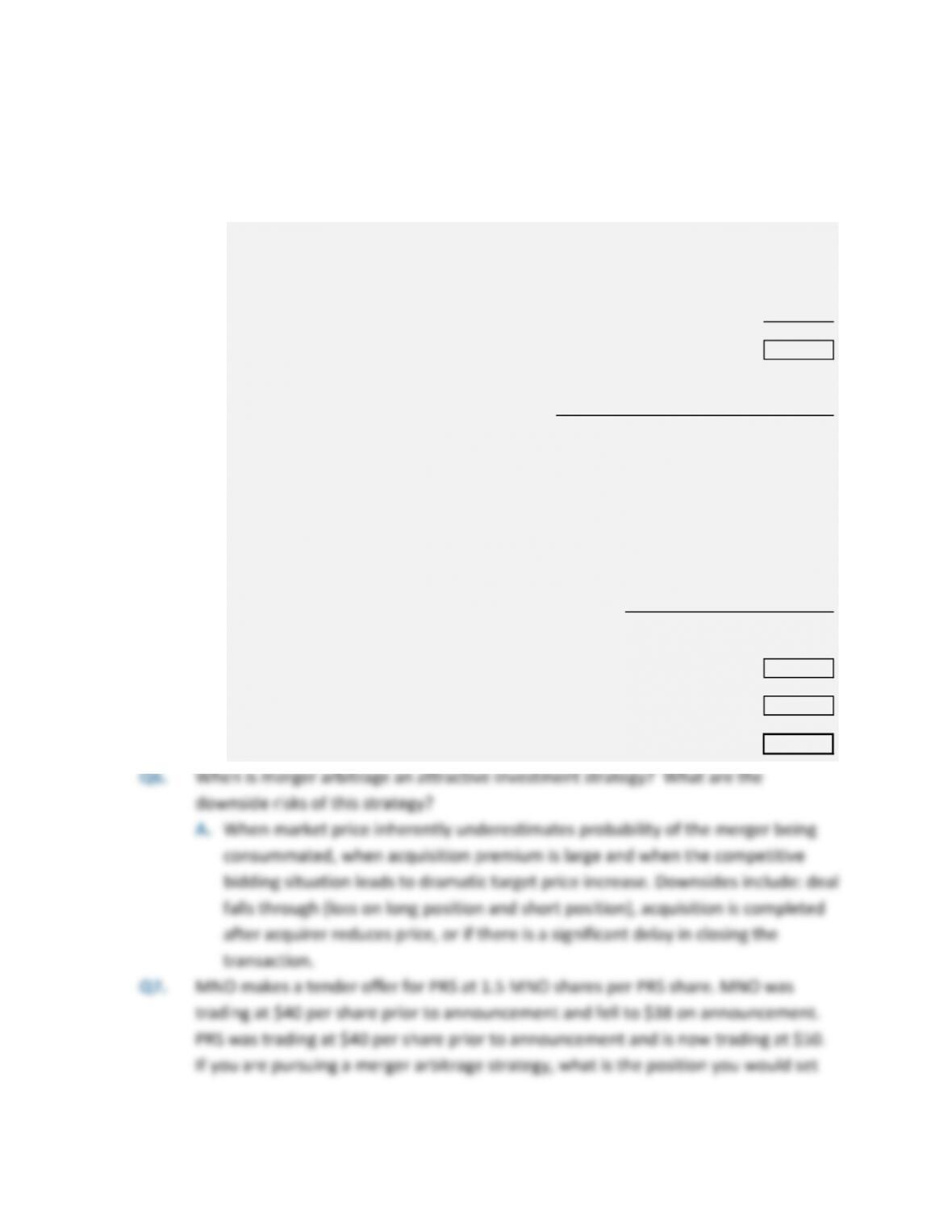
A.
Q6. When is merger arbitrage an attractive investment strategy? What are the
Income Generation
Spot 35.00$ Coupon 40.00$
Dividend Yield 1.0% Interest Income from Short 7.00$
Par 1,000.00$ Stock Dividend (4.67)$
Coupon 4.00% Borrow Cost (1.17)$
Conversion Premium 20% Total 41.17
Conversion Ratio 23.8095 Return 4.12%
Delta 56%
Interest Income 1.5% Monetizing Volatility
Cost of Borrow 0.25% t+0 t+1 t+2 t+3
Stock Price Change 7% -5% 4%
Initial Short Position 466.67$ Stock Price 35.00$ 37.45$ 35.58$ 37.00$
Delta 56% 61% 58% 60%
Convertible 1,000.00$ 1,037.12$ 1,012.11$ 1,032.71$
Begin. Short Val. 466.67$ 466.67$ 543.92$ 491.31$
Value +/– 32.67$ (27.20)$ 19.65$
Delta Hedge Adj. 44.58$ (25.41)$ 17.62$
Ending Short Val. 543.92$ 491.31$ 528.58$
Convert. Profit/(Loss) 37.12 -25.01 20.60
Short Profit/(Loss) (32.67) 27.20 (19.65)
Net Profit/(Loss) 4.45 2.19 0.95
Total Profit/(Loss) 7.59
Return 0.76%
Purchasing an Undervalued Convertible 2.50%
Total Return 7.38%
up to create potential investment value? What derivative transaction could you use
to mitigate your risk?
Q8. Calculate the expected return for the following cash merger arbitrage transaction:
Offer per Target share is $30.25. Target’s share price just prior to the
announcement is $20.00, and $28.50 immediately following the announcement.
The deal is expected to close with a 95% certainty. The deal is expected to close in
four months.
Q9. Describe scenarios whereby distressed / restructuring hedge fund strategies could
produce poor results.
A. The investment thesis for a distressed strategy is that the market is unable to
Q10. Generally speaking, in which two hedge fund strategies would you expect to see
more volatile returns?
Q11. Merger arbitrage is considered a market-neutral strategy. Under what conditions
would this no longer be the case?
A. During severe market downturns, the likelihood of a transaction closing
Q12. What are some ways to neutralize market risk in an equity long/short transaction?
A. Industry neutral – long/short securities are in the same industry to avoid impact