Chapter 15 – Hedge Fund Issues and Performance
Q1. Describe the key characteristics and benefits of hedge funds
A. Key characteristics: lower registration/reporting requirements
compared to mutual funds; act as an investment manager
Q2. How has the perception of hedge funds changed since the financial
crisis?
A. Prior to the crisis, hedge fund managers built their reputations on
high-risk, contrarian bets backed by lots of debt, and attracted
Q3. Describe the problems associated with the high-water mark fee
structure often employed by hedge funds.
A. The high-water mark potentially creates incentive for the hedge
fund manager to take extra risk in order to generate returns high
NA
V
Gain/
(Loss)
Perf.
Fee
Cumulati
ve
Loss
Account
1/1/20
06
1,000,0
00
12/31/20
06
13.90
%
1,139,0
00
139,0
00
27,8
00
0
1/1/20
07
1,111,2
00
12/31/20
07
12.60
%
1,251,2
11
140,0
11
28,0
02
0
1/1/20
08
1,223,2
09
12/31/20
08
–
19.10
%
989,5
76
(233,63
3)
0 (233,63
3)
1/1/20
09
989,5
76
12/31/20
09
23.61
%
1,223,2
09
233,6
33
46,7
27
0
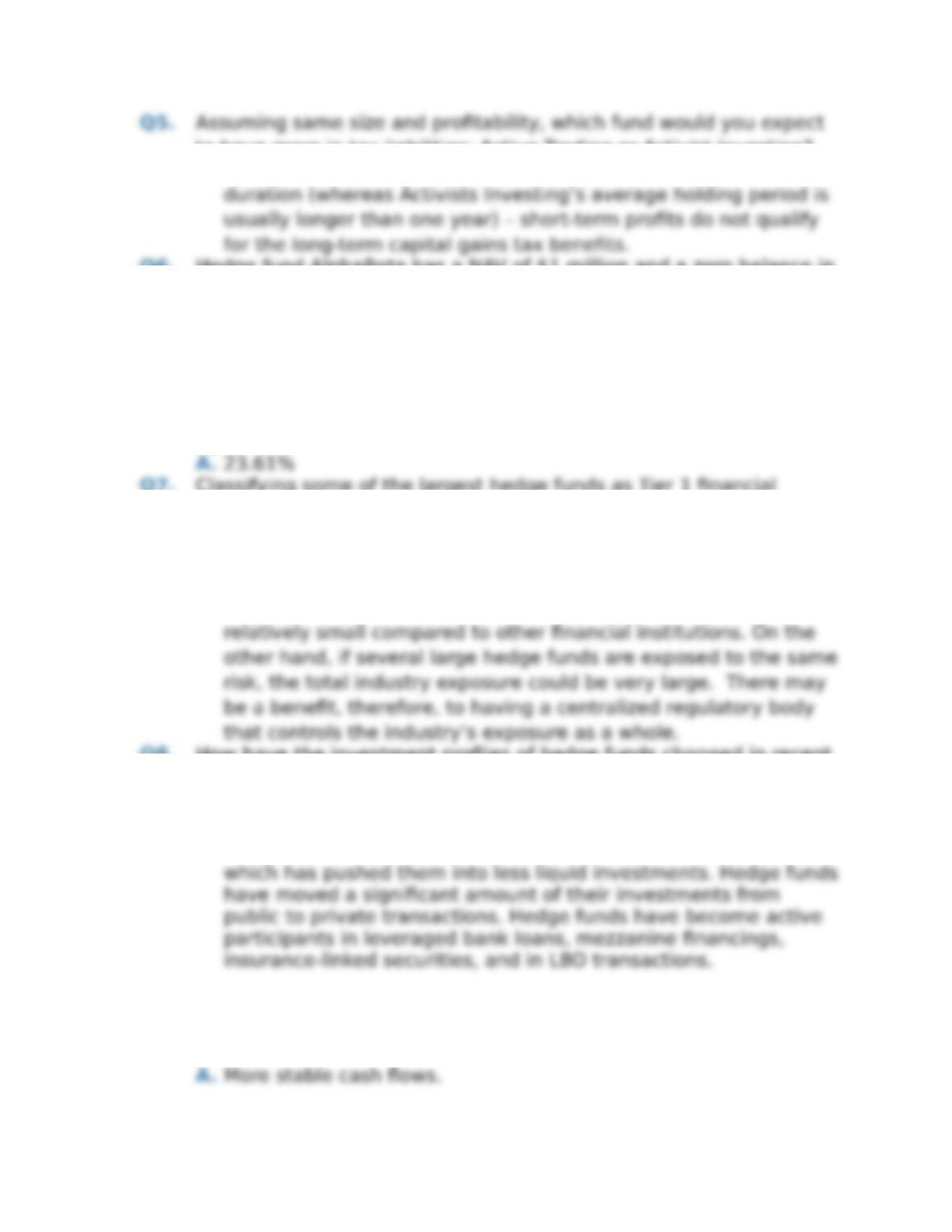
Q4. Assume an investor invests in a hedge funds that employs 25%
margin / 3.0x leverage. What happens to the investor’s money (%
change) if investments in the hedge fund’s portfolio drop 5% in
value?
to have more in tax liabilities: Active Trading or Activist Investing?
A. Active Trading’s trades are most likely less than one year in
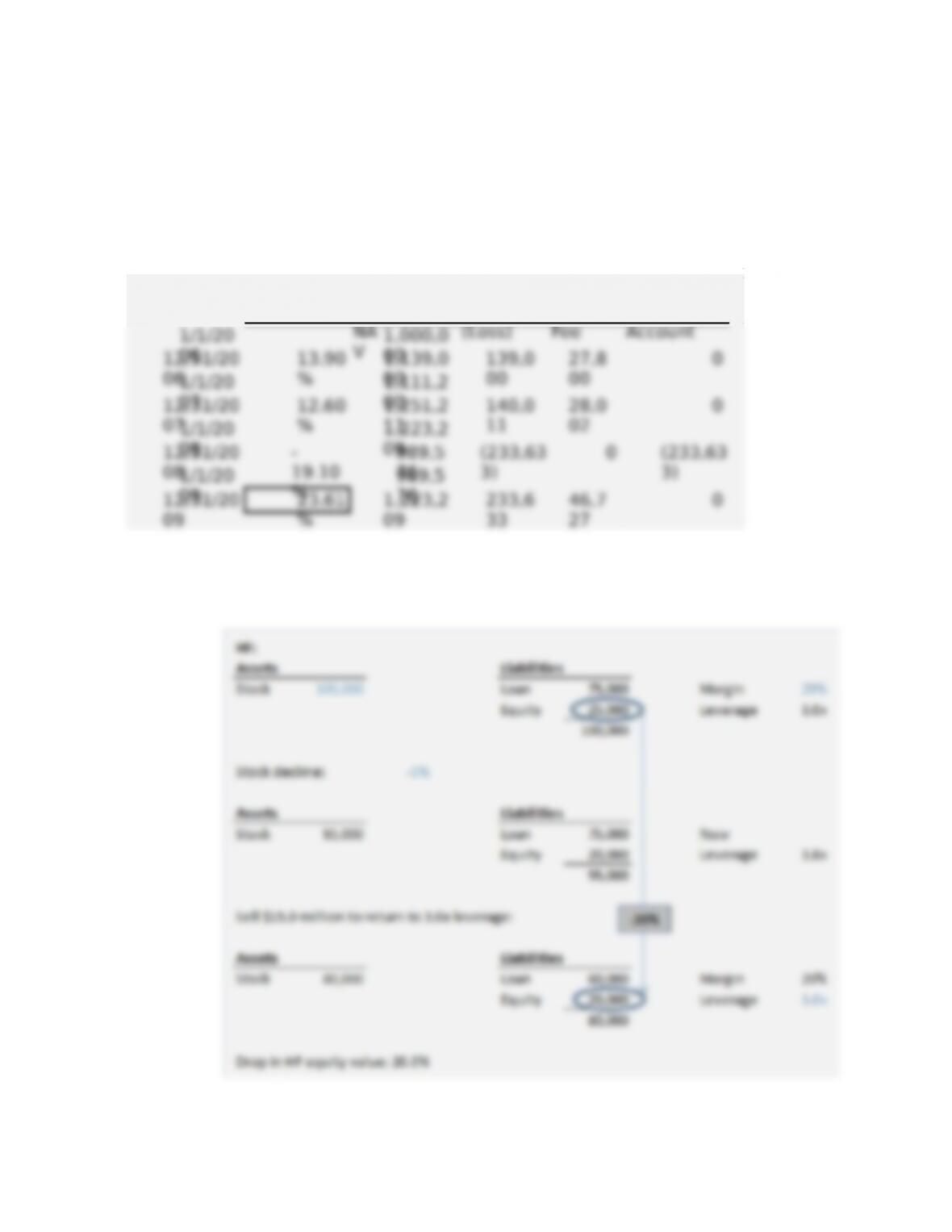
Q6. Hedge fund AlphaBeta has a NAV of $1 million and a zero balance in
its cumulative loss account on January 1, 2016. Now suppose
AlphaBeta’s annual performance (net of management fees) is +
13.9% in 2016, +12.6% in 2017, and -19.1% in 2018. AlphaBeta
charges a 20% performance fee. Based on the high water mark
reached in 2017, what minimum percentage gain the does the fund
need to achieve in 2019 before performance fees can be taken
again?
Q7. Classifying some of the largest hedge funds as Tier 1 financial
holding companies would subject these funds to requirements
regarding capital, liquidity, and risk management. The rationale for
this is that a large hedge fund, on its own, could pose systemic risk
to the financial system. Discuss the merits of this argument.
A. Open-ended discussion. The size of the largest hedge funds is
Q8. How have the investment profiles of hedge funds changed in recent
years as hedge funds have tried to differentiate themselves from
traditional fund managers?
A. Hedge funds have had to search for returns in new markets,
Q9. What is the benefit of a hedge fund like Citadel expanding into the
hedge fund services business such as market making and fund
administration?