Chapter 4 – M&A
Q1. Provide definitions for strategic buyers and financial buyers in a prospective M&A
transaction.
A. Strategic buyers are companies in the same industry as the target companies that
they aempt to acquire. The acquirer has a permanent investment horizon in
mind and identifiable synergies and strategic benefits. Financial buyers are LBO
Q2. Why have strategic buyers traditionally been able to out bid financial buyers in
auctions?
A. Strategic buyers are able to capture synergies that financial buyers cannot. Cost
synergies lead to lower expenses and margin expansion. Revenue synergies lead
Q3. Why are revenue synergies typically given less weight than cost synergies when
evaluating the combination benefits of a transaction?
A. Revenue synergies are more difficult to estimate and capture. Requires a lot
Q4. In the U.S., if an M&A transaction is relatively large within its industry, what is the
name of the regulatory filing that is probably necessary before the transaction can
be consummated? Which agency is it filed with? How long is the waiting period
a9er a filing is made? What is the name of the European regulator that may be
relevant in an M&A transaction?
A. Hart-Sco-Rodino (HSR) filing. This is filed with the Federal Trade Commission
(FTC), which is part of the Justice Department. There is a 30-day waiting period
Q5. Assume an acquiring company’s P/E is 15x and the target company’s P/E is 11x. Is
the acquirer more or less likely to use stock as the acquisition currency? Why?
A. Stock- accretive transaction. Stock at 15x is a more valuable currency.
Q6. What is a potential risk of trying to complete a stock-based acquisition during
periods of high market volatility?
A. If fixed exchange ratio deal, significant 5uctuations in share prices could lead to
high variations in the final economic value of the deal; if 5oating exchange ratio
Q7. Assume an investment bank has provided a fairness opinion on a proposed M&A
transaction. Does this mean the board should go ahead and approve the
transaction?
A. Maybe. The fairness opinion only states that the deal is “fair from a financial
Q8. Why might a board want to include a “go-shop” provision in the merger/purchase
agreement?
A. It helps protect the board against shareholder lawsuits relating to Revlon Duties.
Q9. When is a break-up fee paid? What is the normal fee as a percent of equity value?
A. A break-up fee is paid if an M&A transaction is not completed because a target
Q10. Under what circumstances would an investment bank hold a public auction in an
aempt to help sell a company?
A. When the company to be sold is unlikely to be damaged or disrupted by the
Q11. List the four principal alternative methods for establishing value in an M&A
transaction.
A. Discounted cash 5ow analysis; publicly-traded comparable company analysis;
Q12. Of the major valuation methods which one(s) are based on relative values? …on
intrinsic values? …on ability to pay?
A. Relative: comparable company/transaction; intrinsic: DCF; ability to pay: LBO
Q13. Suppose you are the sell-side advisor for a multinational household and personal
products manufacturer and marketer that sells primarily to the mass consumer
markets. The analyst on your deal team prepares the following comparable
companies analysis. Which, if any, of the companies in the list would you potentially
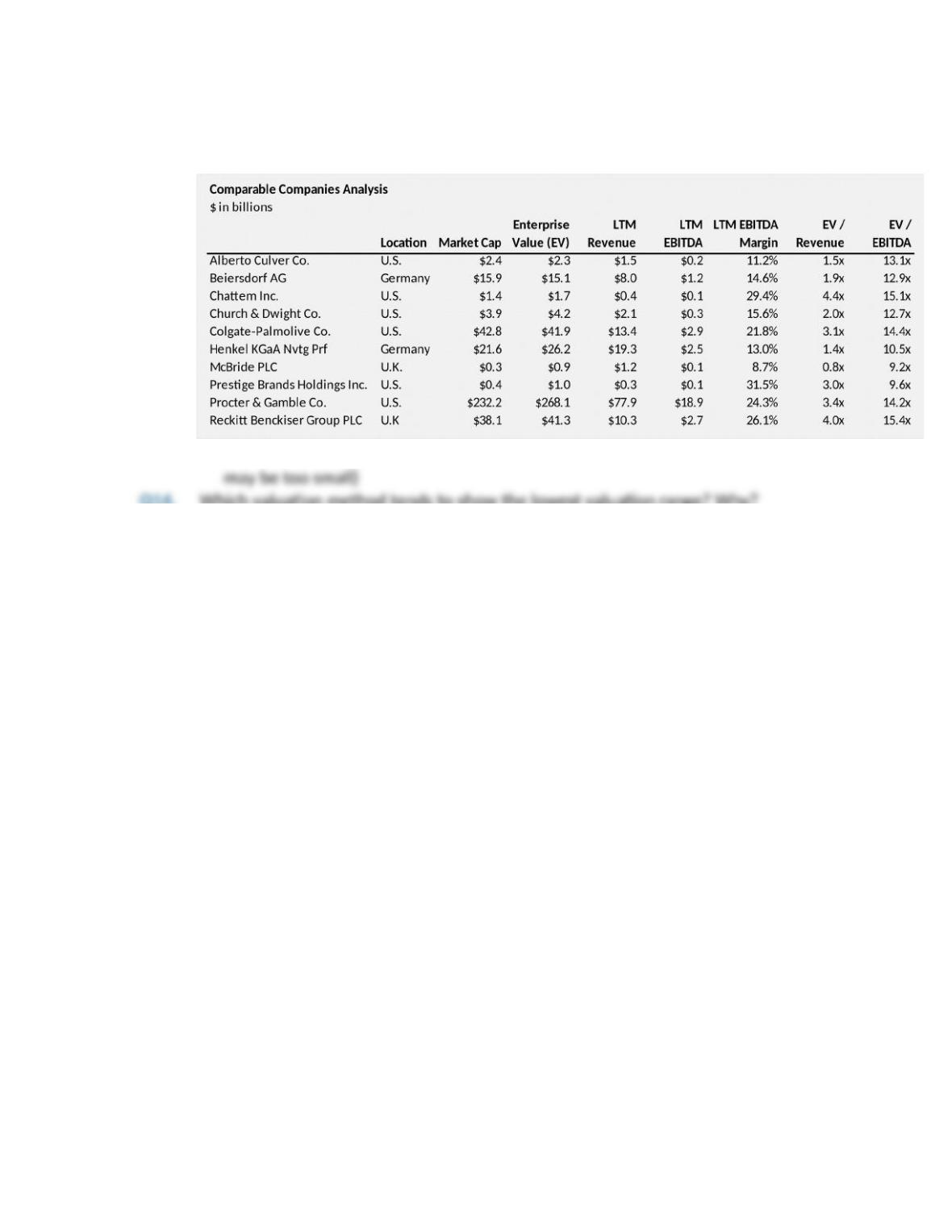
remove from the analysis?
A. P&G may be too big; Prestige may be too small; McBride only sells in Europe (and
Q14. Which valuation method tends to show the lowest valuation range? Why?
A. Comparable companies – no control premium. DCF w/no synergies can also be
low
Q15. Which of the following companies would make a beer LBO target, and why? (a) a
diversified manufacturer of consumer snack products or (b) a manufacturer of
factory automation equipment for car makers, agricultural equipment and other
heavy machinery.
A. (a) – more stable cash 5ows; lower capital expenditures.