Chapter 16 – Overview of Private Equity
Q1. Are private equity firms financial buyers or strategic buyers and why? Which type of
buyer should generally be able to pay more in an M&A auction and why? Why might
that not always be the case?
A. Private equity firms are considered “financial buyers” because they don’t bring
synergies to an acquisition, as opposed to “strategic buyers”, who are generally
competitors of a target company that benefit from synergies when they acquire
Q2. Provide two examples: one of a publicly traded company that would be a good LBO
target, and one that would not be an ideal candidate. Explain your choices.
A. Open-ended. Refer to the qualities discussed in the section “Target Companies
Q3. What type of management is generally needed to run a portfolio company owned by
a private equity firm (describe the characteristics of these managers)?
A. Motivated management that is willing and able to operate a highly leveraged
company that has li9le margin for error. If existing management is not capable of
Q4. What are the five principal financing sources for an LBO transaction?
A. Revolving credit facility, term debt, high yield bonds, mezzanine capital and
equity.
Q5. How is the commitment and redemption of capital di&erent in private equity
compared to hedge funds?
A. Hedge fund investors provide their entire capital commitment to hedge funds in
a single payment upfront, and withdraw funds at their discretion (subject to
Q6. Why would a proposal to eliminate the tax benefits of carried interest (performance
fees) have a greater impact on the private equity industry?
A. Nearly all investments are held for more than one year and qualify for long-term
Q7. Why are general partners typically only allowed to make investments in new
companies during the first five years of a fund’s life?
A. Need the remaining period to build/improve and then monetize the investment.
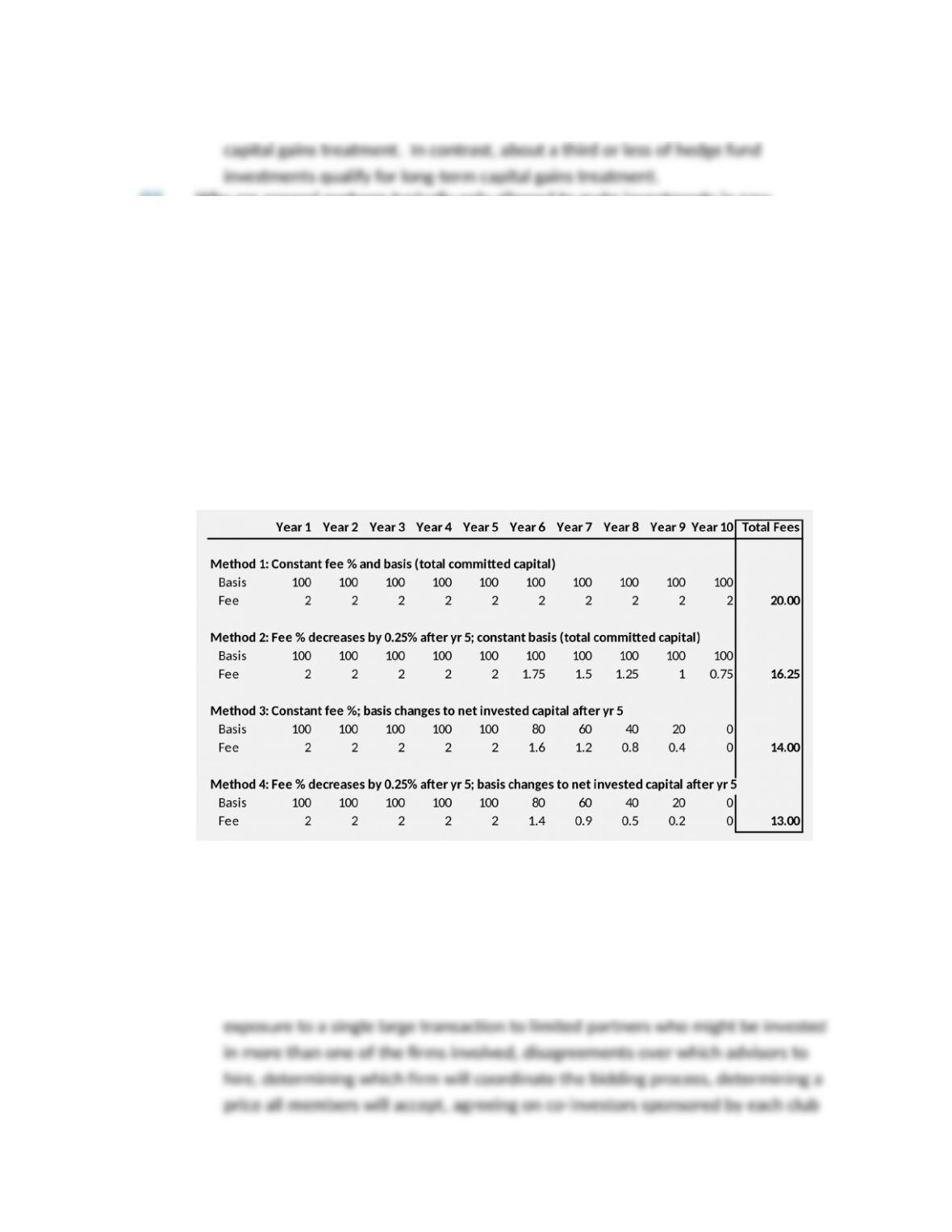
Q8. Suppose a private equity fund has $100 million in committed capital and its base rate
for management fees is 2%. The fund invested in 10 companies during the first 5
years and begins to exit its investments in year 6 at a pace of two exits per year until
the end of year 10, when all investments have been exited. Assume the original cost
basis for each investment is $10 million. Also assume fees calculated on net invested
capital is based on year-end balances. How much in lifetime management fees does
the firm earn, based on each of the four methods described in Exhibit 16.2?
A.
Q9. What type of concessions were private equity firms able to get from investment
banks during 2006 and the first half of 2007 that normally would not be possible?
A. Risky equity bridge loans; covenant-lite loans; PIK toggles.
Q10. Describe the benefits and challenges of club transactions.
A. Club transaction allow the firms involved to spread economic risk, share
expertise, pool relationships with financing sources, reduce the cost to each firm
and reduce competition in bidding wars. The challenges include increasing

Q11. When a private equity fund teams up with management for a potential buyout, why
would they want to avoid having early disclosure of the transaction?
A. News that the company is for sale may bring out competing bids, and may cause
Q12. Why do you think more companies don’t recapitalize their balance sheets by adding
more debt in order to replicate the returns achieved by private equity fund portfolio
companies? Do investment banks ever recommend a leveraged recapitalization of
public companies? Why or why not?
A. Most senior executives at companies are uncomfortable managing a highly
leveraged balance sheet. There is li9le room for error since a large portion of
free cash ,ow must be used to pay interest obligations from the loans. Also, they
Q13. Since private equity firms seek to minimize their equity contribution in a deal in
order to maximize returns, the amount of debt used to finance transactions should
(wishing away financial risk) be the maximum amount of leverage for the company
that debt providers will accept. Why then, are these companies allowed to take on
even more debt for leveraged recapitalizations?
A. During the time that has passed between the initial transaction and the
leveraged recapitalization, the portfolio company should have been able to grow