Archives: Solution Manual
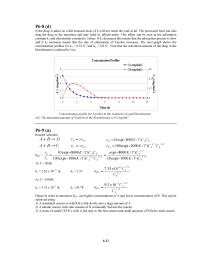
Chemical Engineering Chapter 6 Concentration profile for Tarzlon in the stomach
6-21 P6-8 (d) If the drug is taken on a full stomach most of it will not reach the wall at all. The processed food can also drag the drug to the intestines and may limit its effectiveness. This effect […]
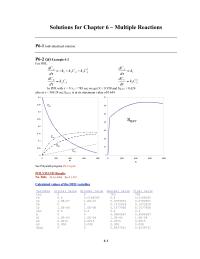
Chemical Engineering Chapter 6 Low conversions are achieved to reuse reactants
6-1 Solutions for Chapter 6 – Multiple Reactions P6-1 Individualized solution P6-2 (a) Example 6-2 For PFR, 0 0.05 0.1 0.15 0.2 0.25 0 200 400 600 800 ! CB CX CY 0 0.1 0.2 0.3 0.4 0 200 400 […]
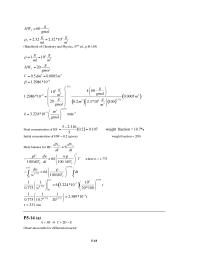
Chemical Engineering Chapter 5 While using polymath for solving the rate law apart
5-18 60 S g MW gmol = 6 3 2.32 2.32 *10 S g g ml m ! = = (Handbook of Chemistry and Physics, 57th ed., p.B-155) Final concentration of HF ( ) 5 2.316 0.2 0.107 weight fraction […]
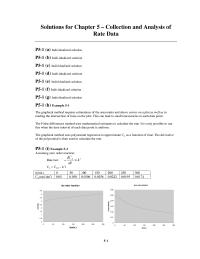
Chemical Engineering Chapter 5 The graphical method requires estimations of the area
The Finite differences method uses mathematical estimates to calculate the rate. It is only possible to use this when the time interval of each data point is uniform. The graphical method uses polynomial regression to approximate CA as a function […]
Chemical Engineering Chapter 4 For assumed turbulent flow, α is proportional to
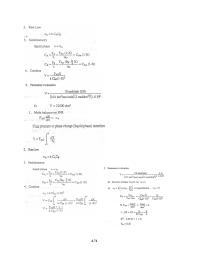
4-74 4-75 CDP4-I (a) CDP4-I (b) 4-76 CDP4-I (c) 4-77 CDP4-I (d) CDP4-I (e) 4-78 CDP4-J (a) b) We know, ε = 0, so 2/1 0)1( WPP ! “= => 2/1 )1(201 W ! “= Also, we know that α […]
Chemical Engineering Chapter 4 the concentration of A leaving the third reactor
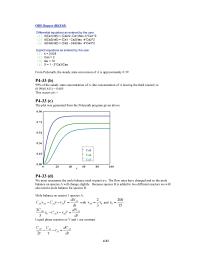
4-61 ODE Report (RKF45) Differential equations as entered by the user [1] d(Ca1)/d(t) = (Cao/2 -Ca1)/tau -k*Ca1^2 P4-33 (b) 99% of the steady state concentration of A (the concentration of A leaving the third reactor) is: (0.99)(0.611) = 0.605 This […]
Chemical Engineering Chapter 4 A cost analysis needs to be done to determine
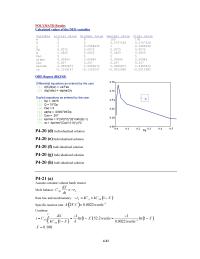
[1] Dp = .0075 [2] Q = 75*Dp [3] Fao = 5 [4] alpha = .0000708/Dp [5] Cao = .207 [6] kprime = 3*(3/Q^2)*(Q*coth(Q)-1) [7] ra = -kprime*(Cao*(1-X)*y)^2 P4-20 (f) Individualized solution P4-20 (g) Individualized solution P4-20 (h) Individualized solution […]
Chemical Engineering Chapter 4 which is not possible because conversion will not be
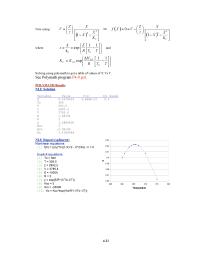
4-21 z 2902.2 V 3785.4 E 1.5E+04 R 2 y 1.5684405 Kco 3 Hrx -2.5E+04 Kc 1.4169064 [3] z = 2902.2 [4] V = 3785.4 [5] E = 15000 [6] R = 2 [7] y = exp(E/R*(1/To-1/T)) [8] Kco = […]
Chemical Engineering Chapter 4 Assume That Takes Three Hours Fill Empty
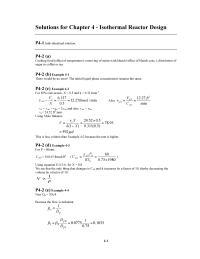
P4-2 (b) Example 4-1 There would be no error! The initial liquid phase concentration remains the same. FAO = 6.137 12.27 / min 0.5 C Flbmol X= = Also, 3 12.27 min AO AO AO Fft vC = = vo […]
Chemical Engineering Chapter 3 Satisfy thermodynamics relationships at equilibrium
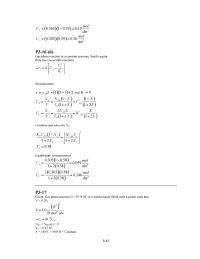
3-21 dm P3-16 (d) Gas phase reaction in a constant pressure, batch reactor Rate law (reversible reaction): 3 C A A C C r k C K ! “ #=# $ % & ‘ ( )( ) 01 3 1 […]
Chemical Engineering Chapter 3 There are two competing effects that bring about
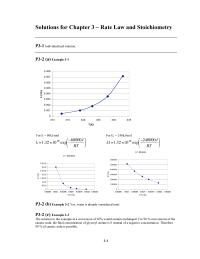
Solutions for Chapter 3 – Rate Law and Stoichiometry P3-1 Individualized solution. P3-2 (a) Example 3-1 0 0.001 0.002 0.003 0.004 0.005 310 315 320 325 330 335 T (K) k (1/s) 0.006 0.007 0.008 For E = 60kJ/mol For […]
Chemical Engineering Chapter 2 The smallest amount of catalyst necessary to achieve
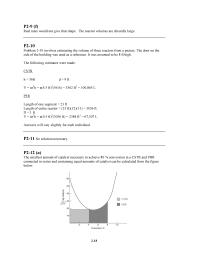
h = 56ft d = 9 ft V = πr2h = π(4.5 ft)2(56 ft) = 3562 ft3 = 100,865 L Length of entire reactor = (23 ft)(12)(11) = 3036 ft D = 1 ft V = πr2h = π(0.5 ft)2(3036 […]
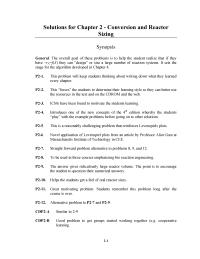
Chemical Engineering Chapter 2 The point is to encourage the student to question
P2-8. To be used in those courses emphasizing bio reaction engineering. P2-9. The answer gives ridiculously large reactor volume. The point is to encourage the student to question their numerical answers. P2-10. Helps the students get a feel of real […]
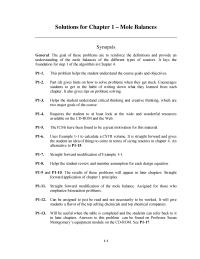
Chemical Engineering Chapter 1 It lays the foundation for step1 of the algorithm
P1-6. Uses Example 1-1 to calculate a CSTR volume. It is straight forward and gives the student an idea of things to come in terms of sizing reactors in chapter 4. An alternative to P1-15. P1-7. Straight forward modification of […]
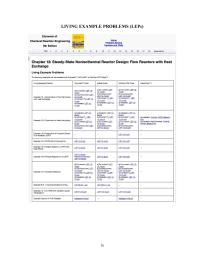
Chemical Engineering Example Problems The following examples can be accessed with Polymath
LIVING EXAMPLE PROBLEMS (LEPs)
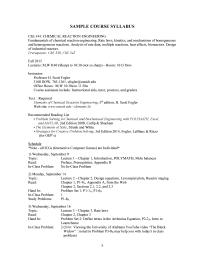
Chemical Engineering Sample Course Syllabus This topic is a major goal of this course
SAMPLE COURSE SYLLABUS Prerequisite: ChE 330, ChE 342 Elements of Chemical Reaction Engineering www.umich.edu/~elements/5e Hint: Problem Solving in Chemical and Biochemical Engineering with POLYMATH, Excel, and MATLAB The Elements of Style Strategies for Creative Problem Solving No Classes – Fall […]
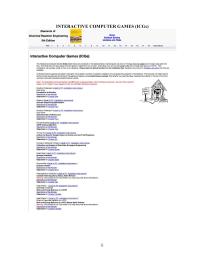
Chemical Engineering Computer Games the player will be asked a number of questions
INTERACTIVE COMPUTER GAMES (ICGs)
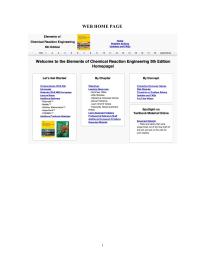
Chemical Engineering Web These are topics that were streamlined out of
WEB HOME PAGE
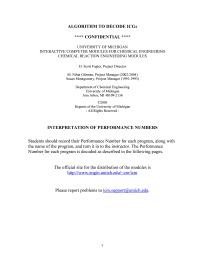
Chemical Engineering Decode random characters Format Interpretation Example
ALGORITHM TO DECODE ICGs **** CONFIDENTIAL **** INTERPRETATION OF PERFORMANCE NUMBERS ICMs with Windows® interface Module Format Interpretation Example KINETIC CHALLENGE I CzBzzAzz 7 2 6 MURDER MYSTERY zzAzz 7 TIC TAC TOE zDzCzBzA GREAT RACE zzzCzABz **** CONFIDENTIAL **** […]
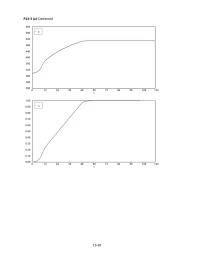
Chemical Engineering Chapter 13 then it may not be prudent to assume that the coolant
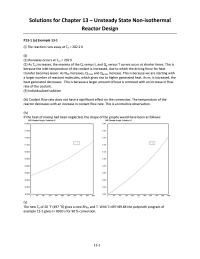
Chemical Engineering Chapter 13 Coolant flow rate does not have a significant
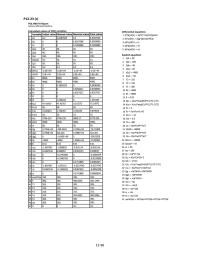
Chemical Engineering Chapter 12 Decreasing the heat of reaction of reaction 1 slightly
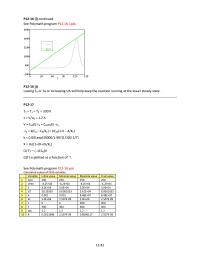
Chemical Engineering Chapter 12 considered constant in the reaction temperature
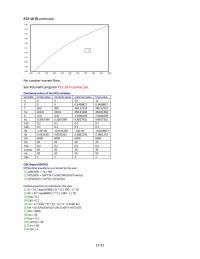
Chemical Engineering Chapter 12 Combine that with the mole balance and rate
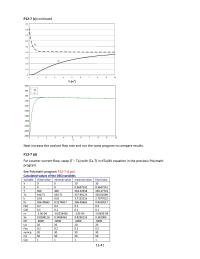
Chemical Engineering Chapter 12 We see that it is better to use a counter
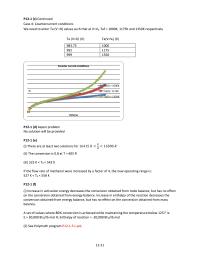
Chemical Engineering Chapter 12 Increase in activation energy decreases the conversion
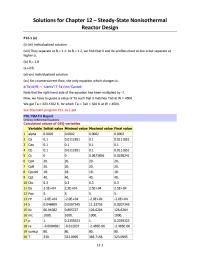
Chemical Engineering Chapter 12 Conversion increases with increase in heat of
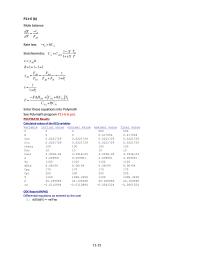
Chemical Engineering Chapter 11 adding inerts keeps the temperature low to
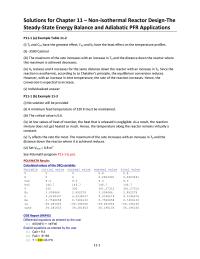
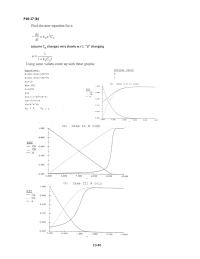
Chemical Engineering Chapter 11 the reaction mixture does not get heated
Chemical Engineering Chapter 10 a maximum in profit is reached and so we set
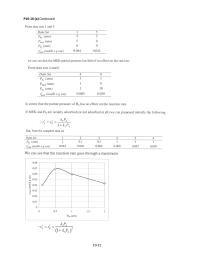
Chemical Engineering Chapter 10 we can see that the MEK partial pressure has
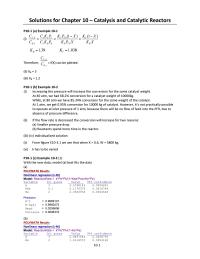
Chemical Engineering Chapter 10 If the flow rate is decreased the conversion
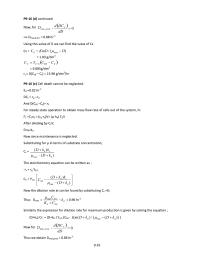
Chemical Engineering Chapter 9 Substituting for μ in terms of substrate concentration
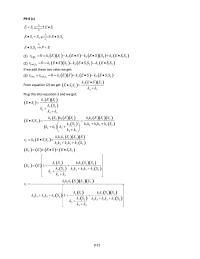
Chemical Engineering Chapter 9 the stability may be examined by estimating
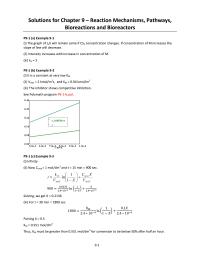
Chemical Engineering Chapter 9 The inhibitor shows competitive inhibition
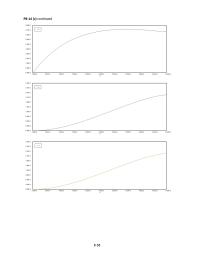
Chemical Engineering Chapter 8 The modification is made in the polymath code
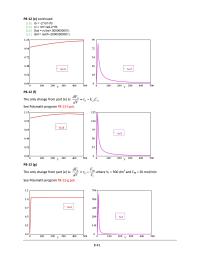
Chemical Engineering Chapter 8 Isothermal gas phase reaction in a membrane
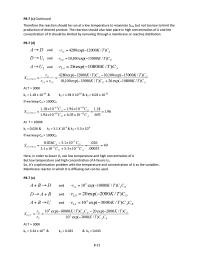
Chemical Engineering Chapter 8 Therefore the reaction should be run at a low
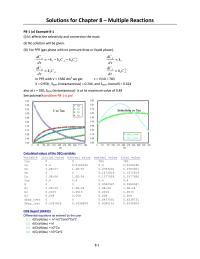
Chemical Engineering Chapter 8 when one product is volatile and the other is not
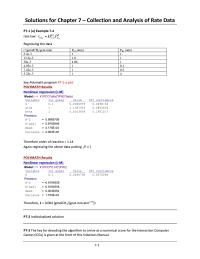
Chemical Engineering Chapter 7 First we fit a polynomial to the data
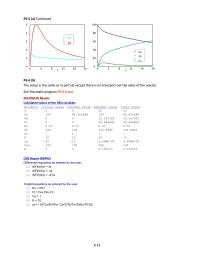
Chemical Engineering Chapter 6 Assuming catalyst distributed uniformly over the whole
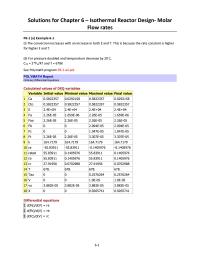
Chemical Engineering Chapter 6 For pressure doubled and temperature decrease
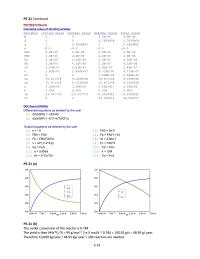
Chemical Engineering Chapter 5 A lower conversion is reached due to equilibrium.
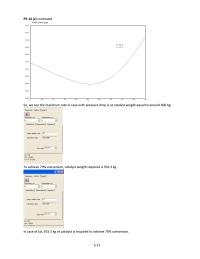
Chemical Engineering Chapter 5 an identical plug flow reactor connected in series
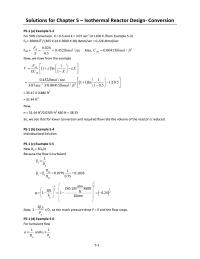
Chemical Engineering Chapter 5 Since the conversion down the reactor increases
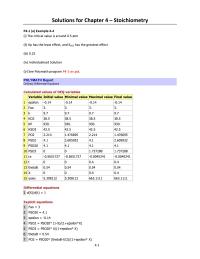
Chemical Engineering Chapter 4 The type of reactor does not change the expression
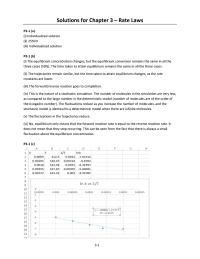
Chemical Engineering Chapter 3 This is the nature of a stochastic simulation
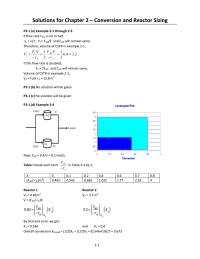
Chemical Engineering Chapter 2 The key for decoding the algorithm to arrive
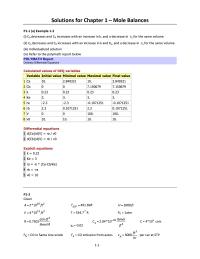
Chemical Engineering Chapter 1 Total number of lB moles gas in the system
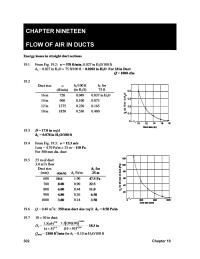
Chapter 19 Homework Possible sizes from Table 19.2 19.13
Chapter 19 302 CHAPTER NINETEEN FLOW OF AIR IN DUCTS FLOW OF AIR DUCTS 303 19. 8 3 10 in d u c t : 19.9 42 60 in duct: De = 0.625 0.250 1.30 (42)(60) (42 60) […]