Archives
978-1305638419 Chapter 1 Solutions Manual
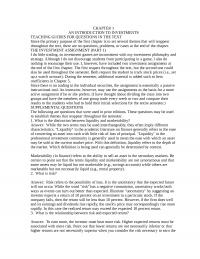
CHAPTER 1 AN INTRODUCTION TO INVESTMENTS TEACHING GUIDES FOR QUESTIONS IN THE TEXT Since the primary purpose of the first chapter is to set several themes that will reappear throughout the text, there are no questions, problems, or cases at […]
978-1305638419 Chapter 10 Solutions Manual
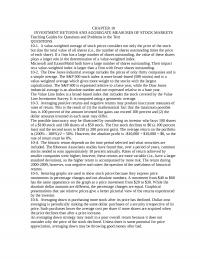
CHAPTER 10 INVESTMENT RETURNS AND AGGREGATE MEASURES OF STOCK MARKETS Teaching Guides for Questions and Problems in the Text QUESTIONS 10-1. A value-weighted average of stock prices considers not only the price of the stock but also the total value […]
978-1305638419 Chapter 11 Solutions Manual
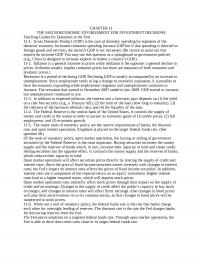
CHAPTER 11 THE MACROECONOMIC ENVIRONMENT FOR INVESTMENT DECISIONS Teaching Guides for Questions in the Text 11-1. Gross Domestic Product (GDP) is the sum of domestic spending by segments of the 11-2. Inflation is a general increase in prices while deflation […]
978-1305638419 Chapter 12 Solutions Manual
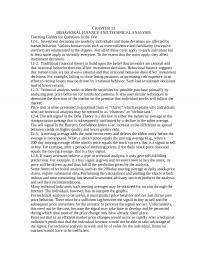
CHAPTER 12 BEHAVIORAL FINANCE AND TECHNICAL ANALYSIS Teaching Guides for Questions in the Text 12-1. Investment decisions are made by individuals and those decisions are affected by human behavior. Various human traits such as overconfidence and familiarity (excessive 12-2. Traditional […]
978-1305638419 Chapter 13 Solutions Manual
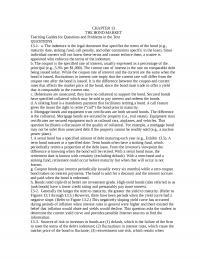
CHAPTER 13 THE BOND MARKET Teaching Guides for Questions and Problems in the Text QUESTIONS 13-1. a. The indenture is the legal document that specifies the terms of the bond (e.g., maturity date, sinking fund, call penalty, and other constraints […]
978-1305638419 Chapter 14 Solutions Manual Part 1
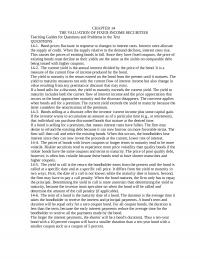
CHAPTER 14 THE VALUATION OF FIXED-INCOME SECURITIES Teaching Guides for Questions and Problems in the Text QUESTIONS 14-1. Bond prices fluctuate in response to changes in interest rates. Interest rates allocate the supply of credit. When the supply relative to […]
978-1305638419 Chapter 14 Solutions Manual Part 2
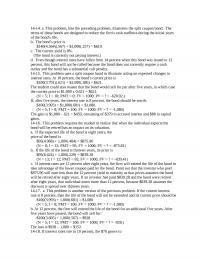
14-14. a. This problem, like the preceding problem, illustrates the split coupon bond. The terms of these bonds are designed to reduce the firm’s cash outflows during the initial years of the bond’s life. b. The bond’s price is c. […]
978-1305638419 Chapter 15 Solutions Manual Part 1
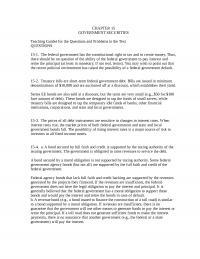
CHAPTER 15 GOVERNMENT SECURITIES Teaching Guides for the Questions and Problems in the Text QUESTIONS 15-1. The federal government has the constitutional right to tax and to create money. Thus, there should be no question of the ability of the […]
978-1305638419 Chapter 15 Solutions Manual Part 2
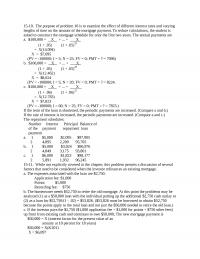
15-10. The purpose of problem 10 is to examine the effect of different interest rates and varying lengths of time on the amount of the mortgage payment. To reduce calculations, the student is asked to construct the mortgage schedule for […]
978-1305638419 Chapter 16 Solutions Manual
CHAPTER 16 CONVERTIBLE BONDS AND CONVERTIBLE PREFERRED STOCK Teaching Guides for Questions and Problems in the Text QUESTIONS 16-1. Convertible bonds may be exchanged at the holder’s option for a specified number of shares of the firm’s stock. Nonconvertible debt […]
978-1305638419 Chapter 17 Solutions Manual Part 1
CHAPTER 17 AN INTRODUCTION TO OPTIONS Teaching Guides for Questions and Problems in the Text QUESTIONS 1. An option is a right to do something. With regard to investing, an option is the right to buy (or to sell) stock […]
978-1305638419 Chapter 17 Solutions Manual Part 2
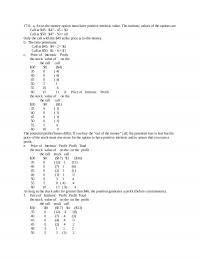
17-8. a. An in-the-money option must have positive intrinsic value. The intrinsic values of the options are Call at $45: $47 – 45 = $2 Call at $50: $47 – 50 = nil Only the call with the $45 strike […]
978-1305638419 Chapter 18 Solutions Manual Part 1
CHAPTER 18 OPTION VALUATION AND STRATEGIES Teaching Guides for Questions and Problems in the Text QUESTIONS 18-1. The Black/Scholes option valuation model specifies variables that affect the value of an option. As these variables change, so does the value of […]
978-1305638419 Chapter 18 Solutions Manual Part 2
18-13. a. This problem illustrates a bear spread designed to profit from a decline in the price of the stock. The investor purchases the option with the $20 strike price for $2 and sells the other option for $5. The […]
978-1305638419 Chapter 19 Solutions Manual
CHAPTER 19 COMMODITY AND FINANCIAL FUTURES Teaching Guides for the Questions and Problems in the Text QUESTIONS 19-1. A futures contract is an agreement for the purchase or sale of a commodity, financial asset, or currency at a specified time […]
978-1305638419 Chapter 2 Solutions Manual
CHAPTER 2 SECURITIES MARKETS Teaching Guides for Questions and Problems in the Text QUESTIONS 2-1. a. Listed securities are traded through a formal exchange such as the New York Stock Exchange. The securities of unlisted firms are traded over-the-counter market […]
978-1305638419 Chapter 20 Solutions Manual
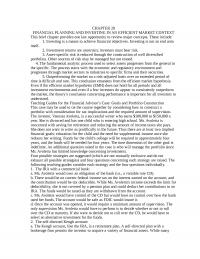
CHAPTER 20 FINANCIAL PLANNING AND INVESTING IN AN EFFICIENT MARKET CONTEXT This brief chapter provides one last opportunity to review major concepts. These include: 1. Investing is a means to achieve financial objectives. Investing is not an end unto itself. […]
978-1305638419 Chapter 3 Solutions Manual Part 1
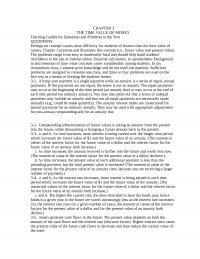
CHAPTER 3 THE TIME VALUE OF MONEY Teaching Guides for Questions and Problems in the Text QUESTIONS Perhaps no concept causes more difficulty for students of finance than the time value of money. Chapter 3 presents and illustrates this concept […]
978-1305638419 Chapter 3 Solutions Manual Part 2
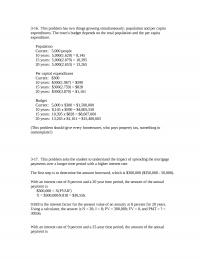
3-16. This problem has two things growing simultaneously: population and per capita expenditures. The town’s budget depends on the total population and the per capita expenditure. Population Per capital expenditures Current: $300 10 years: $300(1.967) = $590 15 years: $300(2.759) […]
978-1305638419 Chapter 4 Solutions Manual
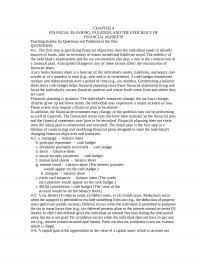
CHAPTER 4 FINANCIAL PLANNING, TAXATION, AND THE EFFICIENCY OF FINANCIAL MARKETS Teaching Guides for Questions and Problems in the Text QUESTIONS 4-1. The first step is specifying financial objectives; then the individual needs to identify sources of funds, take an […]
978-1305638419 Chapter 5 Solutions Manual
CHAPTER 5 RISK AND PORTFOLIO MANAGEMENT Teaching Guides for Questions and Problems in the Text QUESTIONS 5-1. Nondiversifiable risk (also referred to as systematic risk) is the risk that is not reduced through the construction of diversified portfolios. This risk […]
978-1305638419 Chapter 6 Solutions Manual
CHAPTER 6 INVESTMENT COMPANIES: MUTUAL FUNDS Teaching Guides for Questions and Problems in the Text QUESTIONS 6-1. Investment companies, which include mutual funds, receive special tax treatment provided they distribute the income they receive and capital gains they realize. Mutual […]
978-1305638419 Chapter 7 Solutions Manual
CHAPTER 7 CLOSED-END INVESTMENT COMPANIES, REAL ESTATE INVESTMENT TRUSTS (REITs), AND EXCHANGED-TRADED FUNDS (ETFs) Teaching Guides for Questions and Problems in the Text QUESTIONS 7-1. The difference between closed-end and open-end investment companies (mutual 7-2. Investors acquire shares of mutual […]
978-1305638419 Chapter 8 Solutions Manual
CHAPTER 8 STOCK Teaching Guides for Questions and Problems in the Text QUESTIONS 8-1. If an investor buys IBM stock, the maximum amount that can be lost is limited to the amount invested. If IBM were to fail and declare […]
978-1305638419 Chapter 9 Solutions Manual
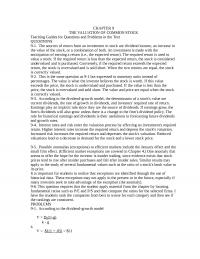
CHAPTER 9 THE VALUATION OF COMMON STOCK Teaching Guides for Questions and Problems in the Text QUESTIONS 9-1. The sources of return from an investment in stock are dividend income, an increase in the value of the stock, or a […]
Finance Chapter 01 Which The Following Investment Defined Economist Equipment
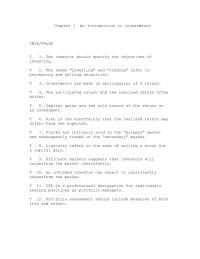
Chapter 1 An Introduction to Investments TRUE/FALSE investing. T 2. The terms “investing” and “trading” refer to purchasing and selling securities. T 3. Investments are made in anticipation of a return. T 4. The anticipated return and the realized return […]
Finance Chapter 02 American Depository Receipts Represent American Stocks Traded
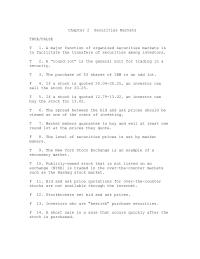
Chapter 2 Securities Markets TRUE/FALSE to facilitate the transfers of securities among investors. T 2. A “round lot” is the general unit for trading in a security. T 3. The purchase of 53 shares of IBM is an odd lot. […]
Finance Chapter 03 What The Implied Annual Return Yield This
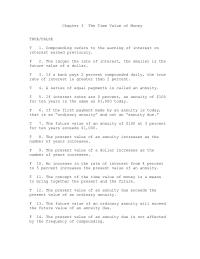
Chapter 3 The Time Value of Money TRUE/FALSE interest earned previously. F 2. The larger the rate of interest, the smaller is the future value of a dollar. T 3. If a bank pays 2 percent compounded daily, the true […]
Finance Chapter 04 The Weak Form The Efficient Market Hypothesis
Chapter 4 Financial Planning, Taxation, and the Efficiency of Financial Markets TRUE/FALSE establish the goals and objectives of the portfolio. F 2. An income statement enumerates of an individual’s receipts and disbursements. T 3. An individual’s net worth is determined […]
Finance Chapter 05 Investors Who Want Bear Less Risk Should
Chapter 5 Risk and Portfolio Management TRUE/FALSE together is one source of systematic risk. F 2. Systematic risk is reduced through diversification. T 3. A portfolio consisting of securities whose returns are highly correlated is not truly diversified. F 4. […]
Finance Chapter 06 The Net Asset Value Mutual Fund Increases
Chapter 6 Investment Companies: Mutual Funds TRUE/FALSE depends on the difference between the fund’s assets and liabilities and the number of shares outstanding. T 3. If an investment company were liquidated, the investor should receive the net asset value. F […]
Finance Chapter 07 Federal Reserve Open Select Number Individual Investors
Chapter 7 Closed–end Investment Companies, Real Estate Investment Trusts (REITs), and Exchange–Traded Funds (ETFs) TRUE/FALSE fund.” T 2. The per share net asset value of the shares in a closed–end investment company depends on the difference between the fund’s assets […]
Finance Chapter 08 Managements are often reluctant to reduce dividends
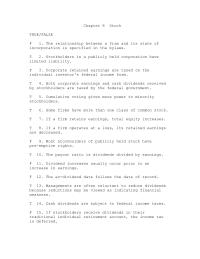
Chapter 8 Stock TRUE/FALSE incorporation is specified in the bylaws. T 2. Stockholders in a publicly held corporation have limited liability. F 3. Corporate retained earnings are taxed on the individual investor’s federal income form. T 4. Both corporate earnings […]
Finance Chapter 08 Payments Longterm Debt Dividends Repurchase Stock Sale
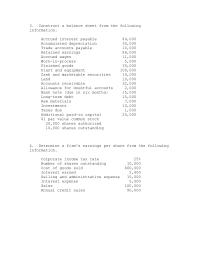
3. Construct a balance sheet from the following information. Accrued interest payable $4,000 Accumulated depreciation 30,000 Trade accounts payable 10,000 Retained earnings 86,000 Accrued wages 11,000 Work-in-process 5,000 Finished goods 30,000 Plant and equipment 100,000 Cash and marketable securities 10,000 […]
Finance Chapter 09 You Have Analyzed Three Risky Firms And
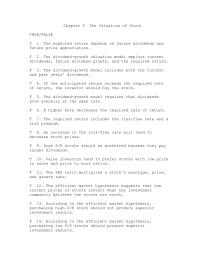
Chapter 9 The Valuation of Stock TRUE/FALSE future price appreciation. T 2. The dividend-growth valuation model employs current dividends, future dividend growth, and the required return. F 3. The dividend–growth model includes both the current and past years’ dividends. T […]
Finance Chapter 10 The rate of return on a stock considers the price
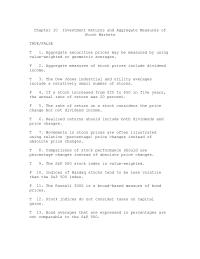
Chapter 10 Investment Returns and Aggregate Measures of Stock Markets TRUE/FALSE value–weighted or geometric averages. F 2. Aggregate measures of stock prices include dividend income. T 3. The Dow Jones industrial and utility averages include a relatively small number of […]
Finance Chapter 11 Monetary Policy Affects Securities Prices Affecting Investors
Chapter 11 The Macroeconomic Environment for Investment Decisions TRUE/FALSE that can be forecasted with accuracy. T 2. The Federal Reserve is the central bank of the United States. F 3. A recession is a period of rising employment. F 4. […]
Finance Chapter 12 Multiple Choice Behavioral Finance Suggests That Investors
Chapter 12 Behavioral Finance and Technical Analysis TRUE/FALSE produces higher returns. T 2. According to behavioral finance, investors often select investment data that confirms a preconceived position. T 3. Behavior financial suggests that investors may fail to sell losing positions […]
Finance Chapter 13 When Investor Purchases Bond She Pays Accrued
Chapter 13 The Bond Market TRUE/FALSE equal if a bond sells for its par value. F 3. Since bonds are legal obligations, there is little risk associated with purchasing these securities. T 4. The indenture specifies the terms of a […]
Finance Chapter 14 Inc Preferred Stock 100 Par Inc Preferred
Chapter 14 The Valuation of Fixed Income Securities TRUE/FALSE principal, when it matures, and the interest it pays. F 3. As interest rates increase, the prices of existing bonds increase. T 4. Most bonds pay interest semi–annually. T 5. The […]
Finance Chapter 15 Government Securities True false Federal Government Debt
Chapter 15 Government Securities TRUE/FALSE default risk because the government has the power to tax and to create money. F 2. The federal government only issues marketable securities such as treasury bills. T 3. Series EE bonds were initially designed […]
Finance Chapter 16 Problems Given The Information Below Answer The
Chapter 16 Convertible Bonds and Convertible Preferred Stock TRUE/FALSE option into common stock. F 2. Generally, convertible bonds lack a call provision. T 3. Convertible bonds are often subordinated to the firm‘s other debt. F 4. If the value of […]
Finance Chapter 17 The Intrinsic Value The Call The
Chapter 17 An Introduction to Options TRUE/FALSE call option) is the difference between the price of the stock and the per share exercise price of the option. F 2. The price of an option is generally less than the option‘s […]
Finance Chapter 18 What The Range Stock Prices That Generates
Chapter 18 Option Valuation and Strategies TRUE/FALSE model, the value of a call option rises as it approaches expiration. T 2. According to the Black/Scholes option valuation model, the value of a call option rises as interest rates increase. F […]
Finance Chapter 19 Futures Contracts Offer The Advantage Potential Leverage
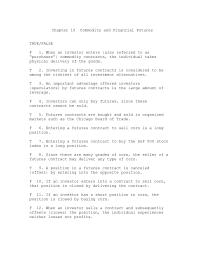
Chapter 19 Commodity and Financial Futures TRUE/FALSE “purchases”) commodity contracts, the individual takes physical delivery of the goods. T 2. Investing in futures contracts is considered to be among the riskiest of all investment alternatives. T 3. An important advantage […]
Finance Chapter 20 Portfolio Risk Encompasses Firms Financing Decisions Interest
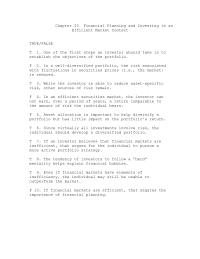
Chapter 20 Financial Planning and Investing in an Efficient Market Context TRUE/FALSE establish the objectives of the portfolio. F 2. In a well–diversified portfolio, the risk associated with fluctuations in securities prices (i.e., the market) is reduced. T 3. While […]