Archives
Chapter 1 Not True Parents Roles Collaborative Members Their
40. The shift away from the medical model of defining exceptionality is the result of a. increasing recognition of the influence of the environment. b. increasing use of technology. c. increasing emphasis on parent advocacy. d. increasing concern regarding cultural […]
Chapter 1 Understanding 20 The Part The Information Processing Model
1. Legally recognized categories of exceptionality are defined by a. the Individuals with Disabilities Education Improvement Act (IDEA). b. the laws of individual states. c. No Child Left Behind (NCLB). d. the Council for Exceptional Children (CEC). 2. Which of […]
Chapter 10 Not Common Characteristic Gifted Underachievers Feelings Inferiority
1. The report Rising Above the Gathering Storm found that a. the US graduated more engineers than other countries. b. the US 12th graders performed above average for 21 countries on a test in science and math. c. the US […]
Chapter 11 Academic Communication And Social Development Children With hearing
1. The use of both oral and manual forms of communication is known as the approach. 2. is the primary language for many Americans who are deaf or hard of hearing. ANSWER: American Sign Language (ASL) POINTS: 1 REFERENCES: History […]
Chapter 12 What is the definition of “visual impairment” and how is it identified?
1. The first formal efforts to educate blind students were in general public school classrooms. a. True b. False 2. The system of raised dots used by many blind and visually impaired individuals to read was invented by a. Helen […]
Chapter 13 The Identification Children With Physical Disabilities
1. The movement served as a model for the American disabilities rights movement. 2. The first major legislative act for individuals with physical disabilities was passed in a. 1917. b. 1954. c. 1975. d. 1990. ANSWER: a POINTS: 1 REFERENCES: […]
Chapter 2 Idea 2004 recognizes The Individual Needs Students And
1. The idea of educating every child to achieve his or her greatest potential is a relatively recent one. a. True b. False 2. Which of the following was NOT a cause leading to federal intervention in the education of […]
Chapter 2 Many Students That Are Having Difficulty Learning
33. Instruction can be adapted to meet interindividual or intraindividual differences by making modifications to a. curriculum content, consensus, and adjustment services. b. curriculum content, teaching strategies, and the learning environment. c. the learning environment, adjustment services, and life skills. […]
Chapter 3 Developmental Delays learning Objectives
1. Prior to the 1930s, support for children with severe disabilities was a. integrated with the regular preschool programs. b. provided in parents‘ homes. c. largely medical in nature and provided on an outpatient basis. d. provided in large, state-run […]
Chapter 4 What Are Some Characteristics Children
1. Although original work was with children with intellectual and developmental disabilities, it is now widely applied to the teaching of young typically developing children. a. Itard’s b. Sequin’s c. Montessori’s d. Kirk’s 2. The term “mental retardation” has been […]
Chapter 5 How do we define ASD?
1. The first person to describe a group of children in 1943 who did not relate to others, had difficulties in speech development, engaged in repetitive behaviors, and were upset by changes was a. Michael Rutter. b. Leo Kanner. c. […]
Chapter 6 Dyslexia is a problem in the area of
1. The category “learning disabilities” was originally conceived of as a heterogeneous group of students who shared in common learning problems stemming from . 2. Students identified as having a learning disability who do not have a clear neurological basis […]
Chapter 7 How is ADHD related to other areas of disabilities
1. Individuals with ADHD may suffer from , the inability to attend and focus, and/or , problems with impulsivity and self-regulation. 2. was coined in the early 20th century to describe children with a cluster of symptoms including hyperactivity and […]
Chapter 8 Self evaluation Asks The Student Compare His Her
1. Which of the following best describes the treatment of children with EBD in the post-WWII era? a. Responsibility for intervention shifted from the medical community to the education community. b. Many children with EBD were institutionalized as that was […]
Chapter 9 Characteristics of Students and Definitions of Communication
1. The ability of the brain to compensate for and reorganize functions following a brain injury is known as _____________. 2. The field of speech disorders has evolved over the years from a focus only on encompassing ________________. to a […]
EDU 30245
A multi-tiered approach that supports the RtI framework is a. the Behavioral Assessment Model. b. the Early Childhood Model. c. the Information Processing Model. d. the Pyramid Model. Dyslexia is a problem in the area of a. social skills. b. […]
EDUC 21261
An ASD condition that resembles autism but is a progressive neurological disorder is a. Turner’s syndrome. b. Rhett syndrome. c. Angelman syndrome. d. Kanner’s syndrome. Which of the following is an example of the RTI Tier II intervention? a. Collaboration […]
EDUK 17056
The commitment to high standards in the educational reform movement (such as those promoted by NCLB and CCSS) a. will help students with intellectual and developmental disabilities perform better in school by providing greater supports and sevices. b. is problematic […]
EDUK 24286
Cognitive development of children with visual impairments a. is no different than the normal development. b. is enhanced because they can only rely on their hearing. c. is affected by their lack of integrating experience. d. is higher than children […]
EDUK 83653
Which of the following is a possible negative result of medication for behavior disorders? a. Reducing the student’s own sense of self-control b. Increasing the student’s need for independence c. Reducing the student’s own sense of self-importance d. There are […]
EDUK 83907
A form of cerebral palsy that affect the abnormal voluntary movement involving balance a. ataxic. b. mixed. c. dyskinetic. d. myclonic. In the U.S., early definitions of giftedness were related to a. performance on achievement tests. b. performance in the […]
SED AP 58916
During the preschool years, the emphasis of educational programming should be to help the children attain a. a functional communication system and basic social skills. b. beginning reading skills to maximize their success in kindergarten. c. replacement behaviors for their […]
SED AP 93951
Although___original work was with children with intellectual and developmental disabilities, it is now widely applied to the teaching of young typically developing children. a. Itard’s b. Sequin’s c. Montessori’s d. Kirk’s In typically developing children, theory of mind is developing […]
SED CE 98847
is the storage of concepts, words, symbols, and generalization. a. Episodic memory b. Semantic memory c. Mnemonic memory d. Motor memory The most obvious characteristic of children who are mildly or moderately intellectually disabled is limited ________ a. cognitive ability. […]
SED DS 54883
The process of bringing all, or most, children with exceptionalities into the general classroom for their education is called a. acceptance. b. IPM. c. inclusion. d. RTI. Deep processing of information a. is not necessary to understand information so that […]
SED DS 79846
Eight-year-old Neal has difficulty with pluralization, saying “foot,” for example, when he should say “feet.” Neal’s language disorder is classified as one of a. morphology. b. pragmatics. c. phonology. d. syntax. Children who have another disorder comorbid with their ADHD […]
SED DS 97801
Acting out aggressively often and intensely could be considered a a. externalizing disorder. b. internalizing disorder. c. anxious disorder. d. compulsive disorder. When cerebral palsy affects just one side of the body, the paralysis is called a. diplegia. b. hemiplegia. […]
SED EM 40338
John has a problem with figure-ground, closure, and spatial relationships. He is experiencing a problem in a. megacognitive processes. b. visual perception. c. auditory perception. d. sensory integration. Students with special gifts and talents excel in which of the following […]
SED EM 72464
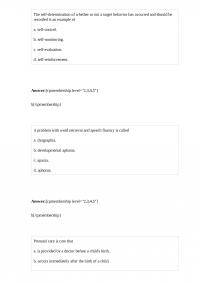
The self-determination of whether or not a target behavior has occurred and should be recorded is an example of a. self-control. b. self-monitoring. c. self-evaluation. d. self-reinforcement. A problem with word retrieval and speech fluency is called a. dysgraphia. b. […]
SED EM 80908
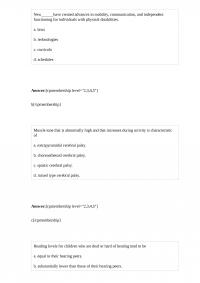
New______have created advances in mobility, communication, and independent functioning for individuals with physical disabilities. a. laws b. technologies c. curricula d. schedules Muscle tone that is abnormally high and that increases during activity is characteristic of a. extrapyramidal cerebral palsy. […]
SED LR 52800
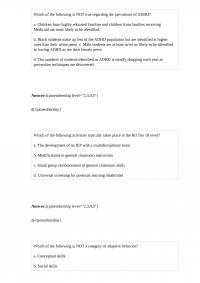
Which of the following is NOT true regarding the prevalence of ADHD? a. Children from highly educated families and children from families receiving Medicaid are most likely to be identified. b. Black students make up less of the ADHD population […]
SED LR 89074
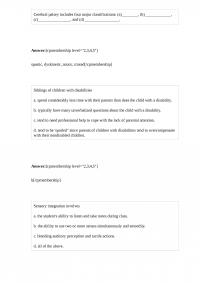
Cerebral palsey includes four major classifications: (a)________, (b)_____________, (c)________________, and (d) _________________. Siblings of children with disabilities a. spend considerably less time with their parents than does the child with a disability. b. typically have many unverbalized questions about the […]
SESP 94720
Which of these is NOT a role of the classroom teacher in identifying children with a possible hearing loss? a. Being aware of the child’s misarticulations b. Giving each child a hearing test with sophisticated equipment c. Noting the frequency […]