Archives
Chapter 1 1 Accounting information is used to help managers and decision makers understand risk
Copyright © 2015 Pearson Education, Inc. Financial Accounting, 3e (Kemp/Waybright) Chapter 1 Business, Accounting, and You 1.1 Questions 1) By taking accounting classes, the student is learning the “language of business.” Answer: TRUE Diff: 1 LO: 1-1 EOC Ref: Vocabulary […]
Chapter 1 2 Cash accounting recognizes business transactions when cash is received or paid.
Copyright © 2015 Pearson Education, Inc. 23) Which accounting concept or principle specifically states that we should record transactions that can be verified? A) Going-concern concept B) Cost principle C) Reliability principle D) Business entity concept Answer: C Diff: 1 […]
Chapter 1 3 Payment of expenses would have which of the following effects on the accounting equation
Copyright © 2015 Pearson Education, Inc. 37) The payment of cash dividends would have which of the following effects on the accounting equation? A) Increase Liabilities B) Decrease Stockholders’ Equity C) Increase Assets D) Increase Stockholders’ Equity Answer: B Diff: […]
Chapter 10 1 A corporation must incorporate through the local government of any state it chooses.
Copyright © 2015 Pearson Education, Inc. Financial Accounting, 3e (Kemp/Waybright) Chapter 10 Corporations: Paid-In Capital and Retained Earnings 10.1 Questions 1) Capital stock represents the number of shares of stock a corporation is authorized by a state to sell. Answer: […]
Chapter 10 2 A stock dividend may be given to reduce the market price of the stock
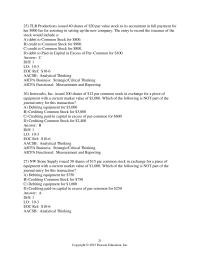
Copyright © 2015 Pearson Education, Inc. 25) TLR Productions issued 40 shares of $20 par value stock to its accountant in full payment for her $900 fee for assisting in setting up the new company. The entry to record the […]
Chapter 10 3 When a company purchases treasury stock, outstanding stock is computed as
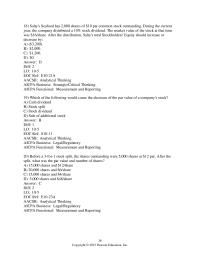
Copyright © 2015 Pearson Education, Inc. 18) Salty’s Seafood has 2,000 shares of $10 par common stock outstanding. During the current year, the company distributed a 10% stock dividend. The market value of the stock at that time was $16/share. […]
Chapter 11 1 The Balance Sheet reports the ending cash, but does not include cash equivalents.
Copyright © 2015 Pearson Education, Inc. Financial Accounting, 3e (Kemp/Waybright) Chapter 11 The Statement of Cash Flows 11.1 Questions 1) The cash flow statement and Balance Sheet use accrual accounting. Answer: FALSE Diff: 1 LO: 11-1 EOC Ref: S11-1 AACSB: […]
Chapter 11 2 Activities that increase and decrease as a result of selling a company’s stock
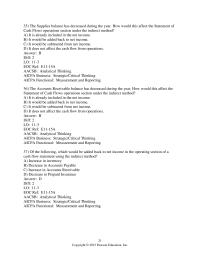
Copyright © 2015 Pearson Education, Inc. 35) The Supplies balance has decreased during the year. How would this affect the Statement of Cash Flows operations section under the indirect method? A) It is already included in the net income. B) […]
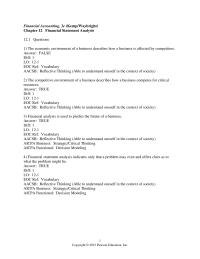
Chapter 12 1 When an analyst compares a business with a similar business it is referred
Copyright © 2015 Pearson Education, Inc. Financial Accounting, 3e (Kemp/Waybright) Chapter 12 Financial Statement Analysis 12.1 Questions 1) The economic environment of a business describes how a business is affected by competitors. Answer: FALSE Diff: 1 LO: 12-1 EOC Ref: […]
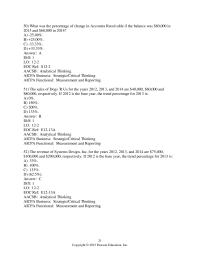
Chapter 12 2 For vertical analysis purposes, the base item on the Balance Sheet
Copyright © 2015 Pearson Education, Inc. 50) What was the percentage of change in Accounts Receivable if the balance was $80,000 in 2013 and $60,000 in 2014? A) -25.00%. B) +25.00%. C) -33.33%. D) +33.33%. Answer: A Diff: 1 LO: […]
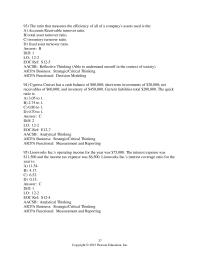
Chapter 12 3 The ratio that measures the efficiency of all of a company’s assets used
Copyright © 2015 Pearson Education, Inc. 93) The ratio that measures the efficiency of all of a company’s assets used is the: A) Accounts Receivable turnover ratio. B) total asset turnover ratio. C) inventory turnover ratio. D) fixed asset turnover […]
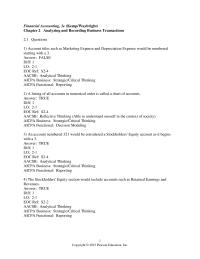
Chapter 2 1 A listing of all accounts in numerical order is called a chart of accounts.
Copyright © 2015 Pearson Education, Inc. Financial Accounting, 3e (Kemp/Waybright) Chapter 2 Analyzing and Recording Business Transactions 2.1 Questions 1) Account titles such as Marketing Expense and Depreciation Expense would be numbered starting with a 3. Answer: FALSE Diff: 1 […]
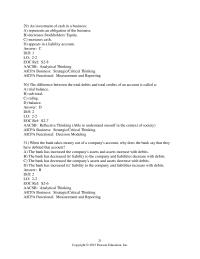
Chapter 2 2 A company has a ten million dollar credit balance in the payable accounts
Copyright © 2015 Pearson Education, Inc. 29) An investment of cash in a business: A) represents an obligation of the business. B) decreases Stockholders’ Equity. C) increases cash. D) appears in a liability account. Answer: C Diff: 1 LO: 2-2 […]
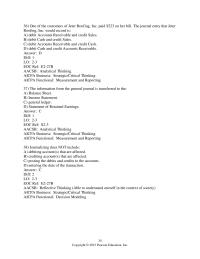
Chapter 2 3 The posting reference column of the general journal provides a cross-reference
Copyright © 2015 Pearson Education, Inc. 36) One of the customers of Jeter Roofing, Inc. paid $223 on her bill. The journal entry that Jeter Roofing, Inc. would record is: A) debit Accounts Receivable and credit Sales. B) debit Cash […]
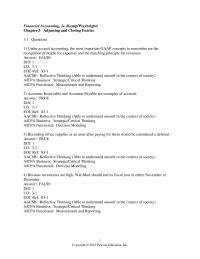
Chapter 3 1 Recording office supplies as an asset after paying for them would be considered a deferral
Copyright © 2015 Pearson Education, Inc. Financial Accounting, 3e (Kemp/Waybright) Chapter 3 Adjusting and Closing Entries 3.1 Questions 1) Under accrual accounting, the most important GAAP concepts to remember are the recognition principle for expenses and the matching principle for […]
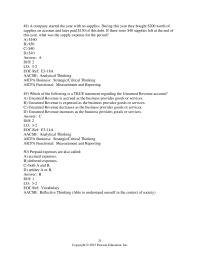
Chapter 3 2 The adjusted trial balance is prepared before the adjusting entries are completed and posted
Copyright © 2015 Pearson Education, Inc. 48) A company started the year with no supplies. During this year they bought $200 worth of supplies on account and later paid $150 of this debt. If there were $40 supplies left at […]
Chapter 3 3 Revenue accounts are closed by crediting them and debiting Retained Earnings
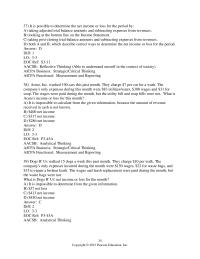
Copyright © 2015 Pearson Education, Inc. 37) It is possible to determine the net income or loss for the period by: A) taking adjusted trial balance amounts and subtracting expenses from revenues. B) looking at the bottom line on the […]
Chapter 4 1 Retailers may buy goods from the manufacturer and then sell the goods to consumers
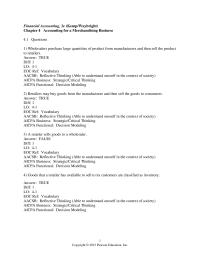
Copyright © 2015 Pearson Education, Inc. Financial Accounting, 3e (Kemp/Waybright) Chapter 4 Accounting for a Merchandising Business 4.1 Questions 1) Wholesalers purchase large quantities of product from manufacturers and then sell the product to retailers. Answer: TRUE Diff: 1 LO: […]
Chapter 4 2 The account in which the revenue earned from the sale of merchandise is entered
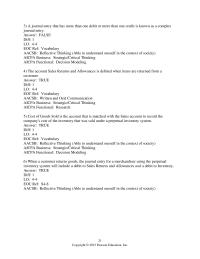
Copyright © 2015 Pearson Education, Inc. 3) A journal entry that has more than one debit or more than one credit is known as a complex journal entry. Answer: FALSE Diff: 1 LO: 4-4 EOC Ref: Vocabulary AACSB: Reflective Thinking […]
Chapter 4 3 In a Balance Sheet prepared in report form, liabilities must be listed after
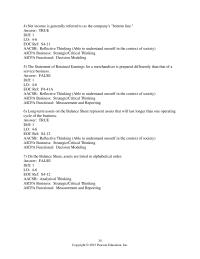
Copyright © 2015 Pearson Education, Inc. 4) Net income is generally referred to as the company’s “bottom line.” Answer: TRUE Diff: 1 LO: 4-6 EOC Ref: S4-11 AACSB: Reflective Thinking (Able to understand oneself in the context of society) AICPA […]
Chapter 5 1 A piece of artwork would probably be inventoried using the specific-identification method
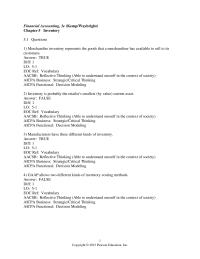
Copyright © 2015 Pearson Education, Inc. Financial Accounting, 3e (Kemp/Waybright) Chapter 5 Inventory 5.1 Questions 1) Merchandise inventory represents the goods that a merchandiser has available to sell to its customers. Answer: TRUE Diff: 1 LO: 5-1 EOC Ref: Vocabulary […]
Chapter 5 2 The choice of inventory costing method does not have an effect on net income
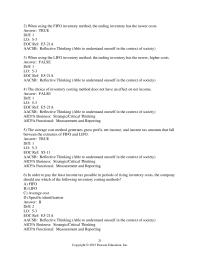
Copyright © 2015 Pearson Education, Inc. 2) When using the FIFO inventory method, the ending inventory has the newer costs. Answer: TRUE Diff: 1 LO: 5-3 EOC Ref: E5-21A AACSB: Reflective Thinking (Able to understand oneself in the context of […]
Chapter 5 3 The historical gross profit percentage can be used to estimate the current period’s gross profit
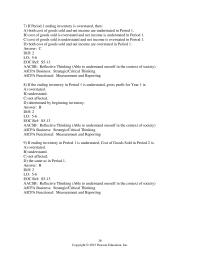
Copyright © 2015 Pearson Education, Inc. 7) If Period 1 ending inventory is overstated, then: A) both cost of goods sold and net income are understated in Period 1. B) cost of goods sold is overstated and net income is […]
Chapter 6 1 Which of the following help ensure the usefulness of accounting information
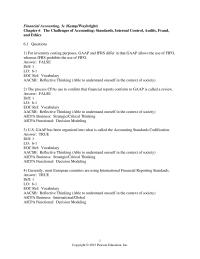
Copyright © 2015 Pearson Education, Inc. Financial Accounting, 3e (Kemp/Waybright) Chapter 6 The Challenges of Accounting: Standards, Internal Control, Audits, Fraud, and Ethics 6.1 Questions 1) For inventory costing purposes, GAAP and IFRS differ in that GAAP allows the use […]
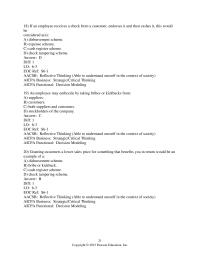
Chapter 6 2 An employee believes that getting away with a fraud without being detected is unlikely
Copyright © 2015 Pearson Education, Inc. 18) If an employee receives a check from a customer, endorses it and then cashes it, this would be considered a(n): A) disbursement scheme. B) expense scheme. C) cash register scheme. D) check tampering […]
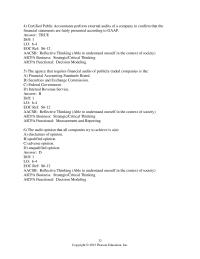
Chapter 6 3 Many states require CPAs to participate in continuing education that deals with ethics.
Copyright © 2015 Pearson Education, Inc. 4) Certified Public Accountants perform external audits of a company to confirm that the financial statements are fairly presented according to GAAP. Answer: TRUE Diff: 1 LO: 6-4 EOC Ref: S6-12 AACSB: Reflective Thinking […]
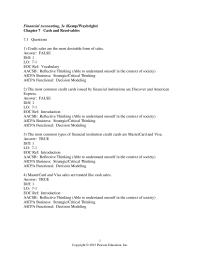
Chapter 7 1 The most common types of financial institution credit cards are MasterCard and Visa.
Copyright © 2015 Pearson Education, Inc. Financial Accounting, 3e (Kemp/Waybright) Chapter 7 Cash and Receivables 7.1 Questions 1) Credit sales are the most desirable form of sales. Answer: FALSE Diff: 1 LO: 7-1 EOC Ref: Vocabulary AACSB: Reflective Thinking (Able […]
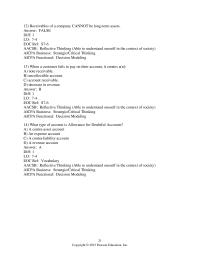
Chapter 7 2 Once an Account Receivable is written off, can a business ever collect that money
Copyright © 2015 Pearson Education, Inc. 12) Receivables of a company CANNOT be long-term assets. Answer: FALSE Diff: 1 LO: 7-4 EOC Ref: S7-6 AACSB: Reflective Thinking (Able to understand oneself in the context of society) AICPA Business: Strategic/Critical Thinking […]
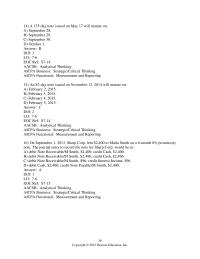
Chapter 7 3 The formula for the quick ratio is quick assets divided by non-current assets
Copyright © 2015 Pearson Education, Inc. 14) A 135-day note issued on May 17 will mature on: A) September 28. B) September 29. C) September 30. D) October 1. Answer: B Diff: 3 LO: 7-6 EOC Ref: S7-14 AACSB: Analytical […]
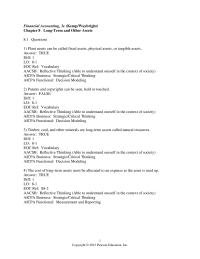
Chapter 8 1 Plant assets can be called fixed assets, physical assets, or tangible assets.
Copyright © 2015 Pearson Education, Inc. Financial Accounting, 3e (Kemp/Waybright) Chapter 8 Long-Term and Other Assets 8.1 Questions 1) Plant assets can be called fixed assets, physical assets, or tangible assets. Answer: TRUE Diff: 1 LO: 8-1 EOC Ref: Vocabulary […]
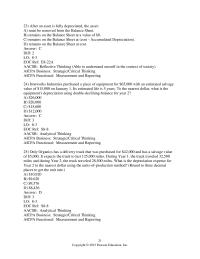
Chapter 8 2 Replacing an engine on a delivery truck would be considered a betterment.
Copyright © 2015 Pearson Education, Inc. 23) After an asset is fully depreciated, the asset: A) must be removed from the Balance Sheet. B) remains on the Balance Sheet at a value of $0. C) remains on the Balance Sheet […]
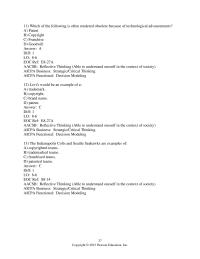
Chapter 8 3 Which of the following is often rendered obsolete because of technological advancements
11) Which of the following is often rendered obsolete because of technological advancements? A) Patent B) Copyright C) Franchise D) Goodwill Answer: A Diff: 1 LO: 8-6 EOC Ref: E8-27A AACSB: Reflective Thinking (Able to understand oneself in the context […]
Chapter 9 1 A contingent liability arises because of a past event, but is dependent upon a future event.
Copyright © 2015 Pearson Education, Inc. Financial Accounting, 3e (Kemp/Waybright) Chapter 9 Current Liabilities and Long-Term Debt 9.1 Questions 1) The majority of a company’s liabilities are estimated liabilities. Answer: FALSE Diff: 1 LO: 9-1 EOC Ref: Introduction AACSB: Reflective […]
Chapter 9 2 Which of the following would be treated as a rental agreement
Copyright © 2015 Pearson Education, Inc. 14) On January 1, Clive Corporation signed a $175,000, 8%, 30-year mortgage that requires semiannual payments of $7,735 on June 30 and December 31 of each year. The journal entry to record the second […]
Chapter 9 3 Having liabilities classified incorrectly will have a big impact on the company’s current ratio
Copyright © 2015 Pearson Education, Inc. 3) Having liabilities classified incorrectly will have a big impact on the company’s current ratio. Answer: TRUE Diff: 1 LO: 9-6 EOC Ref: S9-14 AACSB: Reflective Thinking (Able to understand oneself in the context […]