Financial Accounting, 3e (Kemp/Waybright)
Chapter 8 Long-Term and Other Assets
8.1 Questions
1) Plant assets can be called fixed assets, physical assets, or tangible assets.
2) Patents and copyrights can be seen, held or touched.
3) Timber, coal, and other minerals are long-term assets called natural resources.
4) The cost of long-term assets must be allocated to an expense as the asset is used up.
5) An example of an other asset would be a trademark.
6) Patents, copyrights, and trademarks are:
A) amortized.
B) depleted.
C) depreciated.
D) expensed.
7) Buildings, vehicles, and desks are:
A) amortized.
B) depleted.
C) depreciated.
D) expensed.
8) Coal, oil, and timber are:
A) amortized.
B) depleted.
C) depreciated.
D) expensed.
9) Long-term investments (assets) by a corporation are:
A) amortized.
B) depleted.
C) depreciated.
D) not treated as fixed assets.
10) Assets that CANNOT be seen, touched, or held are called:
A) intangible assets.
B) natural resources.
C) plant assets.
D) tangible assets.
11) Which of the following would NOT be considered an intangible asset?
A) Goodwill
B) Franchise
C) Land
D) Copyright
12) Which of the following would be considered a natural resource?
A) Corn
B) Livestock
C) Timber
D) Wheat
13) Assets that are NOT expected to provide benefits for more than 12 months after the
presentation of the financial statements are called:
A) property, plant, and equipment.
B) long-term assets.
C) natural resources.
D) current assets.
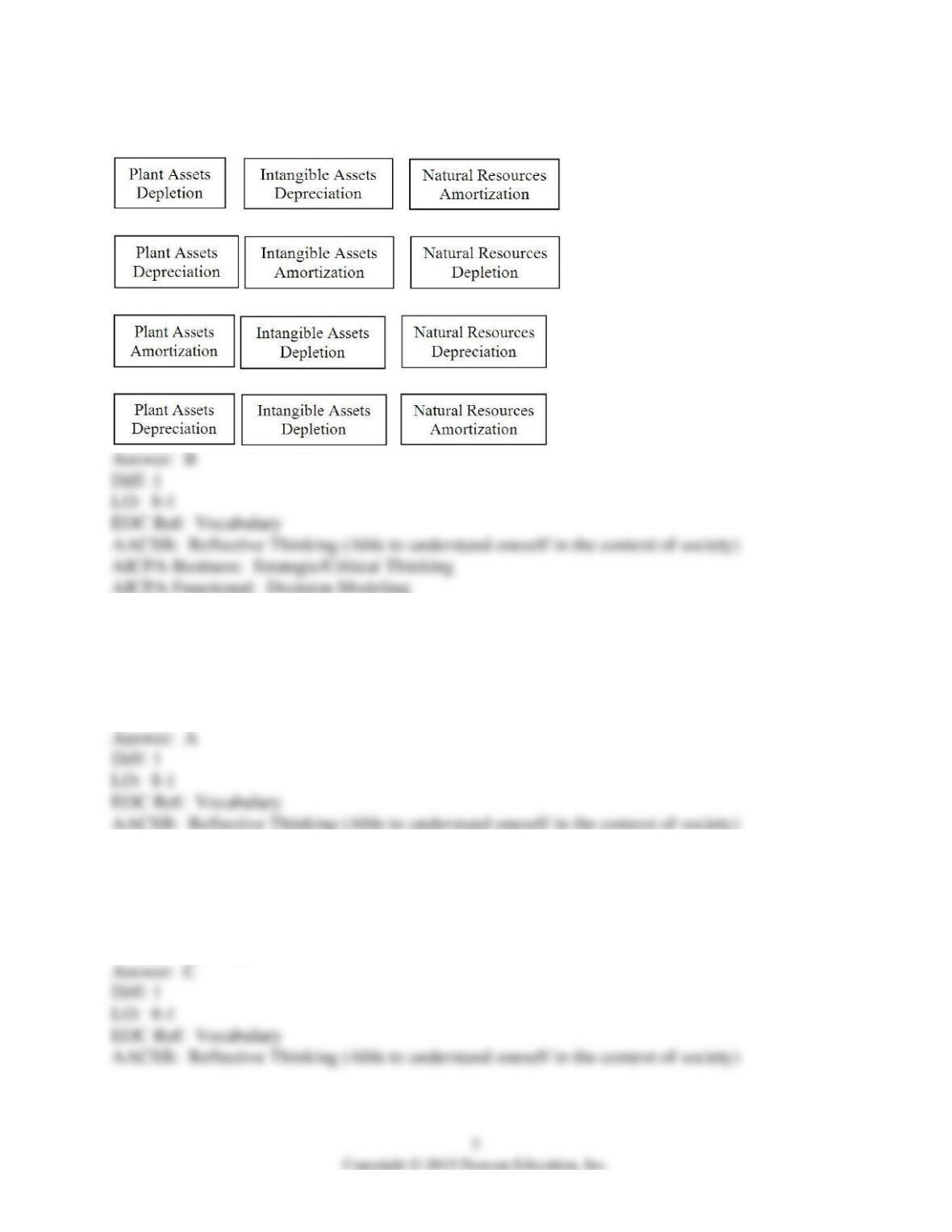
14) Which of the following matches the correct cost allocation terms with the given assets?
A)
B)
C)
D)
15) Which of the following would be considered a fixed asset?
A) land
B) patents
C) timber
D) both A and C are fixed assets
16) Which of the following would NOT be considered a fixed asset?
A) office equipment
B) company car
C) oil
D) office building
8.2 Questions
1) When determining the cost of a plant asset, GAAP requires the use of the market value
principle.
2) Neither land nor land improvements are depreciated.
3) When a company pays a single price for a group of assets, the purchase is referred to as a
basket purchase.
4) Whether a building is purchased or constructed, the same items are used to compute the price
of the building.
5) Costs of testing machinery or equipment before they are used would be included in the price
of the machinery or the equipment.
6) The cost of furniture and fixtures, such as desks, chairs and other items, includes its basic cost
plus all other costs to ready the asset for its intended use.
7) When a company buys a building, realtor commissions are not included in the cost of the
building.
8) The costs associated with clearing land and removing buildings are considered land
improvements.
9) Which of the following would NOT be considered part of the cost of the land?
A) Survey and legal fees
B) Realtor commissions
C) Paving
D) Unpaid property taxes on the land
10) Which would NOT be considered part of land improvements?
A) Removing unwanted buildings from the land
B) Signs
C) In-ground sprinkler systems
D) Fencing
11) Which of the following would be considered part of land improvements?
A) Removal of unwanted building on the land
B) Title transfer fees
C) Paving of the parking lot
D) Surveying fees
12) Which of the following would NOT be a part of land improvements?
A) Paving of the parking lot
B) Installing fences around the property
C) Putting in sidewalks
D) Grading and leveling the land
13) Which of the following would be included in the cost of a constructed building?
A) Purchase price of the building
B) Payments for material, labor, and overhead
C) Survey and legal fees
D) Realtor commissions
14) Which of the following would NOT be considered as part of the cost of a constructed
building?
A) Building permit fees
B) Contractor charges
C) Realtor commissions
D) Architectural fees
15) Which of the following would be considered as part of the cost of purchasing an existing
building?
A) Architectural fees
B) Contractor charges
C) Title transfer fees
D) Payment for materials
16) Which of the following would NOT be considered part of the cost of machinery and
equipment?
A) Repairs and maintenance after start-up
B) Delivery charges
C) Installation costs
D) In-transit insurance costs
17) Which of the following would be considered part of the cost of machinery and equipment?
A) Sales taxes
B) Repairs after start-up
C) Maintenance
D) Insurance after purchase
18) The total cost allocated to each item in a basket purchase is based upon:
A) the original cost of the items.
B) their relative market values.
C) their individual selling price.
D) their individual market values.
19) Metropolitan Masonry made a basket purchase of three items. Item X was appraised at
$35,000; item Y was appraised at $55,000 and item Z was appraised at $60,000. The purchase
price was $125,000. The amount at which item Y should be recorded is:
A) ($55,000/$125,000) × $150,000.
B) ($55,000/$150,000) × $125,000.
C) ($55,000/$95,000) × $150,000.
D) ($55,000/$95,000) × $125,000.
20) Capitol Construction Company made a basket purchase of three items. Item X was appraised
at $35,000; item Y was appraised at $55,000 and item Z was appraised at $60,000. The purchase
price was $125,000. The amount at which item Z should be recorded (rounded to the nearest
dollar) is:
A) $72,000.
B) $83,300.
C) $50,000.
D) $29,167.
21) Lionworks Corporation made a basket purchase of three items. Item X was appraised at
$35,000; item Y was appraised at $55,000; and item Z was appraised at $60,000. The purchase
price was $125,000. The amount at which item X should be recorded (rounded to the nearest
dollar) is:
A) $42,000.
B) $29,167.
C) $41,667.
D) $38,043.
22) Other than land, long-term assets that are capitalized are:
A) expensed in the year of purchase.
B) depreciated over the life of the asset.
C) recorded at market value.
D) recorded at net realizable value.
23) Which would NOT be included in the recorded price of a piece of machinery?
A) Installation costs
B) Maintenance costs
C) Delivery charges
D) Sales taxes
24) Sydney’s Siding made a basket purchase involving four assets. Their market values were A:
$45,000; B: $37,500; C: $41,000; and D: $53,000. The price Sydney’s paid for the four assets
was $160,000. What percentage of the $160,000 price would be allocated to asset C to the
nearest one-tenth of a percent?
A) 30.0%
B) 25.5%
C) 23.2%
D) 21.2%
25) Bob’s Bakery made a basket purchase involving four assets. Their market values were A:
$45,000; B: $37,500; C: $41,000; and D: $53,000. The price Bob’s paid for the four assets was
$145,000. To the nearest dollar, what final price will be recorded for asset D?
A) $30,807
B) $33,683
C) $36,969
D) $43,541
26) Costs that should be charged to the land account include:
A) the cost of removing unwanted buildings.
B) paving the parking lot.
C) installing fences.
D) the cost of a sign.
27) Which of the following would be considered part of the cost of a printing press?
A) The medical fees for a worker who was injured while installing the press
B) The cost of a test run to make sure the press worked properly
C) Both A and B are part of the cost of the printing press.
D) Neither A nor B are part of the cost of the printing press.
28) In accounting, what is the meaning of capitalized?
A) Capitalized means that a liability account is credited (increased) for the cost of an asset.
B) Capitalized means that an asset account is debited (increased) for the cost of an asset.
C) Capitalized means that the cost of an asset is recorded as a debit (increase) to expense.
D) Capitalized means that a given city has been selected as a government center.
8.3 Questions
1) Depreciation is a process of valuation of an asset.
2) Depreciation is based upon cost, useful life and salvage value.
3) A fixed asset’s useful life may be shorter than its physical life due to obsolescence.
4) Straight-line depreciation is calculated by the formula (cost – salvage value) divided by useful
life (generally in years).
5) Book value is depreciable cost minus accumulated depreciation.
6) Calculating depreciation using a base such as miles driven per year would be an example of
double-declining balance depreciation.
7) Double-declining balance is an accelerated method of calculating depreciation where salvage
value is NOT part of the initial computation.
8) A company purchased a truck on August 1, 2013. Using straight-line depreciation, the
company would report four (4) months depreciation on December 31, 2013.
9) The choice of depreciation method depends on the cost of the asset and its’ expected useful
life.
10) A company should choose a depreciation method that most closely matches the cost of the
asset against the future revenues it generates.
11) A new vehicle was purchased on January 1 for $38,000. It has a salvage value of $7,000 and
a useful life of 5 years. To the nearest dollar, how much will the depreciation expense for the
vehicle be for the first year using the straight-line method?
A) $6,200
B) $633
C) $7,600
D) $517
12) New equipment was purchased on January 1 for $142,000. It has a salvage value of $28,000
and a useful life of 8 years. To the nearest dollar, how much will the depreciation expense for the
equipment be for the first year using the straight-line method?
A) $1,188
B) $17,750
C) $1,479
D) $14,250
13) A company purchased a computer system on March 1. Its cost was $35,000, and it had an
estimated salvage value of $5,000. It was expected to have a useful life of four years. To the
nearest dollar, the depreciation for year 1 using straight-line depreciation will be:
A) $8,750.
B) $7,500.
C) $6,250.
D) $5,625.
14) A company purchased a computer system on March 1. Its cost was $35,000 and it had an
estimated salvage value of $5,000. It was expected to have a useful life of four years. To the
nearest dollar, the depreciation for year 2 using straight-line depreciation will be:
A) $8,750.
B) $7,500.
C) $6,250.
D) $5,625.
15) A company purchased furniture on January 1. Its cost was $15,600, and it had a residual
value of $1,600. Its useful life is determined to be 3 years. Using double-declining balance
depreciation, the depreciation for year 1 to the nearest dollar will be:
A) $10,400.
B) $9,333.
C) $5,200.
D) $4,667.
16) Cesario Corporation purchases a machine for $125,000. It has an estimated salvage value of
$10,000 and is expected to produce 50,000 units in its lifetime. During the first year of operation,
it produced 14,500 units. To the nearest dollar, the depreciation for the first year under the units
of production method will be:
A) $36,250.
B) $35,500.
C) $33,350.
D) $31,250.
17) Custom Closets purchased office fixtures on January 1. The cost was $12,000, and the
fixtures had a residual value of $2,000. The fixtures were given a useful life of 8 years. After the
end of three years, it was determined that the fixtures would be obsolete in 2 more years and
their residual value would still be $2,000. What will be the depreciation under the straight-line
method to the nearest dollar be for the fourth year?
A) $1,500
B) $1,250
C) $3,125
D) $3,750
18) Leo’s Lawncare purchased equipment on January 1. The cost was $15,000, and the
equipment had a residual value of $4,000. The equipment was given a useful life of 7 years.
After the end of two years, it was determined that the equipment would be obsolete in 3 more
years and the residual value would still be $4,000. What will be the depreciation under the
straight-line method to the nearest dollar be for the third year?
A) $1,571
B) $2,619
C) $3,142
D) $7,857
19) If an asset generates revenue evenly over time, the depreciation method best suited for this
asset would be the:
A) double-declining balance method.
B) straight-line method.
C) units-of-production method.
D) expense method.
20) If an asset produces more revenue in its early years, the depreciation method best suited for
this asset would be the:
A) expense method.
B) units-of-production method.
C) double-declining balance method.
D) straight-line method.
21) A method best suited for depreciating items, such as copy machines and vehicles, would be
the:
A) expense method.
B) units-of-production method.
C) double-declining balance method.
D) straight-line method.
22) The depreciation method often used for income tax purposes is the:
A) expense method.
B) units-of-production method.
C) double-declining balance method.
D) straight-line method.