18) Salty’s Seafood has 2,000 shares of $10 par common stock outstanding. During the current
year, the company distributed a 10% stock dividend. The market value of the stock at that time
was $16/share. After the distribution, Salty’s total Stockholders’ Equity should increase or
decrease by:
A) ($3,200).
B) $2,000.
C) $1,200.
D) $0.
19) Which of the following would cause the decrease of the par value of a company’s stock?
A) Cash dividend
B) Stock split
C) Stock dividend
D) Sale of additional stock
20) Before a 3-for-1 stock split, the shares outstanding were 5,000 shares at $12 par. After the
split, what was the par value and number of shares?
A) 15,000 shares and $12/share
B) 20,000 shares and $6/share
C) 15,000 shares and $4/share
D) 5,000 shares and $48/share
21) Before a 2-for-1 stock split, the shares outstanding were 40,000 shares at $50 par. After the
split, what was the par value and number of shares?
A) 80,000 shares and $25/share
B) 20,000 shares and $100/share
C) 20,000 shares and $25/share
D) 80,000 shares and $100/share
22) Before a 5-for-3 stock split, the shares outstanding were 45,000 shares at $15 par. After the
split, what was the par value and number of shares?
A) 75,000 shares and $25/share
B) 75,000 shares and $9/share
C) 27,000 shares and $25/share
D) 27,000 shares and $9/share
10.6 Questions
1) A company’s stock that it reacquires is termed treasury stock.
2) Treasury stock transactions are uncommon among larger corporations.
3) Treasury stock is a contra-equity account and carries a debit balance.
4) Treasury stock decreases the number of outstanding shares of stock.
5) Treasury stock is recorded at par value.
6) Treasury stock receives neither voting rights nor dividends.
7) Which of the following is NOT a reason for a company to purchase treasury stock?
A) To reward valued employees
B) To avoid a takeover by an outside company
C) To buy the stock at a high price to increase total Stockholders’ Equity
D) To support the company’s stock price
8) If a company resells treasury stock for less than it was acquired, how is the difference
between the original purchase price and the resell price recorded? First, you would:
A) debit Retained Earnings.
B) debit Paid-in capital–Treasury stock for the necessary amount, provided there is a sufficient
credit in that account.
C) credit Paid-in capital–Treasury stock.
D) credit Retained Earnings.
9) Which of the following is TRUE regarding treasury stock?
A) Treasury Stock has a debit balance.
B) Treasury Stock is a contra-asset account.
C) Treasury Stock is recorded at cost.
D) Both A and C are true of Treasury Stock.
10) When a company purchases treasury stock, outstanding stock is computed as:
A) Issued stock + Treasury stock
B) Issued stock – Treasury stock
C) Authorized stock — Treasury stock
D) Authorized stock + Treasury stock
11) Anderson Industries purchased 1,000 shares of the company’s issued common stock, paying
$10 per share. To record the purchase, the journal entry will be:
A) Debit to Common Stock $10,000, credit to Cash $10,000
B) Debit to Treasury Stock $10,000, credit to Common Stock $10,000
C) Debit to Treasury Stock $10,000, credit to Cash $10,000
D) No journal entry is needed.
12) Charmed, Inc. reacquired 5,000 shares of its $15-par common stock for $13/share. The debit
to Treasury Stock will be:
A) $10,000.
B) $65,000.
C) $75,000.
D) based on the last treasury stock transaction.
13) Charmed, Inc. has 5,000 shares of treasury stock which it purchased for $13/share. It later
resold 2,000 of those shares for $17/share. The amount to be credited to Paid-in Capital–
Treasury Stock is:
A) $30,000.
B) $26,000.
C) $34,000.
D) $8,000.
14) Charmed, Inc. has a $2,400 credit balance in Paid-In Capital–Treasury Stock. It sells 500
shares of treasury stock, which the company reacquired at $21/share, for $18/share. After the
transaction, what will the balance be in the Paid-In Capital in Excess of Par–Treasury account?
A) $3,900 credit
B) $1,500 debit
C) $900 credit
D) $900 debit
15) HiTech Industries reacquired 10,000 shares of its $25-par common stock for $61/share. The
debit to Treasury Stock will be:
A) based on the last treasury stock transaction.
B) $360,000.
C) $250,000.
D) $610,000.
16) HiTech Industries has 10,000 shares of treasury cost which it purchased for $61/share. It
later resold 3,000 of those shares for $87/share. The amount to be credited to Paid-in Capital–
Treasury Stock is:
A) $261,000.
B) $78,000.
C) $156,000.
D) $183,000.
17) HiTech Industries has a $11,800 credit balance in Paid-In Capital–Treasury Stock. It sells
1,000 shares of treasury stock, which the company reacquired at $58/share, for $52/share. After
the transaction, what will the balance be in the Paid-In Capital in Excess of Par–Treasury
account?
A) $5,800 credit
B) $6,000 debit
C) $17,800 credit
D) $11,800 credit
10.7 Questions
1) In addition to the regular financial statements, a company may issue a separate Statement of
Stockholders’ Equity.
2) Common Stock is most often listed after Additional Paid-in Capital in the Stockholders’
Equity section of the Balance Sheet.
3) Which is NOT included in paid-in capital?
A) Preferred Stock
B) Common Stock
C) Cash
D) Additional Paid-in Capital
4) The major parts of the Stockholders’ Equity section of the Balance Sheet are:
A) Paid-In Capital and Retained Earnings.
B) Stock and Retained Earnings.
C) Stock, Paid-In Capital and Retained Earnings.
D) Authorized Stock and Preferred Stock.
5) Stockholders’ stake in stock appears in:
A) Paid-In Capital.
B) Owner’s Equity.
C) Retained Earnings.
D) Cash.
6) In the Stockholders’ Equity section of a Balance Sheet:
A) common stock goes first.
B) preferred stock goes first.
C) Retained Earnings goes first.
D) assets are listed first.
7) Dental Designs, Inc. Stockholders’ Equity section includes the following information:
Preferred Stock
$11,000
Paid-in Capital in Excess of Par—Preferred
17,000
Common Stock
16,000
Paid-in Capital in Excess of Par—Common
4,000
Retained Earnings
7,000
Total paid-in capital is:
A) $48,000.
B) $55,000.
C) $27,000.
D) $21,000.
8) Cellars, Inc. Stockholders’ Equity section includes the following information:
Preferred Stock
$22,000
Paid-in Capital in Excess of Par—Preferred
2,980
Common Stock
48,000
Paid-in Capital in Excess of Par—Common
3,400
Retained Earnings
7,350
Total paid-in capital is:
A) $70,000.
B) $83,730.
C) $76,380.
D) $77,350.
9) The Wellington Winery’s Stockholders’ Equity section includes the following information:
Preferred Stock
$12,000
Paid-in Capital in Excess of Par—Preferred
2,700
Common Stock
15,000
Paid-in Capital in Excess of Par—Common
4,100
Retained Earnings
8,200
What was the total selling price of the preferred stock?
A) $12,000
B) $14,700
C) $16,100
D) $20,200
10) The Wellington Winery’s Stockholders’ Equity section includes the following information:
Preferred Stock
$12,000
Paid-in Capital in Excess of Par—Preferred
2,700
Common Stock
15,000
Paid-in Capital in Excess of Par—Common
4,100
Retained Earnings
8,200
What was the total selling price of the common stock?
A) $15,000
B) $14,700
C) $19,100
D) $27,300
11) Taylor Fish Farm’s Stockholders’ Equity section includes the following information:
Preferred Stock
$13,000
Paid-in Capital in Excess of Par–Preferred
3,400
Common Stock
17,000
Paid-in Capital in Excess of Par–Common
2,100
Retained Earnings
9,100
What was the total selling price of the preferred stock?
A) $13,000
B) $15,100
C) $16,400
D) $19,100
12) Taylor Fish Farm’s Stockholders’ Equity section includes the following information:
Preferred Stock
$13,000
Paid-in Capital in Excess of Par–Preferred
3,400
Common Stock
17,000
Paid-in Capital in Excess of Par–Common
2,100
Retained Earnings
9,100
What was the total selling price of the common stock?
A) $13,000
B) $15,100
C) $16,400
D) $19,100
10.8 Questions
1) Return on equity shows the relationship between net income and ending Stockholders’ Equity.
2) The numerator for the return on equity formula is net income.
3) The formula for return on equity is net income divided by average Stockholders’ Equity.
4) The denominator in calculating return on equity is average common Stockholders’ Equity.
5) The return on equity for a company that has sales of $50,000, net income of $25,000 and
average Stockholders’ Equity of $125,000 is 20%.
6) The return on equity for a company that has sales of $43,000, net income of $13,000, and
average Stockholders’ Equity of $88,000 would be 48.86%.
7) What is the return on equity if sales are $100,000, net income is $22,700 and average common
Stockholders’ Equity is $86,000?
A) 22.7%
B) 26.4%
C) 86.0%
D) Cannot be determined from information given
8) What is the return on equity if sales are $279,800, net income is $48,600 and average common
Stockholders’ Equity is $185,400?
A) 14.8%
B) 66.3%
C) 26.2%
D) 17.4%
9) For the current year, Company A had sales of $300,000, net income of $200,000 and average
common Stockholders’ Equity of $900,000. During the same year, Company B had sales of
$200,000, net income of $100,000 and average common Stockholders’ Equity of $400,000.
Which of the following statements is TRUE regarding this situation?
A) Company A has a better return on equity, $200,000 compared to Company B’s $100,000.
B) Company B has a better return on equity, 25% compared to Company A’s 22.22%.
C) Company A has a better return on equity, $300,000 compared to Company B’s $200,000
D) Company B has a better return on equity, 50% compared to Company A’s 66.66%.
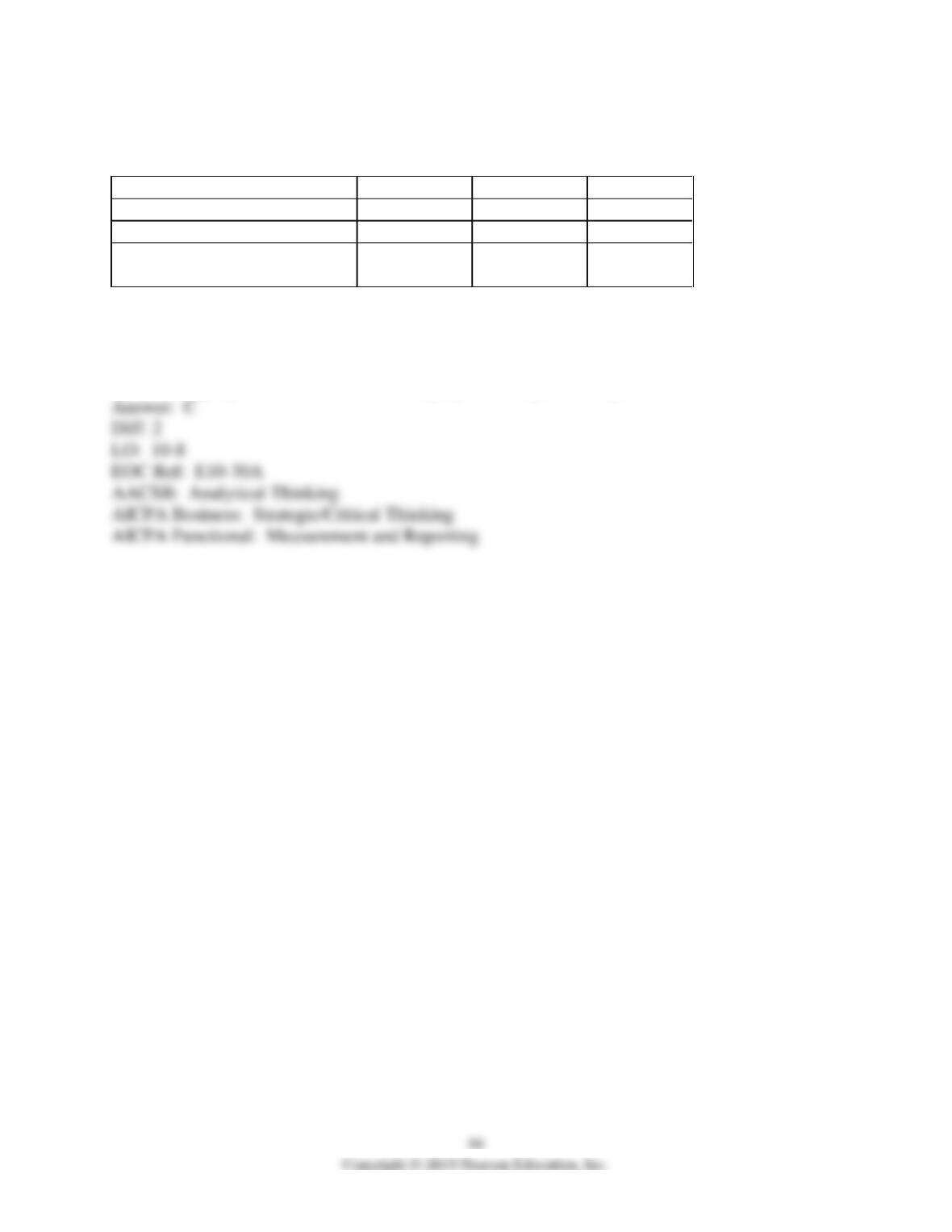
10) Based on the following information, in which year did the company have the best return on
equity?
Year 1
Year 2
Year 3
Sales
$3,000,000
$2,000,000
$1,000,000
Net Income
$500,000
$500,000
$500,000
Average Common
Stockholders’ Equity
$2,500,000
$2,380,952
$2,272,727
A) Year 1
B) Year 2
C) Year 3
D) The company had the same return on equity all three years. No year is better than another.