Financial Accounting, 3e (Kemp/Waybright)
Chapter 4 Accounting for a Merchandising Business
4.1 Questions
1) Wholesalers purchase large quantities of product from manufacturers and then sell the product
to retailers.
2) Retailers may buy goods from the manufacturer and then sell the goods to consumers.
3) A retailer sells goods to a wholesaler.
4) Goods that a retailer has available to sell to its customers are classified as inventory.
5) The general public usually purchase merchandise from wholesalers.
6) Which of the following characterizes Best Buy?
A) Best Buy both purchases and sells products.
B) Best Buy sells products but doesn’t purchase products.
C) Best Buy purchases products but doesn’t sell products.
D) Best Buy neither purchases nor sells products.
7) Inventory for a merchandising business is classified as a(n):
A) liability.
B) revenue.
C) part of Stockholders’ Equity.
D) asset.
8) The general public is referred to as:
A) final consumers.
B) service customers.
C) retail customers.
D) manufacturing customers.
9) Which of the following would NOT be classified as a retailer?
A) Amazon.com
B) H & R Block
C) Wal-Mart
D) Target
10) Which of the following would NOT be classified as a service business?
A) Graham’s Lawn Mowing
B) Tonya’s Tax Service
C) Rick’s Pet Walking
D) Charla’s Fashion Boutique
11) Amazon.com, JCPenney.com, and Wal-Mart.com are examples of Internet:
A) service businesses.
B) manufacturing businesses.
C) retail businesses.
D) wholesalers.
12) The general public most often buys products from:
A) a wholesale business.
B) a retail business.
C) a manufacturer.
D) all of the above.
4.2 Questions
1) Most businesses today use the periodic inventory method.
2) Because of innovative and computerized methods of tracking inventory, most businesses
today use the perpetual inventory system.
3) In the perpetual inventory system, inventory is constantly updated through the inventory
tracking system.
4) Under the perpetual inventory system, the need for a physical count of inventory is eliminated.
5) When the perpetual records do not equal the physical count of the inventory, the general
ledger is updated with the differences.
6) If there is a difference between the physical count and the perpetual record, the account in
which the difference is recorded is:
A) Sales.
B) Cost of Goods Sold.
C) Inventory Expense.
D) Revenue.
7) A useful tool that updates inventory is the:
A) cash register.
B) bar code scanner.
C) price tag on the merchandise.
D) UPC number.
8) Physical inventory counts must be done:
A) when using the periodic system of inventory.
B) when using bar code scan technology.
C) when using the perpetual system of inventory.
D) regardless of inventory system.
9) Under the periodic inventory system, the amount of inventory is:
A) constantly updated.
B) only known when a physical count is taken.
C) adjusted after each sale.
D) adjusted after each purchase.
10) A company uses the perpetual inventory system. At year end the general ledger indicated that
this company had a balance of $50,000 in the Inventory account. Actual inventory on hand per a
physical count was $51,500. What action does the company now need to take?
A) No action is needed; the difference between the ledger and actual is less than 5%.
B) The company needs to debit Cost of Goods Sold and credit Inventory, $1,500.
C) The company needs to debit Inventory and credit Cost of Goods Sold for $1,500.
D) The company should debit the Purchases account and credit Cost of Goods Sold.
11) When accounting for a merchandising business, which of the following is TRUE?
A) Wholesalers must use the periodic inventory system.
B) Retailers must use the perpetual inventory system.
C) Wholesalers must use the periodic inventory system; retailers may use either the perpetual or
periodic inventory system.
D) Retailers and wholesalers may use either the perpetual or periodic inventory system.
12) Woods Company had an inventory balance of $3,500 on January 1. During the accounting
period they made purchases of $11,500. The ending inventory balance was $2,250. If Woods Co.
uses the periodic inventory system, what is the cost of goods available for sale?
A) $3,500
B) $11,500
C) $12,750
D) $15,000
13) Woods Company had an inventory balance of $3,500 on January 1. During the accounting
period they made purchases of $11,500. The ending inventory balance was $2,250. If Woods Co.
uses the periodic inventory system, what is the cost of inventory sold during the period?
A) $11,500
B) $12,750
C) $15,000
D) $17,250
14) Smith Company had an inventory balance of $12,000 on January 1 and $18,000 on
December 31. The cost of goods sold during the period was $63,000. What is the purchase
amount?
A) $6,000
B) $33,000
C) $66,000
D) $69,000
15) TNT Inc. had an inventory balance of $21,000 on January 1, and $23,500 on December 31.
The cost of goods sold during the period was $27,250. What is the purchase amount?
A) $2,500
B) $3,750
C) $29,750
D) $31,000
16) Bach Co. had an inventory balance of $15,250 on January 1, purchased $37,000 during the
accounting period, and the cost of goods sold was $25,000. What is the ending balance in the
inventory account?
A) $27,250
B) $37,000
C) $52,250
D) Not enough information provided
4.3 Questions
1) Both purchase returns and allowances decrease the merchandiser’s inventory cost.
2) The purchase of inventory affects both an asset and the Stockholders’ Equity account.
3) An invoice with the credit terms 3/10, n/30 means that the customer has 3 days to take a 10%
discount off of the invoice total.
4) If an invoice shows a total of $4,000 with terms 2/10, n/30, the customer may pay $3,920
within 10 days to satisfy the bill.
5) Credit terms are determined by the purchaser.
6) If an invoice reads 2/10, n/30, the 10 refers to the percent that can be taken for the discount.
7) If a customer pays within the discount period, the discount will be debited to the Inventory
account.
8) The name of the supplier (vendor) is listed in the:
A) Accounts Payable subsidiary ledger.
B) Accounts Payable total.
C) liabilities ledger.
D) inventory ledger.
9) If damaged goods are received by the merchandiser and are kept with a reduction in price, the
account to be credited by the merchandiser for the reduction in price under a perpetual inventory
system is:
A) Inventory.
B) Accounts Payable.
C) Returns.
D) Cash.
10) A company pays an invoice early and takes 4% off of the original invoice price. The account
to be credited for this amount under a perpetual inventory system is:
A) Inventory.
B) Accounts Payable.
C) Discount.
D) Cash.
11) Simmons, Inc. received an invoice from Wilson Company for $5,550 with terms of 3/10,
n/45 on March 8. If Simmons pays the bill on March 15, they will credit inventory under a
perpetual inventory system for:
A) $0.00.
B) $555.00.
C) $166.50.
D) $5550.00.
12) Northshore Equipment, Inc. purchases $3,500 of inventory on account from Aspen, Co. The
journal entry to record this purchase for Northshore Equipment under a perpetual inventory
system is:
A) debit Inventory; credit Cash.
B) debit Accounts Payable-Aspen; credit Inventory.
C) debit Inventory; credit Accounts Payable-Northshore Equipment.
D) debit Inventory; credit Accounts Payable-Aspen.
13) TNT Corporation pays an invoice for $350 in time to take a 3% discount. The journal entry
to record the payment of this invoice is:
A) debit Accounts Payable $350; credit Cash $350.
B) debit Accounts Payable $340; credit Cash $340.
C) debit Accounts Payable $340, debit Inventory $10; credit Cash for $350.
D) debit Accounts Payable $350; credit Inventory $10.50, credit Cash for $339.50.
14) TLR Productions has received an invoice for $4500 with terms of 3/15, n/50. If TLR pays
the invoice on the seventeenth day, the Cash account will be:
A) credited for $4,500.
B) credited for $4,365.
C) debited for $4,365.
D) credited for $135.
15) If an invoice reads n/15, it means that:
A) the company has 15 days to pay the bill in full.
B) the company has 15 days to take the discount.
C) the company takes 15% off of the total of the invoice.
D) the company pays 85% of the invoice.
16) If an invoice states 5/15, n/60, the 15 refers to the:
A) percent that can be taken for the discount.
B) days in the discount period.
C) days in which to pay the bill in full.
D) percent of the bill that has to be paid in the discount period.
17) The amount of an invoice is $1000, with terms 2/10, n30. The amount to be paid within the
discount period is:
A) $1,000.
B) $980.
C) $900.
D) $700.
18) Which of the following credit terms allows a discount of 3% if payment is made within 15
days of the invoice; otherwise, the total amount of the invoice must be paid within 30 days from
the date of the invoice?
A) 3/15, EOM
B) 3/EOM, n/30
C) 3/15, n/30
D) 15/3, n/30
19) An invoice of $237.50 is dated April 2, terms 2/10, n/30. If the invoice is paid on April 9, the
amount to be paid is:
A) $4.75.
B) $23.75.
C) $232.75.
D) $237.50.
20) Aspen, Inc. purchased merchandise from Crimson Corp. for cash. The journal entry for
Aspen, Inc. under a perpetual inventory system will be:
A) debit Inventory; credit Cash.
B) debit Cash; credit Inventory.
C) debit Inventory; credit Accounts Payable-Crimson Corporation.
D) debit Inventory; credit Accounts Receivable-Crimson Corporation.
21) A record to keep the amount owed to each supplier is called a(n):
A) Accounts Receivable subsidiary ledger.
B) Accounts Payable subsidiary ledger.
C) transportation ledger.
D) general ledger for Accounts Payable.
22) Discounts allowed for customers who pay their invoices early:
A) reduce the cost of the purchased inventory.
B) increase the cost of the purchased inventory.
C) are called manufacturers’ discounts.
D) are called allowances.
23) When merchandise is purchased on account under the perpetual inventory system, the journal
entry is:
A) debit Purchases and credit Accounts Payable.
B) debit Accounts Payable and credit Inventory.
C) debit Inventory and credit Accounts Payable.
D) debit Accounts Payable and credit Purchases.
24) The inventory system that uses the merchandise inventory account as an asset account is
called the:
A) periodic system.
B) perpetual system.
C) merchandising system.
D) Both inventory systems use the merchandise inventory account as an asset.
25) Hawk Company purchases goods for resale from Spirits, Inc. The amount of the purchase is
$12,500 with terms of 3/10, n/30. Hawk later returns $500 of the goods. Under the perpetual
inventory system, the journal entry to record the return is:
A) debit Accounts Payable; credit Purchase Returns and Allowances.
B) debit Purchase Returns and Allowances; credit Accounts Payable.
C) debit Accounts Payable; credit Inventory.
D) debit Accounts Payable; credit Purchase Discounts.
26) Caesar Company returned $750 of goods it had purchased from another company. The
original invoice was for $4,200, 3/10, n/30. What is the discount if Caesar pays the balance
within the discount period?
A) $126.00
B) $103.50
C) $22.50
D) $0.00
27) A discount offered as an inducement for prompt payment of an invoice is called a(n):
A) invoice discount.
B) purchase discount.
C) early discount.
D) cash discount.
28) The discount period is determined by the:
A) seller of the merchandise.
B) purchaser of the merchandise.
C) customer.
D) amount of the invoice.
29) Under the perpetual inventory system, purchases are entered into the asset account,
Inventory, at the:
A) time of purchase.
B) time of sale to consumers.
C) time of the inventory count.
D) end of the accounting period.
30) The time period within which an invoice may be paid early to receive a discount is called
the:
A) credit period.
B) payment period.
C) discount period.
D) cash period.
31) Under the perpetual inventory system, the account to which purchased goods are recorded is:
A) Purchases as a credit.
B) Inventory as a debit.
C) Cost of Goods Sold as a debit.
D) Purchases as a debit.
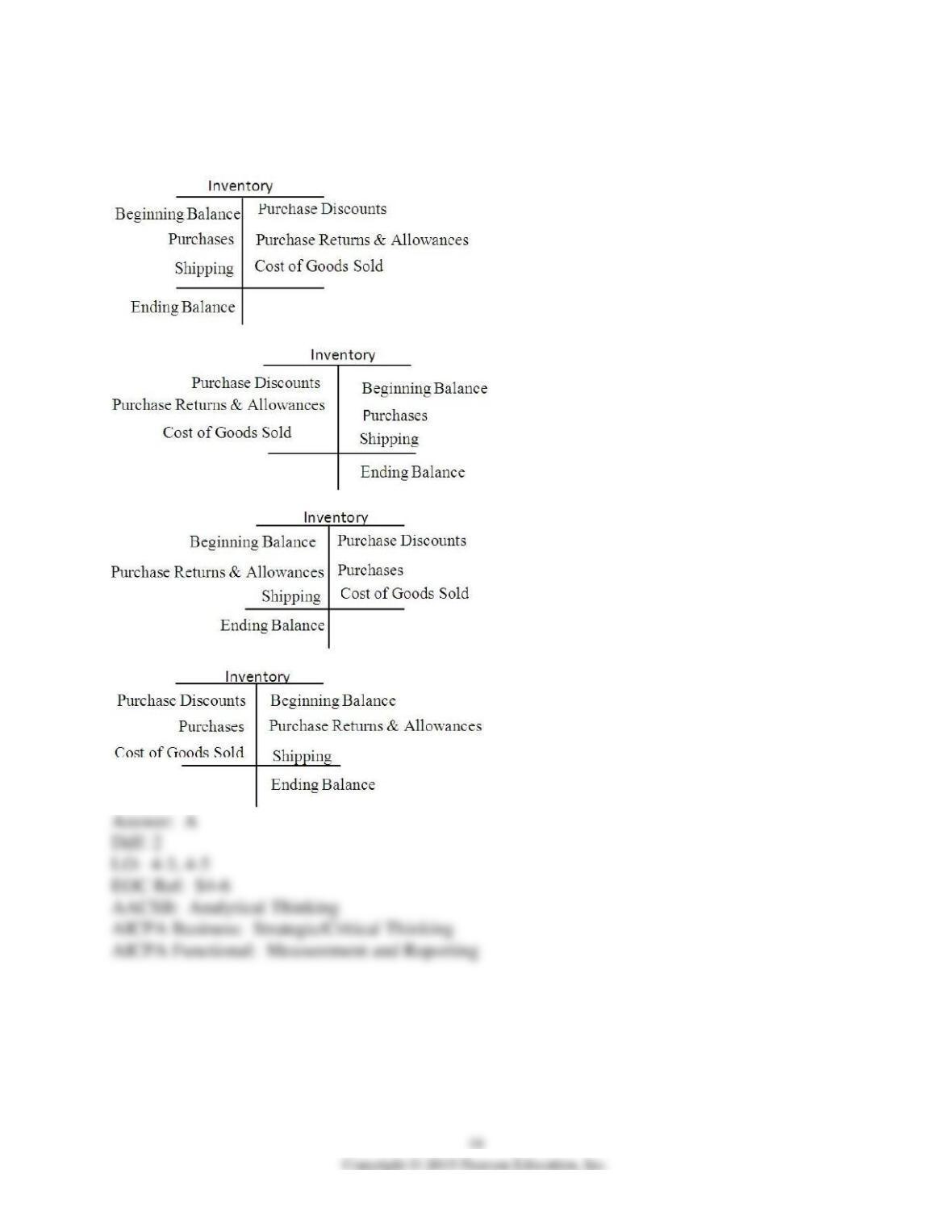
32) Under the perpetual inventory system, which of the following T-accounts correctly shows the
cost flows through the Inventory account?
A)
B)
C)
D)
33) The journal entry to record the purchase of merchandise on credit, under the perpetual
inventory system is:
A) Debit Purchases, credit Accounts Payable
B) Debit Cost of Goods Sold, credit Accounts Payable
C) Debit Inventory, credit Accounts Payable
D) Debit Purchases, credit Inventory
34) If an invoice shows a total of $5,000 with terms 5/15, n/60, which of the following is NOT a
true statement?
A) The customer must pay $5,000 within 60 days after the date of the invoice.
B) The customer may pay $4,750 within 15 days to satisfy the bill.
C) The customer will receive a 10% discount if they pay within 60 days.
D) The customer has a discount period of 15 days.
4.4 Questions
1) Sales Discounts and Sales Returns and Allowances are contra-accounts of the Sales account.
2) Debit card and credit card sales are counted as cash transactions.