Financial Accounting, 3e (Kemp/Waybright)
Chapter 11 The Statement of Cash Flows
11.1 Questions
1) The cash flow statement and Balance Sheet use accrual accounting.
2) The Balance Sheet reports the ending cash, but does not include cash equivalents.
3) A comparative Balance Sheet reports at least two consecutive years of information that can be
used to compile a Statement of Cash Flows.
4) A comparative Balance Sheet details why the ending cash balance increased or decreased.
5) The Statement of Cash Flows is prepared to show why the cash amount changed from the
beginning of the period to the end of the period.
6) A Statement of Cash Flows shows the company’s sources of cash, but does not detail how the
cash was used by the company.
7) The Statement of Cash Flows reports the sources and uses of cash from all of the following
EXCEPT:
A) managerial activities.
B) financing activities.
C) operating activities.
D) investing activities.
8) The ________ is the financial statement associated with the operating, investing and financing
activities of a corporation.
A) Income Statement
B) Statement of Stockholders’ Equity
C) Statement of Cash Flows
D) Balance Sheet
9) The accuracy of the Statement of Cash Flows can be verified by computing the change in the
balance of the:
A) cash and cash equivalent accounts.
B) equity account.
C) revenue accounts.
D) asset and liability accounts.
10) The purpose of the Statement of Cash Flows is to show:
A) the revenue earned.
B) the profits that were earned.
C) the expenses that were paid.
D) how cash was received and used during the period.
11) The cash flow statement is the communicating link between the:
A) Statement of Stockholders’ Equity and the cash reported on the Balance Sheet.
B) Income Statement and the Statement of Stockholders’ Equity.
C) cash reported on the Balance Sheet and the accrual based Income Statement.
D) cash reported on the Balance Sheet and the Statement of Stockholders’ Equity.
11.2 Questions
1) For a business to remain successful, investing activities must be the main source of its cash
over the long run.
2) The difference between the direct and indirect methods is the format of the financing section.
3) The three types of business activities on a Statement of Cash Flows are operating, investing,
and management activities.
4) Operating activities reflect such things as purchasing fixed assets.
5) Cash received from issuing stock would be included in financing activities.
6) Current assets on the Balance Sheet would be affected by and be part of operating activities.
7) The direct method of formatting a Statement of Cash Flows starts with net income.
8) The investing and financing sections of the Statement of Cash Flows is the same for the
indirect and direct method.
9) The Cash Flows from operations arrived at using the indirect method is different than that
arrived at using the direct method.
10) Which of the following is NOT a part of operating activities?
A) Paying dividends
B) Paying payables
C) Earnings revenue
D) Paying utilities
11) Which of the following is NOT a part of investing activities?
A) Buying a building
B) Collecting on a loan receivable
C) Borrowing money
D) Selling off equipment
12) Which of the following is NOT a part of financing activities?
A) Paying dividends
B) Issuing stock
C) Paying off loans
D) Buying land
13) Operating Cash Flows affect:
A) current assets and current liabilities.
B) long-term asset accounts.
C) equity accounts.
D) long-term liability accounts.
14) Investing Cash Flows affect:
A) current assets and current liabilities.
B) long-term asset accounts.
C) equity accounts.
D) long-term liability accounts.
15) Financing activities affect:
A) current and long-term assets.
B) current and long-term liabilities.
C) current assets and current liabilities.
D) long-term liabilities and equity accounts.
16) Which of the following activities is computed differently using the two methods of
formatting a Statement of Cash Flows?
A) Operating activities
B) Financing activities
C) Investing activities
D) Both operating activities and investing activities
17) Operating activities are transactions and events associated with selling a product or providing
a service related to the:
A) revenues and expenses reported on the Income Statement.
B) assets and liabilities reported on the Balance Sheet.
C) net income reported on the Statement of Retained Earnings.
D) Retained Earnings reported on the Balance Sheet.
18) When comparing net cash provided by operations using the direct method versus indirect
method, we find that:
A) net cash is higher using the indirect method.
B) net cash is lower using the indirect method.
C) there is no difference in the net cash between the two methods.
D) Depreciation Expense is used in the direct method.
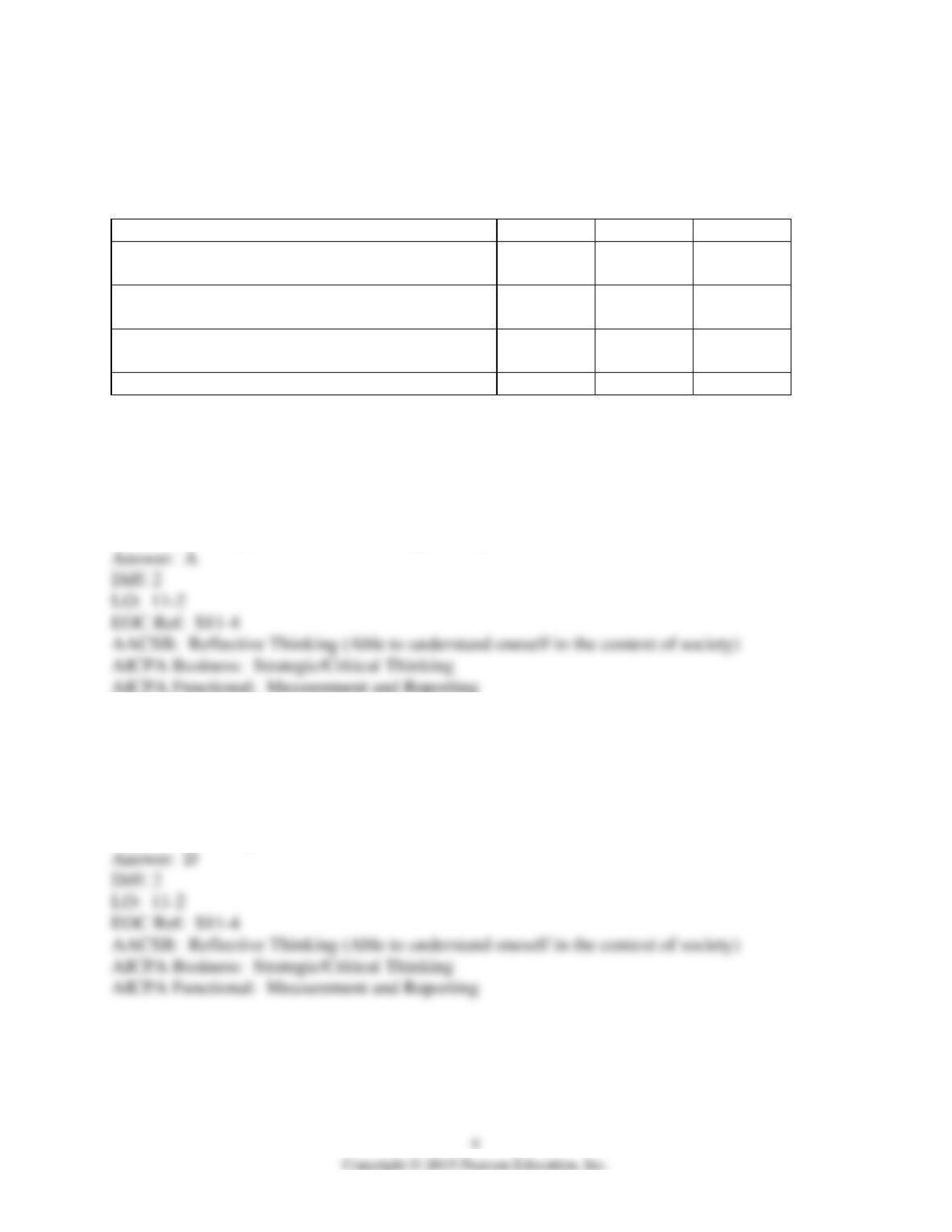
19) As you approach graduation, you are evaluating your job offers from the following
companies. Assuming that all other factors are equal (pay, benefits, location, job duties, industry,
company size, company age etc.), for which of the following companies would you chose to
work and why?
A
B
C
Cash Flows from operations
+$115,000
$100,000
$0
Cash Flows from investing activities
($20,000)
$0
Cash Flows from financing activities
+$5,000
+$100,000
Net increase in cash for the most current year
+$100,000
+$100,000
+$100,000
A) Company A, the company is generating cash from its daily operations, investing in long-term
assets and generating cash from its’ owners or borrowing a relatively small amount.
B) Company B, the company only generates cash from its daily operations and is not spending
the cash for any other reason.
C) Company C, the company only generates cash from the owners.
D) All three companies offer the same opportunity for the future.
20) Are all increases to cash from financing activities the result of a favorable situation?
A) Yes, an increase to cash is always good.
B) No, cash could increase in this category as a result of replacing long-term assets.
C) Yes, this increase would reflect the results of the company’s daily activities.
D) No, although some increases in this category could be positive, some, such as an increase in
long-term debt might be the result of an unfavorable situation.
21) Are all decreases to cash the result of an unfavorable situation?
A) Yes, decreases to cash are always bad.
B) No, cash could decrease as a result of acquiring long-term assets which the company needs to
expand or stay competitive.
C) Yes, cash could decrease as a result of paying off long-term debt which is an unfavorable
action to take.
D) No, cash could decrease because the company issued more stock.
22) Aspen Corp. sold an asset with a book value of $56,000 for $35,000 cash. Which of the
following is a TRUE statement?
A) Loss on sale equals $35,000 and Cash inflow equals $35,000.
B) Loss on sale equals $56,000 and Cash inflow equals $56,000.
C) Loss on sale equals $21,000 and Cash inflow equals $35,000.
D) Loss on sale equals $35,000 and Cash inflow equals $21,000.
23) Bach Company sold an asset with a book value of $56,000 for $100,000 cash. Which of the
following is a TRUE statement?
A) Gain on sale equals $100,000 and Cash inflow equals $100,000.
B) Gain on sale equals $56,000 and Cash inflow equals $56,000.
C) Gain on sale equals $44,000 and Cash inflow equals $100,000.
D) Gain on sale equals $100,000 and Cash inflow equals $46,000.
24) Which of the following is NOT a source of cash for a business?
A) Operating the business
B) Long-term borrowing of cash
C) Buying long-term assets with cash
D) Stockholders’ cash investment
25) Which of the following is NOT a use of cash for a business?
A) Operating the business
B) Buying long-term assets with cash
C) Paying cash dividends
D) All of the above are uses of cash.
11.3 Questions
1) Most businesses prefer to use the indirect method of formatting a Statement of Cash Flows.
2) In order to prepare a Statement of Cash Flows using the indirect method, you need the Income
Statement only.
3) The operating section of a Statement of Cash Flows using the indirect method is prepared
differently from the operating section of a Statement of Cash Flows using the direct method.
4) Operating Cash Flows under the indirect method starts with the net income for the period from
the Income Statement.
5) Even though depreciation, depletion and amortization are expenses, they are considered non–
cash transactions and must be subtracted from net income in the operating activities section of an
indirect method cash flow statement.
6) Gains and losses do not represent Cash Flows.
7) Changes in the long-term assets and long-term liabilities accounts must be analyzed to
determine how they are presented in the operating section of a cash flow statement.
8) Acquisitions and sales of long-term assets belong in the financing section of a cash flow
statement using the indirect method.
9) Changes in long-term liabilities belong in the financing section of a cash flow statement using
the indirect method.
10) The sum of the net increases/decreases in the operating, investing and financing sections of
the cash flow statement is equal to the change in cash over the period.
11) A transaction that exchanged a building for shares of stock would be an investing activity
and would appear on the cash flow statement.
12) A transaction acquiring land by issuing a note for the full purchase price would not appear on
the cash flow statement because no cash was involved, but it may be disclosed in a separate
section.
13) Business transactions that do NOT involve the payment or receipt of cash are considered to
be non-cash transactions.
14) A decrease in a current liability causes an increase in cash.
15) Robbins Company distributed a 5% common stock dividend, this will be reported in the
financing activity section of the cash flow statement.
16) The purchase of treasury stock is shown as a cash outflow in the investing section of the cash
flow statement.
17) Gains on the sale of long-term assets are:
A) added to investing activities.
B) added to financing activities.
C) added to operating activities.
D) subtracted from operating activities.
18) Losses on the sale of long-term assets are:
A) added to operating activities.
B) subtracted from operating activities.
C) added to investing activities.
D) subtracted from investing activities.
19) Cash receipts from the sale of long-term assets, such as equipment and vehicles, are:
A) added to operating activities.
B) subtracted from operating activities.
C) added to investing activities.
D) subtracted from investing activities.
20) The cost of purchasing long-term assets, such as buildings and land, are:
A) added to operating activities.
B) subtracted from operating activities.
C) added to investing activities.
D) subtracted from investing activities.
21) Changes in all current assets EXCEPT ________ are adjustments to net income in the
operating section of an indirect cash flow statement.
A) prepaid expenses
B) inventory
C) cash
D) notes receivable
22) Which would be added back to net income in the operating section of an indirect cash flow
statement?
A) A decrease in Accounts Payable
B) Depreciation
C) An increase in Accounts Receivable
D) An increase in inventory
23) Which would NOT be subtracted from net income in the operating section of an indirect cash
flow statement?
A) An increase in prepaid expenses
B) An increase in Accounts Payable
C) A decrease in Accounts Payable
D) An increase in notes receivable
24) Which would be subtracted from net income in the operating section of an indirect cash flow
statement?
A) A decrease in Notes Payable
B) A decrease in prepaid expenses
C) An increase in sales tax payable
D) An increase in inventory
25) An example of a cash inflow from financing activities is:
A) collecting money owed by customers.
B) issuing preferred stock.
C) selling a piece of equipment.
D) paying off a bond.
26) An example of a cash outflow from financing activities is:
A) paying dividends in cash.
B) buying additional inventory.
C) selling land.
D) collecting notes receivable.
27) Transactions involving the purchase and sale of long-term assets, lending money and
collecting the principal on loans are called:
A) investing activities.
B) operating activities.
C) financing activities.
D) buying and selling activities.
28) An example of a cash outflow from investing activities is:
A) issuance of a note payable.
B) making a loan to another company.
C) paying cash dividends.
D) the purchase of treasury stock.
29) Which of the following is NOT a cash inflow or outflow from an investing activity?
A) A loan made to another party
B) A payment made to acquire property
C) The purchase of treasury stock
D) The sale of the common stock of another company which had been owned by our company.
30) Under the indirect method of cash flow, which of the following adjustments would NOT be
made to net income when computing cash from operating activities?
A) Add an increase in Accounts Payable
B) Add Depreciation Expense
C) Add a decrease in Accounts Payable
D) Subtract the gain on sale of land
31) In the indirect method of Cash Flows, which of the following would be added to net income?
A) A decrease in inventory
B) An increase in Prepaid Insurance
C) A decrease in Accounts Payable
D) An increase in Accounts Receivable
32) When preparing the Statement of Cash Flows by the indirect method, if current liabilities
increase, the difference is:
A) added to net income.
B) added to investing activities.
C) deducted from net income.
D) deducted from investing activities.
33) Under the indirect method, which of the following is NOT a proper adjustment to net income
under operating activities?
A) Adding a decrease in inventory
B) Subtracting an increase in salaries payable
C) Deducting an increase in prepaid expenses
D) Subtracting a gain on the sale of equipment
34) The Accounts Payable balance has decreased during the year. How would this affect the
Statement of Cash Flows operations section under the indirect method?
A) It is already included in the net income.
B) It would be added back to net income.
C) It would be subtracted from net income.
D) It does not affect the cash flow from operations.