Archives
EDU 16954
By what age have children learned to produce nearly all the consonants and vowels that make up the words of their native language? A. 2 B. 3 C. 5 D. 8 Each is an example of psychological processing except: A. […]
EDU 64687
Which of the following determines whether any student, with or without a disability, needs more intensive instruction? A. Response to intervention B. Universal Design for Learning C. Alternative assessment D. Positive behavior supports White students and which of the following […]
EDUC 24353
Advocacy involves each of the following EXCEPT: A. Seeking win-win solutions B. Preventing problems C. Keeping your conscience primed D. Affirming strengths The design of instructional materials and activities that make content information accessible to all children refers to: A. […]
EDUK 38868
Many school psychologists use which measure to determine the presence of ADHD? A. Attention Deficit Disorders Evaluation Scales B. Conner’s Rating Scales C. Peterson’s Rating Scales D. ADHD Assessment Tool Problem behavior typically serves: A. To get a student out […]
EDUK 41044
Which group is the most underrepresented in gifted education? A. Females B. Hispanics C. Black D. Asian/Pacific Islander The majority of students with intellectual disabilities have IQ ranges in which of the following? A. 50″55 to approximately 70 B. 35″40 […]
EDUK 48489
Within the second year of life, the spoken vocabulary of young children increases to which of the following? A.100 words B. 100-200 words C. 200-300 words D. 300-400 words Students with intellectual disabilities have difficulty transferring knowledge or behavior learned […]
SED AP 55999
Which of the following is a test of how well the middle ear is functioning and how well the eardrum can move? A. Audiograms B. Tympanography C. Audiometry D. Behavioral audiological evaluations Teaching students how to deal with fights between […]
SED CE 15413
Compare and contrast the causes of cerebral palsy, spina bifida, epilepsy, and asthma. In the RTI model, identification of learning disabilities is based on each of the following except: A. Response to instruction in terms of progress rates and performance […]
SED CE 80771
Based on an IQ score of 125″130 alone, what percent of the general population would be considered gifted? A. 10 to 15% B. 2 to 3% C. 5 to 8% D. About 20% What percent of TBIs are classified as […]
SED CE 87197
Which of the following identifies the academic content that students should master, the standards for the student’s achievement of content proficiency, and assessment of student progress in meeting the standards? A. Standards-based reform B. The general education curriculum C. Student […]
SED CE 97550
Autism is primarily: A. Biological in origin B. Behavioral in origin C. Environmental in origin D. Familial in origin According to the U.S. Department of Education, what percentage of school age children identified to receive special education services receives services […]
SED CE 99124
Which of the following allows teachers to track two aspects of a behavior together? A. A checklist B. A T-chart C. Curriculum-based measurement D. Goal attainment scaling Which of the following means providing services, resources, and personal assistance on a […]
SED DS 85037
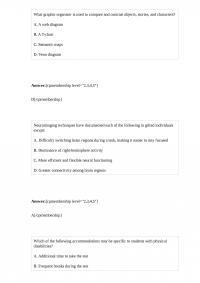
What graphic organizer is used to compare and contrast objects, stories, and characters? A. A web diagram B. A T-chart C. Semantic maps D. Venn diagram Neuroimaging techniques have documented each of the following in gifted individuals except: A. Difficulty […]
SED LR 44923
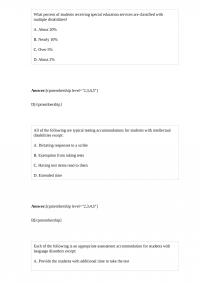
What percent of students receiving special education services are classified with multiple disabilities? A. About 20% B. Nearly 10% C. Over 5% D. About 2% All of the following are typical testing accommodations for students with intellectual disabilities except: A. […]
SED LR 87938
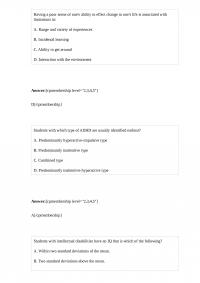
Having a poor sense of one’s ability to effect change in one’s life is associated with limitations in: A. Range and variety of experiences B. Incidental learning C. Ability to get around D. Interaction with the environment Students with which […]
SESP 13922
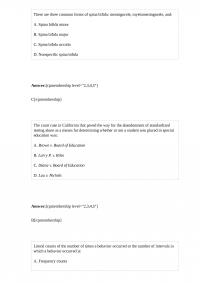
There are three common forms of spina bifida: meningocele, myelomeningocele, and: A. Spina bifida minor B. Spina bifida major C. Spina bifida occulta D. Nonspecific spina bifida The court case in California that paved the way for the abandonment of […]