Archives
ANT 19768
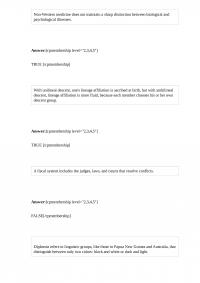
Non-Western medicine does not maintain a sharp distinction between biological and psychological illnesses. With unilineal descent, one’s lineage affiliation is ascribed at birth, but with ambilineal descent, lineage affiliation is more fluid, because each member chooses his or her own […]
ANT 21853
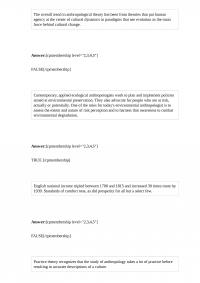
The overall trend in anthropological theory has been from theories that put human agency at the center of cultural dynamics to paradigms that see evolution as the main force behind cultural change. Contemporary, applied ecological anthropologists work to plan and […]
ANT 69251
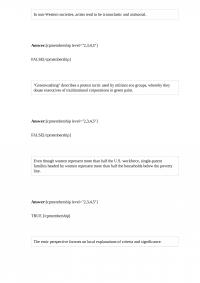
In non-Western societies, artists tend to be iconoclastic and antisocial. “Greenwashing” describes a protest tactic used by militant eco groups, whereby they douse executives of multinational corporations in green paint. Answer: FALSE Even though women represent more than half the […]
ANT 91641
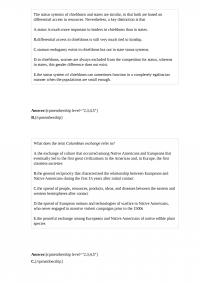
The status systems of chiefdoms and states are similar, in that both are based on differential access to resources. Nevertheless, a key distinction is that A.status is much more important to leaders in chiefdoms than in states. B.differential access in […]
CGS SS 11590
How did the Belgian colonizers of East Africa identify who was Tutsi and who was Hutu? A.individual self-identification B.the number of cattle owned C.previous census data D.phenotype, or how the individual physically looked E.unique tribal body modifications such as scar […]
CGS SS 52684
Which of the following statements about polyandry is most likely true? A.It is found only among fishing communities in Madagascar. B.It is a cultural adaptation to the high labor demands of rice cultivation. C.It is a cultural adaptation to mobility […]
CGS SS 64902
Early anthropologists explained incest taboos as a reflection of “instinctive horror” of mating with close relatives. However, this explanation for incest taboos has been rejected because formal incest restrictions would be unnecessary if humans really do have an instinctive aversion […]
CGS SS 67584
Although anthropologists may be interested in contemporary global issues such as climate change, their perspective is necessarily limited to the local scale of their fieldwork. Survey research is usually conducted through intensive personal contact with the study subjects. Answer: FALSE […]
SOC 10383
The children of your father’s sister are called your cross cousins. The U.S. government continues to subsidize its own corn farmers, who otherwise would go out of business. Answer: TRUE Most band and tribal societies in the world today are […]

SOC 51206
There is no difference between the biological and cultural definitions of race. In the Igbo women’s war, women used song, dance, noise, and “in-your-face” behavior to attempt to subvert formal authority, but women did not gain any greater influence. Answer: […]
SOC 85996
Status in chiefdoms and states is based primarily on differential access to resources. The cargo cults of Melanesia functioned to integrate Melanesians and set the stage for the formation of political parties and economic interest groups. Answer: TRUE Human biological […]

SOC 93915
The Samoan community living in Los Angeles has successfully used the matai system to deal with modern urban problems. The term indigenous people gained legitimacy within international law with the creation in 1982 of the United Nations Working Group on […]

SSCI 32350
Like race, kinship is a cultural construction, in that it exhibits considerable cultural diversity. African American Vernacular English (AAVE) is an incomplete linguistic system that is able only to express thoughts and ideas related to life in inner-city communities. Answer: […]
SSCI 42271
A descent group consists only of a married couple and their children. Among the classic works of processual approaches to culture is Edmund Leach’s Political Systems of Highland Burma. This study made a tremendously important point by taking a regional […]
SSCI 68697
What postmarital residence rule is most often found in societies with lineal kinship terminologies? A.ambilocal B.neolocal C.patrilocal D.matrilocal E.bilocal All cultures have taboos against ________, sexual relations with someone considered to be a close relative, although precisely what constitutes a […]