Archives
BUS 12172
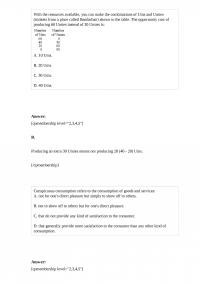
With the resources available, you can make the combinations of Ums and Umies (trinkets from a place called Bandarban) shown in the table. The opportunity cost of producing 60 Umies instead of 30 Umies is: A. 10 Ums. B. 20 […]
BUS 50198
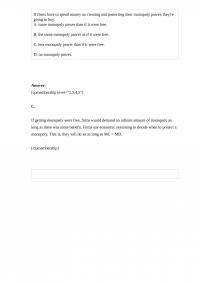
If firms have to spend money on creating and protecting their monopoly power, they’re going to buy: A. more monopoly power than if it were free. B. the same monopoly power as if it were free. C. less monopoly power […]
BUS 52011
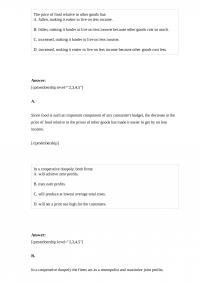
The price of food relative to other goods has: A. fallen, making it easier to live on less income. B. fallen, making it harder to live on less income because other goods cost so much. C. increased, making it harder […]
BUS 52667
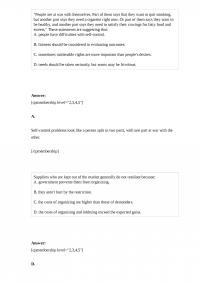
“People are at war with themselves. Part of them says that they want to quit smoking, but another part says they need a cigarette right now. Or part of them says they want to be healthy, and another part says […]
BUS 53334
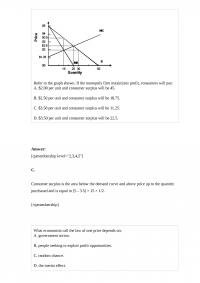
Refer to the graph shown. If the monopoly firm maximizes profit, consumers will pay: A. $2.00 per unit and consumer surplus will be 45. B. $2.50 per unit and consumer surplus will be 18.75. C. $3.50 per unit and consumer […]
BUS 67060
What percent of all jobs in the United States are in manufacturing? A. 10 percent. B. 30 percent. C. 50 percent. D. 70 percent. Answer: The Industrial Revolution was important to the history of economic systems because it: A. changed […]
BUS 76294
Behavioral economists have found that people are more willing to save if saving is the default option, as in the case in which they have to opt out of an automatic payroll deduction savings plan. Economists call this: A. a […]
BUS 83172
John Rawls’s views on income distribution and fairness can best be described by the statement: A. The lesser individuals’ duty should be to work for the well-being of the brightest individuals. B. A high level of income inequality is necessary […]
BUS 86514
The infant industry argument for protection is: A. rejected by many economists because they oppose any government intervention. B. accepted by most economists because historical experience supports it. C. rejected by most economists because many infant industries become reliant on […]
BUS 87278
Flu vaccinations of school children have the unintended effect of protecting the vulnerable elderly from contracting the virus. This is an example of a: A. free rider problem. B. social force. C. goods distribution. D. positive externality. Answer: If the […]
BUS 92819
One issue with using lifetime earnings as a proxy for human life is that it treats upper-income jobs and hence individuals in those jobs as more valuable than lower-income individuals. Answer: When some people do not act rationally, others can […]
ECB 26947
An agreement in which the incentives of both parties match their goals as closely as possible is: A. an X-inefficiency contract. B. a public good. C. an incentive-compatible contract. D. a corporate takeover contract. Answer: Refer to the table above. […]
ECB 27125
If federal, state, and local governments were unable to raise any revenue, then government’s role as: A. only a referee would be unaffected. B. only an actor would be unaffected. C. both an actor and a referee would be eliminated. […]
ECB 31249
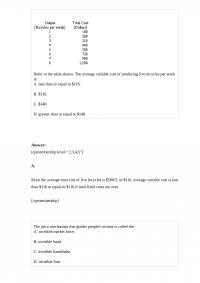
Refer to the table shown. The average variable cost of producing five bicycles per week is: A. less than or equal to $116. B. $116. C. $140. D. greater than or equal to $140. Answer: The price mechanism that guides […]
ECB 43078
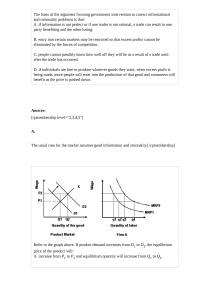
The basis of the argument favoring government intervention to correct informational and rationality problems is that: A. if information is not perfect or if one trader is not rational, a trade can result in one party benefiting and the other […]
ECB 48324
According to the contestable market model, the higher an industry’s concentration ratio, the more profitable the industry. Answer: Domestic producers prefer quotas to tariffs because quotas raise the price of imports and tariffs do not. Answer: FALSE Both quotas and […]
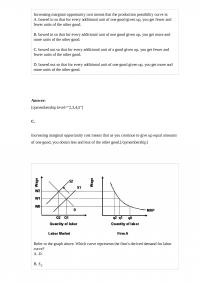
ECB 56867
Increasing marginal opportunity cost means that the production possibility curve is: A. bowed in so that for every additional unit of one good given up, you get fewer and fewer units of the other good. B. bowed in so that […]
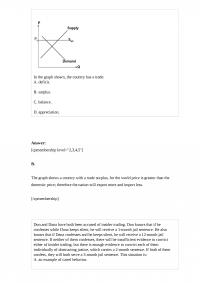
ECB 62225
In the graph shown, the country has a trade: A. deficit. B. surplus. C. balance. D. appreciation. Answer: Don and Dana have both been accused of insider trading. Don knows that if he confesses while Dana keeps silent, he will […]
ECB 62534
In the long run all inputs are variable; in the short run some inputs are fixed. Answer: The distinction between capitalism and socialism is less relevant in the real world today than it was 30 years ago. Answer: TRUE The […]
ECB 63212
Which of the following is an example of a nudge? A. Income is redistributed through tax and spending programs. B. A farmer’s market raises prices because a storm destroyed crops. C. Government taxes cigarettes. D. An employee must check a […]
ECB 67200
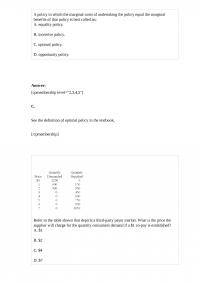
A policy in which the marginal costs of undertaking the policy equal the marginal benefits of that policy is best called an: A. equality policy. B. incentive policy. C. optimal policy. D. opportunity policy. Answer: Refer to the table shown […]
ECB 68614
If a country has a comparative advantage in the production of a good, its resources are better suited to the production of that good than are the resources of other countries. Answer: In the short run when the number of […]
ECB 76027
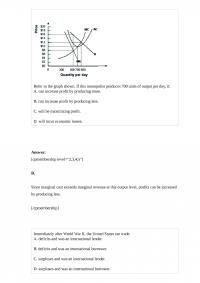
Refer to the graph shown. If this monopolist produces 700 units of output per day, it: A. can increase profit by producing more. B. can increase profit by producing less. C. will be maximizing profit. D. will incur economic losses. […]
ECB 92877
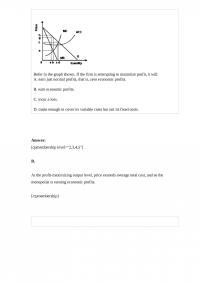
Refer to the graph shown. If the firm is attempting to maximize profit, it will: A. earn just normal profits, that is, zero economic profits. B. earn economic profits. C. incur a loss. D. make enough to cover its variable […]
ECB 94862
In the early 2000s car sales in China had slowed in part caused by the government’s actions to limit businesses from lending funds to consumers. Assuming the car market in China can be analyzed with demand and supply curves, what […]
ECB 94897
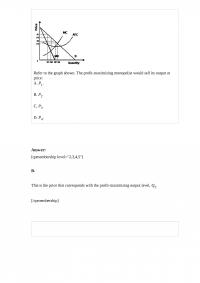
Refer to the graph shown. The profit-maximizing monopolist would sell its output at price: A. P1. B. P2. C. P3. D. P4. Answer: B. This is the price that corresponds with the profit-maximizing output level, Q2. Refer to the graph […]
ECB 98366
A system in which power plants buy and sell the right to pollute in the form of emission credits is known as: A. a voluntary program. B. direct regulation. C. a tax incentive program. D. a market incentive program. Answer: […]
ECON 13521
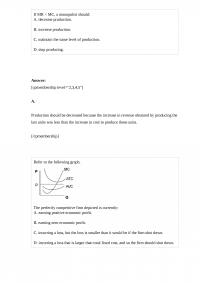
If MR < MC, a monopolist should: A. decrease production. B. increase production. C. maintain the same level of production. D. stop producing. Answer: Refer to the following graph. The perfectly competitive firm depicted is currently: A. earning positive economic […]
ECON 19246
Barriers to entry: A. do not affect the number of firms in an industry. B. exist only in perfectly competitive markets. C. restrict the number of firms in an industry. D. limit output in an industry. Answer: A labor supply […]
ECON 19507
Suppose a lazy monopolist’s fixed costs are lower than the fixed costs of an inefficient monopolist. In all other respects, the monopolists are the same. Which of the following statements about this monopolist is true? A. It charges a higher […]
ECON 26306
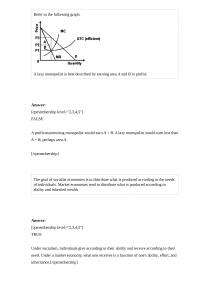
Refer to the following graph. A lazy monopolist is best described by earning area A and B in profits. Answer: The goal of socialist economies is to distribute what is produced according to the needs of individuals. Market economies tend […]
ECON 33891
In general, the greater the elasticity, the: A. smaller the responsiveness of price to changes in quantity. B. smaller the responsiveness of quantity to changes in price. C. larger the responsiveness of price to changes in quantity. D. larger the […]
ECON 49955
Joseph Gallo poured two glasses of wine from the same bottle but put a more expensive price tag on one glass than on the other. He let people test both and asked them which they wanted, and most wanted the […]
ECON 51828
The statement, “Assuming that if it is rational for one person to stand at a football game to get a better view then it is rational for everyone to stand at a football game to get a better view” is […]
ECON 60491
Alex is playing his music at full volume in his dorm room. The other people living on his floor are enjoying his music, but Alex does not know or care. Alex’s music playing is an example of a: A. negative […]
ECON 60567
In Minnesota, tax collectors found that threatening late filers with warnings and fines does not increase tax compliance. Instead, they publicized the fact that most Minnesotans had already filled in their returns. What type of nudge is this? A. an […]
ECON 68662
If marginal utility is declining but still positive, total utility is increasing. Answer: Deciding what the distribution of income should be is an example of normative economics. Answer: TRUE This statement questions what the goals of the economy should be […]
ECON 73631
A life insurance company is likely to require a health examination of a person applying for insurance. This helps reduce the informational problem through the process of: A. signaling. B. screening. C. creating an externality. D. government regulation. Answer: Strategic […]
ECON 75597
Because income differs so much by type of job, some economists argue that a new class distinction has emerged between: A. union and nonunion workers. B. workers and capitalists. C. professionals and nonprofessionals. D. salaried workers and the self-employed. Answer: […]
ECON 87383
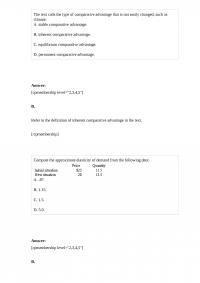
The text calls the type of comparative advantage that is not easily changed, such as climate: A. stable comparative advantage. B. inherent comparative advantage. C. equilibrium comparative advantage. D. permanent comparative advantage. Answer: Compute the approximate elasticity of demand from […]
ECON 88860
Assume that in Canada the opportunity cost of producing one television set is two bushels of wheat. Assume that in the United States the opportunity cost of producing one bushel of wheat is two television sets. If these two countries […]
ECON 95420
Alan is sitting in a bar drinking beers that cost $1 each. According to the economic decision rule, Alan will quit drinking when the marginal: A. benefit to him of an additional beer is less than $1. B. cost to […]
ECON A 12977
If 1 Canadian dollar costs 0.60 U.S. dollar, 1 U.S. dollar costs: A. 0.40 Canadian dollar. B. 0.60 Canadian dollar. C. 1.40 Canadian dollars. D. 1.67 Canadian dollars. Answer: Judgment by performance means that the competitiveness of a market is […]
ECON A 25700
Economics is an art because it: A. is not scientific. B. relies entirely on value judgments. C. blends objective and subjective analyses. D. blends positive and objective analyses. Answer: If a nation has a comparative advantage in the production of […]
ECON A 29109
Capitalism: A. is based on private property and the market. B. does not have a rationing mechanism. C. gives private property rights to government. D. relies on market forces to establish initial property rights. Answer: Which of the following statements […]
ECON A 44284
Several firms are operating in a market where they take the other firms’ response to their actions into account. This market is: A. a competitive market. B. a monopolistically competitive market. C. an oligopolistic market. D. a monopoly. Answer: Total […]
ECON A 80762
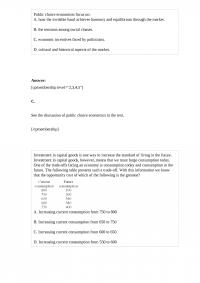
Public choice economists focus on: A. how the invisible hand achieves harmony and equilibrium through the market. B. the tensions among social classes. C. economic incentives faced by politicians. D. cultural and historical aspects of the market. Answer: Investment in […]
ECON A 85347
The discovery of a significant new source of oil that can be exported will lead to: A. depreciation of the currency and a loss of comparative advantage in other sectors. B. depreciation of the currency and a gain of comparative […]
ECON A 86457
The higher the concentration ratio in a given industry, the: A. closer the industry is to a perfectly competitive market structure. B. larger the market shares of the smallest four firms in the industry. C. closer the industry is to […]
ECON A 87802
Labor demand is less elastic when: A. there are many substitutes for labor in the production process. B. the inputs that could be substituted for labor are relatively inexpensive. C. a large amount of labor is essential to the production […]
ECON A 99149
Paternalism describes a situation in which: A. the government passes laws that require citizens to change their behavior. B. people are likely to make bad decisions over and over. C. there is no role for firms to influence people’s behavior. […]
ECON E 15638
Susan’s price elasticity of restaurant meals is 2.27. If the price of a restaurant meal falls by 2 percent, the quantity of restaurant meals Susan demands will: A. increase by 2.27 percent. B. fall by 2.27 percent. C. increase by […]
ECON E 26259
A developing country can be expected to rely more on: A. tariffs than quotas since tariffs are an easy way to raise tax revenue. B. tariffs than quotas because tariffs are more effective means of reducing imports. C. quotas than […]
ECON E 28304
Fixed costs exist only in the: A. long run when some inputs are fixed. B. long run when all inputs are fixed. C. short run when some inputs are fixed. D. short run when all inputs are fixed. Answer: The […]
ECON E 38892
Economists agree that: A. sometimes incentives facing a decision -maker will not achieve the desired result. B. incentives are likely to be inconsequential unless prices are involved. C. social and moral pressures cannot be modeled. D. markets are always the […]
ECON E 46950
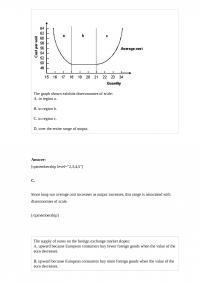
The graph shown exhibits diseconomies of scale: A. in region a. B. in region b. C. in region c. D. over the entire range of output. Answer: The supply of euros on the foreign exchange market slopes: A. upward because […]
ECON E 50755
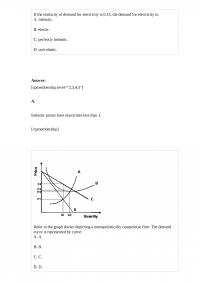
If the elasticity of demand for electricity is 0.13, the demand for electricity is: A. inelastic. B. elastic. C. perfectly inelastic. D. unit elastic. Answer: Refer to the graph shown depicting a monopolistically competitive firm. The demand curve is represented […]
ECON E 61852
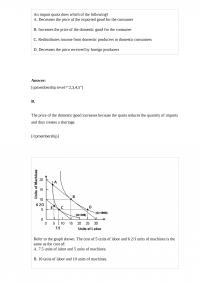
An import quota does which of the following? A. Decreases the price of the imported good for the consumer B. Increases the price of the domestic good for the consumer C. Redistributes income from domestic producers to domestic consumers D. […]
ECON E 90354
Globalization has made economies of scope: A. more important to firms because global corporations can segment the production process. B. more important to firms because global corporations do not have to segment the production process. C. less important to firms […]
ECON E 95663
A tariff is: A. a tax that government places on imported goods. B. a quantity limitation placed on imports C. an all-out restriction on imports. D. a government-imposed procedural rule limiting imports. Answer: The Mexican demand for American goods leads […]
Economics 11880
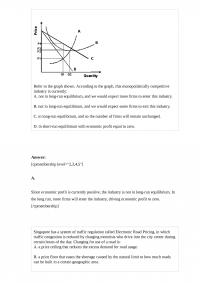
Refer to the graph shown. According to the graph, this monopolistically competitive industry is currently: A. not in long-run equilibrium, and we would expect more firms to enter this industry. B. not in long-run equilibrium, and we would expect some […]
Economics 13264
Andy is offered the following two income scenarios: (1) earn $10,000 the first year, $12,000 the second year, and $15,000 the third year or (2) earn $15,000 the first year, $12,000 the second year, and $10,000 the third year. Which […]
Economics 16512
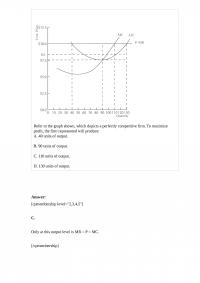
Refer to the graph shown, which depicts a perfectly competitive firm. To maximize profit, the firm represented will produce: A. 40 units of output. B. 90 units of output. C. 110 units of output. D. 130 units of output. Answer: […]
Economics 47631
The statistical analysis of economic data is referred to as: A. microeconomics. B. econometrics. C. deductive reasoning. D. calculus. Answer: Demand for single occupancy apartments is Qd = 400,000 – 250 P. Supply is given by Qs = 200,000 + […]
Economics 49018
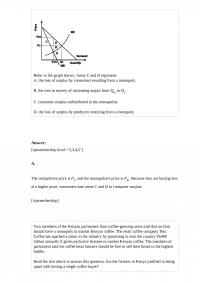
Refer to the graph shown. Areas C and D represent: A. the loss of surplus by consumers resulting from a monopoly. B. the cost to society of increasing output from Qm to Qc. C. consumer surplus redistributed to the monopolist. […]
Economics 50282
The higher is an industry’s concentration ratio, the more competitive is the industry. Answer: Revenue remains unchanged along a straight-line demand curve. Answer: FALSE Revenue is greatest at the midpoint of a straight-line demand curve (where elasticity of demand equals […]
Economics 63180
Compared with a normal monopolist, an effective price-discriminating monopolist produces a: A. smaller output at a lower profit. B. smaller output but at a larger profit. C. larger output at a larger profit. D. larger output but at a lower […]
Economics 69549
According to economic theory, a monopolist would hire a lobbyist only if the expected marginal benefit of lobbying exceeded the marginal cost. Answer: If the price of corn goes up by $1 a bushel and the quantity supplied rises by […]
Economics 82951
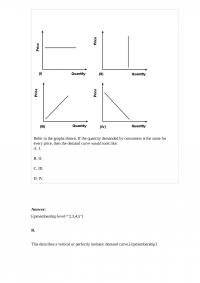
Refer to the graphs shown. If the quantity demanded by consumers is the same for every price, then the demand curve would look like: A. I. B. II. C. III. D. IV. Answer: B. This describes a vertical or perfectly […]
Economics 86116
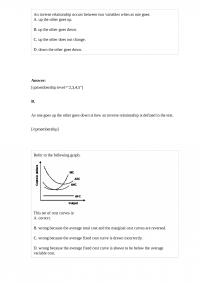
An inverse relationship occurs between two variables when as one goes: A. up the other goes up. B. up the other goes down. C. up the other does not change. D. down the other goes down. Answer: Refer to the […]
Economics 90648
Assume that in Canada the opportunity cost of producing one television set is two bushels of wheat. Assume that in the United States the opportunity cost of producing one bushel of wheat is two television sets. If these two countries […]
Economics 94550
“Letting the data speak” in economics refers to: A. using a layperson’s terms in publications to explain your findings. B. collecting and analyzing data with econometric tools. C. focusing only on the heuristic model. D. using only deductive reasoning. Answer: […]
MicroEconomic 16403
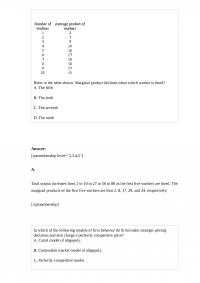
Refer to the table shown. Marginal product declines when which worker is hired? A. The fifth B. The sixth C. The seventh D. The ninth Answer: In which of the following models of firm behavior do firms make strategic pricing […]
MicroEconomic 18473
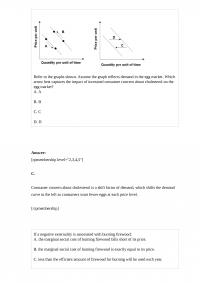
Refer to the graphs shown. Assume the graph reflects demand in the egg market. Which arrow best captures the impact of increased consumer concern about cholesterol on the egg market? A. A B. B C. C D. D Answer: If […]
MicroEconomic 53383
The rule for making optimal decisions is that an activity should be increased until: A. average costs are minimized. B. total costs are minimized. C. total benefits are maximized. D. marginal benefits equal marginal costs. Answer: Along a straight-line demand […]
MicroEconomic 68186
If the average cost of producing 9 sweaters is $6.50 and the marginal cost of producing the tenth sweater is $6.75, the average cost of producing 10 sweaters will: A. be $6.50. B. be more than $6.50. C. be less […]
MicroEconomic 71403
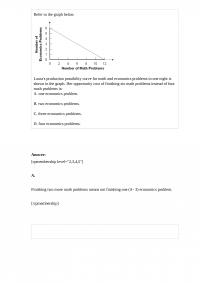
Refer to the graph below. Laura’s production possibility curve for math and economics problems in one night is shown in the graph. Her opportunity cost of finishing six math problems instead of four math problems is: A. one economics problem. […]
MicroEconomic 77476
At one time, sea lions were depleting the stock of steelhead trout. One idea to scare sea lions away from the Washington coast was to launch fake killer whales, which are predators of sea lions. The cost of making the […]
MicroEconomic 78087
Dynamic pricing allows a website to use the personal information collected on a customer, such as income or location, to individualize the price of a product for each customer. Economists consider this type of pricing an example of: A. consumer […]
MicroEconomic 82657
Opening an industry to international competition tends to: A. increase X-inefficiency. B. force lazy monopolists to increase efficiency. C. increase the incidence of lazy monopolists. D. raise a monopolist’s profit as the price is driven up. Answer: If the law […]
MicroEconomic 86292
Relying on experiments and statistical analysis of real-world observations is the premise behind: A. heuristic economics. B. traditional economics. C. modern economics. D. Keynesian economics. Answer: The central characteristic of oligopolistic industries is: A. interdependent pricing decisions. B. flexible prices. […]
MicroEconomic 96026
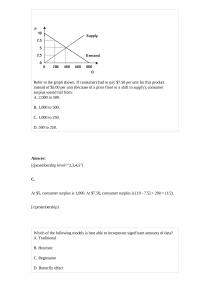
Refer to the graph shown. If consumers had to pay $7.50 per unit for this product instead of $5.00 per unit (because of a price floor or a shift in supply), consumer surplus would fall from: A. 2,000 to 500. […]
MicroEconomic 97712
Say that Janie is exhibiting the endowment effect as she makes a decision. She is: A. deciding on the basis of sunk costs. B. valuing what she already has more. C. consuming on the basis of endorsements by celebrities. D. […]
MicroEconomic 97965
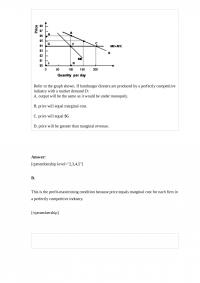
Refer to the graph shown. If hamburger dinners are produced by a perfectly competitive industry with a market demand D: A. output will be the same as it would be under monopoly. B. price will equal marginal cost. C. price […]