The higher the concentration ratio in a given industry, the:
A. closer the industry is to a perfectly competitive market structure.
B. larger the market shares of the smallest four firms in the industry.
C. closer the industry is to an oligopolistic or monopolistic type of market structure.
D. smaller the market shares of the largest four firms in the industry.
Answer:
If you are carrying out purposeful behavior, you are:
A. making completely irrational judgments.
B. using reflection and making reasoned judgments.
C. completely rational.
D. a heuristic individual.
Answer:

On its horizontal axis, a Lorenz curve measures:
A. cumulative percentage of family income.
B. amount of family income.
C. cumulative percentage of families.
D. demand of families.
Answer:
Taking explicit account of a rival’s expected response to a decision you are making is
called:
A. economic decision making.
B. monopolistic decision making.
C. strategic decision making.
D. competitive decision making.
Answer:
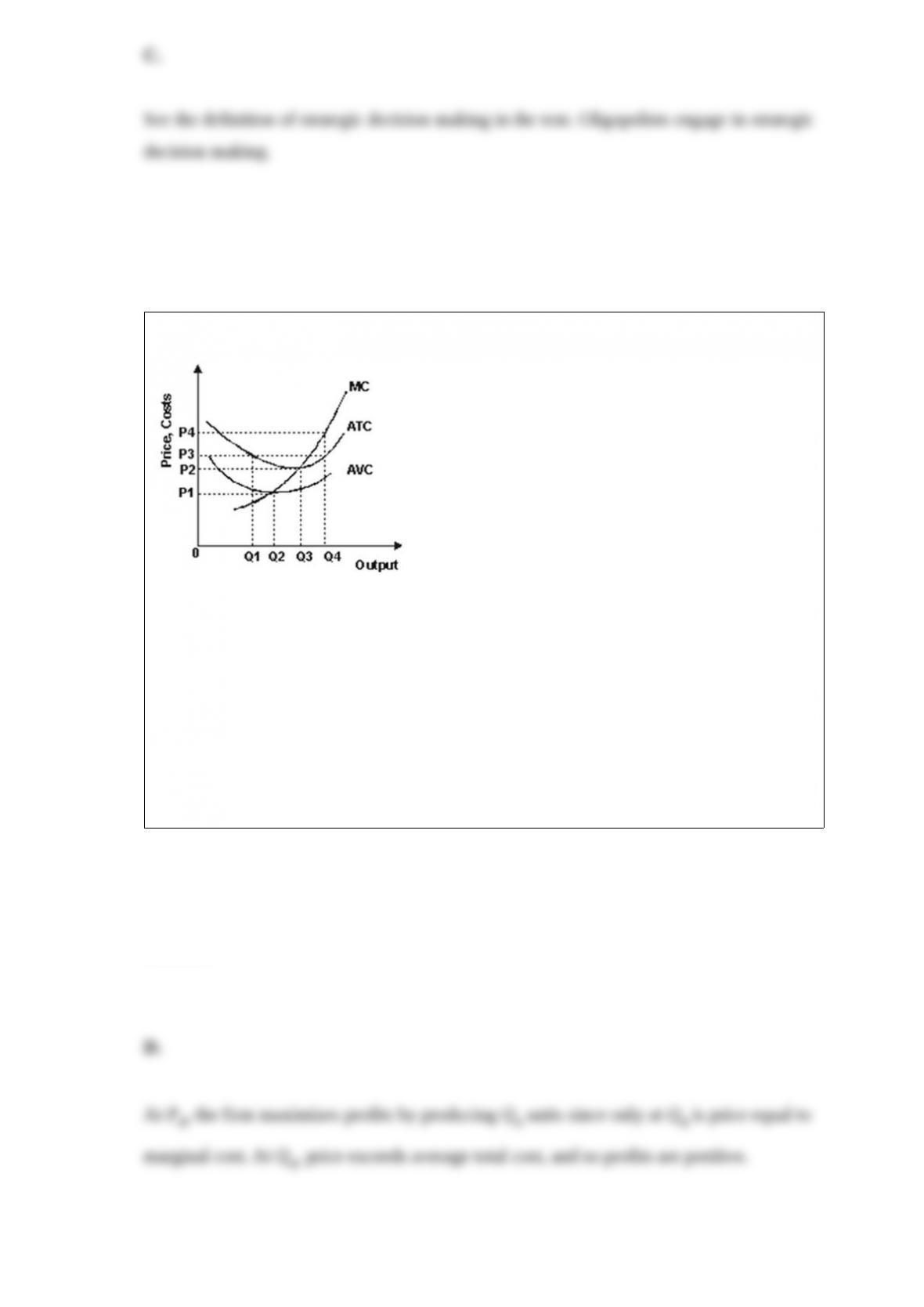
Refer to the graph shown. If the market price is P4, the firm will produce:
A. Q2 and incur a loss.
B. Q3 and break even.
C. Q3 and earn a profit.
D. Q4 and earn a profit.
Answer:
Services make up about what percentage of the U.S. economy?
A. 15 percent
B. 25 percent
C. 55 percent
D. 85 percent
Answer:
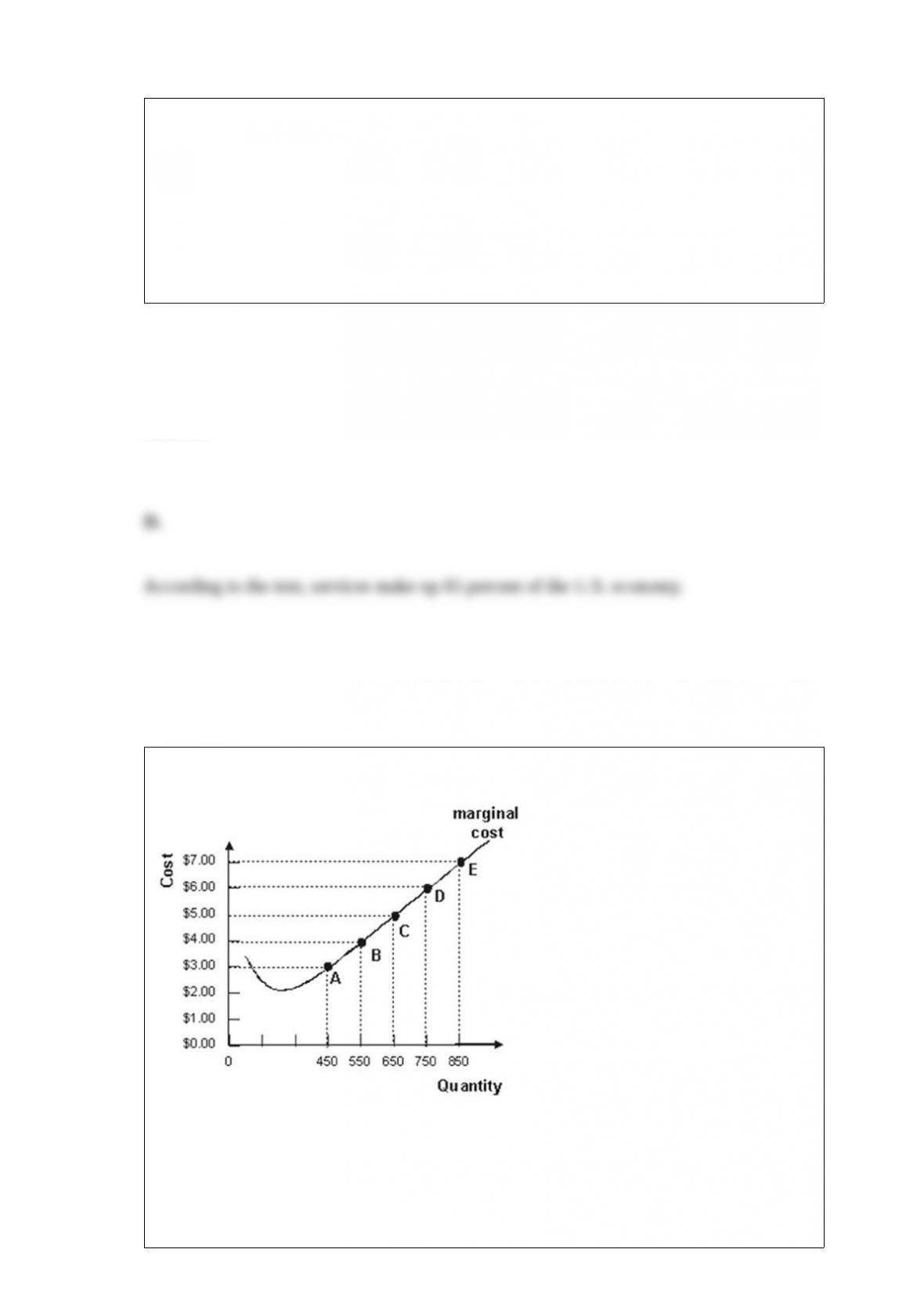
Refer to the graph shown. If market price is currently $5.00 per unit, this perfectly
competitive firm will maximize profit by producing:
A. 450 units of output.
B. 650 units of output.
C. 850 units of output.
D. between 550 and 650 units of output.
Answer:
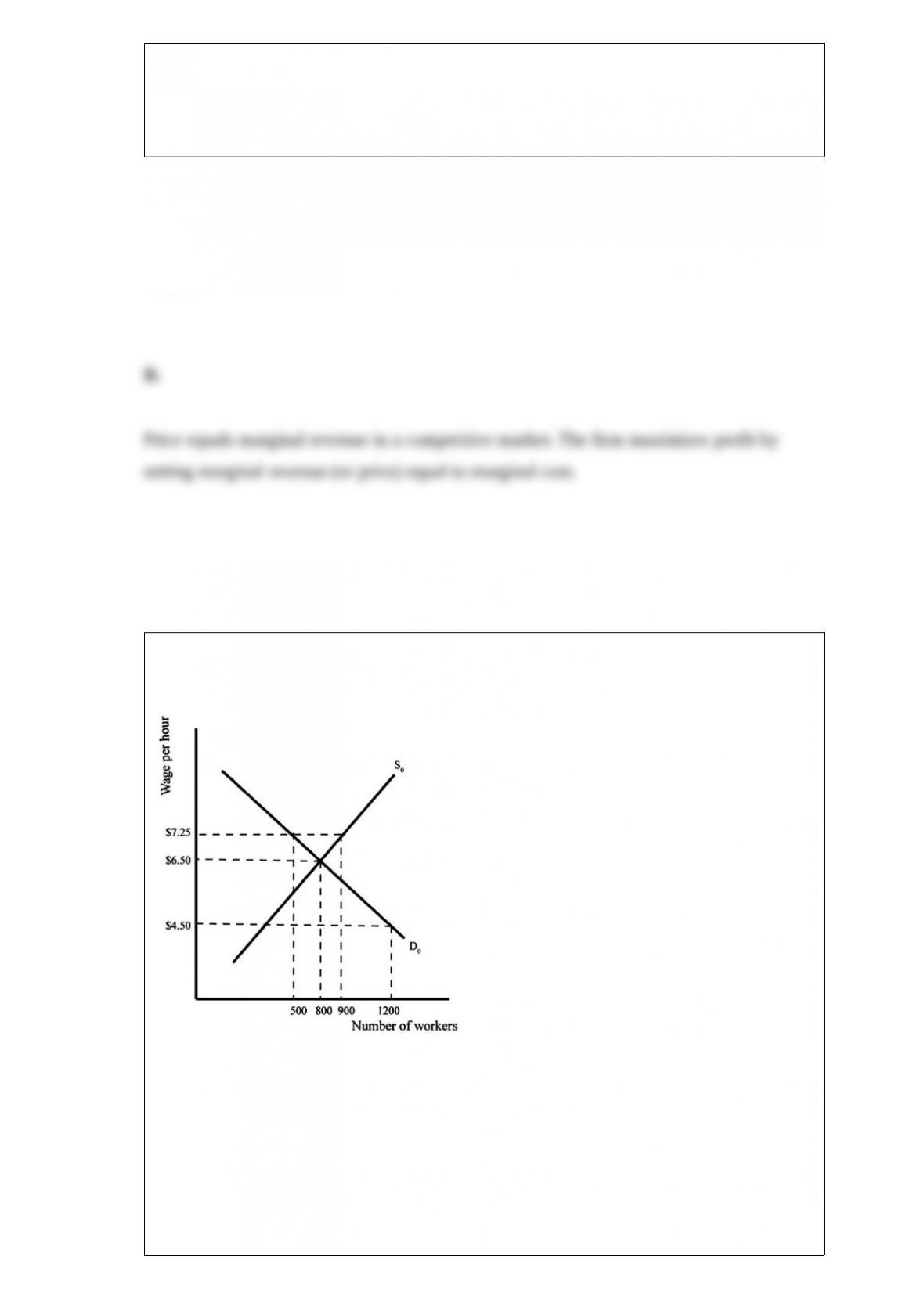
Refer to the graph shown. Without government intervention, market forces would result
in:
A. 800 labor hours demanded, 800 labor hours supplied, and a wage rate of $6.50 per
hour.
B. 500 labor hours demanded, 900 labor hours supplied, and a wage rate of $7.25 per
hour.
C. 1,200 labor hours demanded, 500 labor hours supplied, and a wage rate of $4.50 per
hour.
D. 500 labor hours demanded, 500 labor hours supplied, and a wage rate of $7.25 per
hour.
Answer:
If the world supply curve is SW0, and the country discovers a significant natural
resource that can be exported,
A. the world supply curve will shift down and the trade balance will become a deficit.
B. the world supply curve will shift down and the trade balance will become a surplus.
C. the world supply curve will shift up and the trade balance will become a deficit.
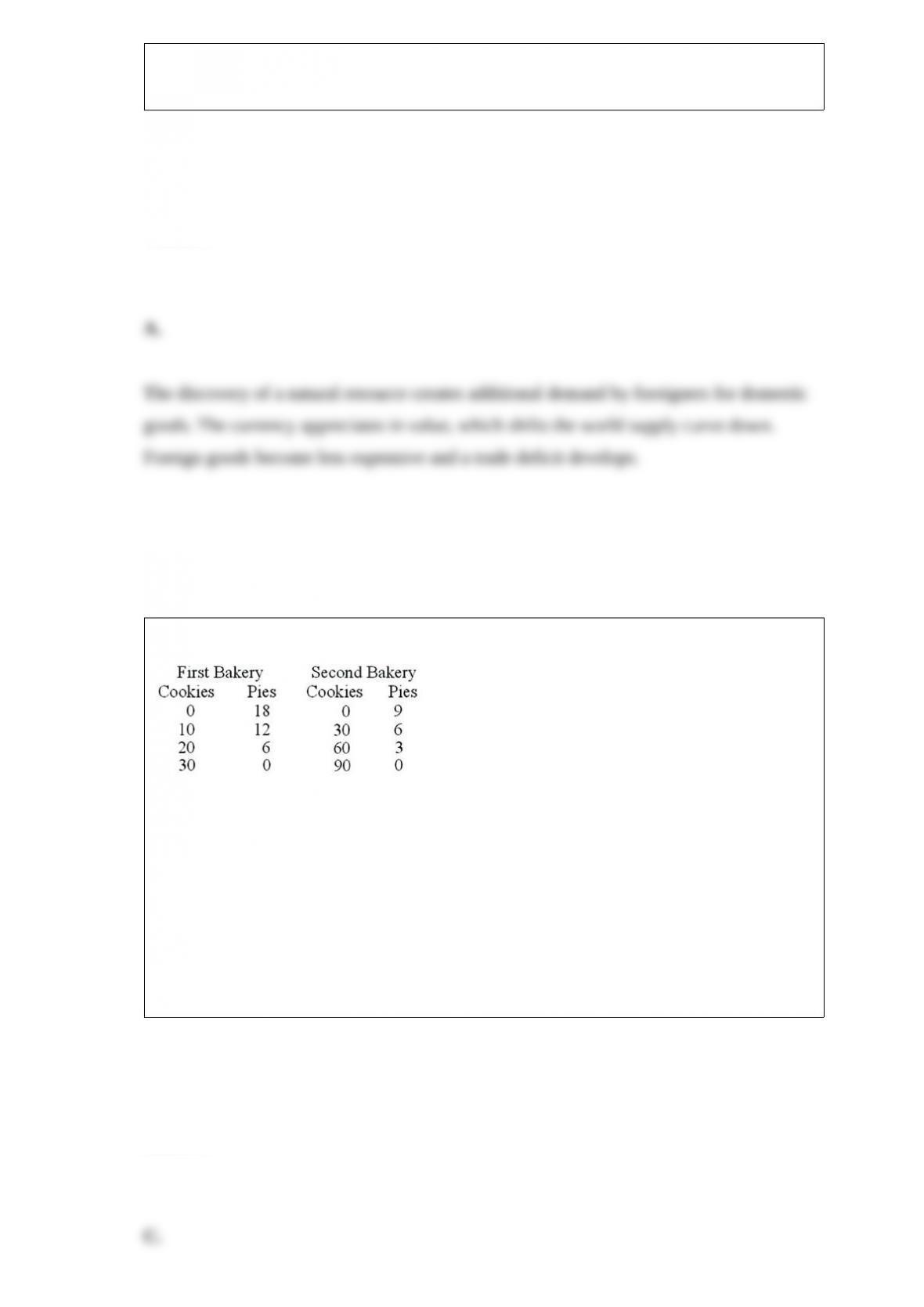
D. the world supply curve will shift up and the trade balance will become a surplus.
Answer:
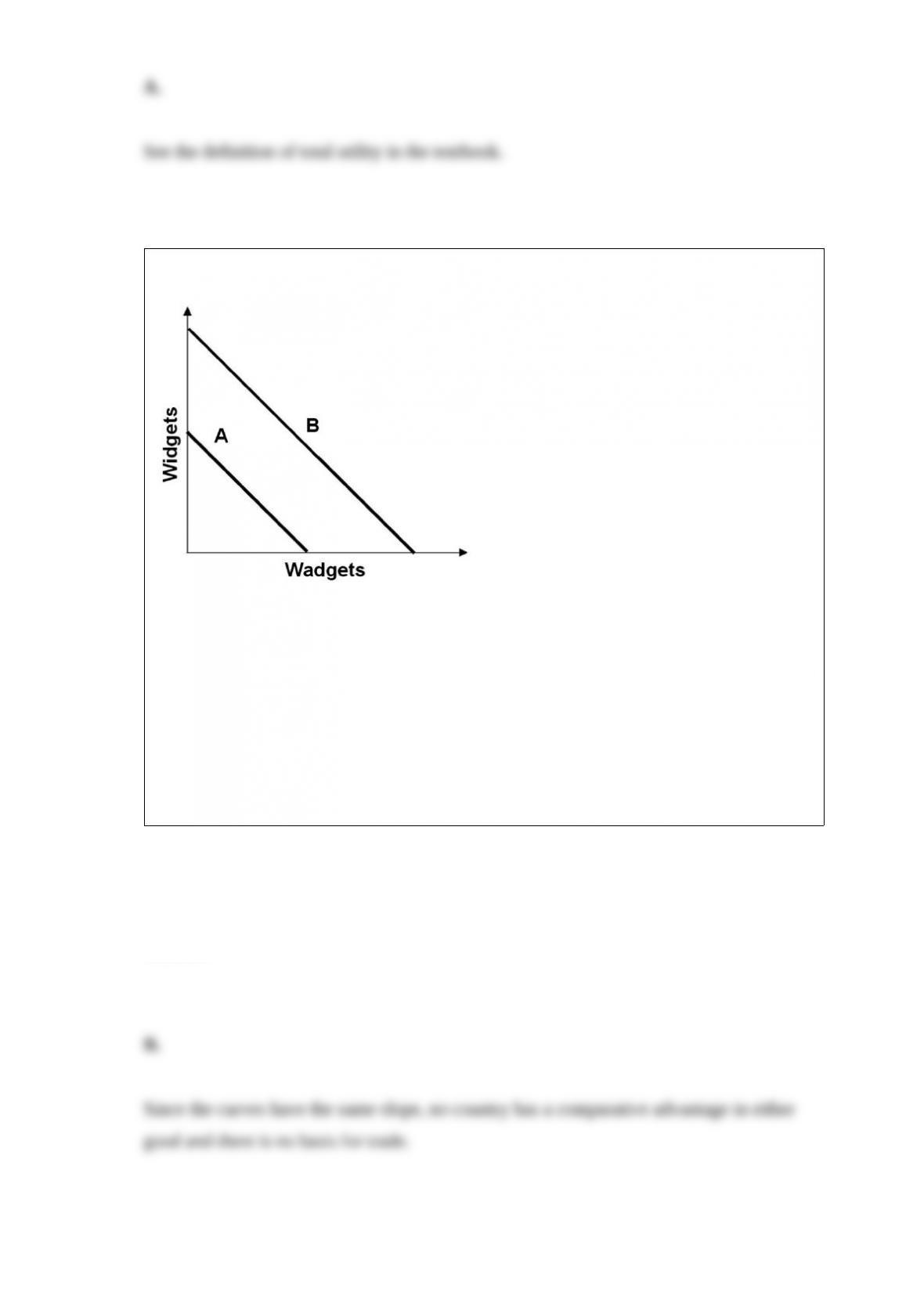
Given the production possibility tables for First and Second Bakeries shown, we can
determine that:
A. First Bakery has a comparative advantage in the production of both goods.
B. Second Bakery has a comparative advantage in the production of pies.
C. First Bakery has a comparative advantage in the production of pies.
D. neither bakery has a comparative advantage.
Answer:

In the United States globalization has:
A. played a significant role in growing income disparity because some sectors have
benefited and others have not.
B. played little role in growing income disparity because all Americans are consumers
who have enjoyed lower prices.
C. played a significant role in growing income disparity because foreign workers’
incomes have risen.
D. played little role in growing income disparity because while some jobs were lost, the
gain in jobs balanced out those that were lost.
Answer:
A Nash equilibrium is:
A. the payoff that maximizes the joint payoff.
B. the output level that minimizes average total cost.

C. the strategy that maximizes the outcome of all the players.
D. the set of strategies such that no player can improve his or her position by changing
his or her own action.
Answer:
Suppose that initially, supply is given by the equation Qs = 4P – 16. If, as a result of
higher production costs, the quantity supplied decreases by 4 at every price, the new
supply equation would be:
A. Qs = 8P – 16.
B. Qs = P – 16.
C. Qs = 4P – 20.
D. Qs = 4P – 12.
Answer:

There are many restaurants in the city of Raleigh, each one offering food and services
that differ from those of its competitors. There is also free entry of sellers into the
market, and each seller serves a very small fraction of the total number of meals served
each day. The restaurant industry in Raleigh is best categorized as:
A. an oligopoly.
B. monopolistically competitive.
C. a pure monopoly.
D. perfectly competitive.
Answer:
Total utility refers to the:
A. total satisfaction one gets from the consumption of a product.
B. satisfaction one gets from the consumption of an additional unit of a product.
C. maximum satisfaction one can get from the consumption of a good.
D. satisfaction one gets from the consumption of an additional unit of a product times
its price.
Answer:
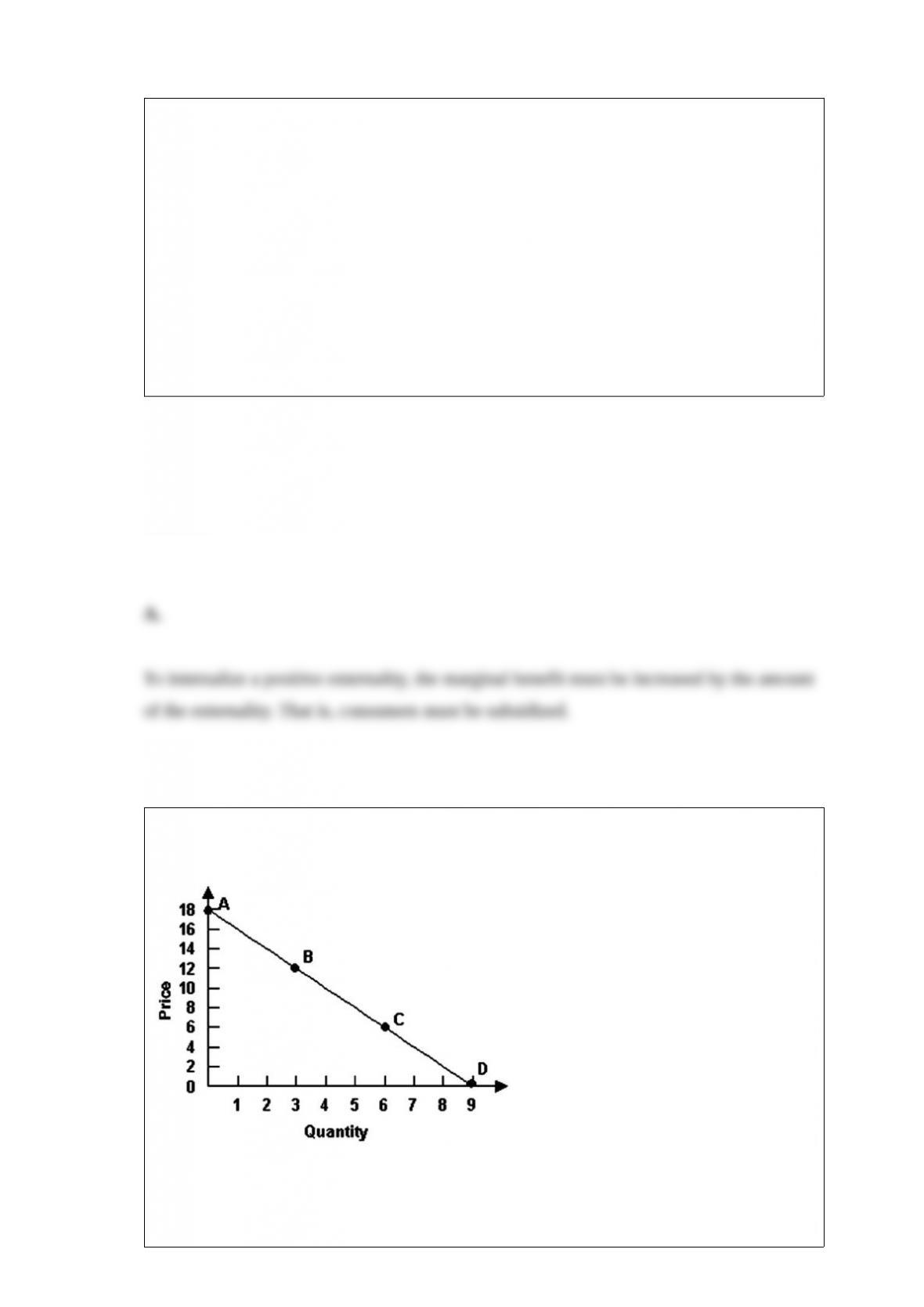
Refer to the graph shown. Given these production possibility curves, you would suggest
that:
A. Country A should specialize in widgets and Country B in wadgets.
B. No trade should take place.
C. Country A should specialize in wadgets and Country B in widgets.
D. Both countries should produce an equal amount of each.
Answer:
If a positive externality is to be taken full advantage of, the:
A. consumer of the good should receive a subsidy equal to the marginal cost imposed
on third parties that results from production (or consumption) of the good.
B. producers’ marginal costs should be increased by an amount equal to the marginal
benefit to third parties that results from production of the good.
C. consumer of the good should pay a tax equal to the marginal benefit to third parties
that results from production (or consumption) of the good.
D. producers’ marginal costs should be decreased by an amount equal to the marginal
cost imposed on third parties that results from production of the good.
Answer:
Refer to the graph shown. Calculate the approximate average elasticity of demand as
the price falls from $18 to $0:
A. 3.

B. 1.
C. 2/3.
D. 3/2.
Answer:
Which of the following would cause the demand curve for euros to shift right?
A. Americans want to buy more European goods.
B. Americans want to buy fewer European goods.
C. Europeans want to buy more American goods.
D. Europeans want to buy fewer American goods.
Answer:

If a person works 10 percent fewer hours after being given a raise of 20 percent, the
individual’s elasticity of labor supply is:
A. .5.
B. -.5.
C. 2.
D. -2.
Answer:
If markets are perfectly competitive and production of a good results in water pollution,
the imposition of a tax on the good will:
A. reduce the number of firms producing that good in the long run.
B. increase the number of firms producing that good in the long run.
C. reduce the number of firms producing that good in the short run.
D. increase the number of firms producing that good in the short run.
Answer:
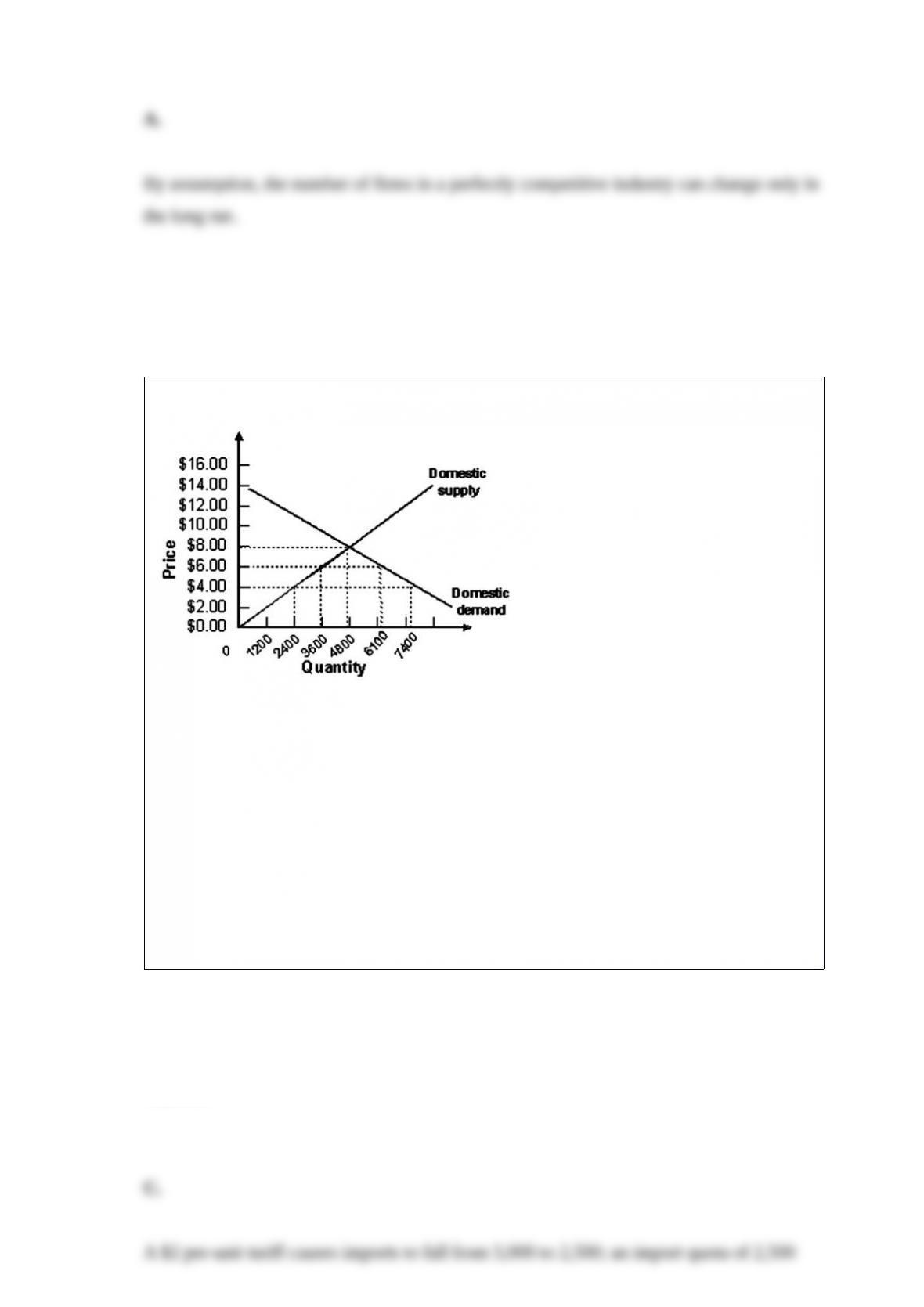
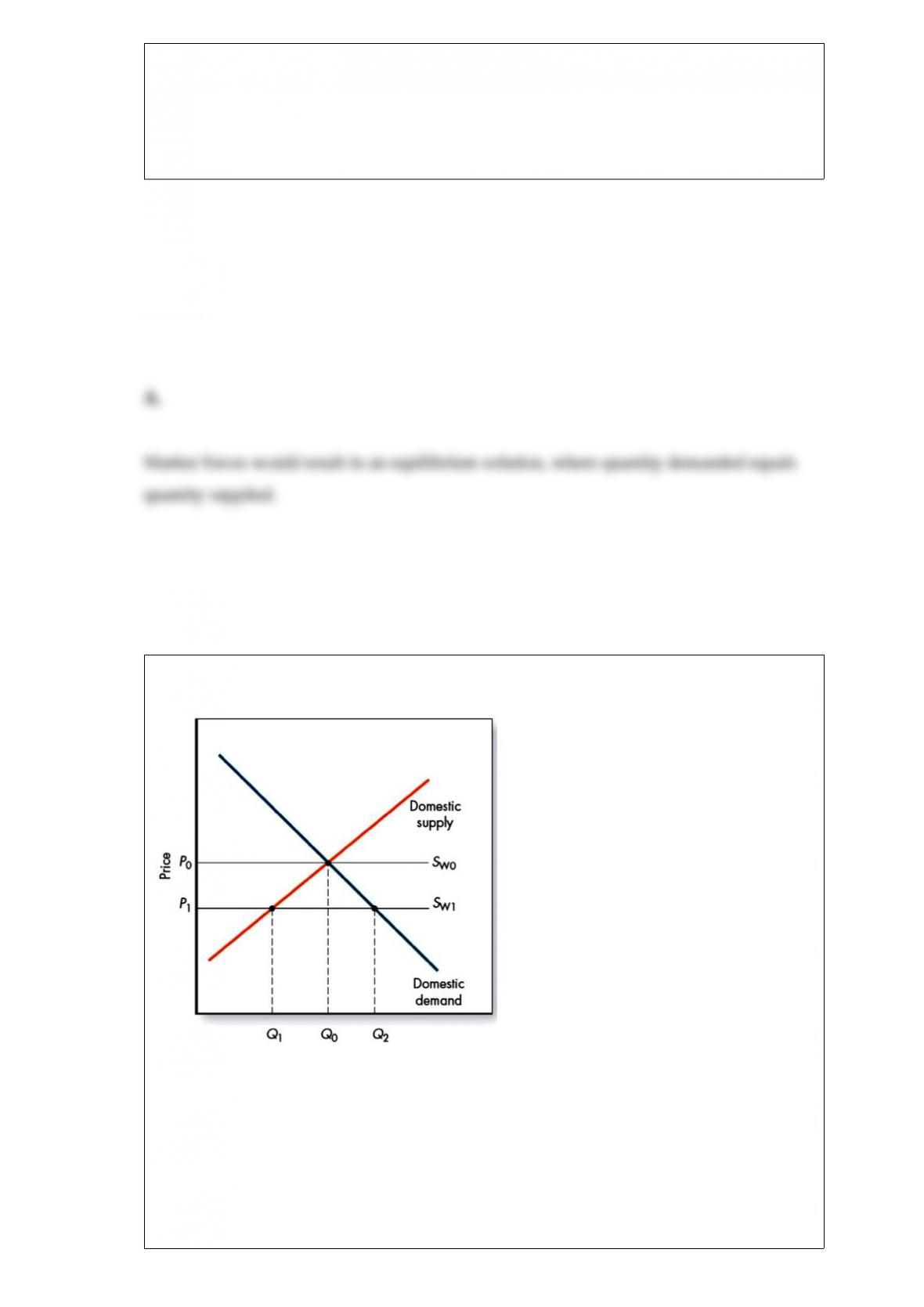
Refer to the graph shown for a small country that is a price taker internationally.
Assume the foreign supply of this product is perfectly elastic at a price of $4 per unit.
To have the same effect on imports as a $2 per-unit tariff, the government would need
to set an import quota of:
A. 1,200 units.
B. 1,300 units.
C. 2,500 units.
D. 5,000 units.
Answer:

Suppose the minimum possible price of constructing homes is $50 per square foot. As a
result of a sharp drop in the demand for home construction, the equilibrium price of
home construction falls to $40 per square foot. Assuming the home construction
industry is perfectly competitive and there are no specialized inputs, firms will:
A. exit the industry, and the price will fall below $40 in the long run.
B. exit the industry, and the price will rise above $40 in the long run.
C. exit the industry, and the price will remain at $40 in the long run.
D. enter the industry as the price rises above $40 in the long run.
Answer:
Because there are very significant economies of scale involved in making flat screen
television sets in a competitive market, the price of flat screen TVs will:
A. fall as output expands because long-run average total costs are lower for higher
quantities.
B. rise because the long run average total cost curve is upward sloping over the entire
range of output.
C. rise because of the combination of stronger demand and higher production costs.
D. stay exactly the same regardless of any shifts in the demand curve.

Answer:
According to standard economic theory, rational individuals:
A. always do what is in their own best interest.
B. never do what is in their own best interest.
C. do what is in their best interest only part of the time.
D. suffer from psychological failure.
Answer:
Behavioral economics helps explain:
A. why people are rational.

B. why people are selfish.
C. why being selfish is rational.
D. the degree to which people are altruistic.
Answer:
If a country’s exchange rate depreciates,
A. the world price level rises.
B. the world price level falls.
C. the world price level remains unchanged.
D. Exchange rates have no impact on world prices.
Answer:

According to the contestable market approach:
A. technological innovations can occur only when products are supplied in an
oligopolistic market.
B. technological innovations can occur only when products are supplied in a
competitive market.
C. market structure is more important to technological progress than the conditions of
entry.
D. the conditions of entry are more important to technological progress than market
structure.
Answer:
Unemployment compensation is available to:
A. anyone who is unemployed for an unlimited duration.
B. anyone who is unemployed but for a limited duration.
C. people who are out of work through no fault of their own and have worked in a
covered occupation for a substantial number of weeks in the period just before they
became unemployed.
D. people who are out of work through no fault of their own regardless of previous
employment history.
Answer:
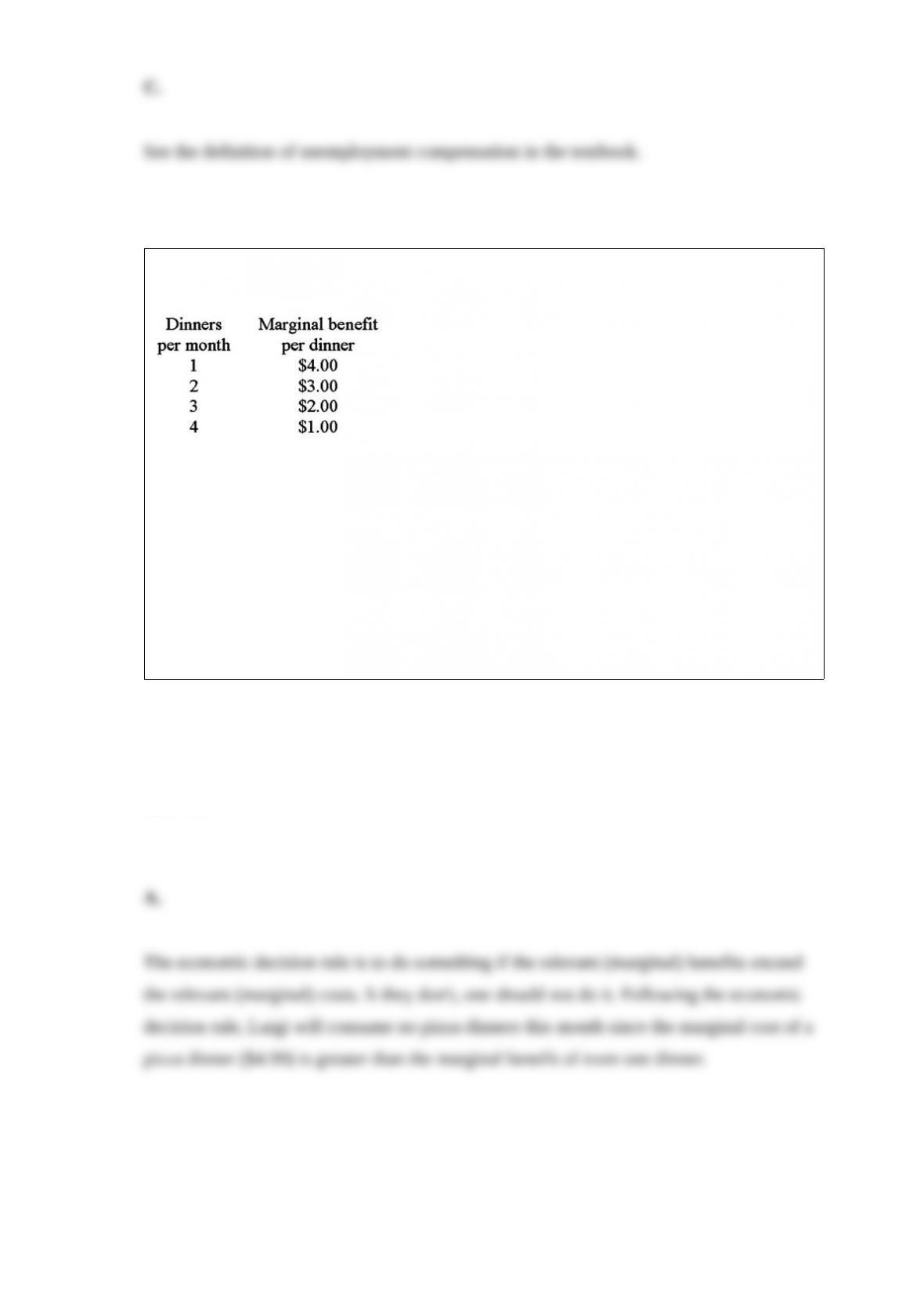
The table below shows how the marginal benefit of pizza dinners varies for Luigi with
the number consumed per month.
Suppose the price per dinner is $4.99 and accurately reflects the marginal cost of the
dinners to Luigi. Assuming that Luigi is rational, he will:
A. not consume any pizza dinners this month.
B. consume one pizza dinner this month.
C. consume two pizza dinners this month.
D. consume three pizza dinners this month.
Answer: