Archives: Quiz
978-0133460629 Chapter 12 Part 1
Foundations of Macroeconomics, 7e (Bade/Parkin) Chapter 12 Money, Interest, and Inlation 12.1 Money and the Interest Rate 1) The quantity of money demanded is the A) average daily volume of bank account withdrawals. B) amount that people and businesses choose […]
978-0133460629 Chapter 11 Part 13
Topic: Open market operation Skill: Level 3: Using models Section: Checkpoint 11.4 Status: Old AACSB: Analytical thinking 9) If the Fed sells $100 million of U.S. government securities, what happens to the quantity of money? Skill: Level 2: Using deinitions […]
978-0133460629 Chapter 11 Part 12
8) The Second National Bank of Townville has $400,000 in checking deposits, $125,000 in savings deposits, $500,000 in loans, $20,000 in its reserve account at the Fed, and $5,000 of currency in its vault. What is the amount of its […]
978-0133460629 Chapter 11 Part 11
115) The Citizens First Bank sells $100,000 of government securities to the Fed. This sale immediately A) decreases the quantity of money. B) decreases the bank’s checkable deposits. C) increases the bank’s reserves. D) decreases the bank’s assets. E) increases […]
978-0133460629 Chapter 11 Part 10
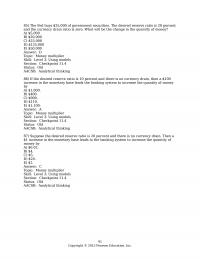
85) The Fed buys $25,000 of government securities. The desired reserve ratio is 20 percent and the currency drain ratio is zero. What will be the change in the quantity of money? A) $5,000 B) $20,000 C) $25,000 D) $125,000 […]
978-0133460629 Chapter 11 Part 9
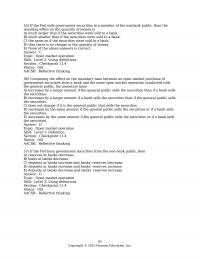
55) If the Fed sells government securities to a member of the nonbank public, then the resulting efect on the quantity of money is A) much larger than if the securities were sold to a bank. B) much smaller than […]
978-0133460629 Chapter 11 Part 8
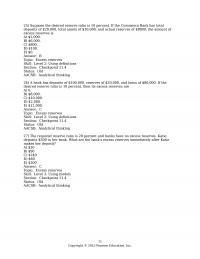
25) Suppose the desired reserve ratio is 10 percent. If the Commerce Bank has total deposits of $20,000, total assets of $10,000, and actual reserves of $8000, the amount of excess reserves is A) $2,000. B) $6,000. C) $800. D) […]
978-0133460629 Chapter 11 Part 7
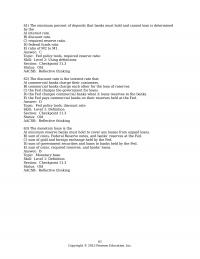
61) The minimum percent of deposits that banks must hold and cannot loan is determined by the A) interest rate. B) discount rate. C) required reserve ratio. D) federal funds rate. E) ratio of M2 to M1. Skill: Level 2: […]
978-0133460629 Chapter 11 Part 6
31) The required reserve ratio is 10 percent and Charlie deposits $3,000 in her checking account. The bank must A) increase reserves by $3,000. B) increase reserves by $300. C) decrease reserves by $3,000. D) decrease reserves by $300. E) […]
978-0133460629 Chapter 11 Part 5
11.3 The Federal Reserve System 1) A public authority that provides banking services to commercial banks and regulates inancial institutions and markets is called a A) commercial bank. B) thrift institution. C) central bank. D) money market fund. E) mint. […]
978-0133460629 Chapter 11 Part 4
11.2 The Banking System 1) A commercial bank is deined as A) any institution that accepts deposits. B) a irm that is chartered to accept deposits and make loans. C) the institution that sets regulations for commercial activities. D) a […]
978-0133460629 Chapter 11 Part 3
61) Which of the following are included in the M1 deinition of money? A) currency and checkable deposits B) currency and savings deposits C) traveler’s checks and money market mutual funds D) currency and small time deposits E) traveler’s checks […]
978-0133460629 Chapter 11 Part 2
31) When money is used to compare the relative price of a burrito and a taco, money is being used as a A) medium of exchange. B) store of value. C) measurement of inlation. D) unit of account. E) token […]
978-0133460629 Chapter 11 Part 1
Foundations of Macroeconomics, 7e (Bade/Parkin) Chapter 11 The Monetary System 11.1 What Is Money? 1) Which statement about money is most correct? A) Money is a new invention and only includes dollar bills and coins. B) Money is a new […]
978-0133460629 Chapter 10 Part 10
13) At the beginning of the year, United Delivery had trucks valued at $1.3 million. During the year, United Delivery purchased new trucks valued at $500,000. If the value of the trucks at the end of the year was $1.5 […]
978-0133460629 Chapter 10 Part 9
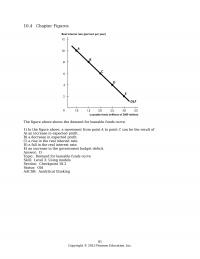
10.4 Chapter Figures The igure above shows the demand for loanable funds curve. 1) In the igure above, a movement from point A to point C can be the result of A) an increase in expected proit. B) a decrease […]
978-0133460629 Chapter 10 Part 8
34) Suppose the government’s budget deicit increases by $500 billion. If there is no Ricardo-Barro efect, what occurs? A) The demand for loanable funds curve shifts rightward, the real interest rate rises, and the quantity of loanable funds increases. B) […]
978-0133460629 Chapter 10 Part 7
9) If there is no Ricardo-Barro efect, a government budget surplus ________ the total supply of loanable funds and ________ the real interest rate. A) increases; raises B) increases; lowers C) decreases; raises D) decreases; lowers E) does not change; […]
978-0133460629 Chapter 10 Part 6
83) In the loanable funds market, if the real interest rate is higher than the equilibrium real interest rate, A) there is a shortage of loanable funds. B) there is a surplus of loanable funds. C) there is a surplus […]
978-0133460629 Chapter 10 Part 5
54) If the disposable income decreases, then A) the supply of loanable funds increases. B) the supply of loanable funds decreases. C) the quantity of loanable funds demanded increases. D) the quantity of loanable funds supplied decreases. E) the demand […]
978-0133460629 Chapter 10 Part 4
25) The demand for loanable funds curve slopes downward because the A) higher the real interest rate, the lower the cost of investment. B) expected rate of proit is related positively to the real interest rate. C) price of bonds […]
978-0133460629 Chapter 10 Part 3
61) Intel’s capital at the end of the year equals Intel’s capital at the beginning of the year A) minus its stock dividends. B) plus net investment. C) minus depreciation. D) plus gross investment. E) plus depreciation. Skill: Level 2: […]
978-0133460629 Chapter 10 Part 2
31) During 2013, a country‘s total purchases of newly produced capital goods are $1,000 billion, the country issues $750 billion of stock certiicates, and there is $200 billion of depreciation. Net investment in this country equals A) $800 billion. B) […]
978-0133460629 Chapter 10 Part 1
Foundations of Macroeconomics, 7e (Bade/Parkin) Chapter 10 Finance, Saving, and Investment 10.1 Financial Institutions and Markets 1) Economists use the word “capital” to mean A) the tools, instruments, and other produced goods used to produce goods and services. B) the […]
978-0133460629 Chapter 09 Part 9
8) What are the sources of human capital? Skill: Level 1: Deinition Section: Checkpoint 9.2 Status: Old AACSB: Written and oral communication 9) Explain the productivity curve and how the components interact. Answer: The productivity curve is a relationship that […]
978-0133460629 Chapter 09 Part 8
2) The idea of continuous economic growth as a “perpetual motion machine” best relects the prediction of which growth theory? A) the classical growth theory B) the traditional growth theory C) the Keynesian growth theory D) the new growth theory […]
978-0133460629 Chapter 09 Part 7
23) One possible way of achieving faster economic growth is to A) regulate the amount of international trade and limit it so that not too much occurs. B) limit research and development because research and development does not contribute anything […]
978-0133460629 Chapter 09 Part 6
29) Classical growth theory predicts that increases in A) real GDP per person are permanent and sustainable. B) real GDP per person are temporary and not sustainable. C) resources permanently increase labor productivity. D) resources permanently increase real GDP per […]
978-0133460629 Chapter 09 Part 5
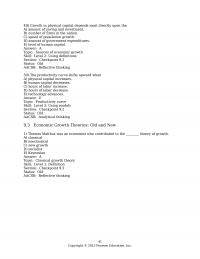
49) Growth in physical capital depends most directly upon the A) amount of saving and investment. B) number of irms in the nation. C) speed of population growth. D) amount of government expenditures. E) level of human capital. Skill: Level […]
978-0133460629 Chapter 09 Part 4
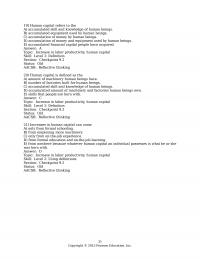
19) Human capital refers to the A) accumulated skill and knowledge of human beings. B) accumulated equipment used by human beings. C) accumulation of money by human beings. D) accumulation of money and equipment used by human beings. E) accumulated […]
978-0133460629 Chapter 09 Part 3
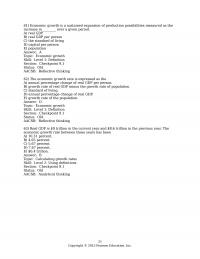
61) Economic growth is a sustained expansion of production possibilities measured as the increase in ________ over a given period. A) real GDP B) real GDP per person C) the standard of living D) capital per person E) population Skill: […]
978-0133460629 Chapter 09 Part 2
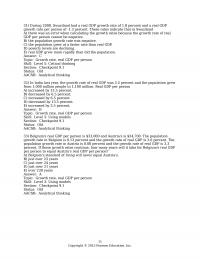
31) During 2008, Swaziland had a real GDP growth rate of 1.8 percent and a real GDP growth rate per person of -1.3 percent. These rates indicate that in Swaziland A) there was an error when calculating the growth rates […]
978-0133460629 Chapter 09 Part 1
Foundations of Macroeconomics, 7e (Bade/Parkin) Chapter 9 Economic Growth 9.1 The Basics of Economic Growth 1) Economic growth is deined as A) a decrease in the rate of inlation. B) an increase in employment. C) a sustained expansion of production […]
978-0133460629 Chapter 08 Part 8
6) The smaller the extent of job rationing, the A) lower potential GDP. B) lower the unemployment rate. C) lower the labor force participation rate. D) higher the labor supply. E) higher the real wage rate. Skill: Level 3: Using […]
978-0133460629 Chapter 08 Part 7
53) The two fundamental causes of unemployment at full employment are A) seasonal jobs and technological change. B) foreign competition and inancial bankruptcies. C) job search and job rationing. D) decreases in labor productivity and more generous retirement beneits. E) […]
978-0133460629 Chapter 08 Part 6
27) An eiciency wage is designed to ________ work efort and to ________ labor turnover. A) decrease; lower B) decrease; raise C) increase; raise D) increase; lower E) not change; decrease Skill: Level 1: Deinition Section: Checkpoint 8.2 Status: Old […]
978-0133460629 Chapter 08 Part 5
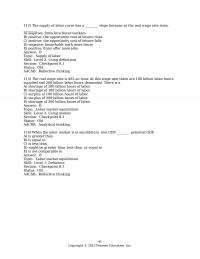
112) The supply of labor curve has a ________ slope because as the real wage rate rises, ________. A) negative; irms hire fewer workers B) positive; the opportunity cost of leisure rises C) positive; the opportunity cost of leisure falls […]
978-0133460629 Chapter 08 Part 4
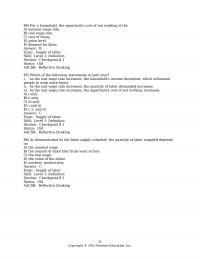
84) For a household, the opportunity cost of not working is the A) nominal wage rate. B) real wage rate. C) cost of living. D) price level. E) demand for labor. Skill: Level 1: Deinition Section: Checkpoint 8.1 Status: Old […]
978-0133460629 Chapter 08 Part 3
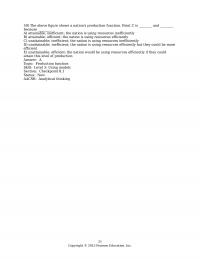
59) The above igure shows a nation‘s production function. Point C is ________ and ________ because ________. A) attainable; ineicient; the nation is using resources ineiciently B) attainable; eicient; the nation is using resources eiciently C) unattainable; ineicient; the nation […]
978-0133460629 Chapter 08 Part 2
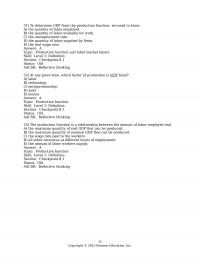
31) To determine GDP from the production function, we need to know A) the quantity of labor employed. B) the quantity of labor available for work. C) the unemployment rate. D) the quantity of labor supplied by irms. E) the […]
978-0133460629 Chapter 08 Part 1
Foundations of Macroeconomics, 7e (Bade/Parkin) Chapter 8 Potential GDP and the Natural Unemployment Rate 8.1 Potential GDP 1) The Classical macroeconomic model proposes that A) government intervention is required to help the economy reach its potential. B) real GDP equals […]
978-0133460629 Chapter 07 Part 10
2) “The new goods bias puts a downward bias into the CPI and its measure of the inlation rate.” Is the previous sentence correct or not? Explain your answer. Skill: Level 2: Using deinitions Section: Checkpoint 7.2 Status: Old AACSB: […]
978-0133460629 Chapter 07 Part 9
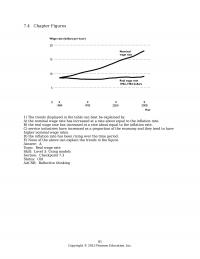
7.4 Chapter Figures 1) The trends displayed in the table can best be explained by A) the nominal wage rate has increased at a rate about equal to the inlation rate. B) the real wage rate has increased at a […]
978-0133460629 Chapter 07 Part 8
54) If the nominal interest rate is greater than the real interest rate, A) it is an indication of economic growth. B) inlation must be occurring. C) lenders must lose because they can only make loans using the real interest […]
978-0133460629 Chapter 07 Part 7
24) In order to determine if the quantity of goods and services that an hour’s work can buy has increased or decreased between 2000 and 2012, one should compare the A) 2000 nominal wage with the 2012 nominal wage. B) […]
978-0133460629 Chapter 07 Part 6
45) An example of the new goods bias in the calculation of the CPI is a price increase in A) butter relative to margarine. B) an iPod player relative to a Walkman. C) a 2013 Honda Civic Si Coupe relative […]
978-0133460629 Chapter 07 Part 5
16) In constructing the CPI, the BLS has to deal with commodity substitution bias, which is deined as A) consumers’ substitution of discount stores for full service stores to avoid the higher prices in the full service stores. B) consumers’ […]
978-0133460629 Chapter 07 Part 4
86) Looking at the annual inlation rates in the United States from 2000 to 2013, we see that they A) were above 10 percent throughout the period. B) were at or below 5 percent throughout the period and was negative […]
978-0133460629 Chapter 07 Part 3
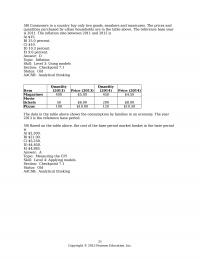
58) Consumers in a country buy only two goods, sneakers and manicures. The prices and quantities purchased by urban households are in the table above. The reference base year is 2011. The inlation rate between 2011 and 2012 is A) […]
978-0133460629 Chapter 07 Part 2
31) In 2013, the reference base period for the CPI for the nation of Webot, a typical consumer spent $30 on potatoes and $150 on steak. If the price of steak is $15 and the price of potatoes is $1 […]