Archives: Quiz
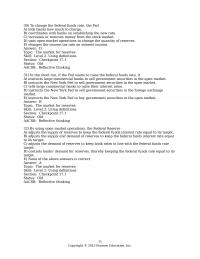
978-0133460629 Chapter 17 Part 2
30) To change the federal funds rate, the Fed A) tells banks how much to charge. B) coordinates with banks on establishing the new rate. C) increases or removes money from the stock market. D) uses open market operations to […]
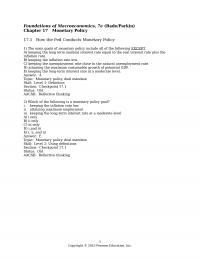
978-0133460629 Chapter 17 Part 1
Foundations of Macroeconomics, 7e (Bade/Parkin) Chapter 17 Monetary Policy 17.1 How the Fed Conducts Monetary Policy 1) The main goals of monetary policy include all of the following EXCEPT A) keeping the long term nominal interest rate equal to the […]
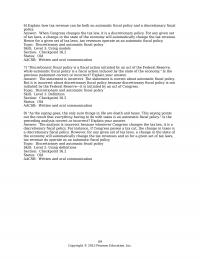
978-0133460629 Chapter 16 Part 8
6) Explain how tax revenue can be both an automatic iscal policy and a discretionary iscal policy. Skill: Level 3: Using models Section: Checkpoint 16.2 Status: Old AACSB: Written and oral communication 7) “Discretionary iscal policy is a iscal action […]
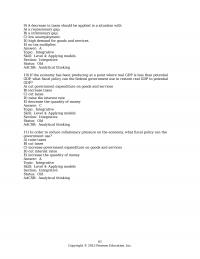
978-0133460629 Chapter 16 Part 7
9) A decrease in taxes should be applied in a situation with A) a recessionary gap. B) a inlationary gap. C) low unemployment. D) high demand for goods and services. E) no tax multiplier. Skill: Level 4: Applying models Section: […]
978-0133460629 Chapter 16 Part 6
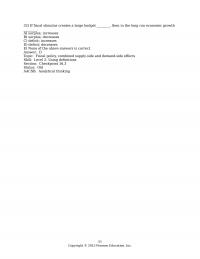
32) If iscal stimulus creates a large budget ________, then in the long run economic growth ________. A) surplus; increases B) surplus; decreases C) deicit; increases D) deicit; decreases E) None of the above answers is correct. Skill: Level 2: […]
978-0133460629 Chapter 16 Part 5
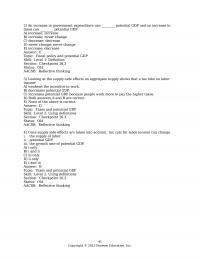
2) An increase in government expenditure can ________ potential GDP and an increase in taxes can ________ potential GDP. A) increase; increase B) increase; never change C) decrease; decrease D) never change; never change E) increase; decrease Skill: Level 1: […]
978-0133460629 Chapter 16 Part 4
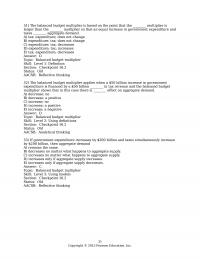
51) The balanced budget multiplier is based on the point that the ________ multiplier is larger than the ________ multiplier so that an equal increase in government expenditure and taxes ________ aggregate demand. A) tax; expenditure; does not change B) […]
978-0133460629 Chapter 16 Part 3
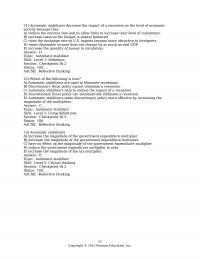
21) Automatic stabilizers decrease the impact of a recession on the level of economic activity because they A) reduce the interest rate and so allow irms to increase their level of investment. B) increase taxes so the budget is always […]
978-0133460629 Chapter 16 Part 2
28) If tax revenues are $230 billion and the government’s outlays are $235 billion, then the budget A) deicit is $5 billion and government debt will remain the same. B) surplus is $5 billion and government debt will increase by […]
978-0133460629 Chapter 16 Part 1
Foundations of Macroeconomics, 7e (Bade/Parkin) Chapter 16 Fiscal Policy 16.1 The Federal Budget 1) The federal budget is deined as A) a monthly statement of expenditure laws passed by the U.S. government. B) a monthly statement of whether the U.S. […]
978-0133460629 Chapter 15 Part 8
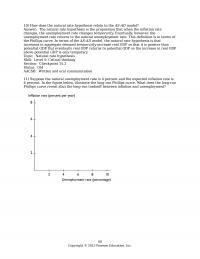
10) How does the natural rate hypothesis relate to the AS-AD model? Skill: Level 5: Critical thinking Section: Checkpoint 15.2 Status: Old AACSB: Written and oral communication 11) Suppose the natural unemployment rate is 4 percent and the expected inlation […]
978-0133460629 Chapter 15 Part 7
2) “The short-run Phillips curve shows the tradeof between real GDP and inlation.” Is the previous statement correct or incorrect? Briely explain you answer. Skill: Level 1: Deinition Section: Checkpoint 15.1 Status: Old AACSB: Relective thinking 3) “The short-run Phillips […]
978-0133460629 Chapter 15 Part 6
14) If the Fed tries to lower the unemployment rate so it is lower than the natural unemployment rate, in the short run before the expected inlation rate changes, the SRPC ________ and the LRPC ________. A) does not change; […]
978-0133460629 Chapter 15 Part 5
55) When the natural unemployment rate ________, the short-run Phillips curve shifts ________ and the long-run Phillips curve shifts ________. A) increases; leftward; leftward B) decreases; rightward; rightward C) decreases; leftward; rightward D) increases; rightward; rightward E) increases; rightward; leftward […]
978-0133460629 Chapter 15 Part 4
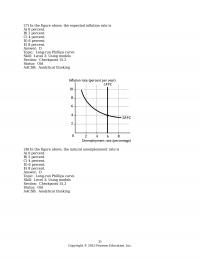
27) In the igure above, the expected inlation rate is A) 0 percent. B) 2 percent. C) 4 percent. D) 6 percent. E) 8 percent. Skill: Level 3: Using models Section: Checkpoint 15.2 Status: Old AACSB: Analytical thinking 28) In […]
978-0133460629 Chapter 15 Part 3
60) If real GDP exceeds potential GDP, then employment is ________ full employment, and the unemployment rate is ________ the natural unemployment rate. A) below; above B) equal to; below C) above; below D) above; above E) equal to; equal […]
978-0133460629 Chapter 15 Part 2
30) According to ________, when real GDP is ________ percentage points greater than potential GDP, the unemployment rate is one percentage point ________ the natural unemployment rate. A) Keynes’ Law; two; below B) Okun’s Law; two; below C) Phillip’s Law; […]
978-0133460629 Chapter 15 Part 1
Foundations of Macroeconomics, 7e (Bade/Parkin) Chapter 15 The Short-Run Policy Tradeof 15.1 The Short-Run Phillips Curve 1) If the economy is at full employment, then the unemployment rate A) is greater than the natural unemployment rate. B) is equal to […]
978-0133460629 Chapter 14 Part 12
Skill: Level 2: Using deinitions Section: Checkpoint 14.3 Status: Old AACSB: Relective thinking 6) Discuss how the marginal propensity to consume, imports, and marginal tax rates inluence the expenditure multiplier. Skill: Level 2: Using deinitions Section: Checkpoint 14.3 Status: Old […]
978-0133460629 Chapter 14 Part 11
13) How do irms respond to unplanned inventory changes? What is the efect on their production and GDP? Skill: Level 3: Using models Section: Checkpoint 14.2 Status: Old AACSB: Written and oral communication 14) A country reports that it has […]
978-0133460629 Chapter 14 Part 10
4) Investment decreases by $300 billion, government expenditure is unchanged, and exports increase by $500 billion. As a result, autonomous expenditure ________, the total expenditure ________, and equilibrium real GDP ________. A) decreases by $300 billion; decreases; decreases by more […]
978-0133460629 Chapter 14 Part 9
14.4 The AD Curve and Equilibrium Expenditure 1) When the price level ________, equilibrium expenditure ________ and the quantity of real GDP demanded ________. A) falls; increases; increases B) rises; increases; decreases C) falls; increases; decreases D) rises; decreases; increases […]
978-0133460629 Chapter 14 Part 8
Topic: Multiplier Skill: Level 2: Using deinitions Section: Checkpoint 14.3 Status: Old AACSB: Analytical thinking 38) Which of the following reduces the magnitude of the expenditure multiplier? A) higher marginal tax rates B) decrease in imports C) decrease in saving […]
978-0133460629 Chapter 14 Part 7
8) When investment increases, the multiplier points out that A) consumption decreases by a greater amount. B) real GDP increases by a greater amount. C) consumption increases by the same amount. D) real GDP decreases by a greater amount. E) […]
978-0133460629 Chapter 14 Part 6
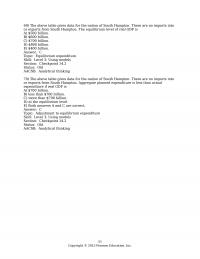
69) The above table gives data for the nation of South Hampton. There are no imports into or exports from South Hampton. The equilibrium level of real GDP is A) $500 billion. B) $600 billion. C) $700 billion. D) $800 […]
978-0133460629 Chapter 14 Part 5
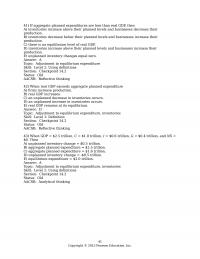
41) If aggregate planned expenditures are less than real GDP, then A) inventories increase above their planned levels and businesses decrease their production. B) inventories decrease below their planned levels and businesses increase their production. C) there is no equilibrium […]
978-0133460629 Chapter 14 Part 4
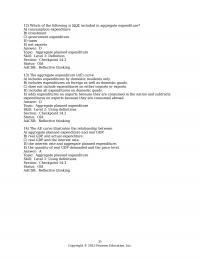
12) Which of the following is NOT included in aggregate expenditure? A) consumption expenditure B) investment C) government expenditure D) taxes E) net exports Skill: Level 1: Deinition Section: Checkpoint 14.2 Status: Old AACSB: Relective thinking 13) The aggregate expenditure […]
978-0133460629 Chapter 14 Part 3
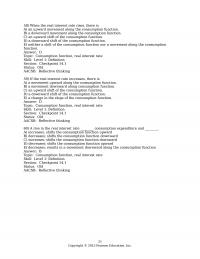
58) When the real interest rate rises, there is A) an upward movement along the consumption function. B) a downward movement along the consumption function. C) an upward shift of the consumption function. D) a downward shift of the consumption […]
978-0133460629 Chapter 14 Part 2
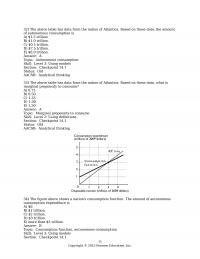
32) The above table has data from the nation of Atlantica. Based on these data, the amount of autonomous consumption is A) $1.5 trillion. B) $1.0 trillion. C) $0.5 trillion. D) $7.5 trillion. E) $6.0 trillion. Skill: Level 3: Using […]
978-0133460629 Chapter 14 Part 1
Foundations of Macroeconomics, 7e (Bade/Parkin) Chapter 14 Aggregate Expenditure Multiplier 14.1 Expenditure Plans and Real GDP 1) Which of the following variables is ixed in the aggregate expenditure model? A) price level B) consumption C) output D) investment E) real […]
978-0133460629 Chapter 13 Part 11
13.7 Essay: Aggregate Demand 1) What is the efect on the aggregate demand curve from an increase in the price level? In particular, does the aggregate demand curve shift leftward or rightward? Skill: Level 2: Using deinitions Section: Checkpoint 13.2 […]
978-0133460629 Chapter 13 Part 10
11) A decrease in investment leads to ________ in aggregate demand and ________ in real GDP. A) an increase; an increase B) an increase; a decrease C) a decrease; an increase D) a decrease; a decrease E) no change; a […]
978-0133460629 Chapter 13 Part 9
84) Staglation is a combination of ________ real GDP and a ________ price level. A) increasing; rising B) increasing; falling C) decreasing; rising D) decreasing; falling E) no change in; rising Skill: Level 1: Deinition Section: Checkpoint 13.3 Status: Old […]
978-0133460629 Chapter 13 Part 8
54) To prevent demand-pull inlation, A) irms must refuse to increase the money wage rate. B) irms must refuse to increase the real wage rate. C) the Fed must not let the quantity of money persistently rise. D) the natural […]
978-0133460629 Chapter 13 Part 7
D) 140. E) 150. Answer: B Topic: Equilibrium AD and AS Skill: Level 3: Using models Section: Checkpoint 13.3 Status: Old AACSB: Analytical thinking 27) The table above gives data for the nation of Pearl, a small island in the […]
978-0133460629 Chapter 13 Part 6
63) When the price level rises, the real interest rate ________ and the quantity of real GDP demanded ________. A) rises; increases B) rises; decreases C) falls; increases D) falls; decreases E) does not change; does not change Skill: Level […]
978-0133460629 Chapter 13 Part 5
35) Aggregate demand ________ and shifts the AD curve ________ when ________. A) increases; rightward; government expenditure increases B) increases; rightward; taxes increase C) increases; rightward; future expected proit decreases D) decreases; leftward; foreign income increases E) increases; leftward; government […]
978-0133460629 Chapter 13 Part 4
5) Which of the following produces a movement along the aggregate demand curve and does not shift the aggregate demand curve? A) a change in foreign incomes B) a change in the price level C) a change in monetary policy […]
978-0133460629 Chapter 13 Part 3
61) An increase in the money wage rate leads to A) an upward movement along the aggregate supply curve. B) a downward movement along the aggregate supply curve. C) a leftward shift of the aggregate supply curve. D) a rightward […]
978-0133460629 Chapter 13 Part 2
31) The quantity of real GDP supplied decreases if the price level ________ because it ________ proits. A) rises; increases B) rises; decreases C) falls; increases D) falls; decreases E) None of the above answers is correct because the AS […]
978-0133460629 Chapter 13 Part 1
Foundations of Macroeconomics, 7e (Bade/Parkin) Chapter 13 Aggregate Supply and Aggregate Demand 13.1 Aggregate Supply 1) Over the business cycle, factors such as the quantity of capital, human capital and technology A) grow but do not luctuate as much as […]
978-0133460629 Chapter 12 Part 10
12.7 Essay: Money, the Price Level, and Inlation 1) A government policymaker suggests “Double the money supply and U.S. citizens’ real incomes will double.” In the long run, is this policy advice correct? Skill: Level 3: Using models Section: Checkpoint […]
978-0133460629 Chapter 12 Part 9
7) What efect does an increase in the price level have on the demand for money and the demand for money curve? Skill: Level 1: Deinition Section: Checkpoint 12.1 Status: Old AACSB: Relective thinking 8) What efect does an increase […]
978-0133460629 Chapter 12 Part 8
24) It is estimated that if the inlation rate is lowered from 3 percent a year to 0 percent a year, the growth rate of real GDP will rise by ________ percentage points a year. A) 0.06 to 0.09 B) […]
978-0133460629 Chapter 12 Part 7
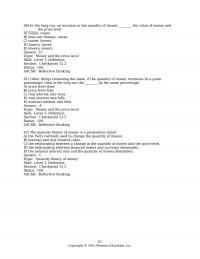
60) In the long run, an increase in the quantity of money ________ the value of money and ________ the price level. A) raises; raises B) does not change; raises C) raises; lowers D) lowers; raises E) lowers; lowers Skill: […]
978-0133460629 Chapter 12 Part 6
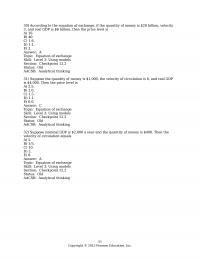
30) According to the equation of exchange, if the quantity of money is $20 billion, velocity 3, and real GDP is $6 billion, then the price level is A) 10. B) 40. C) 1.6. D) 1.1. E) 2. Skill: Level […]
978-0133460629 Chapter 12 Part 5
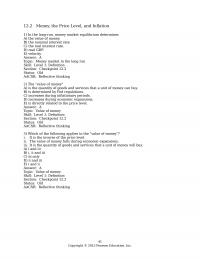
12.2 Money, the Price Level, and Inlation 1) In the long-run, money market equilibrium determines A) the value of money. B) the nominal interest rate C) the real interest rate. D) real GDP. E) velocity. Skill: Level 1: Deinition Section: […]
978-0133460629 Chapter 12 Part 4
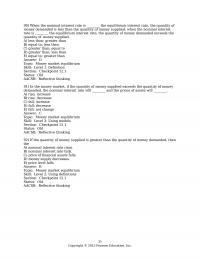
90) When the nominal interest rate is ________ the equilibrium interest rate, the quantity of money demanded is less than the quantity of money supplied; when the nominal interest rate is ________ the equilibrium interest rate, the quantity of money […]
978-0133460629 Chapter 12 Part 3
61) During an economic expansion when real GDP increases, the A) demand for money increases. B) demand for money decreases. C) supply of money decreases. D) nominal interest rate is constant. E) real interest rate is constant. Skill: Level 2: […]
978-0133460629 Chapter 12 Part 2
31) Which of the following increases the quantity of money demanded? A) a rise in the nominal interest rate B) a rise in the inlation rate C) a rise in the real interest rate D) a fall in the nominal […]