Archives: Quiz
GSM 409 Quiz 2
The purpose of marketing research is __________. a. to gain customers b. to identify customer c. to fulfill customer needs d. to develop new products When premature entry into the marketplace causes the failure of a new venture, it can […]
MG 261 Quiz 2
When considering management, the entrepreneur should be concerned about a. ownership positions. b. pension and profit sharing. c. total number of employees. d. employee benefits. Which of the following is not a suggestion a tax accountant or lawyer might make […]
MOB 614
SEC stands for the a. Stock Exchange Corporation. b. Securities and Exchange Commission. c. Standard Equity Commission. d. Source of Equity Company. The displacement school of thought can be divided into which three groups? a. political, cultural, environmental b. cultural, […]
M 396 Test 2
According to the Learned Intermediary Rule, pharmaceutical manufacturers do not have to warm consumers about drug dangers as long as they have adequately warned physicians. a. True b. False According to the article excerpted in the text entitled, The Functions […]
LAW 726
Give a brief description of the increased protection in U.S. Copyright laws starting in 1994 and using approximate dates. The Equal Employment Opportunity Commission (EEOC) favors English-only rules because they decrease the ability for people to stereotype based on national […]
LWB 876 Test 2
According to Citizens United v. Federal Election Commission, which of the following is not a reason to allow corporations the right to spend money and advertise for political candidates? a. Political speech is the most important, and most protected, speech […]
M 538
Which of the following are ways businesses justify electronic surveillance of employees? I. It measures and encourages efficiency. II. It uncovers employee disloyalty. III. It enhances the fairness of personnel evaluations. IV. It prevents employees from sending personal emails on […]
JD 885 Test 1
A majority of states have enacted off-the-job privacy protection laws. What is the LEAST effective argument by an employer to regulate off-the-clock activities in a state that has not enacted such lifestyle rights legislation? a. It will provide a healthy […]
LWB 688 Midterm 1
Employment practices without business justification applied to all employees that result in a less favorable effect for one group than for another group may state a claim for: a. disparate treatment b. disparate impact c. inclusion d. reasonable accommodation In […]
Economics 279 Homework
In an economic union, member countries do not have free flow of factors of production but have a common internal policy. A bank deposit in Germany denominated in euros is a Eurocurrency deposit. Answer: FALSE Intra-industry trade in differentiated products […]
Economics 307
In the Plaza Agreement, the United States agreed to reduce its fiscal deficit. If additional domestic production will lead to positive spillover effects, then an import tariff that increases domestic production would better adhere to the specificity rule than would […]
Economics 775 Quiz 2
A central bank can sterilize the increase in the money supply that results from an intervention to defend a fixed exchange rate by selling domestic government bonds. Proposals for reform of antidumping policy include restricting its use to cases where […]
ECON 814 Quiz
Making effective monetary policy for the euro zone should be a relatively easy task for the European Central Bank (ECB) since the euro member countries are very similar. Answer: Just before the Asian crisis, Thailand had large current account deficits. […]
ECON 861 Quiz 3
A country’s nonofficial financial account balance equals its net foreign investment. Answer: The Bretton Woods conference led to the creation of the International Monetary Fund (IMF). Answer: TRUE The assignment rule says that, with fixed exchange rates, fiscal policy should […]
MicroEconomic 158 Test 2
Unlike a tariff, quotas do not allow domestic monopolists to assert their monopoly pricing powers. Answer: Forward exchange contracts are used for hedging but not for speculating. Answer: FALSE In a two-country two-good model, the opening of trade will necessarily […]
ECB 181 Homework
A rise in the domestic product of an economy deteriorates its current account balance. Answer: Increases in a country’s endowments of factors of production increase current output, but do not contribute to long-run economic growth. Answer: FALSE If Canada has […]
ECON 172 Midterm 2
The price elasticity of demand measures the responsiveness of consumers to changes in the price of a product. Answer: If a country’s currency is a reserve currency, then intervention in the foreign exchange market to maintain a pegged exchange rate […]
BUS 496
In the floating exchange rate system, government officials must intervene in the foreign exchange market to keep the exchange rate from fluctuating. Answer: The official settlements balance is the sum of the capital account balance and the public current account […]
ECON 143 Test 1
Most or all of the mark-up revenue from a quota will be captured by the government if the government auctions off import licenses. Answer: New technology developed by a multinational corporation in one of its research facilities in a leading […]
BUS 893 Midterm 1
The impact of economic growth on a country’s willingness to trade is determined solely by the extent of the shift of its production-possibility curve. Answer: Hedging a position exposed to exchange-rate risk is the act of reducing or eliminating a […]
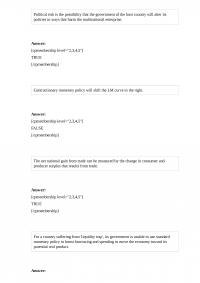
ECB 410 Midterm Political risk is
Political risk is the possibility that the government of the host country will alter its policies in ways that harm the multinational enterprise. Answer: Contractionary monetary policy will shift the LM curve to the right. Answer: FALSE The net national […]
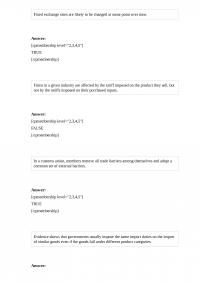
BUS 354 Quiz 1
Fixed exchange rates are likely to be changed at some point over time. Answer: Firms in a given industry are affected by the tariff imposed on the product they sell, but not by the tariffs imposed on their purchased inputs. […]
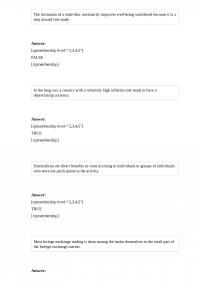
Economics 257 Quiz 2
The formation of a trade bloc necessarily improves well-being worldwide because it is a step toward free trade. Answer: In the long run, a country with a relatively high inflation rate tends to have a depreciating currency. Answer: TRUE Externalities […]
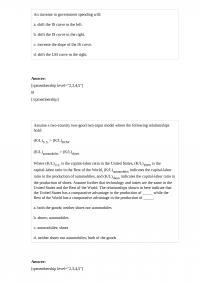
MicroEconomic 118 Midterm An
An increase in government spending will: a. shift the IS curve to the left. b. shift the IS curve to the right. c. increase the slope of the IS curve. d. shift the LM curve to the right. Answer: Assume […]
ECB 312 Homework
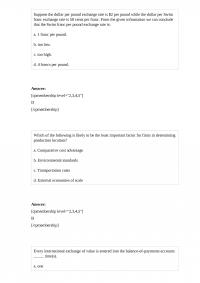
Suppose the dollar per pound exchange rate is $2 per pound while the dollar per Swiss franc exchange rate is 50 cents per franc. From the given information we can conclude that the Swiss franc per pound exchange rate is: […]
ECON 689 Test 1
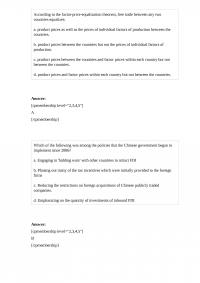
According to the factor-price-equalization theorem, free trade between any two countries equalizes: a. product prices as well as the prices of individual factors of production between the countries. b. product prices between the countries but not the prices of individual […]
Economics 889
Everything else remaining unchanged, the effect of domestic spending shocks on a country with a floating exchange rate differs depending on: a. whether sterilized intervention is used or not. b. the mobility of capital across countries. c. the current trade […]
BUS 226 Midterm 1
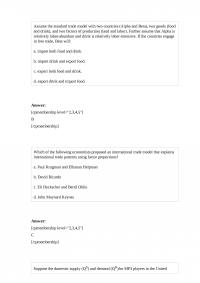
Assume the standard trade model with two countries (Alpha and Beta), two goods (food and drink), and two factors of production (land and labor). Further assume that Alpha is relatively labor-abundant and drink is relatively labor-intensive. If the countries engage […]
ECB 483 Quiz 2
Which of the following arises when the knowledge that IMF rescue packages are possible leads lenders to be less careful about their international lending practices? a. Global contagion b. Moral hazard c. Debt overhang d. Debt restructuring Answer: Which of […]
MicroEconomic 337
_____ purchasing power parity states that a bundle of tradable products will have the same cost in different countries if the cost is stated in the same currency. a. Full b. Partial c. Relative d. Absolute Answer: Under a floating […]
ECB 149 Quiz 2
The value of price elasticity of demand for a normal commodity is negative because it indicates: a. the inverse relationship between the price and the quantity demanded for the commodity. b. that the value of the consumer surplus is negative […]
Economics 746 Quiz 2
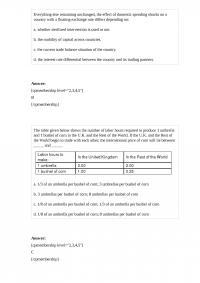
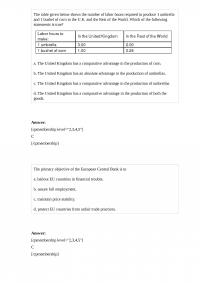
The table given below shows the number of labor hours required to produce 1 umbrella and 1 bushel of corn in the U.K. and the Rest of the World. Which of the following statements is true? a. The United Kingdom […]
MicroEconomic 502 Final
Under a floating exchange rate system, an increase in the international demand for electronic appliances manufactured in Japan will result in: a. Deflation in the Japanese economy. b. An increase in Japan’s trade deficit with other countries. c. An appreciation […]
ECON A 212 Midterm The figure
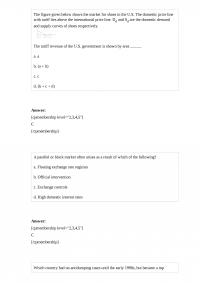
The figure given below shows the market for shoes in the U.S. The domestic price line with tariff lies above the international price line. Dd and Sd are the domestic demand and supply curves of shoes respectively. The tariff revenue […]
BUS 888 Quiz 1
Assume that a large capital-abundant country trades only two goods with the rest of the world, medical equipment and corn. Medical equipment is relatively capital-intensive. An increase in the country’s endowment of capital will cause the price of medical equipment […]
ECON 587
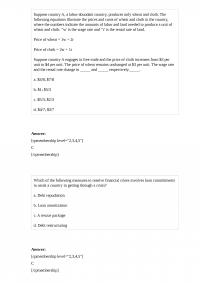
Suppose country A, a labor-abundant country, produces only wheat and cloth. The following equations illustrate the prices and costs of wheat and cloth in the country, where the numbers indicate the amounts of labor and land needed to produce a […]
ECON 282 Test 1 Assume a country
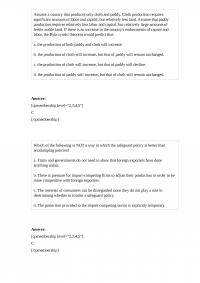
Assume a country that produces only cloth and paddy. Cloth production requires significant amounts of labor and capital, but relatively less land. Assume that paddy production requires relatively less labor and capital, but relatively large amounts of fertile arable land. […]
ECB 320 Test 1
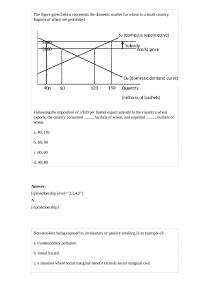
The figure given below represents the domestic market for wheat in a small country. Imports of wheat are prohibited. Following the imposition of a $20 per bushel export subsidy to the country’s wheat exports, the country consumed _____ bushels of […]
Economics 336 Final
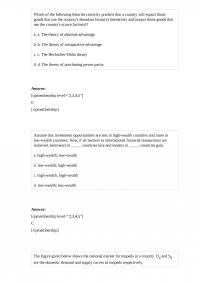
Which of the following theories correctly predicts that a country will export those goods that use the country’s abundant factor(s) intensively and import those goods that use the country’s scarce factor(s)? a. a. The theory of absolute advantage b. b. […]
Economics 502 Midterm 1
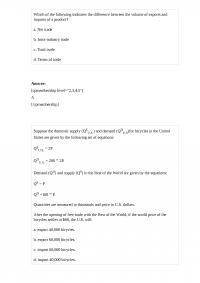
Which of the following indicates the difference between the volume of exports and imports of a product? a. Net trade b. Intra-industry trade c. Total trade d. Terms of trade Answer: Suppose the domestic supply (QS U.S.) and demand (QD […]
MicroEconomic 426 Final
Monetary policy under a fixed exchange rate regime will be: a. more effective than fiscal policy. b. more powerful with high capital mobility than with low capital mobility. c. likely to cause large and persistent deficits. d. constrained and relatively […]
ECON E 280
Suppose that the training, skills, and attitudes received by employees in the computer gaming development industry have positive spillover effects as workers leave the industry and move to other jobs. The specificity rule suggests that the best way to achieve […]
BUS 629
The infant industry argument is valid if the present value of the stream of national benefits is less than the present value of the stream of national costs. Answer: Banks open branches in countries where profits are taxed less and […]
ECON 440 Quiz 2
A country’s balance of payments records: a. the prices that a country pays for its imports and the prices that the country receives for its imports. b. the flows of value between that country’s residents and residents of the rest […]
ECON 580 Homework
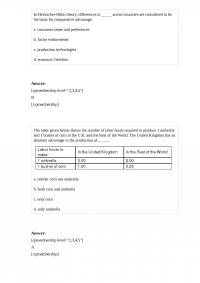
In Heckscher-Ohlin theory, differences in _____ across countries are considered to be the basis for comparative advantage. a. consumer tastes and preferences b. factor endowments c. production technologies d. economic freedom Answer: The table given below shows the number of […]
ECON E 767 Quiz 3
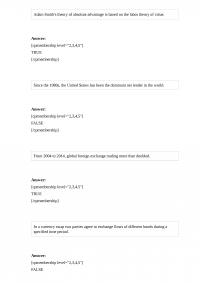
Adam Smith’s theory of absolute advantage is based on the labor theory of value. Answer: Since the 1980s, the United States has been the dominant net lender in the world. Answer: FALSE From 2004 to 2014, global foreign exchange trading […]
ECON 637 Homework
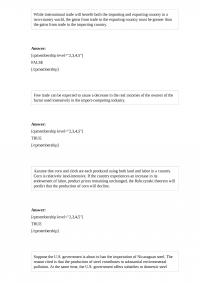
While international trade will benefit both the importing and exporting country in a two-country world, the gains from trade in the exporting country must be greater than the gains from trade in the importing country. Answer: Free trade can be […]
ECON 159
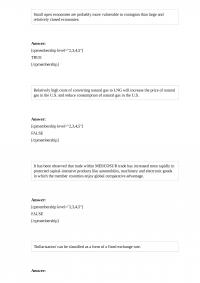
Small open economies are probably more vulnerable to contagion than large and relatively closed economies. Answer: Relatively high costs of converting natural gas to LNG will increase the price of natural gas in the U.S. and reduce consumption of natural […]
ECON 721 Quiz 2
In the absence of trade, a country produces at a point where its production-possibility curve is tangent to the highest possible community indifference curve. Answer: If markets are perfectly competitive, the free-trade price of a good in an importing country […]
ECB 222
In a two-country two-commodity model, if a country has higher labor productivity in producing both the goods, it must produce and export both the goods to the other country. Answer: The production effect of a tariff measures the welfare gain […]