Archives
BUSOP 868 Quiz
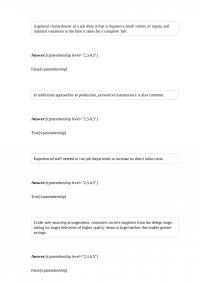
A general characteristic of a job shop is that it requires a small variety of inputs, and minimal variations in the time it takes for a complete ‘job’. In traditional approaches to production, preventive maintenance is also common. Answer: True […]
BUSOPMT 595 Quiz 2
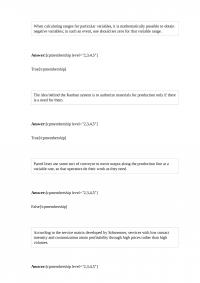
When calculating ranges for particular variables, it is mathematically possible to obtain negative variables; in such an event, one should set zero for that variable range. The idea behind the Kanban system is to authorize materials for production only if […]
OIM 853 Midterm 2
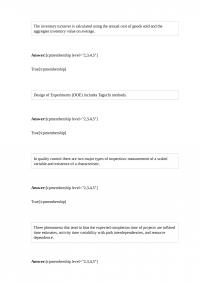
The inventory turnover is calculated using the annual cost of goods sold and the aggregate inventory value on average. Design of Experiments (DOE) includes Taguchi methods. Answer: True In quality control there are two major types of inspection: measurement of […]
Operation Management 841 Midterm 1
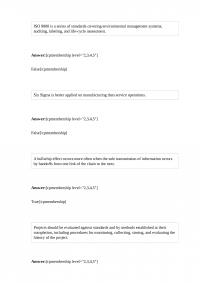
ISO 9000 is a series of standards covering environmental management systems, auditing, labeling, and life-cycle assessment. Six Sigma is better applied on manufacturing than service operations. Answer: False A bullwhip effect occurs more often when the sole transmission of information […]
OPMT 805 Quiz 1
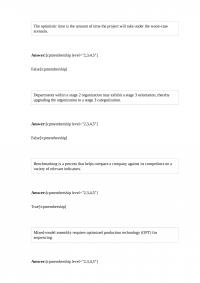
The optimistic time is the amount of time the project will take under the worst-case scenario. Departments within a stage 2 organization may exhibit a stage 3 orientation, thereby upgrading the organization to a stage 3 categorization. Answer: False Benchmarking […]
QSO 520 Test 1
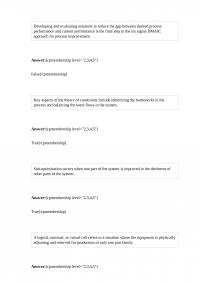
Developing and evaluating solutions to reduce the gap between desired process performance and current performance is the final step in the six sigma DMAIC approach for process improvement. Key aspects of the theory of constraints include identifying the bottlenecks in […]
QSO 769 Quiz 2
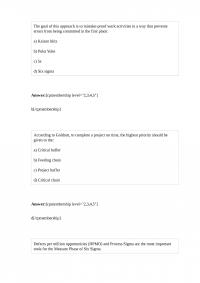
The goal of this approach is to mistake-proof work activities in a way that prevents errors from being committed in the first place: a) Kaizen blitz b) Poka Yoke c) 5s d) Six sigma According to Goldratt, to complete a […]