Archives
Chapter 1 Mutual Funds Secondary Markets Help Support
1 CHAPTER 1 TRUE/FALSE QUESTIONS to market. (F) 5. Deposits in a credit union by a household are an example of direct finance. (F) 6. When a surplus spending units (SSU) owns a financial claim created by financial intermediation, its […]
Chapter 10 The Dealers Return The Bid ask Spread Auction
1 CHAPTER 10 TRUE/FALSE QUESTIONS alter the riskiness of their portfolios. (F) 5. Stock with betas less than one tend to have more price variability than the market. (F) 6. Limited liability of stockholders protects them from losses on their […]
Chapter 11 An Margin Deposited Before Entering Into The
CHAPTER 11 TRUE-FALSE QUESTIONS (F) 1. Hedgers always buy futures contracts. (T) 2. Writing calls can generate potentially unlimited losses. (T) 3. The price sensitivity rule assists the hedger by estimating the number of futures contracts to trade. (F) 4. […]
Chapter 12 Eurobonds are bearer bonds and do not have to be registered
1 CHAPTER 12 TRUE/FALSE QUESTIONS dollar in the spot market will be higher than in the forward market. (F) 2. A country’s forward exchange rate will increase relative to its spot exchange rate when people expect it to have more […]
Chapter 13 Using Matched funding Pricing The Major Factor Determining
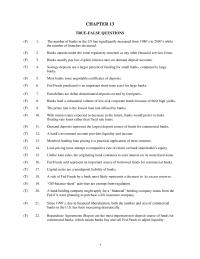
1 CHAPTER 13 TRUE-FALSE QUESTIONS the number of branches decreased. (F) 2. Banks operate under the same regulatory structure as any other financial services firms. (F) 3. Banks usually pay low explicit interest rates on demand deposit accounts. (T) 4. […]
Chapter 14 Us Bank Regulated Us Bank Regulations The
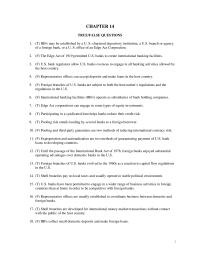
1 CHAPTER 14 TRUE/FALSE QUESTIONS of a foreign bank, or a U. S. office of an Edge Act Corporation. 2. (F) The Edge Act of 1919 permitted U.S. banks to create international banking facilities. 3. (F) U.S. bank regulators allow […]
Chapter 15 The Most Significant Cause Bank Failure Today
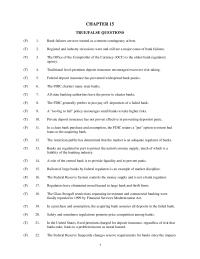
(F) 22. The Federal Reserve frequently changes reserve requirements for banks since the impacts 1 CHAPTER 15 TRUE/FALSE QUESTIONS (F) 1. Bank failures are now treated as a remote contingency at best. (T) 2. Regional and industry recessions were and […]
Chapter 16 Federal Savings And Loan Insurance Corporation Federal
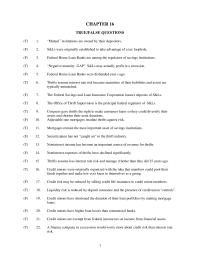
1 CHAPTER 16 TRUE/FALSE QUESTIONS typically unmatched. (F) 7. The Federal Savings and Loan Insurance Corporation insures deposits of S&Ls. (T) 8. The Office of Thrift Supervision is the principal federal regulator of S&Ls. (T) 9. Congress gave thrifts the […]
Chapter 17 The Major Areas Business For Life Insurance
1 CHAPTER 17 TRUE/FALSE QUESTIONS insurance companies because life companies have greater certainty of claims. (F) 4. An annuity provides both insurance against premature death and savings features. (F) 5. Property/liability insurance companies pay little federal income tax, thus explaining […]
Chapter 18 Investment Bankers Tend Reduce Their Risk Underwriting
1 CHAPTER 18 TRUE/FALSE QUESTIONS simultaneously engage in commercial banking. 4. (T) A security underwriting takes place in the primary market; subsequent trading in the security takes place in the secondary market. 5. (F) A dealer earns a commission for […]
Chapter 19 Which Fund Would You Choose Fund Fund
1 CHAPTER 19 TRUE/FALSE QUESTIONS less volatile. 2. (T) Market arbitrage by hedge funds is the simultaneous buying and selling of a security or derivative of the security to exploit market pricing differentials. 3. (F) When purchasing load mutual fund, […]
Chapter 2 Federal Reserve regulations affect many nonbank institutions
19 CHAPTER 2 TRUE/FALSE QUESTIONS (F) 1. Deposits should expand when reserve requirements increase. (F) 2. The Fed’s most influential tool is reserve requirements. (T) 3. Federal Reserve regulations affect many nonbank institutions. (T) 4. Depository institutions create money when […]
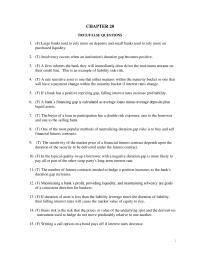
Chapter 20 This Bank Also Has 135 Million Interest bearing
1 CHAPTER 20 TRUE/FALSE QUESTIONS purchased liquidity. 2. (T) Insolvency occurs when an institution’s duration gap becomes positive. 3. (F) A firm informs the bank they will immediately draw down the maximum amount on their credit line. This is an […]
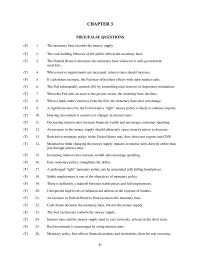
Chapter 3 Monetary Policy Probably Affects All The Following
(F) 15. Increasing interest rates increase wealth and encourage spending. (F) 16. Easy monetary policy strengthens the dollar. (T) 17. A prolonged “tight” monetary policy can be associated with falling bond prices. (F) 18. Stable employment is one of the […]
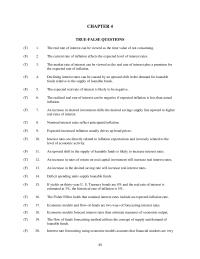
Chapter 4 Basic Approaches Forecasting Interest Rates Include Economic
43 CHAPTER 4 TRUE-FALSE QUESTIONS the expected rate of inflation. (F) 4. Declining interest rates can be caused by an upward shift in the demand for loanable funds relative to the supply of loanable funds. (F) 5. The expected real […]
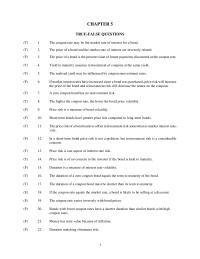
Chapter 5 Which The Following Statements About Duration True
1 CHAPTER 5 TRUE-FALSE QUESTIONS the price of the bond and reinvestment risk will decrease the return on the coupons. (T) 7. A zero coupon bond has no reinvestment risk. (T) 8. The higher the coupon rate, the lower the […]
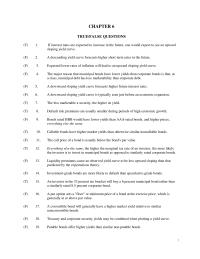
Chapter 6 A descending yield curve forecasts higher short-term rates
1 CHAPTER 6 TRUE/FALSE QUESTIONS sloping yield curve. (F) 2. A descending yield curve forecasts higher short-term rates in the future. (F) 3. Expected lower rates of inflation will lead to an upward sloping yield curve. (F) 4. The major […]
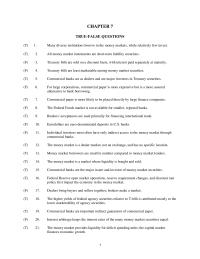
Chapter 7 All money market instruments are short-term liability securities
1 CHAPTER 7 TRUE-FALSE QUESTIONS alternative to bank borrowing. (T) 7. Commercial paper is more likely to be placed directly by large finance companies. (F) 8. The Federal Funds market is not available for smaller, regional banks. (T) 9. Bankers’ […]
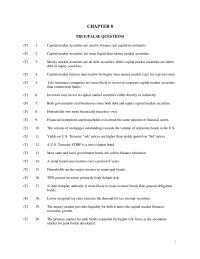
Chapter 8 Corporate Bonds Are Fact Not Less Marketable
1 CHAPTER 8 TRUE/FALSE QUESTIONS than commercial banks. (T) 6. Investors may invest in capital market securities either directly or indirectly. (F) 7. Both governments and businesses issue both debt and equity capital market securities. (F) 8. Households owe more […]
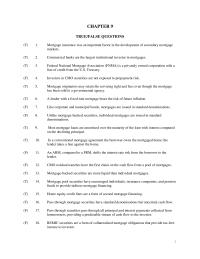
Chapter 9 Commercial banks are the largest institutional investor
1 CHAPTER 9 TRUE/FALSE QUESTIONS markets. (T) 2. Commercial banks are the largest institutional investor in mortgages. (T) 3. Federal National Mortgage Association (FNMA) is a privately owned corporation with a line of credit from the U.S. Treasury. (F) 4. […]