1
CHAPTER 20
TRUE/FALSE QUESTIONS
purchased liquidity.
their credit line. This is an example of liability side risk.
will have a payment change within the maturity bucket if interest rates change.
liquid assets.
and one to the selling bank.
8. (T) One of the most popular methods of neutralizing duration gap risks is to buy and sell
financial futures contracts.
duration of the security to be delivered under the futures contract.
pay all or part of the other swap party’s long-term interest rate.
11. (T) The number of futures contracts needed to hedge a position increases as the bank’s
duration gap increases.
of a consistent direction for bankers.
then falling interest rates will cause the market value of equity to rise.
14. (T) Basis risk is the risk that the prices or value of the underlying spot and the derivatives
instrument used to hedge do not move predictably relative to one another.
2
or less.
position in euro futures could help offset the corporation’s foreign exchange risk.
attempt to determine the maximum loss they might sustain over a designated period of
time.
reduce the interest rate risk of banks.
MULTIPLE-CHOICE QUESTIONS
bank’s overall interest rate risk exposure and protect the bank’s net worth depends upon
(among other factors):
A) The relative duration of bank assets and liabilities.
B) The duration of the underlying security named in the futures contract.
C) The price of the futures contract.
D) All of the above.
E) None of the above.
A) The duration of the underlying security named in the futures contract
B) The initial futures price
C) The change expected in interest rates divided by 1 + the original interest rate.
D) All of the above.
E) None of the above.
A) Long term assets funded by short term liabilities
B) Short term assets funded by short term liabilities
C) Long term assets funded by long term liabilities
D) Short term assets funded by long term liabilities
E) Long term liabilities funded by short term assets
3
A) Demand deposits increase $120; loans increase $80
B) Reverse repurchase agreements increase $50; demand deposit decrease $50
C) Repurchase agreements increase $100; Demand deposit decrease $50
D) Demand deposits decrease $120; loan repayments are $250
E) Demand deposits increase $10; loans decrease $10
or bank run. Which one of the following alternatives is an appropriate way to deal
with deposit withdrawal?
A) Increasing in Euro dollar deposits
B) Contacting an investment banker to find new corporate deposits
C) Increasing Fed funds borrowed
D) Issuance of a negotiable CD
E) Selling the bank’s holdings of T-bills
Refer to the information below for questions 6-8:
Formosa International Bank (FIB) (mill$)
Funds borrowed
$6,300
Maximum amount FIB can still borrow
$8,600
Cash–type assets
$4,700
Excess cash reserves
$ 100
Federal Reserve borrowings
$ 200
A) $16,520
B) $13,400
C) $14,200
D) $12,280
E) $15,760
A) $6,500
B) $14,500
C) $14,900
D) $16,280
E) $15,760
A) $4,520
B) $6,500
C) $5,200
D) $7,280
E) $6,900
4
Refer to the information below for questions 9-10:
Formosa Independence Bank has the following balance sheet:
Assets
Return
Mill $
Liabilities and Equity
Cost
Mill $
Cash
0.00%
$ 35
Fixed rate deposits
3.50%
$240
Investments (< 1 year)
4.00%
$400
Rate sensitive deposits
2.00%
$360
Short term loans (< 1 year)
6.00%
$280
Fed fund borrowings
2.50%
$ 75
Long term fixed rate loans
(maturity > 1 year)
6.75%
$250
Long term borrowings at
fixed rate (maturity > 1 year)
5.50%
$119
Total
$710
Equity
$ 66
Total
$710
9. (B) The bank’s one-year gap between assets and liabilities is (Mill $)
A) $425
B) $245
C) $174
D) $140
E) $126
other things are equal, what is the change in net interest income for Formosa Independence
Bank over the year?
A) $0
B) $1,400,000
C) -$1,400,000
D) $1,592,500
E) -$1,592,500
and risk-sensitive liabilities will move directly with interest rates. If interest rates fall the
bank’s overall NII will
A) Fall
B) Rise
C) Necessarily be unchanged
D) Rise or fall depending on the size of the spread affect relative to the size of the CGAP
effect
A) Predicted increase in net deposit withdraws before holidays
B) A natural disaster in the bank’s community
C) Corporation calls in a bond the bank is holding
D) Maturation of notes payable
5
and borrowed funds are 5% of assets. Bank B has a loan to deposit ratio of 120%. Core
deposits are 55% of assets and borrowed funds are 20% of assets. Which bank has more
liquidity risk? Ceteris paribus, which bank will probably be more profitable when interest
rates are low?
A) Bank A; Bank A
B) Bank A; Bank B
C) Bank B; Bank A
D) Bank B; Bank B
in 6 month maturity T-Bills, and $75 million invested in consumer loans with a 3 year
duration. If they are all portfolios of this bank, what is the duration of the bank’s asset
portfolio in years?
A) 5.95 years
B) 6.50 years
C) 7.23 years
D) 8.78 years
E) 9.51 years
Refer to the information below for questions 15-17:
As a portfolio manager of Asian Investments and Co., you like to evaluate the Value-at-Risk
of your currency holding of Taiwanese and Japanese assets. Use the historical data in the past
20 years, you obtain the following information regarding the exchange rate between USD ($)
with Taiwanese Dollar (TWD) and Japanese Yen (JPY):
DEAR and VAR Calculations:
Time Horizon (Days) =
10
Lower Tail
Probability=
0.005
$ Amount
Standard Deviation
Adverse Move
DEAR (TWD)
1,000,000
0.0050
2.58
DEAR (JPY)
1,000,000
0.0100
2.58
DEAR (TWD and JPY)
2,000,000
?
2.58
where DEAR is daily earnings-at-risk, standard deviation is the volatility calculated by
the historical data, adverse move is the t-value of the lower bound of the distribution of
asset value.
A) $9,892.55; $22,544.78
B) $11,842.32; $22,784.71
C) $15,672.22; $14,784.56
D) $11,928.93; $52, 874.78
E) $12,892.39; $25,784.78
Hint: DEAR =$ Value of Position
Price Sensitivity
Adverse Movement
6
calculate the DEAR for this 2-million USD portfolio.
A) $29,892.55
B) $21,842.32
C) $15,672.22
D) $31,579.78
E) $25,784.66
Answer: D
A) $ 99,864.02
B) $111,842.52
C) $115,627.25
D) $131,529.81
E) $135,784.62
weight of 1.0. This bank also has loans of $105 million and investments of $65 million
with interest rate sensitivity weights of 1.40 and 1.15 respectively. This bank also has
$135 million in interest-bearing deposits with an interest rate sensitivity weight of 0.90
and other money market borrowings of $75 million with an interest rate sensitivity
weight of 1.0. What is the weighted interest-sensitive gap for this bank?
A) $50.25
B) $-15
C) -$50.25
D) $34.25
coupon rate of 13 percent and is selling in the market today for $902. Coupon payments
are made annually on this bond. What is the yield to maturity (YTM) for this bond?
A) 13.25%
B) 12.75%
C) 16.00%
D) 11.45%
income when interest rates in the market:
A) Rise
B) Unchange
C) Fall
D) A bank with a positive interest-sensitive gap will never have a decrease in
net interest income
7
duration of 2.70 years. This bank has $250 million in total assets and $225 million in total
liabilities. This bank has:
A) A negative duration gap of 1.55 years.
B) A positive duration gap of 1.28 years.
C) A negative duration gap of 3.85 years.
D) A negative duration gap of 1.28 years.
in the market are 7% today. It has been forecasted that interest rates will rise to 9% over
the next couple of weeks. How will this bank’s price change in percentage terms?
A) This bond’s price will rise by 2 percent.
B) This bond’s price will fall by 2 percent.
C) This bond’s price will not change
D) This bond’s price will rise by 14.02 percent
E) This bond’s price will fall by 14 .02 percent
of 3 years. This bank has total assets of $500 million and total liabilities of $250 million.
Currently, market interest rates are 10 percent. If interest rates fall to 8 percent, what is
this bank’s change in net worth?
A) Net worth will decrease by $31.81 million
B) Net worth will increase by $31.81 million
C) Net worth will increase by $27.27 million
D) Net worth will decrease by $27.27 million
E) Net worth will not change at all
24. (A) A bank wishing to avoid higher borrowing costs would be most likely to use:
A) A short or selling hedge in futures.
B) A long or buying hedge in futures.
C) A call option on futures contracts.
D) B and C above.
years. This bank has $1000 million in assets and $750 million in liabilities. They are
planning on trading in a Treasury bond future which has a duration of 8.5 years and
which is selling right now for $99,000 for a $100,000 contract. How many futures
contracts does this bank need to fully hedge itself against interest rate risk?
A) 3714 contracts
B) 3125 contracts
C) 2971 contracts
D) 371 contracts
E) 37 contacts
8
market price of $98,750. Market interest rates are 6 percent today but are expected to rise
to 7.5 percent. What is the change in this futures contract’s market price from this change
in interest rates?
A) +$12,577
B) -$12,577
C) +$62,883
D) -$62,883
E) -$33,578
27. (B) A microhedge is a
A) Hedge against a change in a particular macro variable
B) Hedge of a particular asset or liability
C) Hedge of an entire balance sheet
D) Hedge using options
E) Hedge without basis risk
year duration. The manager believes interest rates may increase 50 basis points. Which
of the following could be used to help limit his risk?
I. Sell the bonds forward.
II. Buy bond futures contracts.
III. Buy call options on the bonds.
IV. Buy put options on the bonds.
A) I only
B) II only
C) I and III only
D) II and III only
E) I and IV only
A) Hedge of a particular asset or liability
B) Hedge using futures on macroeconomic variables
C) Hedge using options in liabilities
D) Hedge without basis risk
E) Hedge of an entire balance sheet
Refer to the information below for questions 30-32:
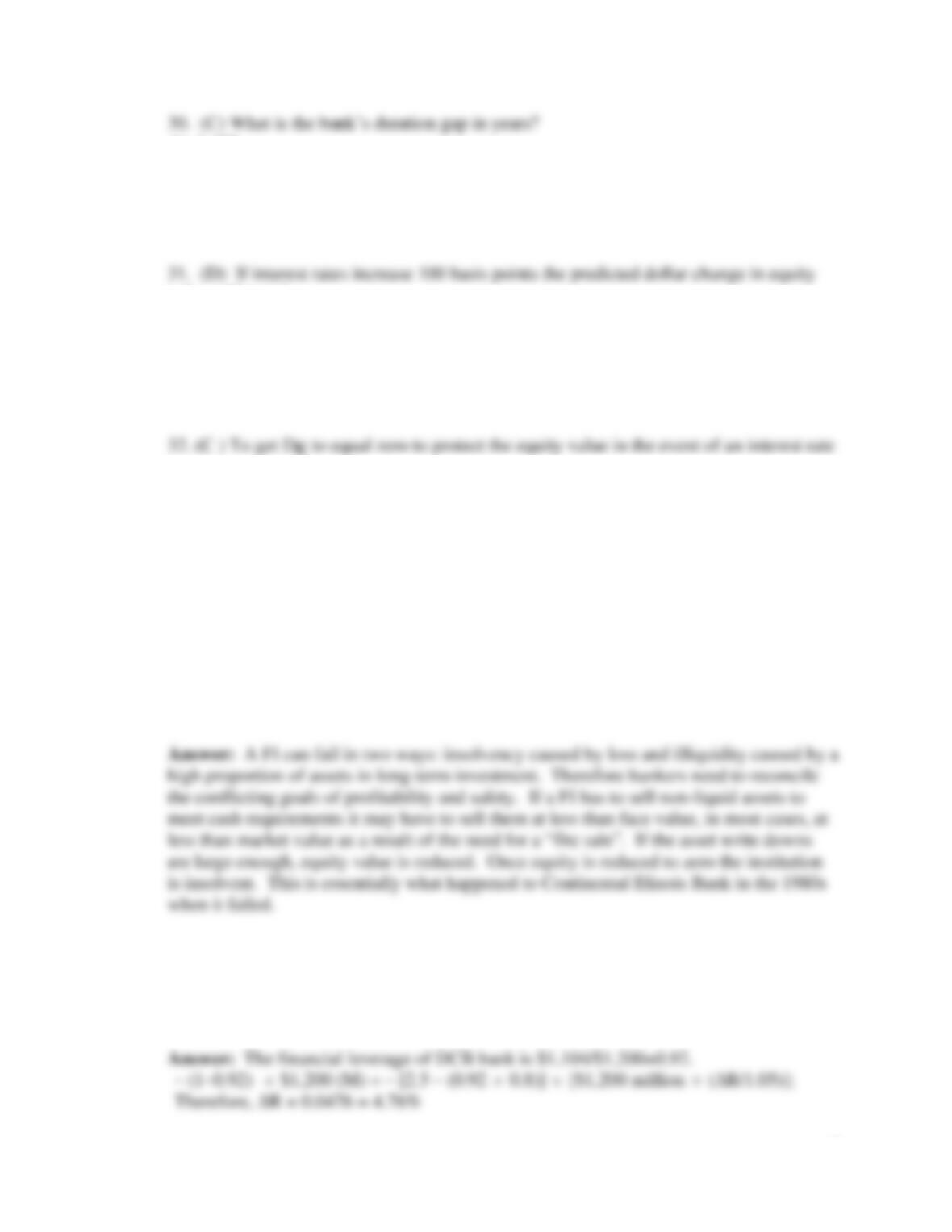
XYZ Bank has DA = 2.4 years and DL = 0.9 years. The bank has total equity of $82
million and total assets of $850 million. Currently, interest rates are at 6%.
9
A) 1.432
B) 1.488
C) 1.587
D) 1.656
E) 1.722
value will equal
A) $10,171,698
B) –$10,171,698
C) $12,724,528
D) –$12,724,528
E) $4,928,756
change, the bank could
A) Reduce DA to 1.2 years
B) Increase DL to 2.5 years
C) Increase DL to 2.77 years
D) Reduce DA to zero
E) Increase DL to 3.10 years
ESSAY QUESTIONS
1. Explain the dilemma between liquidity, solvency and profitability. Why liquidity risk
can lead to insolvency risk?
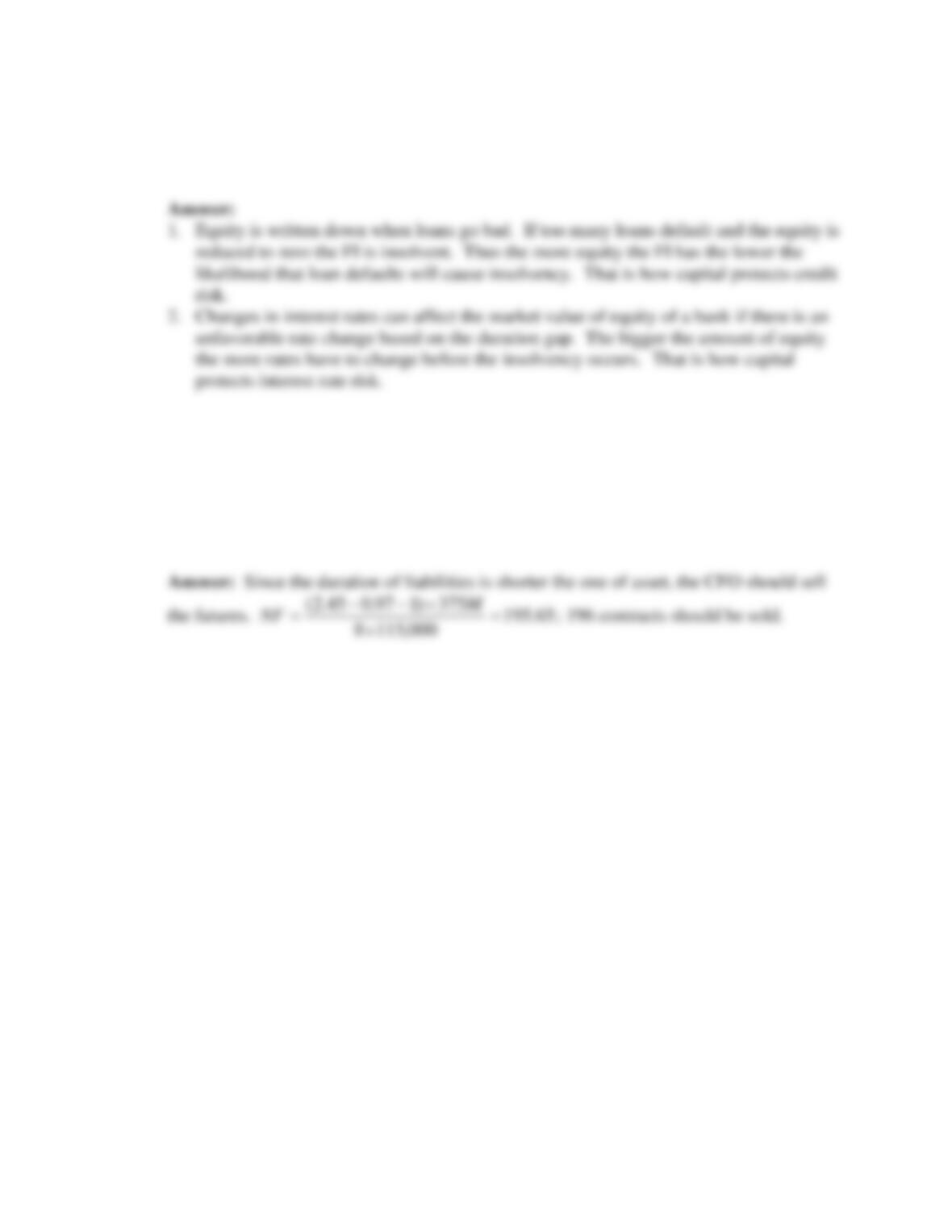
2. DCB bank has an assets size $1,200 million, with duration DA = 2.5 years, DL =
0.80 years. In addition, the total liability is $1,104 million. According to the duration gap
model, what size interest rate change would make the institution insolvent if rates are
currently 5%?
10
3. Why the capital in a financial institution can protect against credit risk and
interest rate risk?
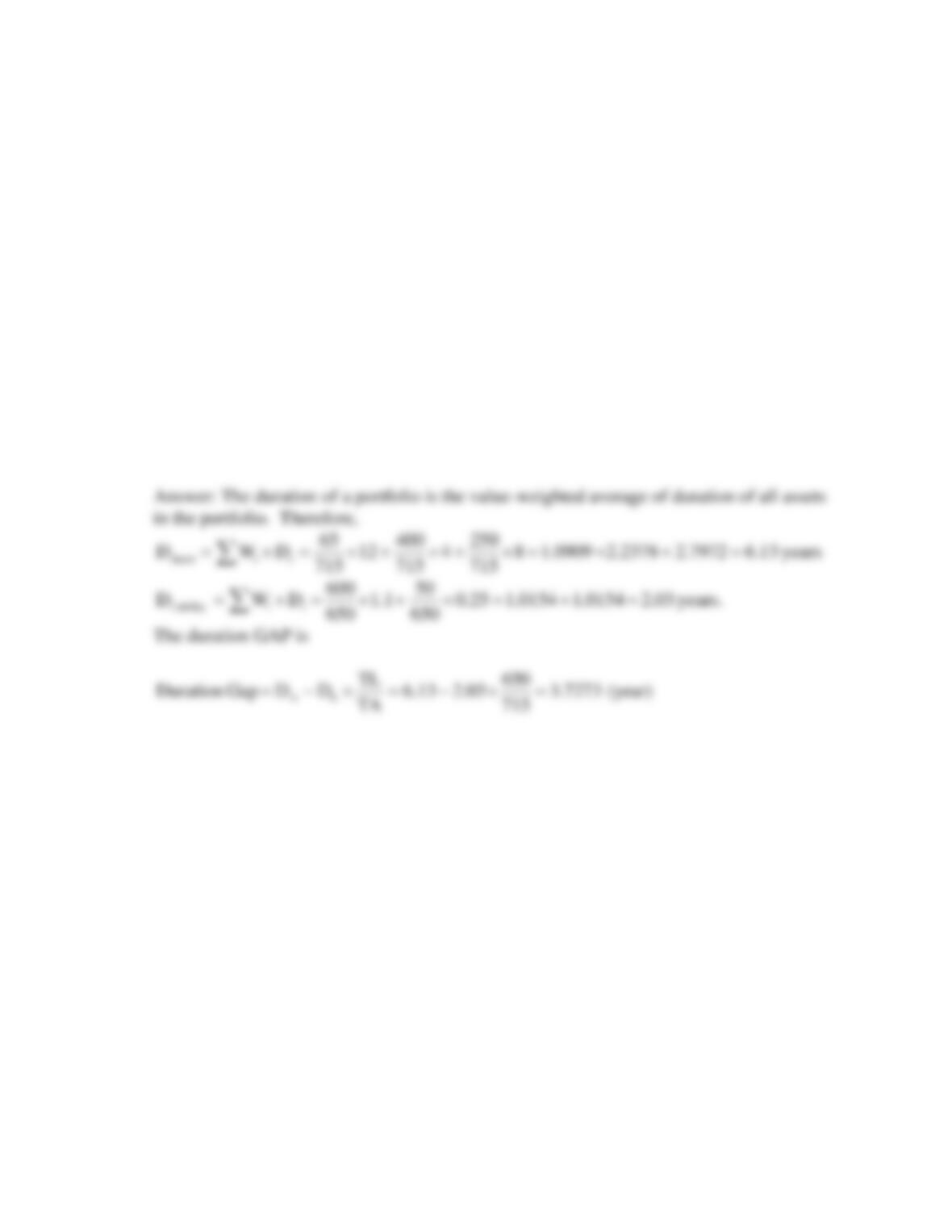
4. Formosa Independence Bank has DA = 2.45 years and DL = 1.08 years. In
addition, this bank has total assets of $375 million and liabilities of $337.5 million. The
CFO of Formosa Independence Bank wishes to effectively reduce the duration gap to one
year by hedging with T-Bond futures that have a market value of $115,000 and a DFut = 8
years. How many contracts are needed and should the bank buy or sell them? If D stands
for duration.
11
5. The average durations and dollar amounts of assets and liabilities held in Freedom
Bank are shown as the below:
Asset and Liability
Items
Avg.Duration(yrs)
$
Amount
Investment Grade
Bonds
12.00
$65.00
Commercial Loans
4.00
$400.00
Consumer Loans
8.00
$250.00
Deposits
1.10
$600.00
Nondeposit
Borrowings
0.25
$50.00
What is the weighted average duration of Freedom Bank’s asset portfolio? What is the
weighted average duration of Freedom Bank’s liability portfolio? What is the leverage–
adjusted duration gap?