1
CHAPTER 15
TRUE/FALSE QUESTIONS
agency.
loans to the acquiring bank.
liability of the banking industry.
finally repealed in 1999 by Financial Services Modernization Act.
banks take, leads to a problem known as moral hazard.
2
of these changes is not big to risk taking behavior of banks.
threatening the integrity of bank deposits.
MULTIPLE-CHOICE QUESTIONS
a. concern for concentrated financial power
b. historical experience with bank failures and panics
c. states vs. federal authority
d. all of the above
a. moral hazard.
b. the innovation cycle.
c. the regulatory dialectic.
d. securitization.
a. reducing the chance of failure.
b. increasing the cost of funds.
c. increased labor cost to comply with regulations.
d. increased profit from the added compliance costs.
a. which is an increase in the chance that a random accident will occur.
b. which is an incentive to decreased risk-taking by the insured.
c. which is an incentive to increase risk-taking by the insurance authority.
d. which is an incentive to increase risk-taking by the insured.
a. prevented bank failures.
b. created a moral hazard associated with increased risk assumption.
c. helped large banks at the expense of small banks.
d. charged increased premiums for increased risk.
a. to provide stability of the money supply
b. to serve certain social objectives
c. to reduce barriers to entry
d. to offset the moral hazard incentives to protect the deposit insurance fund
banks’ ability to pay is called a _______.
a. loss; run
b. panic; run
c. run; panic
d. payoff; regulatory dialectic
(c) 8. Regulations limiting risk taking of financial institutions are imposed because
3
a. the costs of regulation exceeds the benefits.
b. the private costs of failure exceed the social costs of failure.
c. the social costs of a general bank failure exceed the private costs to shareholders.
d. risk is harmful.
a. banks hold illiquid assets and reserves that are but a fraction of total deposits.
b. assets may rise in value more quickly than liabilities when interest rates change.
c. excessive loan losses may erode net worth.
d. asset values fall below the value of liabilities.
insurance?
a. risk-based capital standards.
b. risk-based deposit insurance premiums.
c. truth-in-lending regulations.
d. safety and soundness examinations.
a. $25,000 b $50,000 c. $250,000 d. $150,000
a. prevent bank runs by large depositors.
b. increase the regulatory monitoring of banks.
c. force the banks to invest in less risky investments.
d. prevent bank panics by insuring the small deposits of many people.
a. bank holding companies
b. credit unions
c. commercial banks
d. savings and loan associations
Reserve System and are insured by the _________.
a. state; members; FDIC-DIF
b. national; members; OCC-DIF
c. state; nonmember; FDIC-DIF
d. national; member; FRB-DIF
the failed bank and assumes its ________?
a. FDIC; charter; deposit liabilities
b. FDIC; assets; loan payments
c. assuming bank; deposits; assets
d. assuming bank; assets; deposit liabilities
4
facto 100 percent deposit insurance because
a. all accounts up to $100,000 have been paid off by the FDIC.
b. the assuming bank assumes all deposits of the failed banks.
c. the assuming bank assumes all deposits up to $100,000.
d. the large accounts above $100,000 are assumed by the FDIC.
total $60 million. Uninsured deposits and other unsecured liabilities total $80 million.
What proportion of uninsured deposits will be recovered by depositors?
a. 60% b. 50% c. 40% d. 100%
total $60 million. Uninsured deposits and other unsecured liabilities total $80 million.
What proportion of the stockholders’ claim of $10 million will be realized in the FDIC
payoff?
a. 0% b. 10% c. 50% d. 100%
invest funds for all but one of the following reasons:
a. acquire the sound assets of the failed bank
b. acquire the deposit liabilities
c. pay a premium for the intangible value of the bank
d. infuse sufficient cash to provide adequate capitalization.
a. not all banks participated.
b. the amount of the deposit funds were not adequate.
c. there was never a “deep pocket” backing such as the Federal Reserve System to
prevent bank panics in the first place.
d. the FDIC worked hard to undermine the confidence in the nonfederal insurance
arrangements.
a. failure of a single bank induces fear about the solvency of other banks.
b. they reduce the money supply in the economy.
c. a large number of people in a community lose their liquid wealth.
d. all of the above
a. the Comptroller of the Currency
b. the Federal Reserve System
c. the FDIC
d. individual state agencies
a. the competitiveness of financial services markets.
b. the incentives of managers.
c. the high salaries paid to managers.
d. the fear of loss by most depositors.
5
a. the Comptroller of the Currency
b. the Federal Reserve
c. the FDIC
d. individual state agencies
a. prevented bank depositor panics, but not bank failures.
b. prevented bank panic and bank failures.
c. prevented bank failures, but not bank depositor panic.
d. not prevented bank depositor panics, but has eliminated bank failures.
a. they provide essential financial services to consumers and businesses.
b. there is a need to control the money supply.
c. government has promised to insure deposits.
d. all of the above
a. a “too big to fail” policy.
b. a flat proportional premium charge to banks and thrifts for deposit insurance.
c. regulatory accounting practices, which inflated capital ratios.
d. all of the above
a. the size of the funds was more than enough to pay all depositors.
b. they overcharged the institutions on their premiums.
c. they did not have a “deep pocket” with unlimited borrowing power like Congress
behind them.
d. the regulation of the depositors was not as restrictive as it should have been.
a. bank depositor panics.
b. economic recession.
c. insufficient bank regulation.
d. fraud, embezzlement, and poor management practices.
a. To promote safety and soundness.
b. To affect the structure of banking.
c. To make sure bank capital ratios are competitive.
d. To protect the interest of consumers.
a. encourage high risk-taking by proper diversification.
b. limit proper diversification.
c. limit risk-taking and encourage diversification.
d. limit the size of depository institutions.
6
economic panic with
a. restricted bank liquidity and increased bank capital requirements.
b. increased availability of liquidity and interbank guarantees of deposits.
c. increased availability of liquidity and federal guarantees for bank deposits.
d. restricted money supply and lowered interest rates.
a. price control
b. consumer protection
c. safety and soundness
d. workplace safety
a. verify the bank’s financial statements according to generally accepted accounting
principles.
b. maintain proper control of the bank by FDIC.
c. promote and safety, soundness, and compliance with regulations.
d. make sure the bank is not taking any risk.
a. reduces the need for close regulatory supervision.
b. increases the need for more regulations, examinations, and regulators.
c. reduces the church attendance rate of bank managers.
d. increases the role of markets in disciplining excessive risk-taking.
assistance for a purchase and assumption is $15 million, the FDIC is likely to:
a. pay off depositors of the failed bank.
b. establish a Deposit Insurance National Bank.
c. ask Congress for assistance.
d. encourage a purchase and assumption of the failed bank by a healthy bank.
a. want an option of either federal or state bank chartering.
b. want to maintain the right to make loans and take deposits.
c. want the right to fight competition.
d. want the option of remaining a bank or a bank holding company.
an insurance underwriting subsidiary if:
a. the state insurance commissioner approves of the merger.
b. the bank holding company is well capitalized.
c. the bank holding company does business in the states where the
insurance company is licensed.
d. the holding company applies to the Fed and becomes a financial holding
company.
7
a. bank charters were more difficult to obtain.
b. banks could establish branches in response to customer demographics rather than
to political boundaries.
c. large bank mergers were encouraged.
d. bank holding companies were prohibited from entering nonbanking businesses.
a. bank capital.
b. liquidity.
c. asset quality.
d. management competency.
a. driving up deposit insurance premiums
b. denying job opportunities to managers who take risks
c. pricing nondeposit financial claims accordingly
d. refusing to demand loanable funds from risky banks
in its risk-based deposit premium system,
a. the banks will be upset with FDIC.
b. the risk-based premium system will adequately “tax” the excess risk returns of
banks that have made risky investments.
c. the moral hazard associated with deposit insurance is still present.
d. the regulator will not have to worry about banks taking excessive risk.
a. encourage S&Ls to convert their charters to commercial banks.
b. reduce deposit insurance premiums
c. merge BIF and SAIF into DIF
d. merge FDIC and NCUSIF
which of the following groups not to be concerned with how the bank is managed?
a. insured depositors
b. uninsured depositors
c. stockholders
d. subordinated creditors
industry’s interest over the public’s interest, what has occurred?
a. regulatory representation
b. regulatory capture
c. regulatory acquisition
d. regulator-regulated negotiation
8
a. Consumer Credit Protection Act of 1968
b. Banking Act of 1933 (Glass-Steagall)
c. FDIC Improvement Act of 1991
d. FIRRE Act of 1989
a. FDIC
b. Office of Comptroller of Currency
c. Office of Thrift Supervision
d. Federal Reserve System
considerable influence in an institution’s application for chartering because
a. the FDIC establishes the types of deposit accounts that financial institutions can
offer.
b. the FDIC reviews all bank charter applications.
c. chartering criteria include eligibility for deposit insurance.
d. the FDIC advises the Fed as to which banks it should charter.
never be examined by the
a. state banking authority
b. FDIC
c. OCC
d. Fed
a. the Fed
b. the OCC
c. the FDIC
d. all of the above
a. the Fed
b. the FDIC
c. both of the above
d. none of the above
a. Financial institutions are the major collectors of the public’s savings.
b. Financial institutions have the power to create money.
c. Financial institutions provide businesses and individuals with loans that support
consumption and investment spending.
d. Financial institutions assist governments in conducting economic policy, collecting
taxes and dispensing government payments.
e. All of the above.
bank regulatory powers is referred to as:
a. Dual Banking System
b. Balance of Power
9
c. Federalism
d. Cooperative Regulation
e. Coordinated Control
U.S. is:
a. The Glass-Steagall Act
b. The Federal Deposit Insurance Corporation Improvement Act
c. The Federal Reserve Act
d. The Riegle-Neal Interstate Banking and Branching Efficiency Act
e. The National Bank Act
banks to form financial services conglomerates is
a. The Gramm-Leach-Bliley Act (Financial Services Modernization Act)
b. The National Banking Act
c. The Glass-Steagall Act
d. The Garn-St. Germain Act
e. The Riegle Neal Interstate Banking Act
regulators. In the U.S., what is the act that requires financial institutions to share
information about customer identities with appropriate government agencies?
a. The USA Patriot Act
b. The Sarbanes-Oxley Act
c. The 9/11 Act
d. The U.S. Treasury Department Act
e. The Gramm-Leach-Bliley Act
ESSAY QUESTIONS
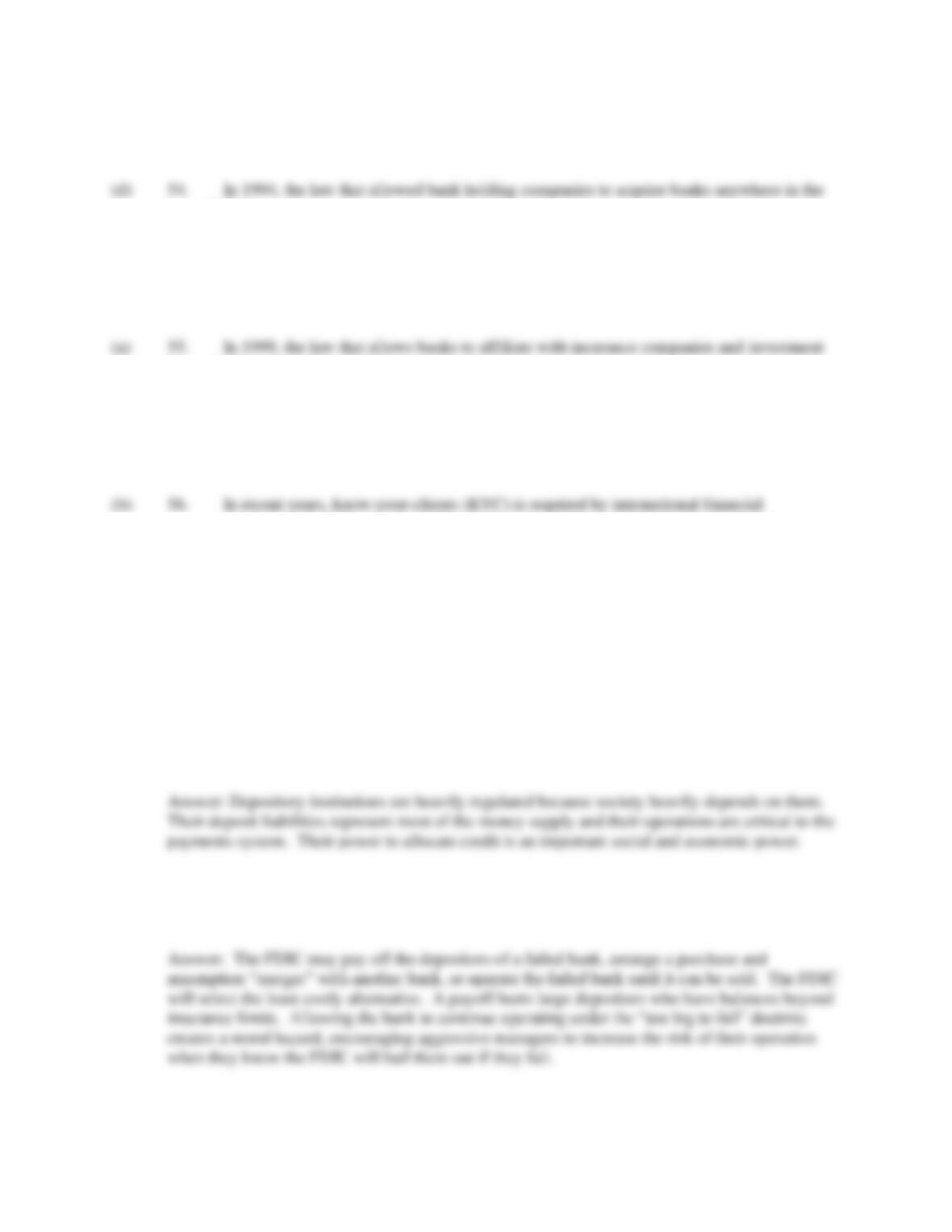
1. Explain why depository institutions are today the most regulated firms in the financial services
industry.
2. Describe three methods by which the FDIC may handle a failed bank. Which method do you
believe is of most benefit to depositors? Which of these methods causes a moral hazard?
Explain.
10
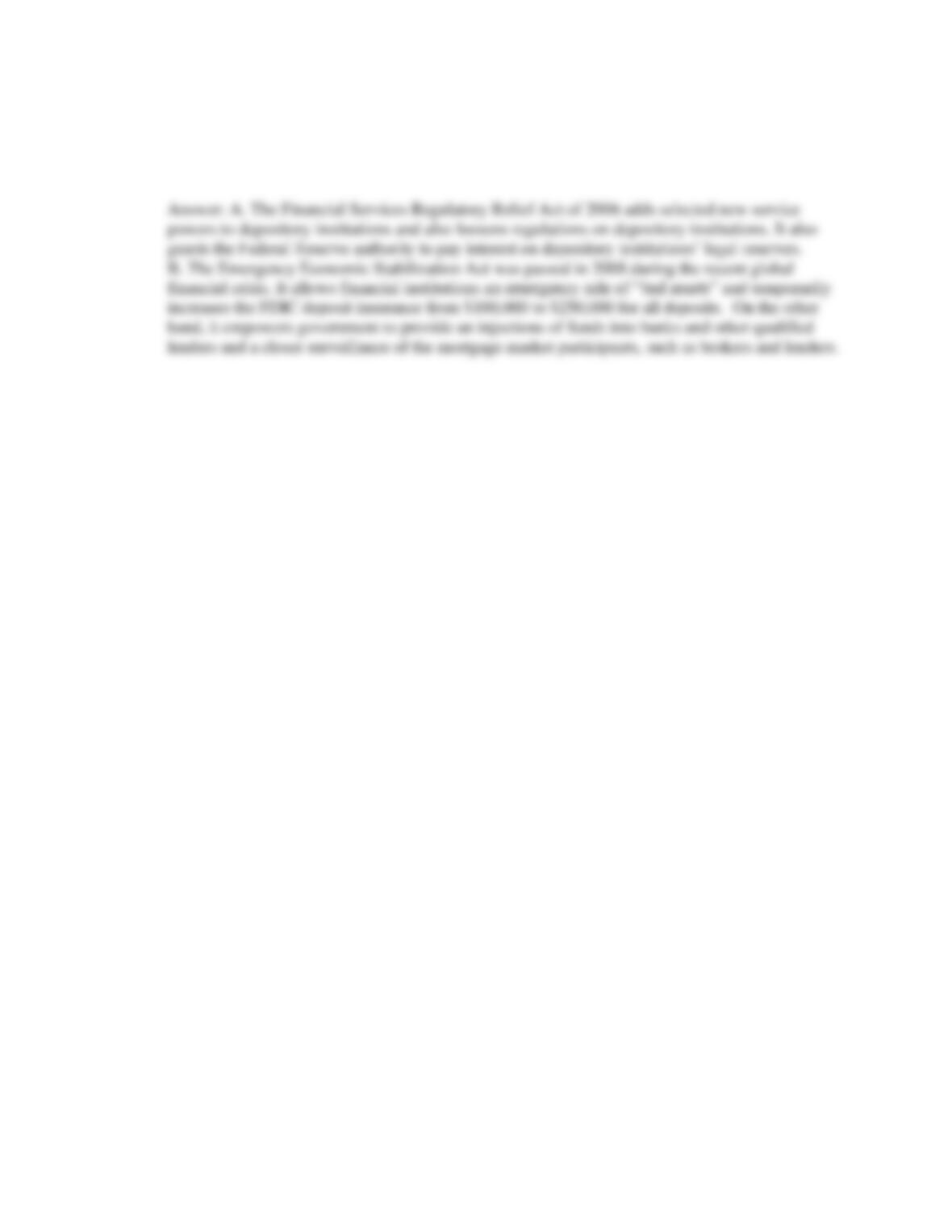
3. In recent years, the Federal Government implements some important regulations to deal with the
volatility in financial markets. Please explain what do the following acts do to financial markets:
the Financial Services Regulatory Relief Act of 2006 and the Emergency Economic Stabilization
Act in 2008?