Archives

978-0132357166
123 Test Item File 124 125 Chapter 1 – Experiencing Art Multiple Choice Questions 1. When first experiencing an unfamiliar work of art, start by asking questions about: a. expressive content, historical style, individual style. b. patrons, function, and collocation. […]
978-0132357166 Chapter 1
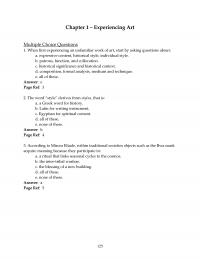
125 Chapter 1 – Experiencing Art Multiple Choice Questions 1. When first experiencing an unfamiliar work of art, start by asking questions about: a. expressive content, historical style, individual style. b. patrons, function, and collocation. c. historical significance and historical […]
978-0132357166 Chapter 10
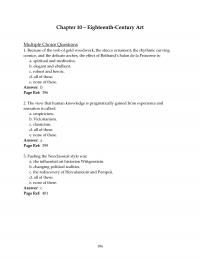
184 Chapter 10 – Eighteenth-Century Art Multiple Choice Questions 1. Because of the web of gold woodwork, the stucco ornament, the rhythmic curving cornice, and the delicate arches, the effect of Boffrand’s Salon de la Princesse is: a. spiritual and […]
978-0132357166 Chapter 11
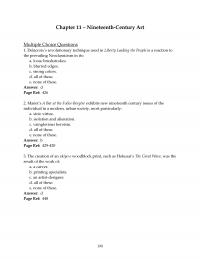
190 Chapter 11 – Nineteenth-Century Art Multiple Choice Questions 1. Delacroix’s revolutionary technique used in Liberty Leading the People is a reaction to the prevailing Neoclassicism in its: a. loose brushstrokes. b. blurred edges. c. strong colors. d. all of […]
978-0132357166 Chapter 12
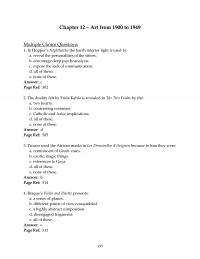
195 Chapter 12 – Art from 1900 to 1949 Multiple Choice Questions 1. In Hopper’s Nighthawks the harsh interior light is used to: a. reveal the personalities of the sitters. b. encourage deep psychoanalysis. c. expose the lack of communication. […]
978-0132357166 Chapter 13
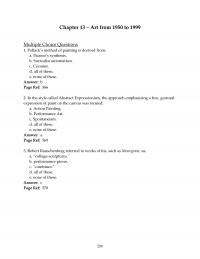
200 Chapter 13 – Art from 1950 to 1999 Multiple Choice Questions 1. Pollack’s method of painting is derived from: a. Picasso’s synthesis. b. Surrealist automatism. c. Cézanne. d. all of these. e. none of these. 2. In the style […]
978-0132357166 Chapter 14
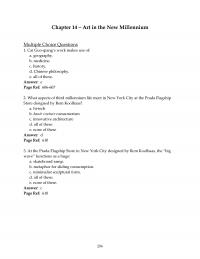
206 Chapter 14 – Art in the New Millennium Multiple Choice Questions 1. Cai Guo-qiang’s work makes use of: a. geography. b. medicine. c. history. d. Chinese philosophy. e. all of these. 2. What aspects of third millennium life meet […]
978-0132357166 Chapter 2
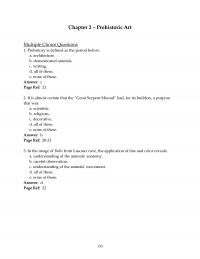
133 Chapter 2 – Prehistoric Art Multiple Choice Questions 1. Prehistory is defined as the period before: a. architecture. b. domesticated animals. c. writing. d. all of these. e. none of these. 2. It is almost certain that the “Great […]
978-0132357166 Chapter 3
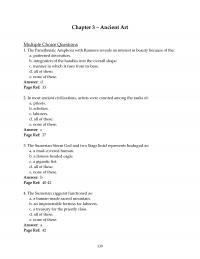
Chapter 3 – Ancient Art Multiple Choice Questions 1. The Panathenaic Amphora with Runners reveals an interest in beauty because of the: a. patterned decoration. b. integration of the handles into the overall shape. c. manner in which it rises […]
978-0132357166 Chapter 4
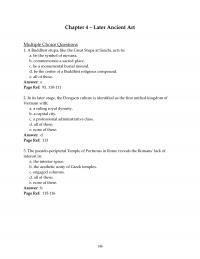
146 Chapter 4 – Later Ancient Art Multiple Choice Questions 1. A Buddhist stupa, like the Great Stupa at Sanchi, acts to: a. be the symbol of nirvana. b. commemorate a sacred place. c. be a monumental burial mound. d. […]
978-0132357166 Chapter 5
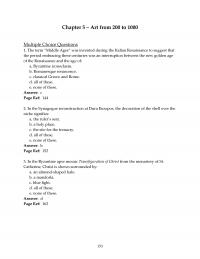
Chapter 5 – Art from 200 to 1000 Multiple Choice Questions 1. The term “Middle Ages” was invented during the Italian Renaissance to suggest that the period embracing these centuries was an interruption between the new golden age of the […]
978-0132357166 Chapter 6
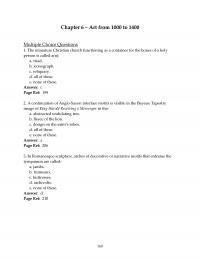
160 Chapter 6 – Art from 1000 to 1400 Multiple Choice Questions 1. The miniature Christian church functioning as a container for the bones of a holy person is called a(n): a. triad. b. iconograph. c. reliquary. d. all of […]
978-0132357166 Chapter 7
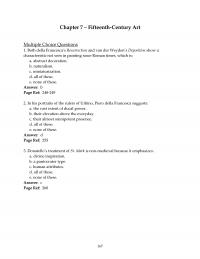
Chapter 7 – Fifteenth-Century Art Multiple Choice Questions 1. Both della Francesca’s Resurrection and van der Weyden’s Deposition show a characteristic not seen in painting since Roman times, which is: a. abstract decoration. b. naturalism. c. miniaturization. d. all of […]
978-0132357166 Chapter 8
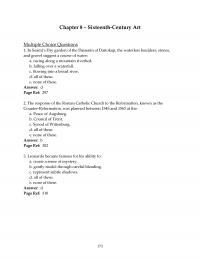
173 Chapter 8 – Sixteenth-Century Art Multiple Choice Questions 1. In Soami’s Dry garden of the Daisenin of Daitokuji, the waterless boulders, stones, and gravel suggest a course of water: a. racing along a mountain riverbed. b. falling over a […]
978-0132357166 Chapter 9
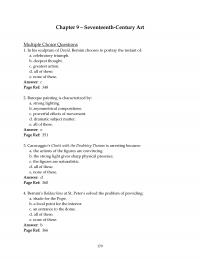
Chapter 9 – Seventeenth-Century Art Multiple Choice Questions 1. In his sculpture of David, Bernini chooses to portray the instant of: a. celebratory triumph. b. deepest thought. c. greatest action. d. all of these. e. none of these. Answer: c […]
Art History Chapter 1 Experiencing Art Major Part The Task For Art History Emphasize Our
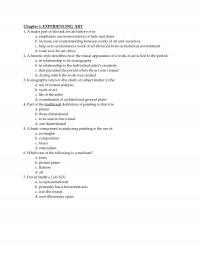
Chapter 1: EXPERIENCING ART 1. A major part of the task for art history is to: a. emphasize our memorization of facts and dates b. increase our understanding between works of art and ourselves c. help us to understand a […]
Art History Chapter 10 Eighteenthcentury Art Boffrand S Design For The Princess S Salon Example Neoclassicism Completely
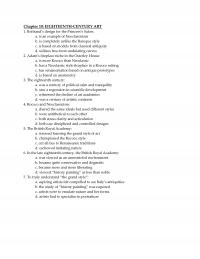
Chapter 10: EIGHTEENTH-CENTURY ART 1. Boffrand’s design for the Princess’s Salon: a. is an example of Neoclassicism b. is completely unlike the Baroque style c. is based on models from classical antiquity d. utilizes free-form undulating curves 2. Adam’s fireplace […]
Art History Chapter 11 Nineteenthcentury Art Delacroix S Liberty Leading The People Revolutionary Because Was Praise
Chapter 11: NINETEENTH-CENTURY ART 1. Delacroix’s Liberty Leading the People is revolutionary because it: a. was in praise of King Charles X b. rejoiced over the failure of the “July Revolution” c. introduced sharp linearity d. initiated the use of […]
Art History Chapter 12 Art From Balla S Speeding Automobile Study Velocity The Fixed Moment Universal Dynamism
Chapter 12: ART FROM 1900 TO 1949 1. Balla’s Speeding Automobile—Study of Velocity: a. is the fixed moment in universal dynamism b. is an abstract representation c. relates the dynamism of modern art to the violence of war d. uses […]
Art History Chapter 13 Art From Jacob Lawrence His Paintings Aimed Sensitize Society S Social Conscience
Chapter 13: ART FROM 1950 TO 1999 1. Jacob Lawrence in his paintings: a. aimed to sensitize society’s social conscience b. utilized the depth of illusory space c. used flowing forms and lyrical pastel colors d. strove to avoid interjecting […]
Art History Chapter 14 Art The New Millennium The End The Twentieth Century May Have
Chapter 14: ART IN THE NEW MILLENNIUM 1. The end of the twentieth century may have marked the end of: a. realism in art b. optimism in art c. nationalism in art d. all “isms” in art 2. One feature […]
Art History Chapter 2 Prehistoric Art The Cave Paintings Lascaux The Animals Are Depicted Quite
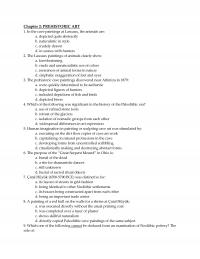
Chapter 2: PREHISTORIC ART 1. In the cave paintings at Lascaux, the animals are: a. depicted quite abstractly b. naturalistic in style c. crudely drawn d. in scenes with hunters 2. The Lascaux paintings of animals clearly show: a. foreshortening […]
Art History Chapter 3 Ancient Art The Taotie Was Thought The Symbol Many Chinese Societies
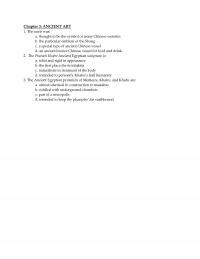
Chapter 3: ANCIENT ART 1. The taotie was: a. thought to be the symbol of many Chinese societies b. the particular emblem of the Shang c. a special type of ancient Chinese vessel d. an ancient bronze Chinese vessel for […]
Art History Chapter 4 Later Ancient Art Bce The Great Stupa Sanchi Was Mound Form
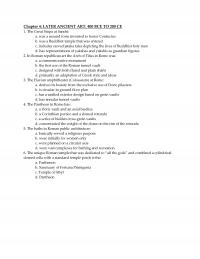
Chapter 4: LATER ANCIENT ART, 400 BCE TO 200 CE 1. The Great Stupa at Sanchi: a. was a mound form invented to honor Confucius b. was a Buddhist temple that was entered c. includes carved jataka tales depicting the […]
Art History Chapter 5 Art From The Synagogue Ancient Dura Europos There Were Only Abstract
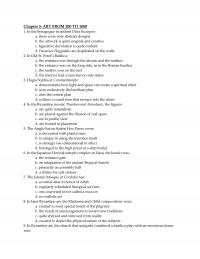
Chapter 5: ART FROM 200 TO 1000 1. In the Synagogue in ancient Dura Europos: a. there were only abstract designs b. the artwork is quite original and creative c. figurative decoration is quite evident d. Passover Haggadahs are duplicated […]
Art History Chapter 6 Art From The Romanesque Monastic Church Ste Foy Conques The Ambulatory
Chapter 6: ART FROM 1000 TO 1400 1. In the Romanesque monastic church of Ste. Foy at Conques: a. the ambulatory solves an important architectural problem b. the vault is replaced by the wooden truss roof c. the dome is […]
Art History Chapter 7 Fifteenthcentury Art Both The Piero Resurrection And The Rogier Deposition Show
Chapter 7: FIFTEENTH-CENTURY ART 1. Both the Piero Resurrection and the Rogier Deposition show: a. an interest in ancient classical motifs b. Christ like a Greek god c. naturalism d. triangular composition 2. The term Renaissance: a. emerged during the […]
Art History Chapter 8 Sixteenthcentury Art The Sixteenth Century Was Characterized Time When There Was
Chapter 8: SIXTEENTH-CENTURY ART 1. The sixteenth century was characterized as a time when: a. there was tranquility and stability b. the papacy declined in power c. artists were not known as individuals d. society was convulsed by shifting alliances […]
Art History Chapter 9 Seventeenthcentury Art Their Representation Vivacious Movement Both Bernini S David And Hals S
Chapter 9: SEVENTEENTH-CENTURY ART 1. In their representation of vivacious movement, both Bernini’s David and Hals’s Merry Drinker: a. were self-portraits b. were characteristic of most seventeenth-century art c. avoided naturalism and illusionism d. revealed that they were products of […]