Chapter 11: NINETEENTH-CENTURY ART
1. Delacroix’s Liberty Leading the People is revolutionary because it:
a. was in praise of King Charles X
b. rejoiced over the failure of the “July Revolution”
c. introduced sharp linearity
d. initiated the use of loose brushstrokes
2. Romanticism can be characterized by:
a. expression of spontaneous feeling
b. support of the rational and lucid in subject matter
c. unreserved support for the theories of rationalism
d. strong reaction to any violent feelings
3. Academic art:
a. implied the use of impressionist realism
b. chose its themes from the everyday world
c. was a term applied to conservative art
d. avoided treatment of historical or moralistic themes
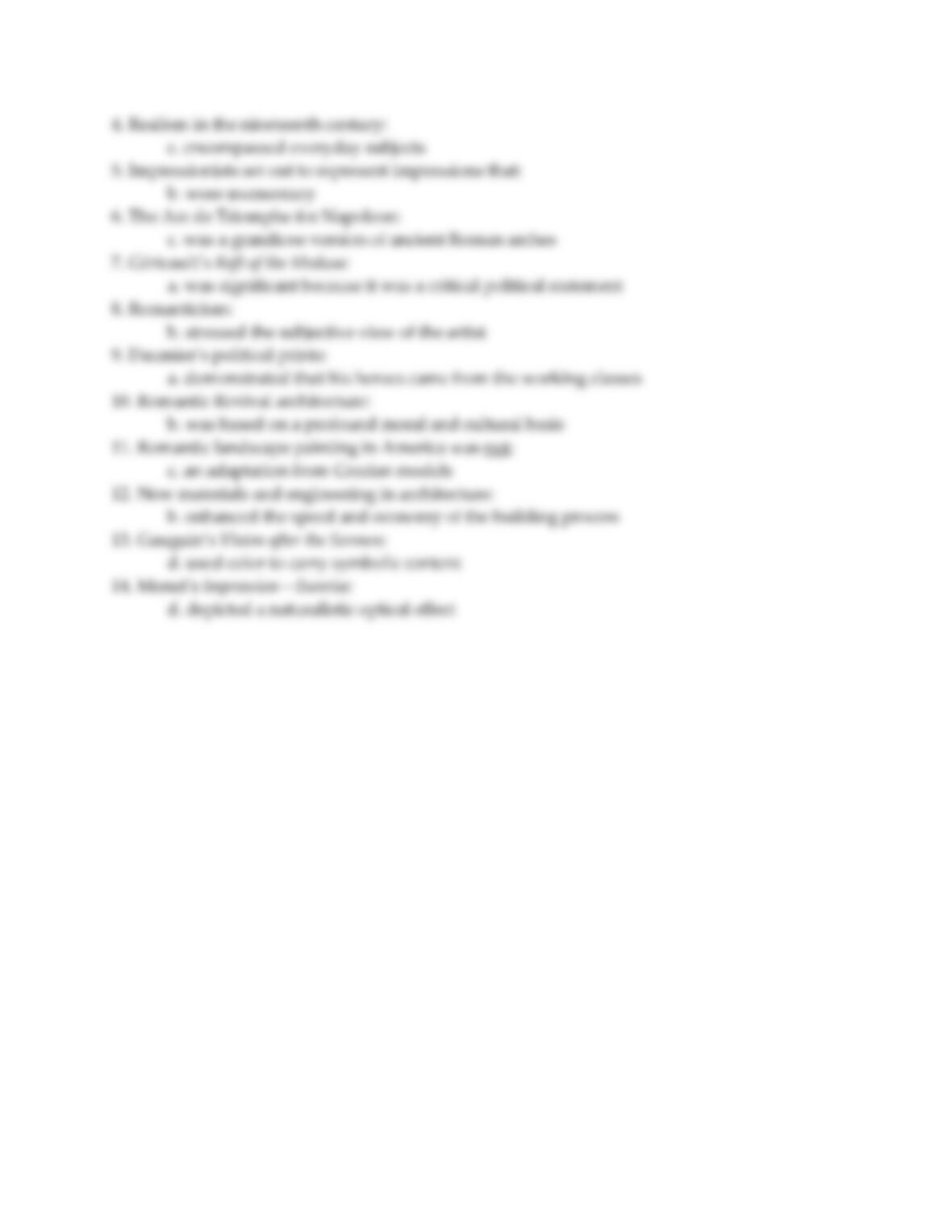
4. Realism in the nineteenth century:
a. stressed the exalted mission of art
b. totally supported the goals of French academies
c. encompassed everyday subjects
d. utilized modified heroic nationalistic themes
5. Impressionists set out to represent impressions that:
a. were gathered over an extended period of time
b. were momentary
c. involved light, color, and texture
d. were rendered in exact verisimilitude
6. The Arc de Triomphe for Napoleon:
a. was intended primarily to honor the French Revolution
b. was to commemorate Napoleon’s coronation
c. was a grandiose version of ancient Roman arches
d. was an example of Romantic Gothic revival architecture
7. Géricault’s Raft of the Medusa:
a. was significant because it was a critical political statement
b. was an allegorical reflection on the French Revolution
c. reflected his studies of ancient Roman models
d. was the reinterpretation of a Baroque theme
8. Romanticism:
a. was dominated by a single, unified style
b. stressed the subjective view of the artist
c. subordinated expression of the artist’s feelings
d. reacted against the unbridled spirit of human imagination

9. Daumier’s political prints:
a. demonstrated that his heroes came from the working classes
b. spared radical artists from his attacks
c. were indifferent to the cause of the freedom of the press
d. were comments on political but not moral issues
10. Romantic Revival architecture:
a. revived only the Greek and Gothic styles
b. was based on a profound moral and cultural basis
c. was determined solely on esoteric aesthetic grounds
d. in public buildings was free of political connotations
11. Romantic landscape painting in America was not:
a. nationalistic in spirit
b. a viewing of American scenery as a God-given paradise
c. an adaptation from Grecian models
d. interconnected with deep emotion
12. New materials and engineering in architecture:
a. led to an extension of the Romantic Revival style
b. enhanced the speed and economy of the building process
c. included the extensive use of the Roman arch
d. were based on traditional building practices
13. Gauguin’s Vision after the Sermon:
a. was composed using traditional perspective
b. was naturalistic in painterly style
c. demonstrated how to use color in a traditional manner
d. used color to carry symbolic content
14. Monet’s Impression—Sunrise:
a. showed a rendering of the landscape, not sensation
b. demonstrated the effective use of the color black
c. had a strong scientific basis
d. depicted a naturalistic optical effect
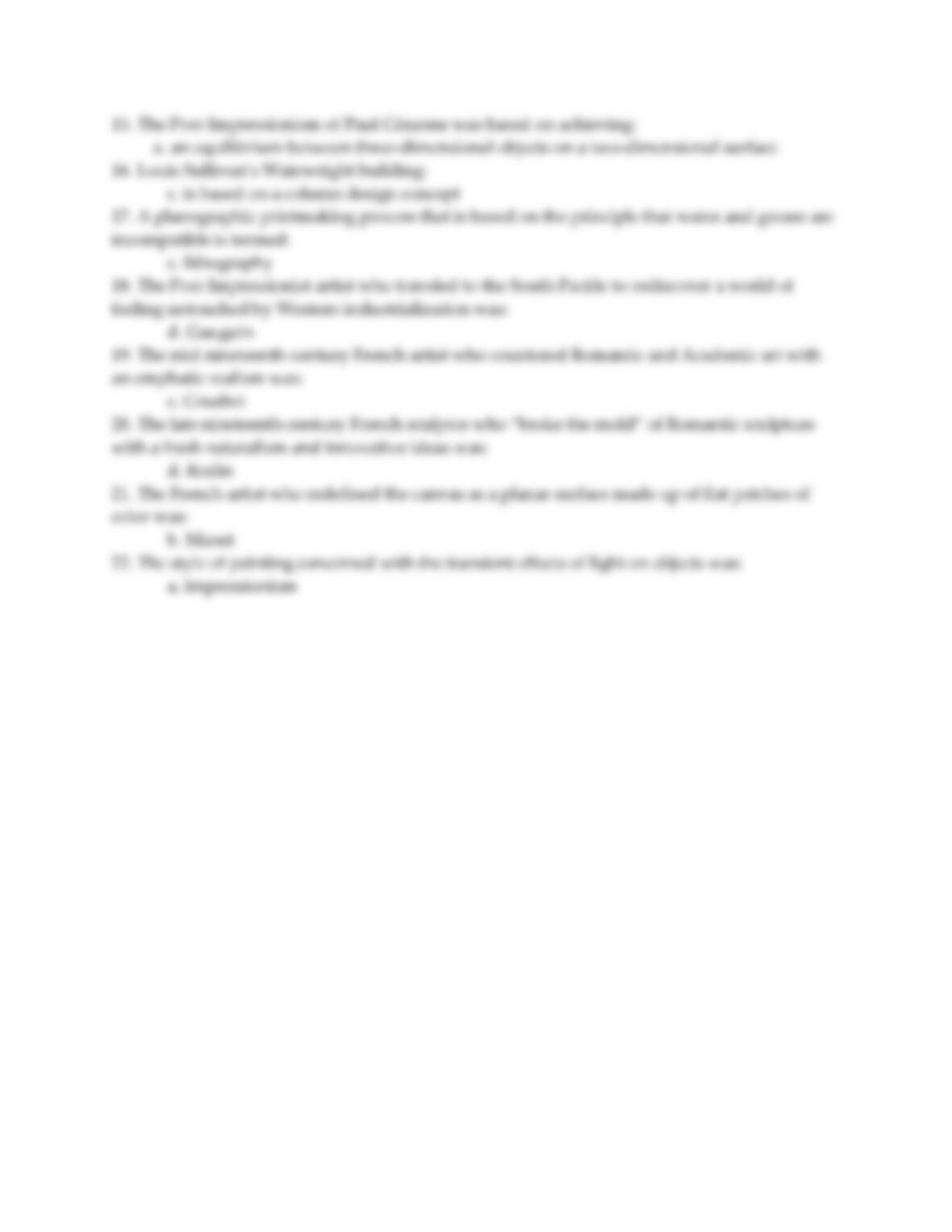
15. The Post-Impressionism of Paul Cézanne was based on achieving:
a. an equilibrium between three-dimensional objects on a two-dimensional surface
b. photographically-accurate drawing
c. the freezing of motion and of the artist’s moving viewpoint
d. revival of Renaissance perspective
16. Louis Sullivan’s Wainwright building:
a. exposes the load-bearing, steel-frame construction
b. emphasizes vertical and horizontal articulation
c. is based on a column design concept
d. is the first skyscraper with no decoration

17. A planographic printmaking process that is based on the principle that water and grease are
incompatible is termed:
a. etching
b. silkscreen
c. lithography
d. engraving
18. The Post-Impressionist artist who traveled to the South Pacific to rediscover a world of
feeling untouched by Western industrialization was:
a. Seurat
b. Van Gogh
c. Cézanne
d. Gauguin
19. The mid nineteenth-century French artist who countered Romantic and Academic art with
an emphatic realism was:
a. Delacroix
b. Homer
c. Courbet
d. Eakins
20. The late nineteenth-century French sculptor who “broke the mold” of Romantic sculpture
with a fresh naturalism and innovative ideas was:
a. Canova
b. Rude
c. Carpeaux
d. Rodin
21. The French artist who redefined the canvas as a planar surface made up of flat patches of
color was:
a. Courbet
b. Manet
c. Cézanne
d. Monet
22. The style of painting concerned with the transient effects of light on objects was:
a. Impressionism
b. Realism
c. Romanticism
d. Expressionism
ANSWERS TO MULTIPLE CHOICE QUESTIONS
Chapter 11