ADDITIONAL PROJECTS
Retailing Management 9th Edition
Example 4
Store Layout and Design
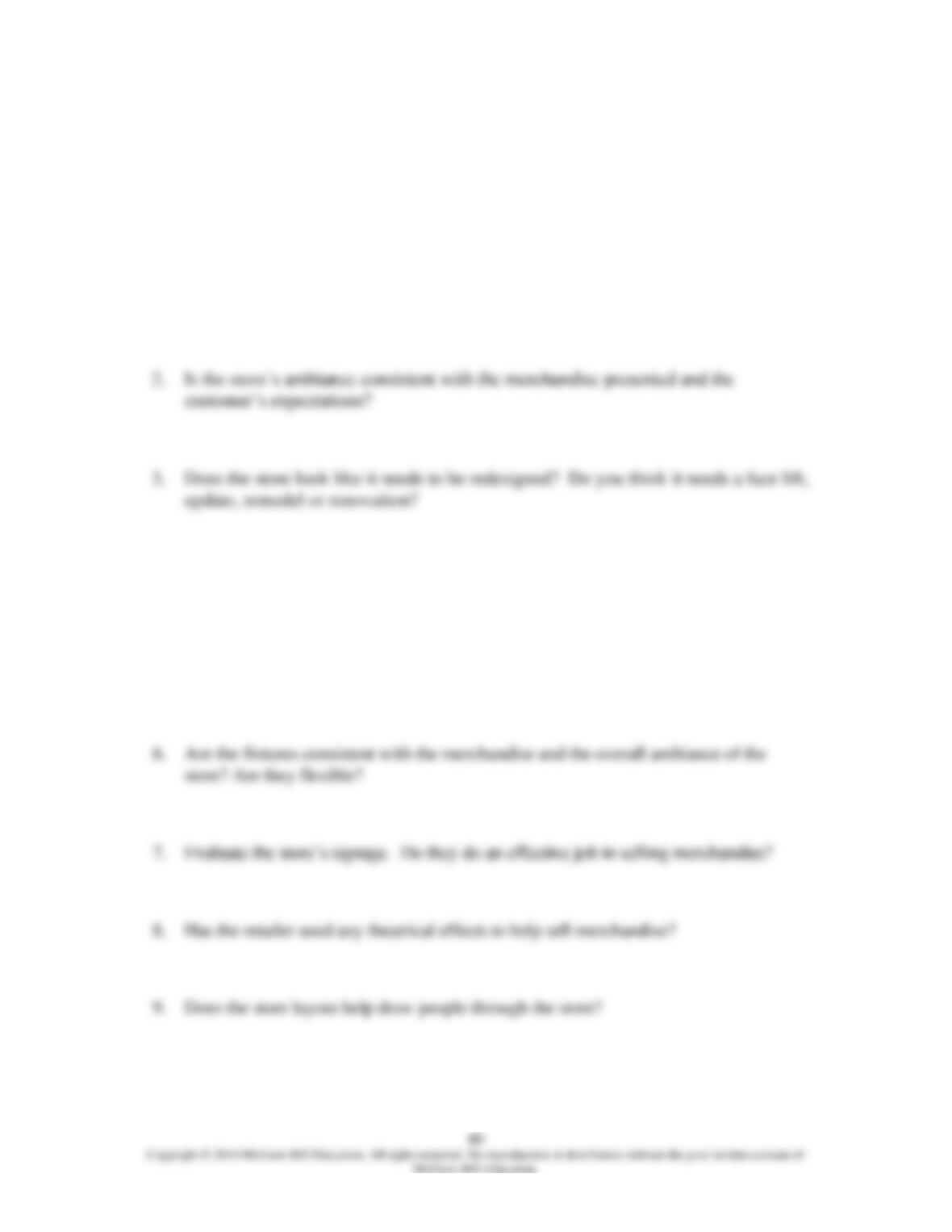
Go to “your store” and evaluate the store layout, design, and visual merchandising
techniques employed. Explain your answers to the following questions:
1. In general, is the store layout, design, and visual merchandising techniques used
consistent with the exterior of the store and location?
4. To what extent is the store’s layout, design, and merchandising techniques flexible?
5. Notice the lighting. Does it do a good job in highlighting merchandise, structuring
space, capturing a mood, and downplaying unwanted features?
ADDITIONAL PROJECTS
Retailing Management 9th Edition
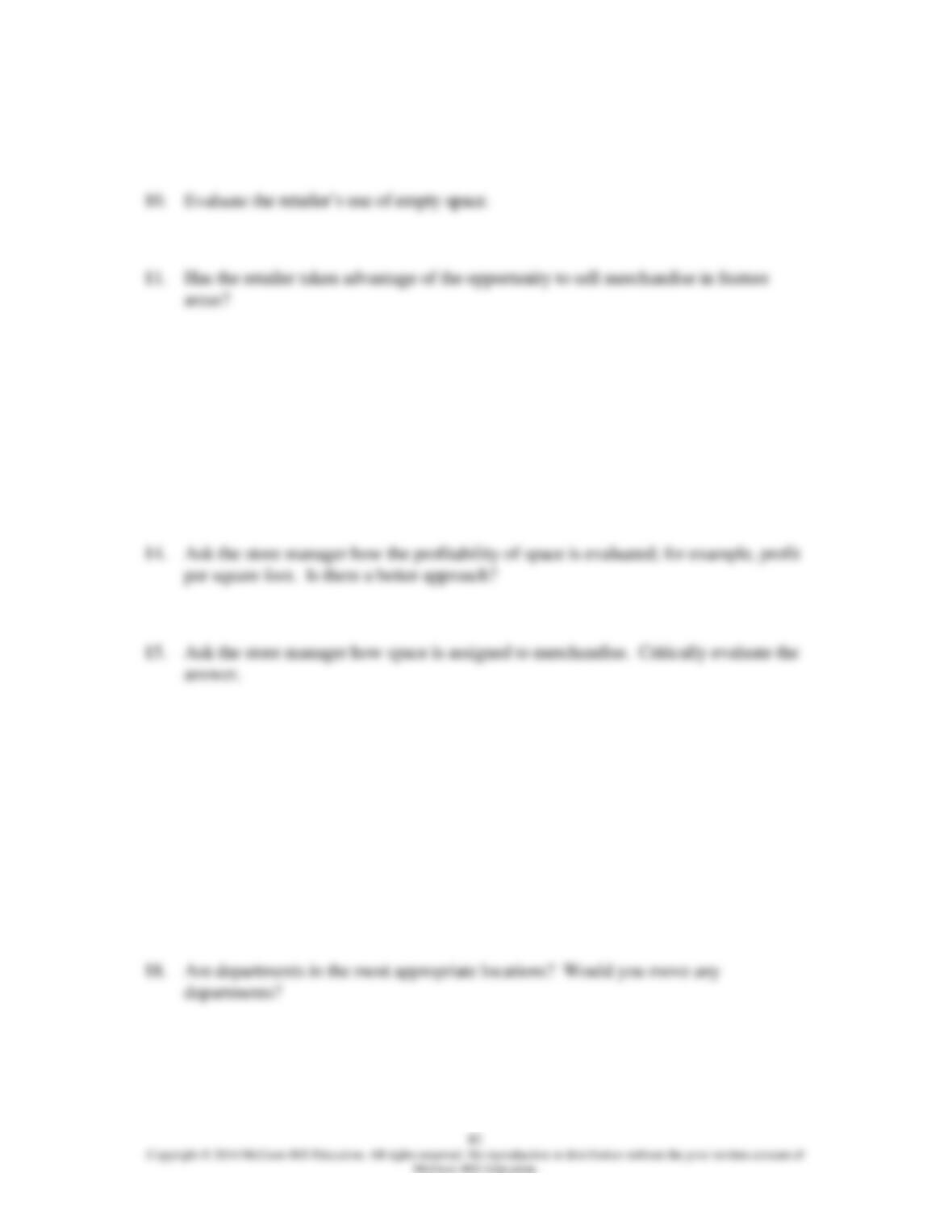
12. Does the store make creative use of wall space?
13. What type of layout does the store use? Is it appropriate for the type of store? Would
another type layout be better?
16. Ask the store manager if plan-o-grams are used. If so, try to determine what factors
are considered when putting together a plan-o–gram.
17. Has the retailer employed any techniques for achieving greater space productivity
such as using the “cube,” down-sizing gondolas and racks, and minimizing non-
selling space?
ADDITIONAL PROJECTS
Retailing Management 9th Edition
42
COLLECTING INFORMATION ABOUT STUDENTS
NAME: __________________________;
preferred EMAIL ___________________________
Your major ____________________________________________________
Employment? ___________________________________________________
Approximate Hours per Week______________________________________
Suggested Group (maximum 4 other classmates)
Please consider the following topics carefully. Determine your first, second, and third
choices. Also, please indicate any class members with whom you would prefer to work.
You may hand in preferences for an entire group. Hand in by September 9th.
____ 1. Best Practices in Online Apparel Retailing
___ 2. Best Practices in Online Book Retailing

ADDITIONAL PROJECTS
Retailing Management 9th Edition
43
Please circle the preferred presentation date for your group:
Tuesday, Nov. 18th
Thursday, Nov. 20th
Other Marketing Courses taken in the past?

ADDITIONAL PROJECTS
Retailing Management 9th Edition
44
Sample Forms for Team Selection and Evaluation
Issues
[Summary of information received by Amit Poddar from a request posted on ELMAR]
Instructor #1
I have attached (see immediately below, after the horizontal rule) a description of Team
Member Expectations, Ideal Team Member Criteria, and a Peer Evaluation for Group
Projects that I use for Principles of Marketing. I hand out this document when I assign the
team projects and the students are dividing into teams. I have found it is helpful to fully
explain my expectations before the group work begins.
I still have an occasional team that has an under performing student. If the team
approaches me early, I can help them correct the problem. If the team does not contact
me or they wait until the night before a project is due, there is little I can do to help.
ADDITIONAL PROJECTS
Retailing Management 9th Edition
45
Team Member Expectations
Why does this Marketing course incorporate team assignments?
“Many companies are putting employees into self-directed work teams as an important
mechanism for dealing with today’s complex and rapidly changing environment. As a
result, businesses recommended that curriculum and teaching methods be designed to
develop students’ communication and interpersonal skills through the use of student
groups in the learning process.”(1) Students are finding that employers are asking
prospective candidates to describe their experiences working in teams during the
interview process. (3)
Some of the disadvantages of teams that the professor would like to avoid in this course
are the free rider problem and the divide and conquer approach. A free rider is a person in
the group who is not contributing or doing their fair share. Free riders lower group morale
How will I be evaluated on my participation on the team assignments?
At the end of the semester, each student will complete a Peer Evaluation for Group
Projects. This assessment instrument will give the instructor feedback on how individuals
ADDITIONAL PROJECTS
Retailing Management 9th Edition
Ideal Team Member Criteria
Important items that contribute to being an ideal team member:
1. Able to use the library resources to collect information
2. Attends all team meetings
3. Comfortable using PowerPoint
11. Organized
12. Enthusiastic attitude about the team assignments
13. Productive team member
14. Volunteers for tasks
15. Sets realistic deadlines
16. Shares the responsibility for team assignments
References
1. Siciliano, Julie. “A Template for Managing Teamwork in Courses Across the
Curriculum.” Journal of Education for Business, May/June 1999.
2. Vik, Gretchen N. “Doing more to teach teamwork than telling students to sink or
swim.” Business Communication Quarterly, December 2001.
Team Member Evaluations
Team Number _______________________
Peer Evaluation for Group Projects
ADDITIONAL PROJECTS
Retailing Management 9th Edition
47
Feel free to provide additional comments on the reverse side to mention specific aspects
of your own performance and/or to explain your rationale for the rating you have
assigned, especially where an individual may have contributed disproportionately (or
failed to participate sufficiently).
Instructor #2
I use the attached (below) form. Furthermore, in the first class itself I announce very
clearly that free riders might lose 5-10% or might even fail if they don’t work. I kind of
put it little more threateningly and it has worked for me for the last 7 years. Moreover, I
ADDITIONAL PROJECTS
Retailing Management 9th Edition
48
GROUP MEMBER EVALUATION FORM
For each member in your group, determine how much you feel he or she contributed to
YOUR NAME:
PROJECT TOPIC:
Next, there is a table with the following columns:
Instructor #3
PEER EVALUATION FORM
This peer evaluation is designed to correct possible inequities in grading your group
project. You are asked to rate your team members according to each person’s contribution
to the team effort. The ratings should reflect a team member’s time, effort, ability, and
willingness to work things out with the other members. It should not reflect the grade you
think your group paper/presentation should receive.
ADDITIONAL PROJECTS
Retailing Management 9th Edition
49
1. On the lines in the left column below, list each member of your project group,
including your own name. Use last names as well as first names.
Title of Project (not course
name):________________________________________________________________
NAMES GRADE
1. (Your name :) (Grade yourself :)
2. (Other Members)
3,
4.
5.
7.
9.
10.
Instructor #4
Peer Evaluation – If a team member does not complete the assigned duties or does not do
a fair share, he or she will suffer the consequences, not the other team members!! The
procedure is as follows:
1. I will grade your advertising campaign team project. Grades will be numerical
based on the above criteria and weights.
ADDITIONAL PROJECTS
Retailing Management 9th Edition
50
You may wish to use the following criteria in your peer evaluations:
1. Number of meetings attended and prompt attendance at meetings
2. Amount of work contributed
3. Quality of ideas and work contributed
4. Cooperation/contribution to the team effort
Example:
Team project grade = 90
Individual Team Individual
Team Member Contribution % Grade Grade
Robert Goulet 95% 90 85
600/6 539/6
Average 100% Average 90
ADDITIONAL PROJECTS
Retailing Management 9th Edition
51
Copyright © 2014 McGraw-Hill Education. All rights reserved. No reproduction or distribution without the prior written consent of
McGraw-Hill Education.
Columns 1 and 2 will be filled out by each team member for his or her peers and will be
handed in the last day of class. The instructor will grade the project and return the form,
averaging the individual contributions in column 2 and filling in Columns 3 and 4.
Instructor #5
*****Team Member Evaluations***** Each team member will be evaluated on their
contribution to each team assignment by all other team members. Team members will use
the following 3-point scale to evaluate each member:
• 3-Good Team Member-Contributed roughly the same amount of work as the other
team members.
Your team assignment grade will be deducted from the initial team assignment grade as
followings:
• If all team members give you evaluations of 2 or lower (except all 1s), your grade
for that assignment will be 75% of the initial team grade. For example, if your
team’s project grade is a 90, and team members give you evaluations of 2, 2, and

ADDITIONAL PROJECTS
Retailing Management 9th Edition
52
Instructor #6
PROJECT EVALUATION
EVALUATION OF YOUR OWN GROUP
Since this was a group project, you will now have the opportunity to evaluate the
contributions made by each of the members of your group.
Contributions of your group members
You now have the opportunity to evaluate the contributions of each member of the group.
Please list the names of all group members (including yourself) in the space below. Next,
please allocate 100 total points among to the other group members based on your
Name Points
______________________________________________ ____________
______________________________________________ ____________
______________________________________________ ____________
______________________________________________ ____________
______________________________________________ ____________
______________________________________________ ____________
_______________________________________________ ____________
Make sure the point total is 100!

ADDITIONAL PROJECTS
Retailing Management 9th Edition
53
Instructor #7
Groups are required to prepare and sign a group contract that covers everything from
designating a project manager, indicating a target grade (and resolving their differing
goals), schedule of work, and grounds for firing. I ask them to be very explicit about the
latter so that it makes it easier on them later to actually fire a member. Most firings that
I’ve had occur have been for total lack of participation, however.
Two weeks before their presentation date, they must submit a draft outline (full
sentence/thought format). This doesn’t give me individual-specific feedback but the
emerging group leaders (if any) usually let me know at this point whether people are
pulling their weight. This by itself doesn’t go into my evaluation of individuals, but it is
something I can file away in the case that someone protests their eventual peer
evaluation.
Once all group work is done, they are asked to individually submit peer evaluations on a
series of 10-point questions, the total of which sums to 100. I keep to myself the specific
target scores that can affect their grade, but essentially, if they average a peer score of 80
or less, they get only 80% of the project grade. I’ve had a few really bad examples (peer
ADDITIONAL PROJECTS
Retailing Management 9th Edition
54
Instructor #8
I have used group projects throughout my teaching career having taught team projects at
four different universities, every semester and in every class, I have taught except
statistics and principles of marketing. The following are my observations:
The downside of smaller teams is that it requires more effort on your part as the
instructor. There are more projects to grade, sometimes more clients to recruit, and
certainly more effort required to manage the different strengths and weakness that occur
across teams. However, since I have primarily taught at “teaching” not research schools,
where the mission of the University is based on increased interactions between faculty
and students – through “lower” student/faculty ratio; I have recognized that this is an
Fortunately, at GCSU, unless you make the error yourself to provide student overrides
you will not have more than 50 students in a class. Though three is the ideal, I often allow
teams to form with four students. Partly because of attrition and firings. It is typical that
at least one team per class will lose a team member during the semester due the student
withdrawing from the course or, because their teammates fired them. Thus, a team of
three can quickly become a team of 2 or even on a couple of occasions a team of one.

ADDITIONAL PROJECTS
Retailing Management 9th Edition
The second issue that I have found plays significantly in regards to freeloading is team
member selections. I use part of the first four class periods for team building/ice breaker
activities that explore the strengths and weakness, skills and abilities, and personalities of
the classmates. I discuss the skills that a team will have to have to be successful, we talk
about what makes a successful team, the role of professionalism and ethics in teams, how
to hire a team member and how to fire a team member (students are required to read
“Team building and responsibilities”) . Then I let teams self select. When 40 – 80% of a
student’s grade is tied to teamwork, they generally do their best to find a suitable team to
match their needs. Not all students want to work for an A, thus in larger classes there is
usually a team that very clearly bonds on the notion that C is sufficient.
The final thing I would add to this is that, unfortunately there will always be some
individuals who attempt to freeload. If we make a serious effort to limit the ability to
freeload and a student still freeloads, let it be. Why should the classroom be any different
from the real world? Look around in your own work environment there are plenty of

ADDITIONAL PROJECTS
Retailing Management 9th Edition
56
For what they are worth, these are my thought and observations.
Instructor #9
Group Member Evaluation
MKXXX Consumer Behavior
Group #: _____ Exercise: __________________________________ Date: ______
Your Name ______________________________
Other Group Members Performance Bonus
______________________________ $_________
ADDITIONAL PROJECTS
Retailing Management 9th Edition
57
Comments: ____________________________________________________________
______________________________________
________________________________________________________________________
_________________________________________
________________________________________________________________________
_________________________________________
________________________________________________________________________
_________________________________________