Exercise 9–24
1. To include the $4 million in year 2016 purchases and increase retained earnings
to what it would have been if 2015 cost of goods sold had not included the $4
million purchases:
Analysis:
2015 2016
Beginning inventory Beginning inventory
Purchases O Purchases U
Less: Ending inventory
Cost of goods sold O
2. The 2015 financial statements that were incorrect as a result of the errors would
3. A “prior period adjustment” to retained earnings would be reported, and a
Exercise 9–25
Requirement 1
The $42,000 should have been charged to purchases instead of advertising
expense. This error caused 2015 net purchases and thus cost of goods sold to be
understated and advertising expense to be overstated by $42,000. The understatement
of ending inventory for the $30,000 in merchandise held on consignment caused 2015
cost of goods sold to be overstated.
Analysis: U = Understated
O = Overstated
2015
Beginning inventory
Plus: net purchases U by 42,000
Requirement 2
Exercise 9–26
List A List B
e 1. Gross profit ratio a. Reduction in selling price below the original
selling price.
Exercise 9–27
Requirement 1
If market price at year-end is less than contract price for outstanding purchase
commitments, a loss is recorded for the difference.
Requirement 2
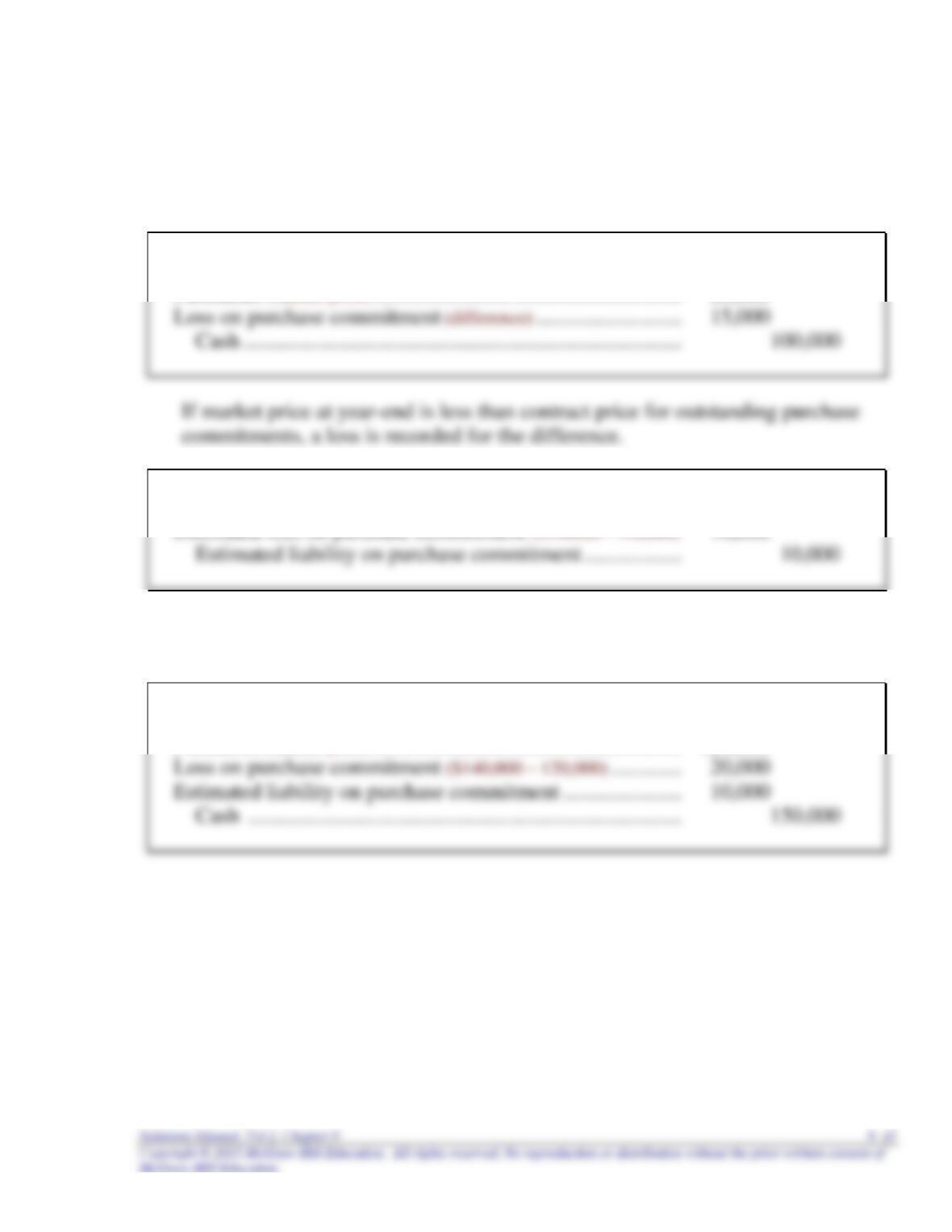
If market price on purchase date declines from year-end price, the purchase is
March 21, 2017
Exercise 9–28
If market price is less than the contract price, the purchase is recorded at the
market price.
June 15, 2016
Purchases (market price) ………………………………………………… 85,000
June 30, 2016
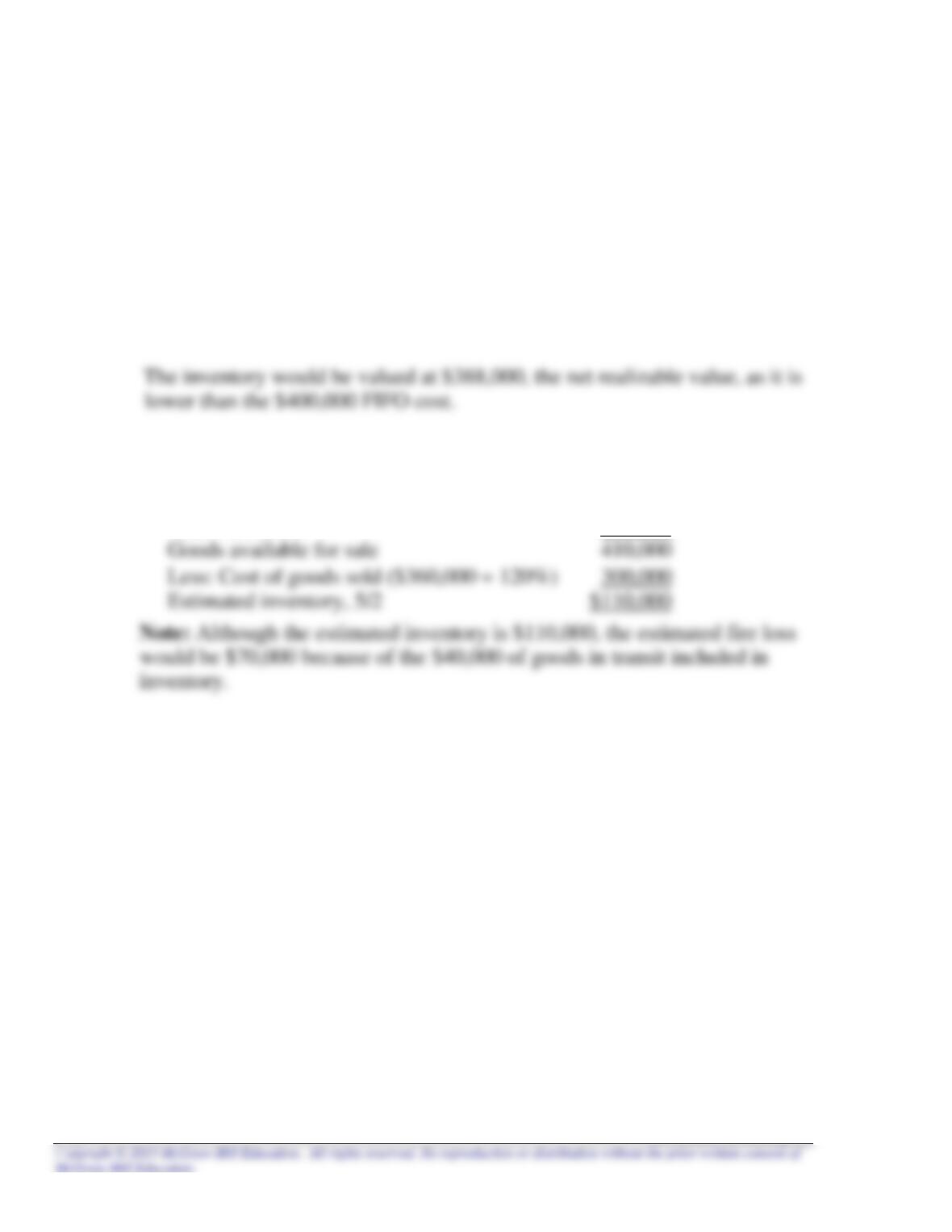
If market price on purchase date declines from year-end price, the purchase is
recorded at market price.
August 20, 2016
Purchases (market price) ………………………………………………… 120,000
9–46 Intermediate Accounting, 8/e
CPA / CMA REVIEW QUESTIONS
CPA Exam Questions
1. c. Net realizable value = 388,000 ($408,000 selling price – $20,000 costs to
sell.)
2. c.
Inventory, 1/1 $ 80,000
Add: Purchases 330,000
CPA Exam Questions (concluded)
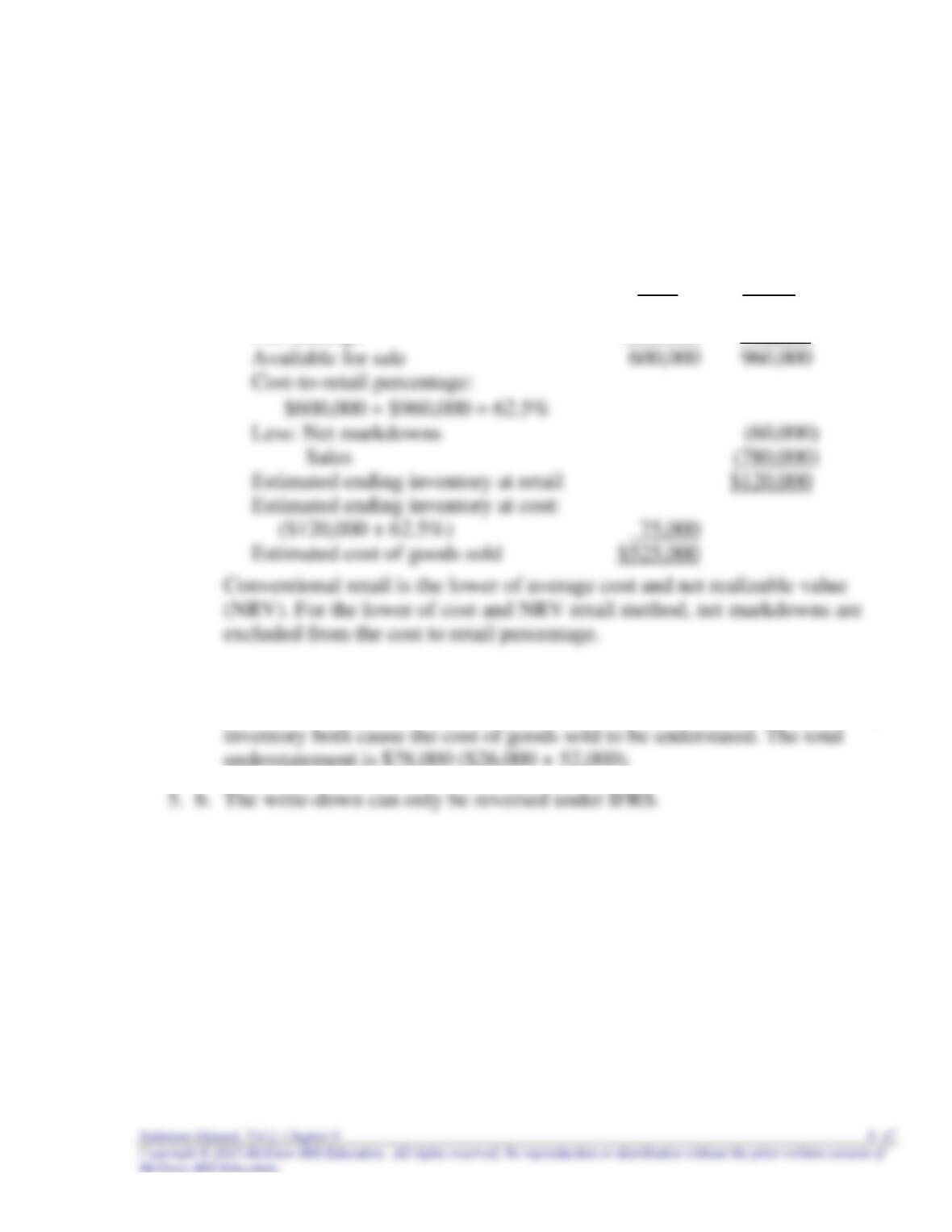
3. d.
Cost Retail
Beginning inventory and purchases $600,000 $920,000
Net markups _______ 40,000
4. c. The understatement of beginning inventory and the overstatement of ending
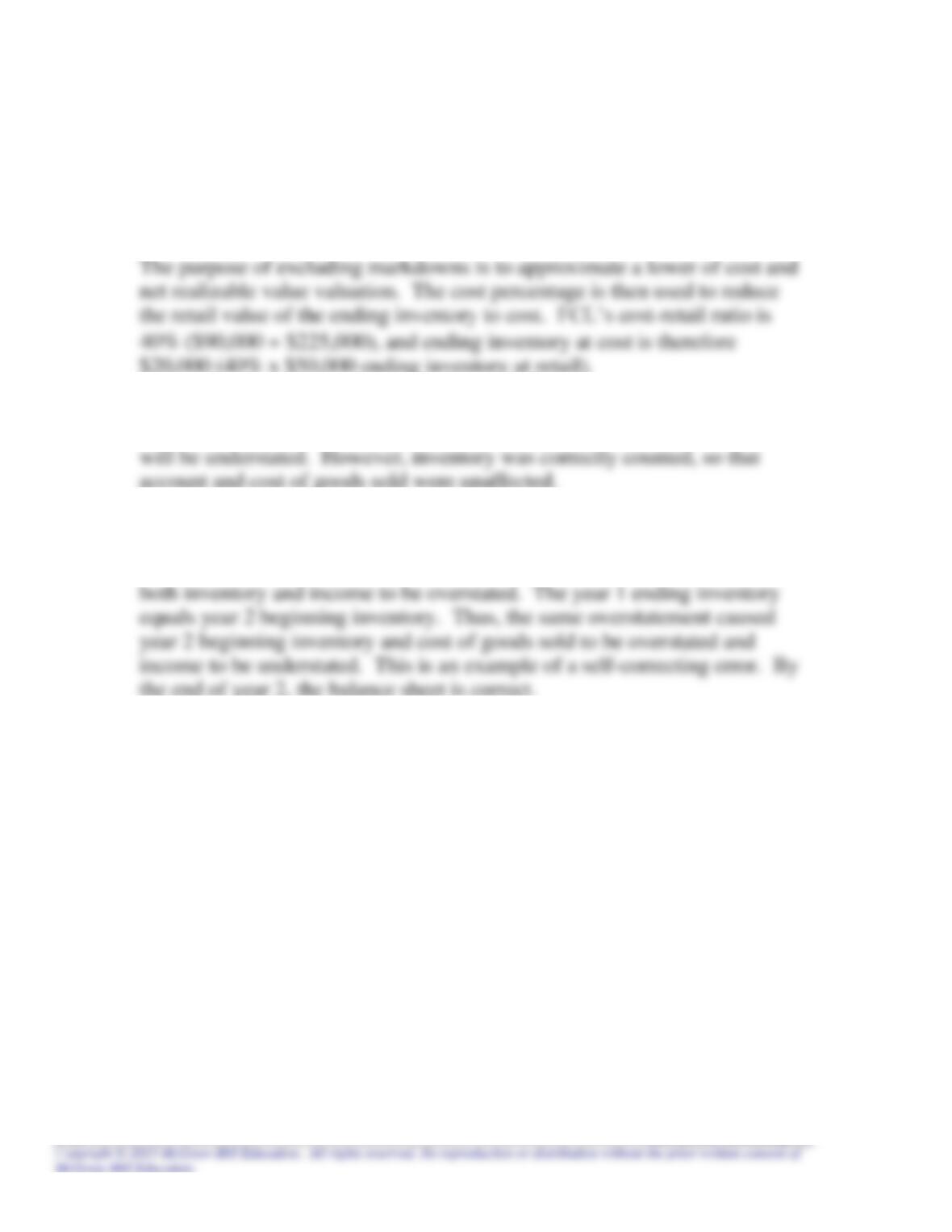
9–48 Intermediate Accounting, 8/e
CMA Exam Questions
1. b. The conventional retail inventory method adds beginning inventory, net
purchases, and markups (but not markdowns) to calculate a cost percentage.
2. d. The failure to record a sale means that both accounts receivable and sales
3. d. The overstatement (double counting) of inventory at the end of year 1
caused year 1 cost of goods sold (BI + Purchases – EI) to be understated and
Problem 9–1
Requirement 1
Product
NRV per unit
A
$16 – (15% x $16) = $13.60
B
$18 – (15% x $18) = $15.30
C
$ 8 – (15% x $8) = $ 6.80
D
$ 6 – (15% x $6) = $ 5.10
$13 – (15% x $13) = $11.05
(1)
(2)
Product
(units)
Cost
NRV
Inventory
Value
[Lower of
(1) and (2)]
A (1,000)
$10,000
$13,600
$10,000
B (800)
12,000
12,000
C (600)
1,800
4,080
1,800
D (200)
1,400
1,020
1,020
E (600)
8,400
6,630
6,630
$33,600
$31,450
Requirement 2
Inventory book value would be $31,450, the lower of aggregate inventory cost
PROBLEMS
9–50 Intermediate Accounting, 8/e
Problem 9–2
Requirement 1
Lower of cost and NRV
Product
Cost
Net
Realizable
Value
(a)
By
Individual
Products
(b)
By
Product
Type
(c)
By Total
Inventory
Tools:
Hammers
$ 500
$ 550
$ 500
Saws
2,000
1,800
1,800
Screwdrivers
600
780
600
$3,100
$3,130
$3,100
Paint products:
1-gallon cans
2,500
Paint brushes
400
450
400
$3,400
$2,950
2,950
$6,500
$6,080
$5,800
$6,050
$6,080
Requirement 2
(a) Individual products
Problem 9–3
Requirement 1
Fruit Marshmallow Chocolate
Toppings Toppings Topping
Estimate of cost of goods sold:
Cost percentage 80% 70% 65%
x Net sales $200,000 $55,000 $20,000
Requirement 2
The two main factors that could cause the estimates of the inventory lost to be
over- or understated are:
9–52 Intermediate Accounting, 8/e
Problem 9–4
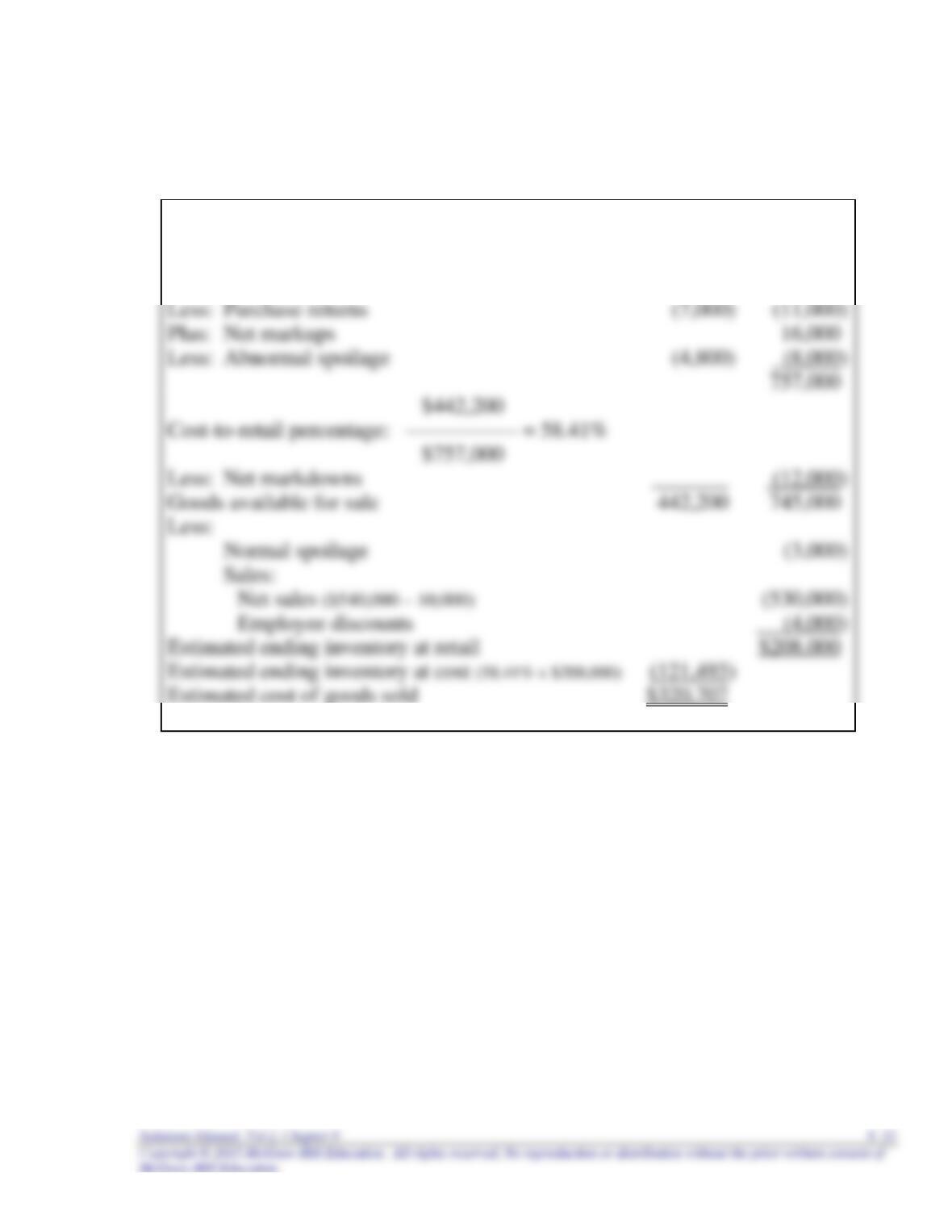
1. Average cost
Cost
Retail
Beginning inventory
$ 90,000
$180,000
Plus: Purchases
355,000
580,000
Freight-in
Less: Purchase returns
(7,000)
Less: Net markdowns
Abnormal spoilage
Goods available for sale
442,200
745,000
Less:
Normal spoilage
(3,000)
Sales:
Net sales ($540,000 – 10,000)
Estimated ending inventory at retail
$208,000
Estimated ending inventory at cost (59.36% x $208,000)
Estimated cost of goods sold
$318,731
Problem 9–4 (concluded)
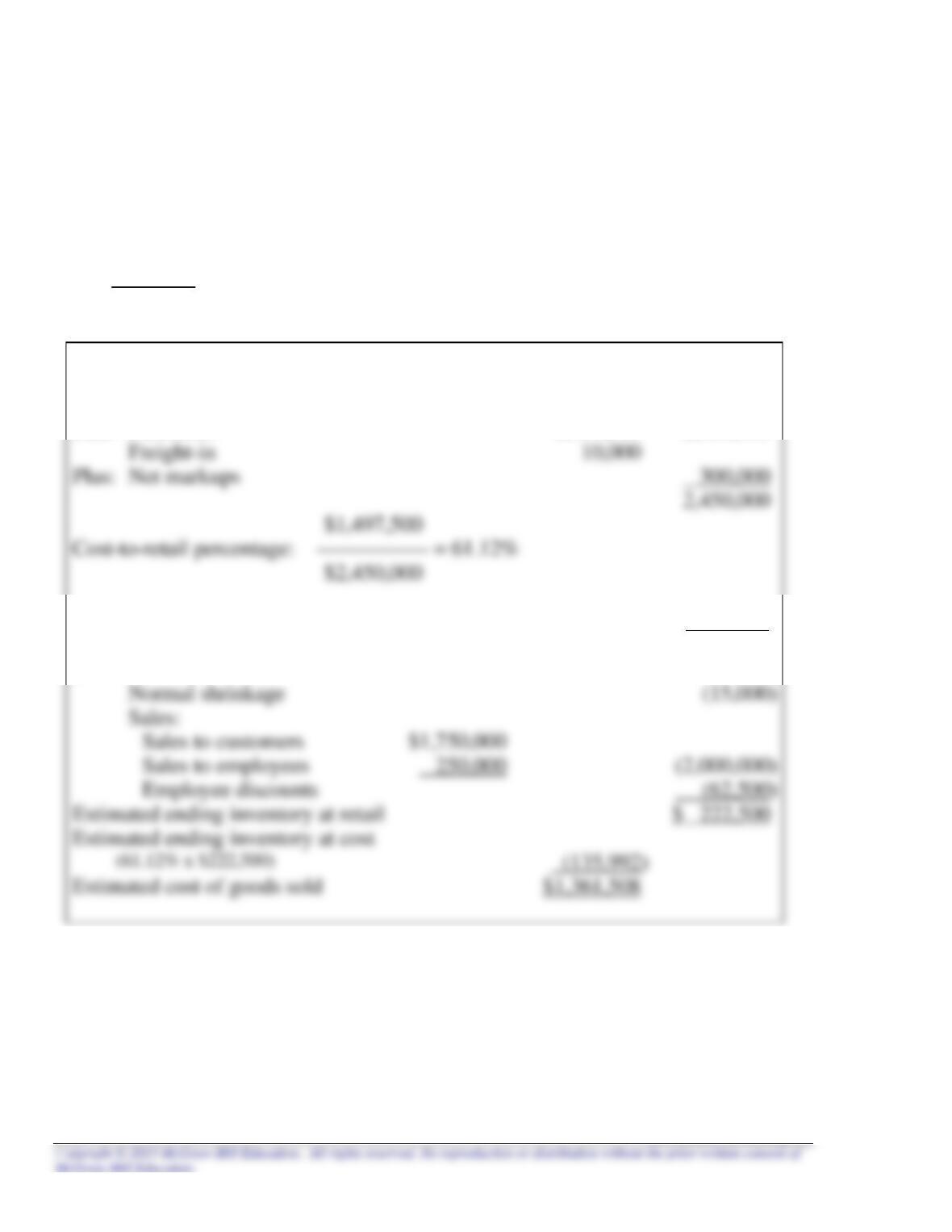
2. Conventional
Cost
Retail
Beginning inventory
$ 90,000
$180,000
Plus: Purchases
355,000
580,000
Freight-in
9,000
Less: Purchase returns
Less: Abnormal spoilage
Less: Net markdowns
_______
Goods available for sale
442,200
745,000
Less:
Normal spoilage
Net sales ($540,000 – 10,000)
Employee discounts
Estimated ending inventory at retail
$208,000
Estimated ending inventory at cost (58.41% x $208,000)
9–54 Intermediate Accounting, 8/e
Problem 9–5
Requirement 1
Employee discounts must be deducted in the retail column.
$250,000
= $312,500 – 250,000 = $62,500 = Employee discounts
.80
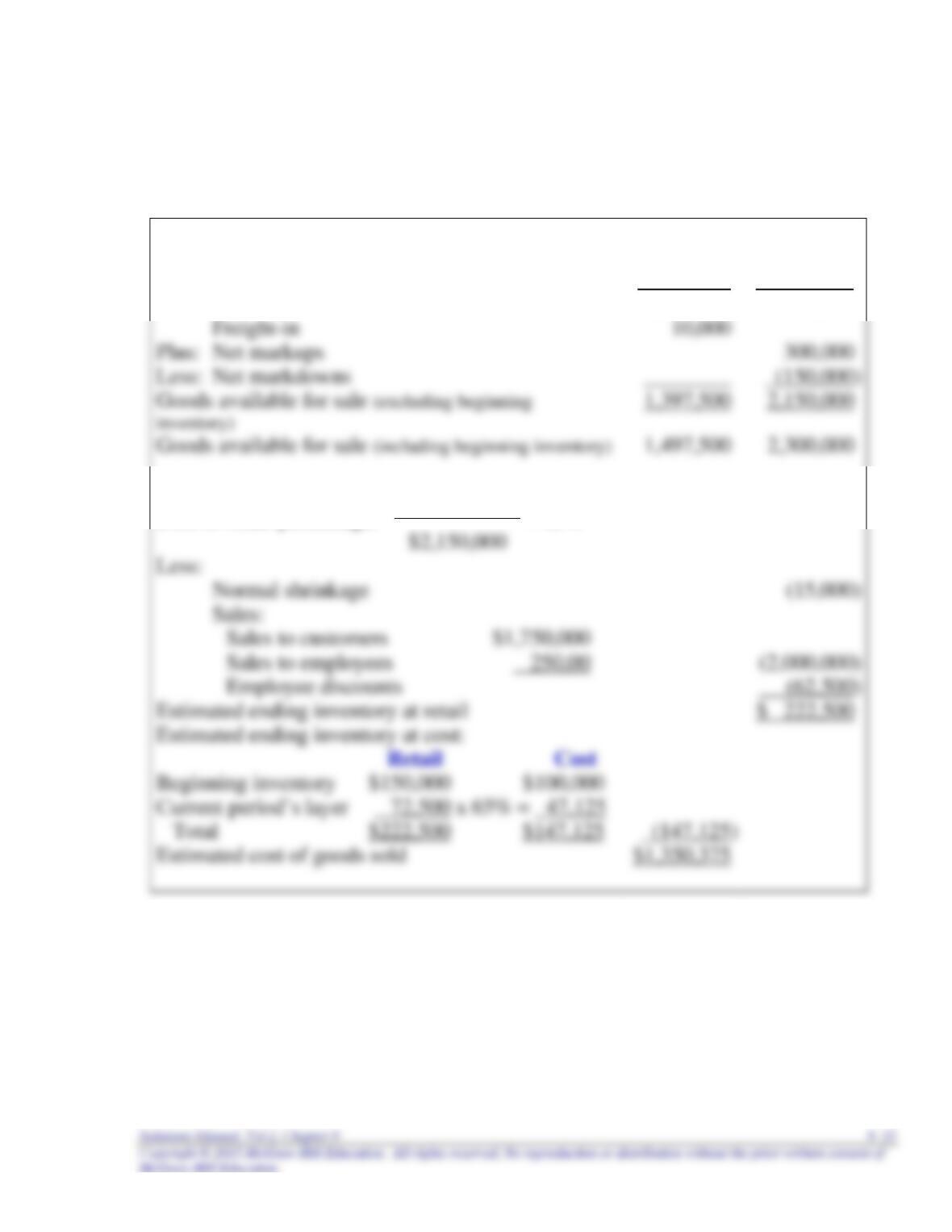
Cost
Retail
Beginning inventory
$ 100,000
$ 150,000
Plus: Purchases
1,387,500
2,000,000
Freight-in
Plus: Net markups
2,450,000
Less: Net markdowns
________
(150,000)
Goods available for sale
1,497,500
2,300,000
Less:
Normal shrinkage
Sales:
Sales to customers $1,750,000
Employee discounts
Estimated ending inventory at retail
$ 222,500
Estimated cost of goods sold
$1,361,508
Problem 9–5 (concluded)
Requirement 2
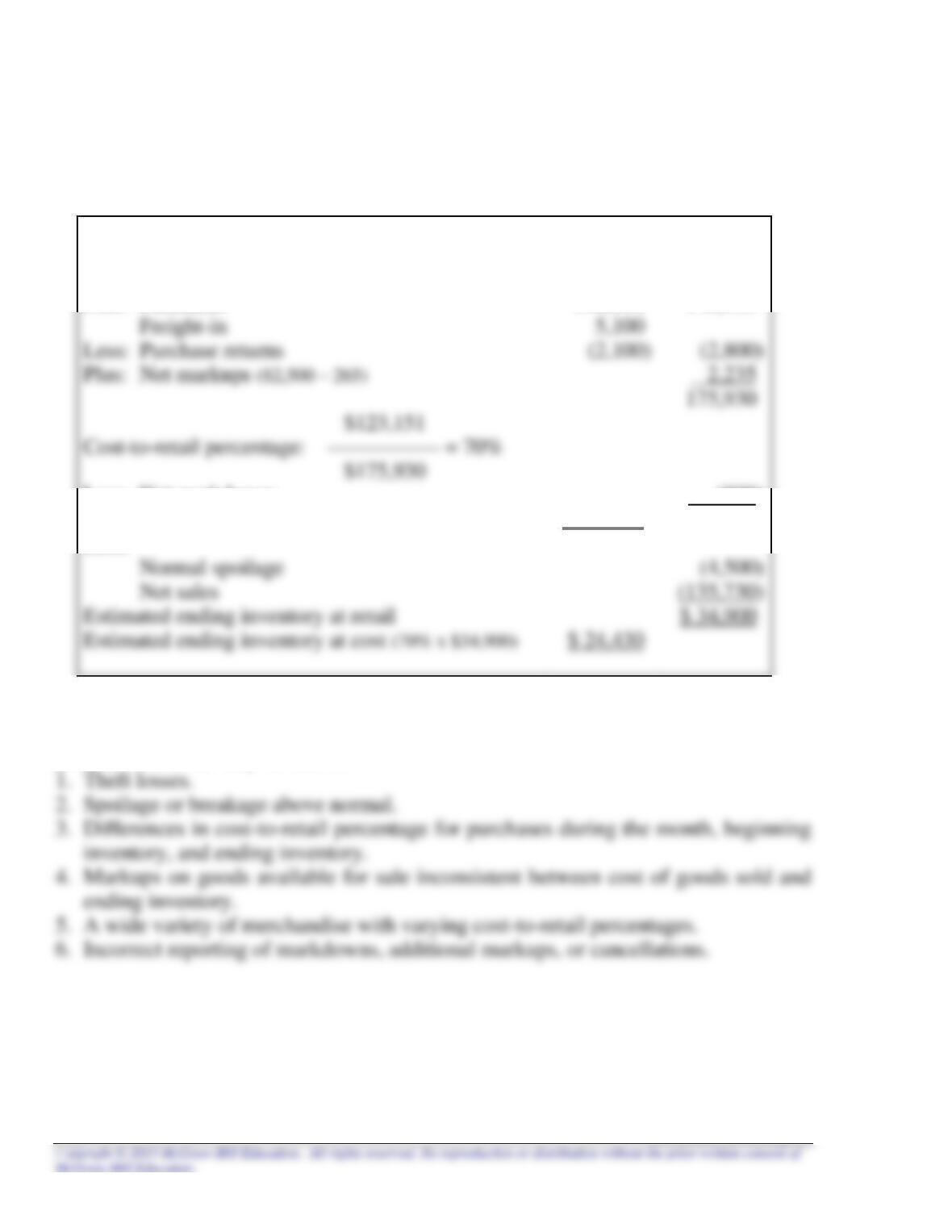
Cost
Retail
Beginning inventory
$ 100,000
$ 150,000
Plus: Purchases
1,387,500
2,000,000
Freight-in
Plus: Net markups
Less: Net markdowns
________
Goods available for sale (including beginning inventory)
1,497,500
2,300,000
Less:
Normal shrinkage
Sales:
Sales to customers $1,750,000
Employee discounts
Estimated ending inventory at retail
$ 222,500
Estimated ending inventory at cost:
Beginning inventory $150,000 $100,000
Estimated cost of goods sold
$1,350,375
$1,397,500
Cost-to-retail percentage: = 65%
9–56 Intermediate Accounting, 8/e
Problem 9–6
Requirement 1
Cost
Retail
Beginning inventory
$ 20,000
$ 30,000
Plus: Purchases
100,151
146,495
Freight-in
Less: Purchase returns
Plus: Net markups ($2,500 – 265)
175,930
Less: Net markdowns
_______
(800)
Goods available for sale
$123,151
175,130
Less:
Normal spoilage
Net sales
Estimated ending inventory at retail
$ 34,900
Requirement 2
The difference between the inventory estimate per retail method and the amount
per physical count may be due to:
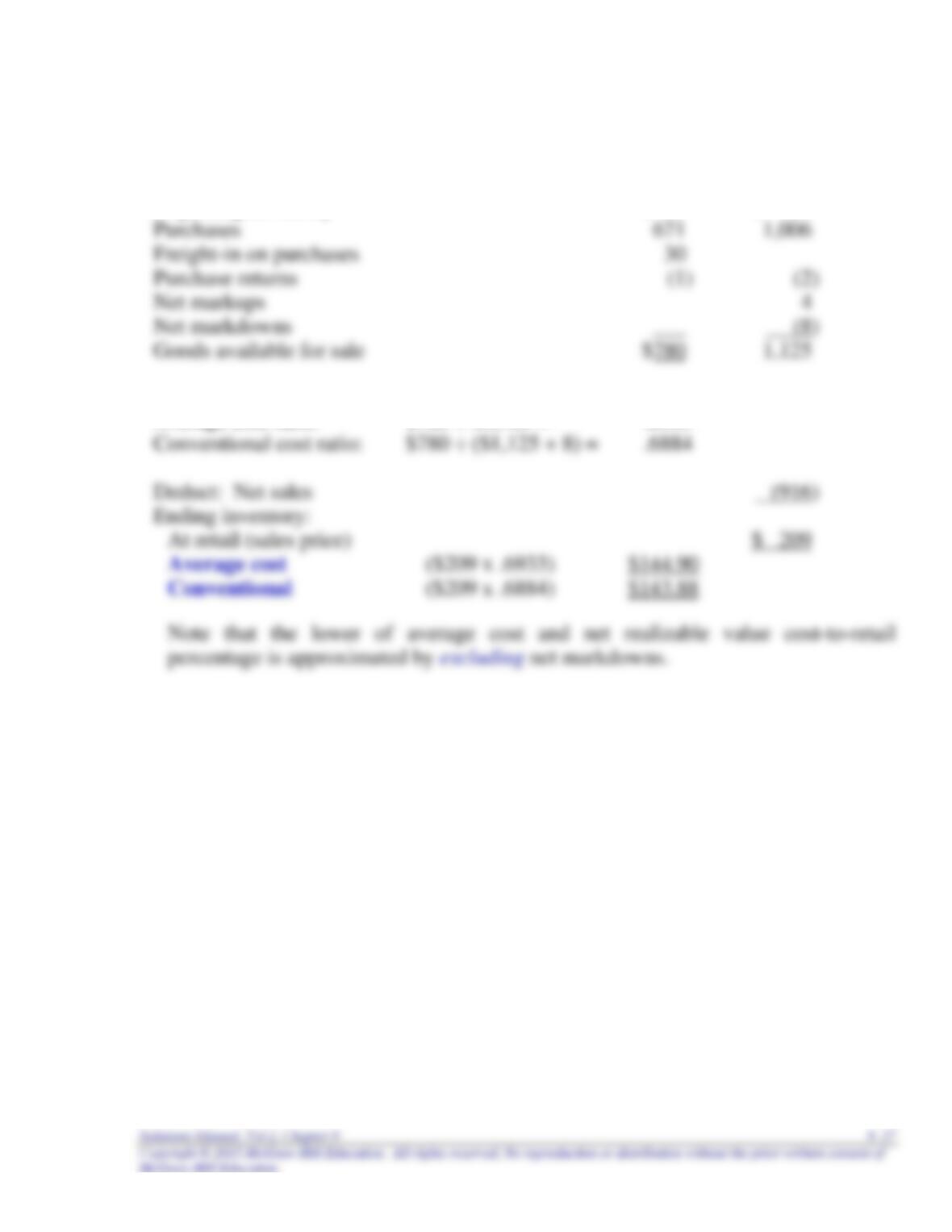
Problem 9–7
($ in 000s) Cost Retail
Beginning inventory $ 80 $ 125
Cost-to-retail percentages:
Average cost ratio: $780 ÷ $1,125 = .6933
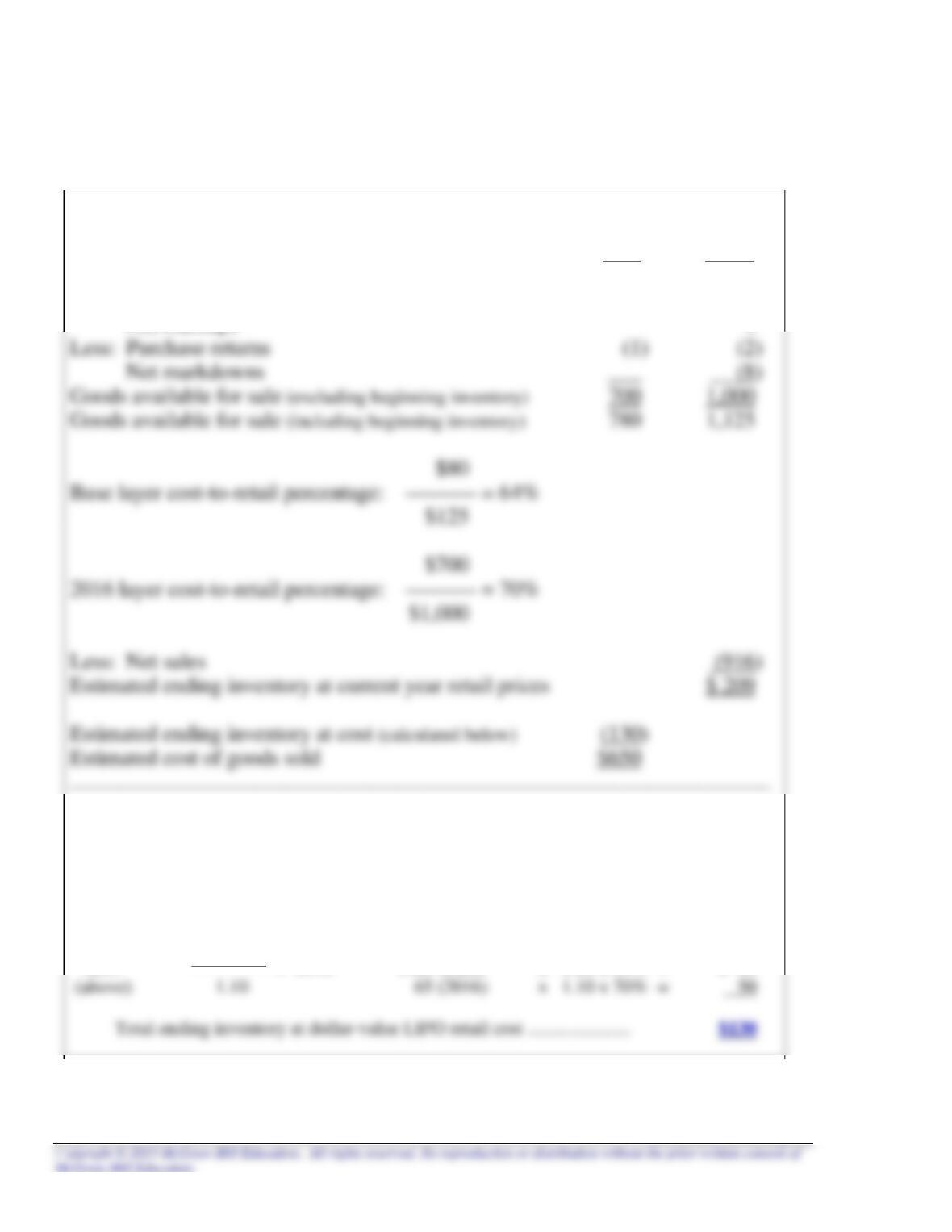
9–58 Intermediate Accounting, 8/e
Problem 9–8
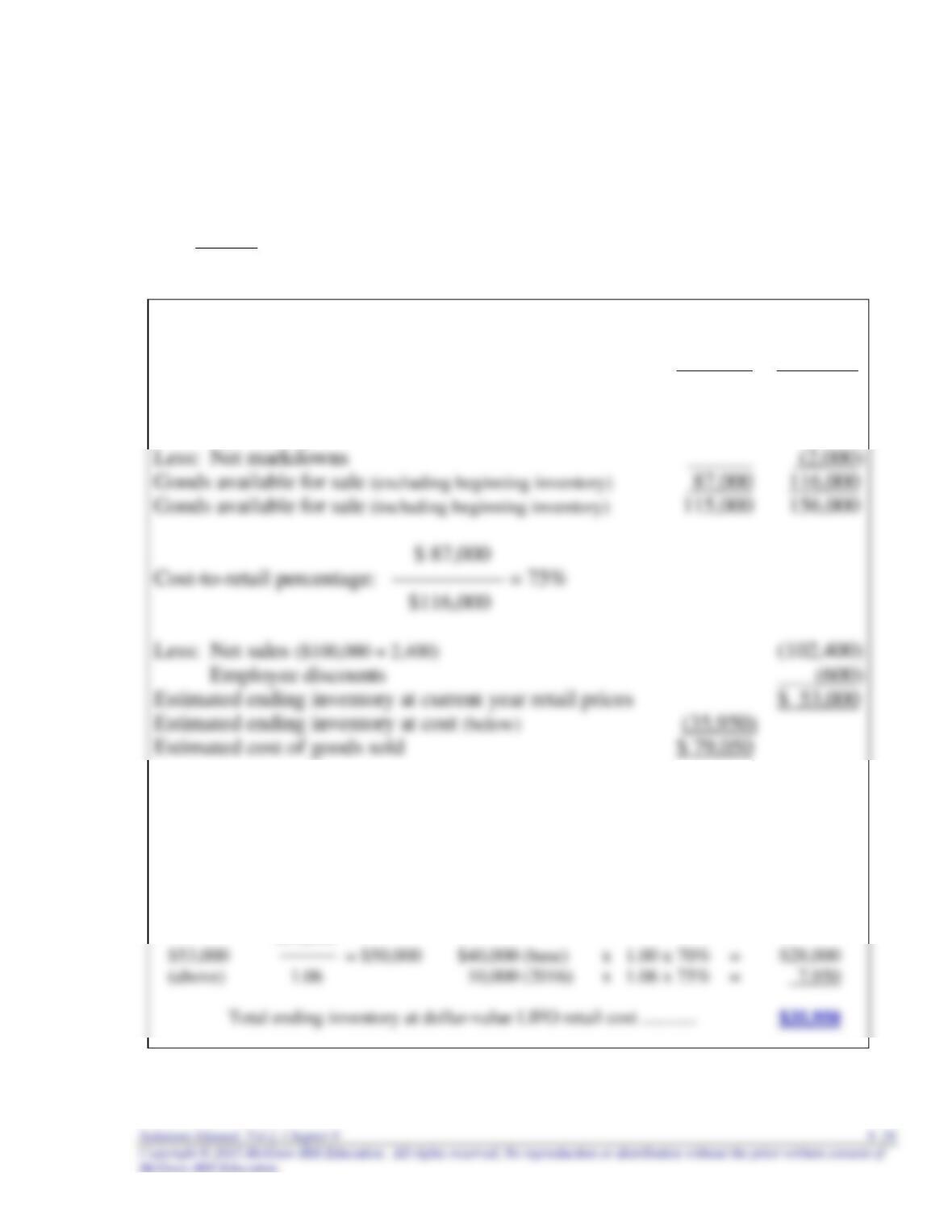
($ in 000s)
Cost
Retail
Beginning inventory
$ 80
$ 125
Plus: Net purchases
671
1,006
Freight-in
30
Net markups
4
Less: Purchase returns
Net markdowns
___
Goods available for sale (excluding beginning inventory)
700
1,000
Goods available for sale (including beginning inventory)
780
1,125
Less: Net sales
Estimated ending inventory at current year retail prices
Estimated ending inventory at cost (calculated below)
Estimated cost of goods sold
Step 1 Step 2 Step 3
Ending Ending Inventory Inventory
Inventory Inventory Layers Layers
at Year-End at Base Year at Base Year Converted to
Retail Prices Retail Prices Retail Prices Cost
$209
$209 = $190 $125 (base) x 1.00 x 64% = $ 80
Problem 9–9
Employee discounts must be deducted in the retail column.
2016:
$2,400
= $3,000 – 2,400 = $600 = Employee discounts
.80
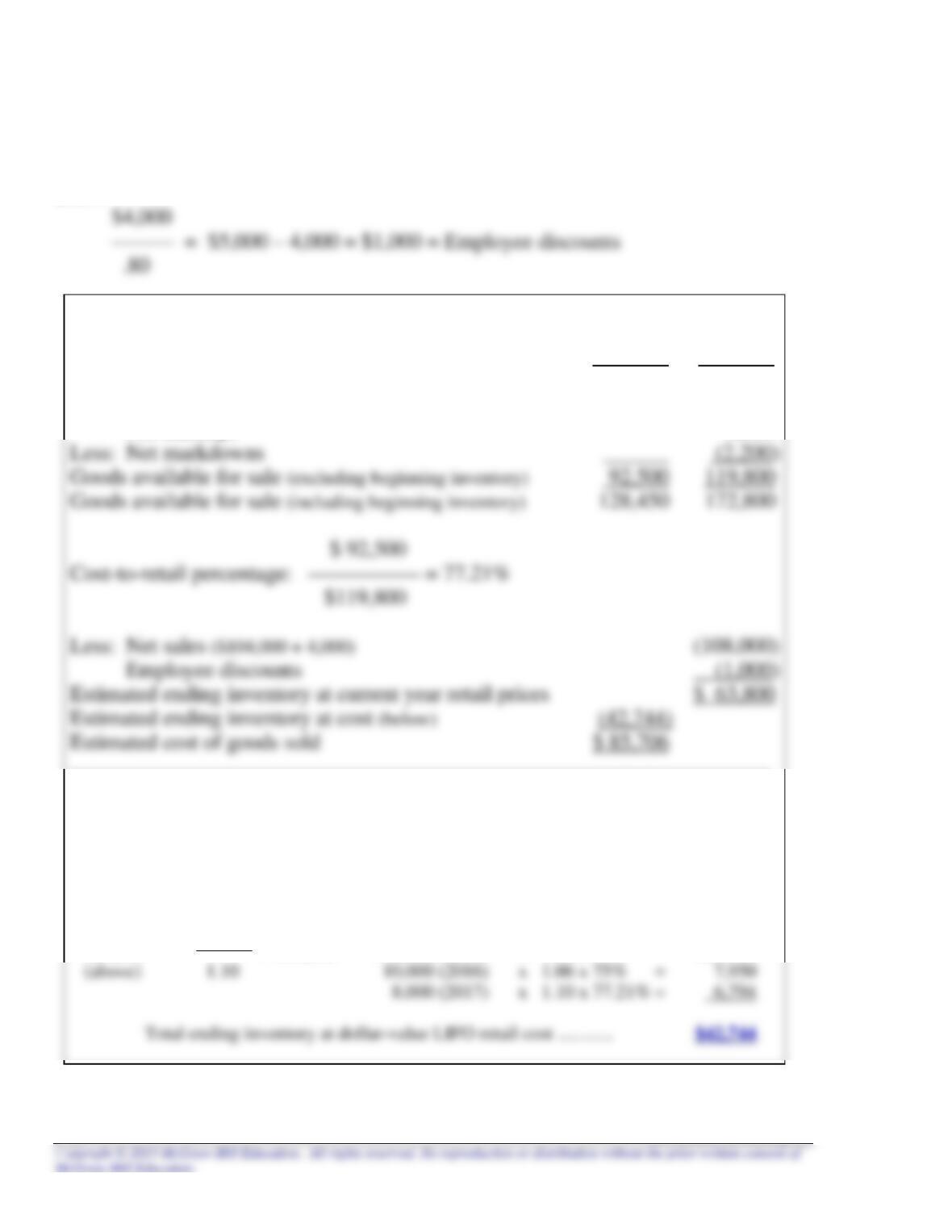
Cost
Retail
Beginning inventory
$ 28,000
$ 40,000
Plus: Net purchases
85,000
108,000
Freight-in
2,000
Net markups
10,000
Less: Net markdowns
Goods available for sale (excluding beginning inventory)
116,000
Goods available for sale (including beginning inventory)
115,000
156,000
Estimated ending inventory at current year retail prices
Estimated ending inventory at cost (below)
(35,950)
Estimated cost of goods sold
$ 79,050
___________________________________________________________________________
Step 1 Step 2 Step 3
Ending Ending Inventory Inventory
Inventory Inventory Layers Layers
at Year-End at Base Year at Base Year Converted to
Retail Prices Retail Prices Retail Prices Cost
$53,000
9–60 Intermediate Accounting, 8/e
Problem 9–9 (concluded)
2017:
Cost
Retail
Beginning inventory
$ 35,950
$ 53,000
Plus: Net purchases
90,000
114,000
Freight-in
2,500
Net markups
8,000
Less: Net markdowns
Goods available for sale (excluding beginning inventory)
Goods available for sale (including beginning inventory)
Estimated ending inventory at current year retail prices
Estimated ending inventory at cost (below)
Estimated cost of goods sold
$ 85,706
___________________________________________________________________________
Step 1 Step 2 Step 3
Ending Ending Inventory Inventory
Inventory Inventory Layers Layers
at Year-End at Base Year at Base Year Converted to
Retail Prices Retail Prices Retail Prices Cost
$63,800
$63,800 = $58,000 $40,000 (base) x 1.00 x 70% = $28,000