Exercise 9–4
1. The accounting treatment required for a correction of an inventory
error in previously issued financial statements:
FASB ASC 250–10–50–7: “Accounting Changes and Error Corrections–
Overall–Disclosure–Other Presentation Matters.”
Any error in the financial statements of a prior period discovered after the
financial statements are issued or are available to be issued (as discussed
in Section 855-10–25) shall be reported as an error correction, by
restating the prior-period financial statements. Restatement requires all of
the following:
• a. The cumulative effect of the error on periods prior to those
presented shall be reflected in the carrying amounts of assets and
liabilities as of the beginning of the first period presented.
2. The use of the retail method to value inventory:
FASB ASC 330–10–30–13: “Inventory–Overall–Initial Measurement–
Determination of Inventory Costs.”
9–22 Intermediate Accounting, 8/e
Exercise 9–5
Beginning inventory (from records) $140,000
Plus: Net purchases (from records) 370,000
Exercise 9–6
Beginning inventory (from records) $100,000
Less: Cost of goods sold:
Net sales $220,000
Exercise 9–7
Merchandise inventory, January 1, 2016 $1,900,000
Purchases 5,800,000
9–24 Intermediate Accounting, 8/e
Exercise 9–8
Requirement 1
Beginning inventory (from records) $ 58,500
Plus: Net purchases ($110,000 – 4,000) 106,000
Freight-in (from records) 3,000
Requirement 2
Beginning inventory (from records) $ 58,500
Plus: Net purchases ($110,000 – 4,000) 106,000
Freight-in (from records) 3,000
Exercise 9–9
Beginning inventory + Net purchases – Ending inventory = Cost of goods sold
$27,000 + 31,000 – 28,000 = $30,000 = Cost of goods sold
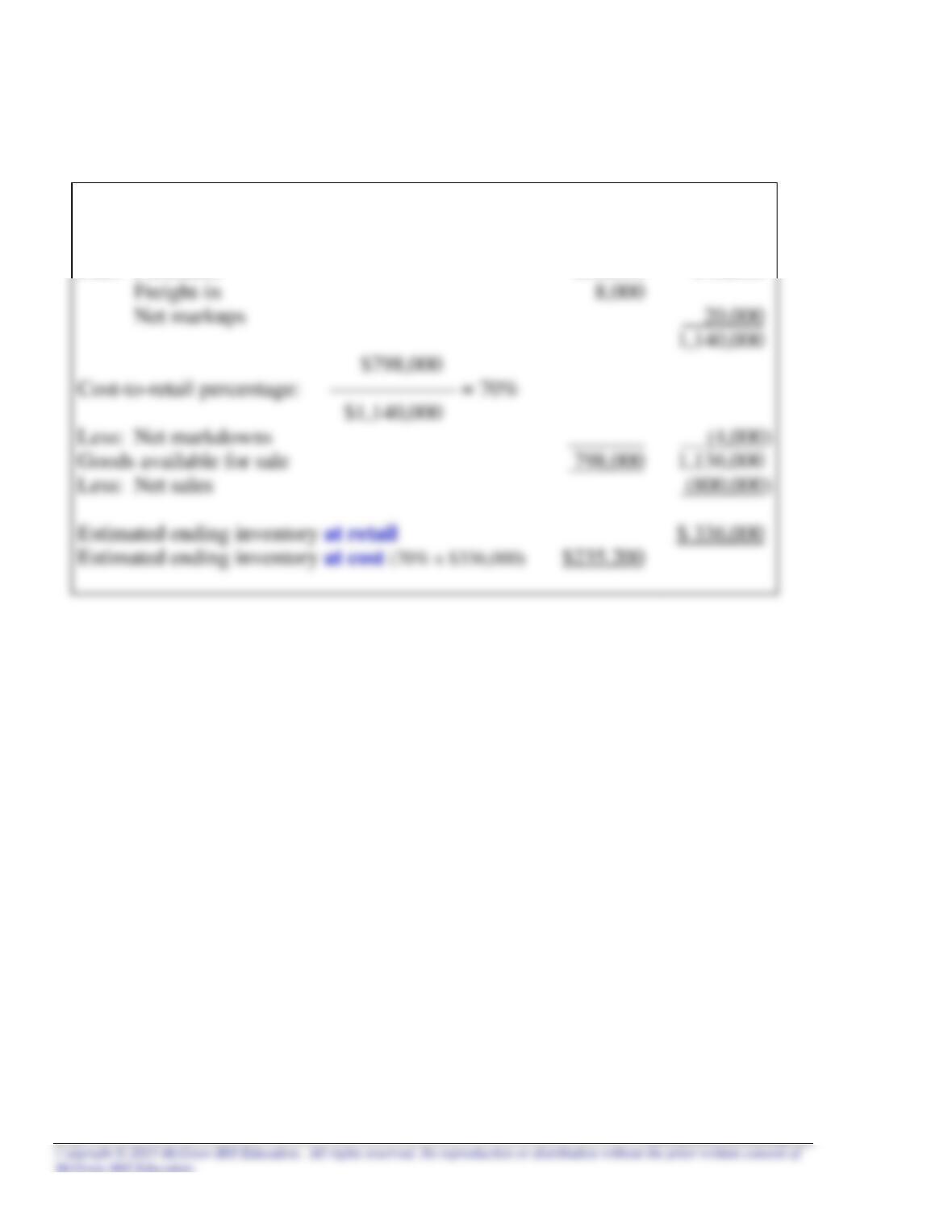
Exercise 9–10
Cost
Retail
Beginning inventory
$35,000
$50,000
Plus: Net purchases
19,120
31,600
Net markups
Less: Net markdowns
______
Goods available for sale
Less: Net sales
Estimated ending inventory at retail
Estimated ending inventory at cost (66% x $50,000)
Estimated cost of goods sold
9–26 Intermediate Accounting, 8/e
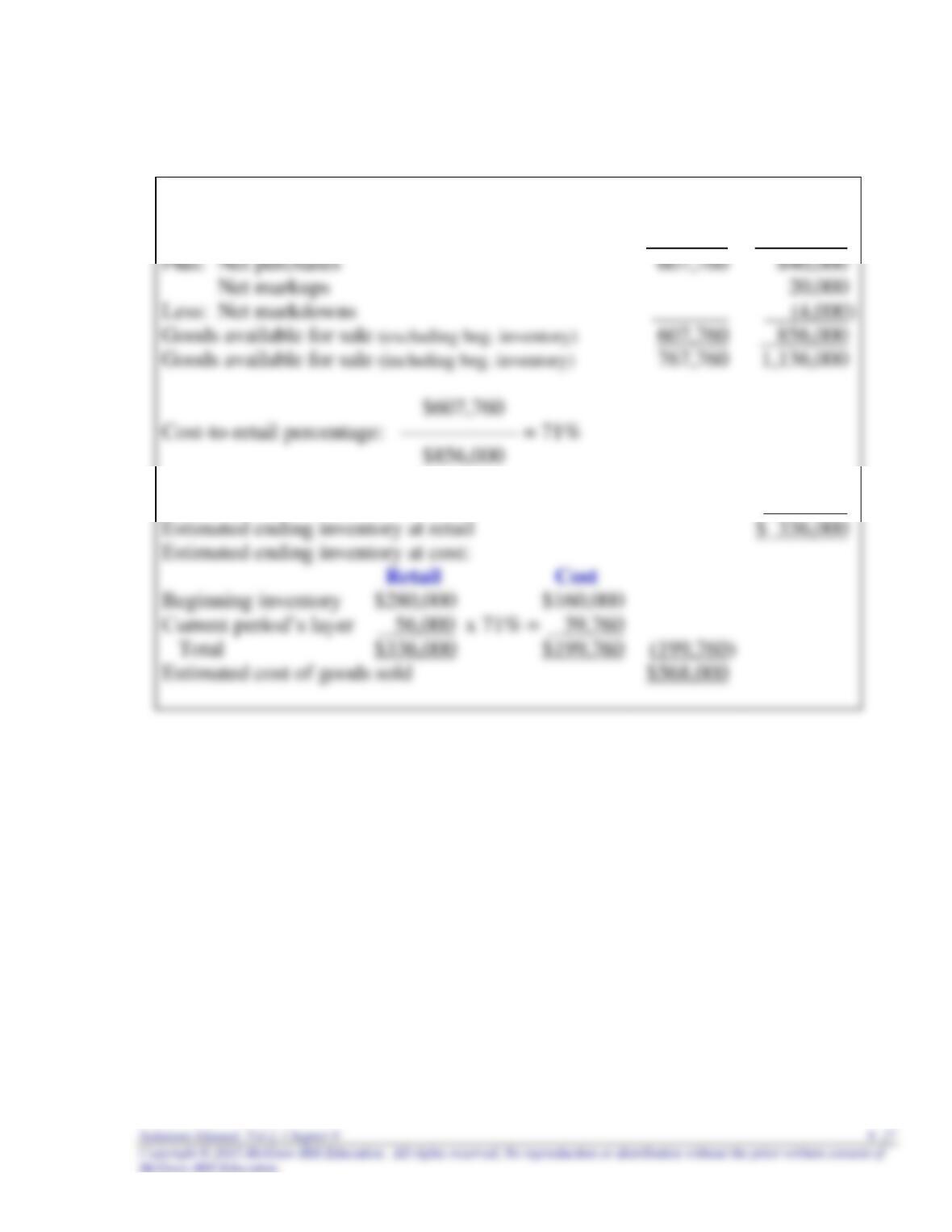
Exercise 9–11
Cost
Retail
Beginning inventory
$190,000
$ 280,000
Plus: Purchases
600,000
840,000
Freight-in
Net markups
Less: Net markdowns
Goods available for sale
Less: Net sales
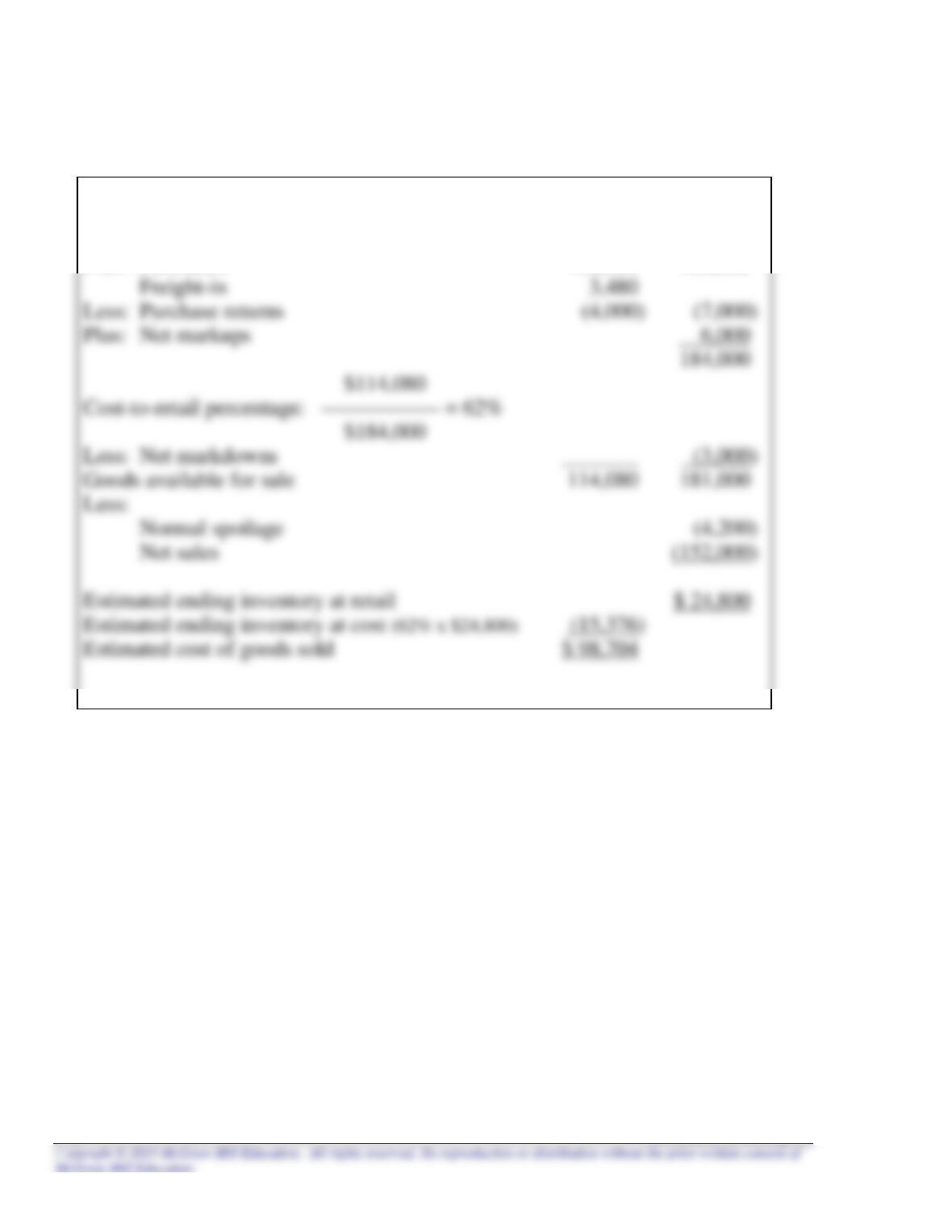
Exercise 9–12
Cost
Retail
Beginning inventory
$160,000
$ 280,000
Plus: Net purchases
Net markups
Less: Net markdowns
Goods available for sale (excluding beg. inventory)
Goods available for sale (including beg. inventory)
Less: Net sales
(800,000)
Estimated ending inventory at retail
$ 336,000
Estimated ending inventory at cost:
Beginning inventory $280,000 $160,000
Estimated cost of goods sold
9–28 Intermediate Accounting, 8/e
Exercise 9–13
Cost
Retail
Beginning inventory
$ 12,000
$ 20,000
Plus: Purchases
102,600
165,000
Freight-in
Less: Purchase returns
Plus: Net markups
184,000
Less: Net markdowns
_______
Goods available for sale
114,080
181,000
Less:
Normal spoilage
Net sales
Estimated ending inventory at retail
$ 24,800
Estimated ending inventory at cost (62% x $24,800)
Estimated cost of goods sold
$ 98,704
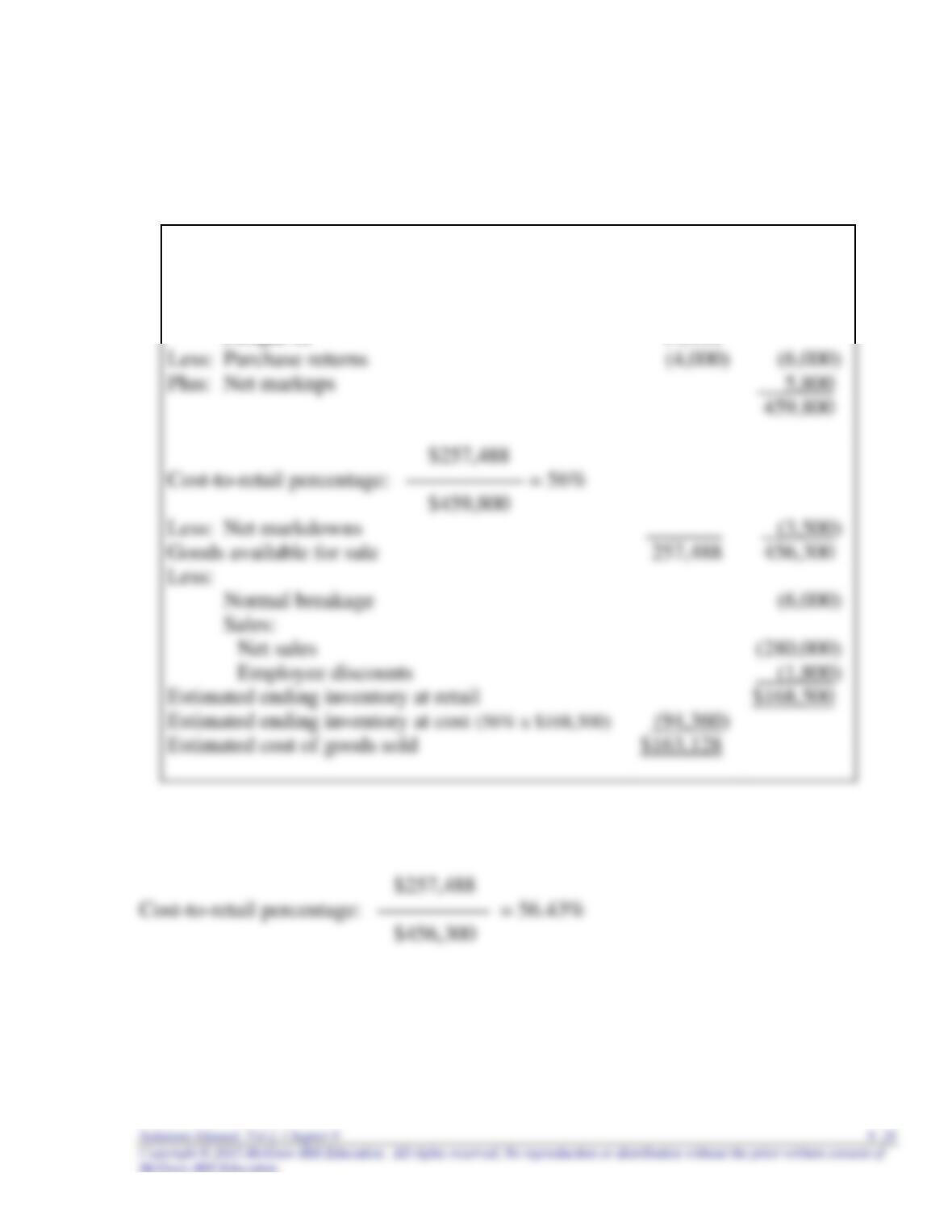
Exercise 9–14
Requirement 1
Cost
Retail
Beginning inventory
$ 40,000
$ 60,000
Plus: Purchases
207,000
400,000
Freight-in
14,488
Less: Purchase returns
459,800
Less: Net markdowns
_______
Goods available for sale
257,488
456,300
Less:
Normal breakage
Sales:
Net sales
Employee discounts
Estimated ending inventory at retail
$168,500
Estimated ending inventory at cost (56% x $168,500)
Estimated cost of goods sold
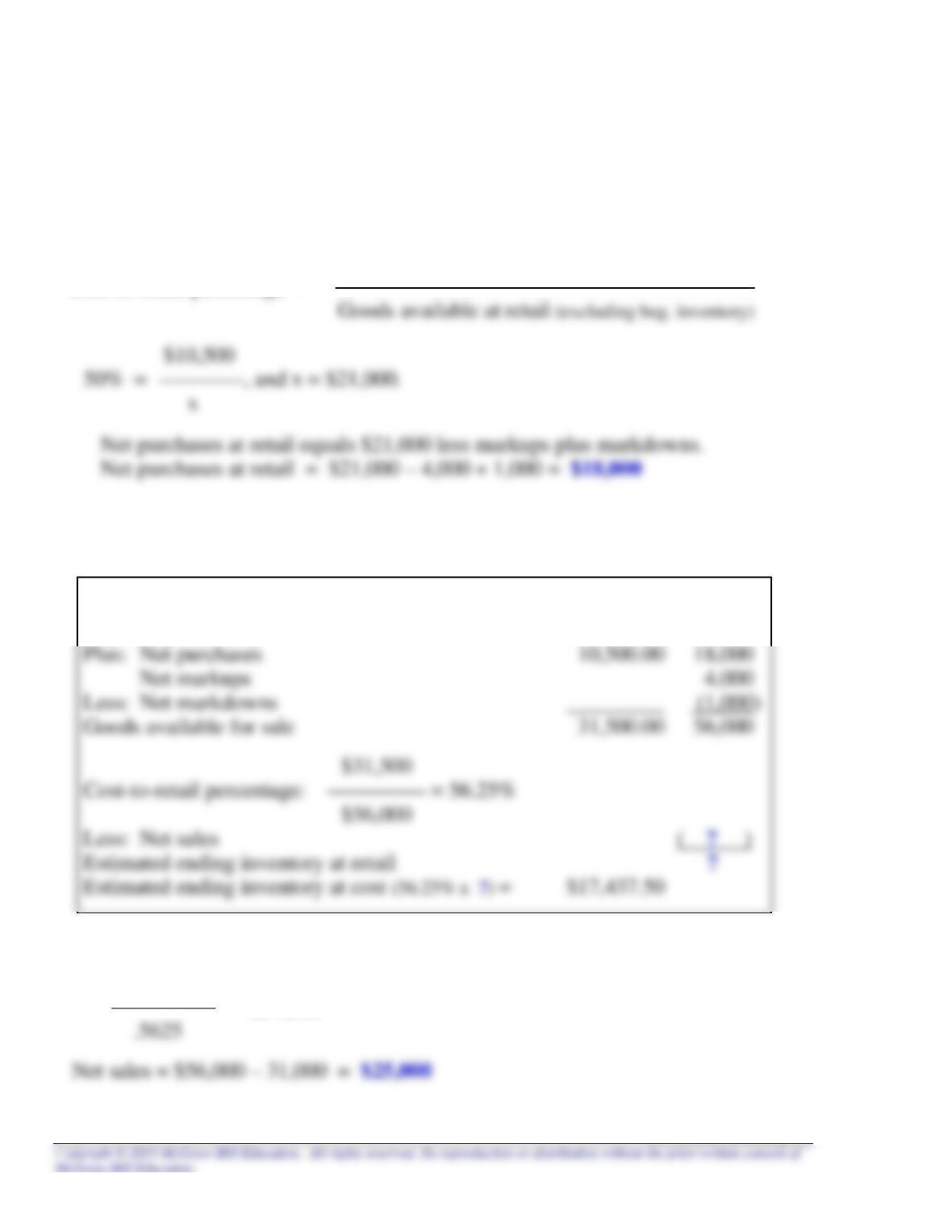
Requirement 2
Net markdowns are included in the cost-to-retail percentage:
9–30 Intermediate Accounting, 8/e
Exercise 9–15
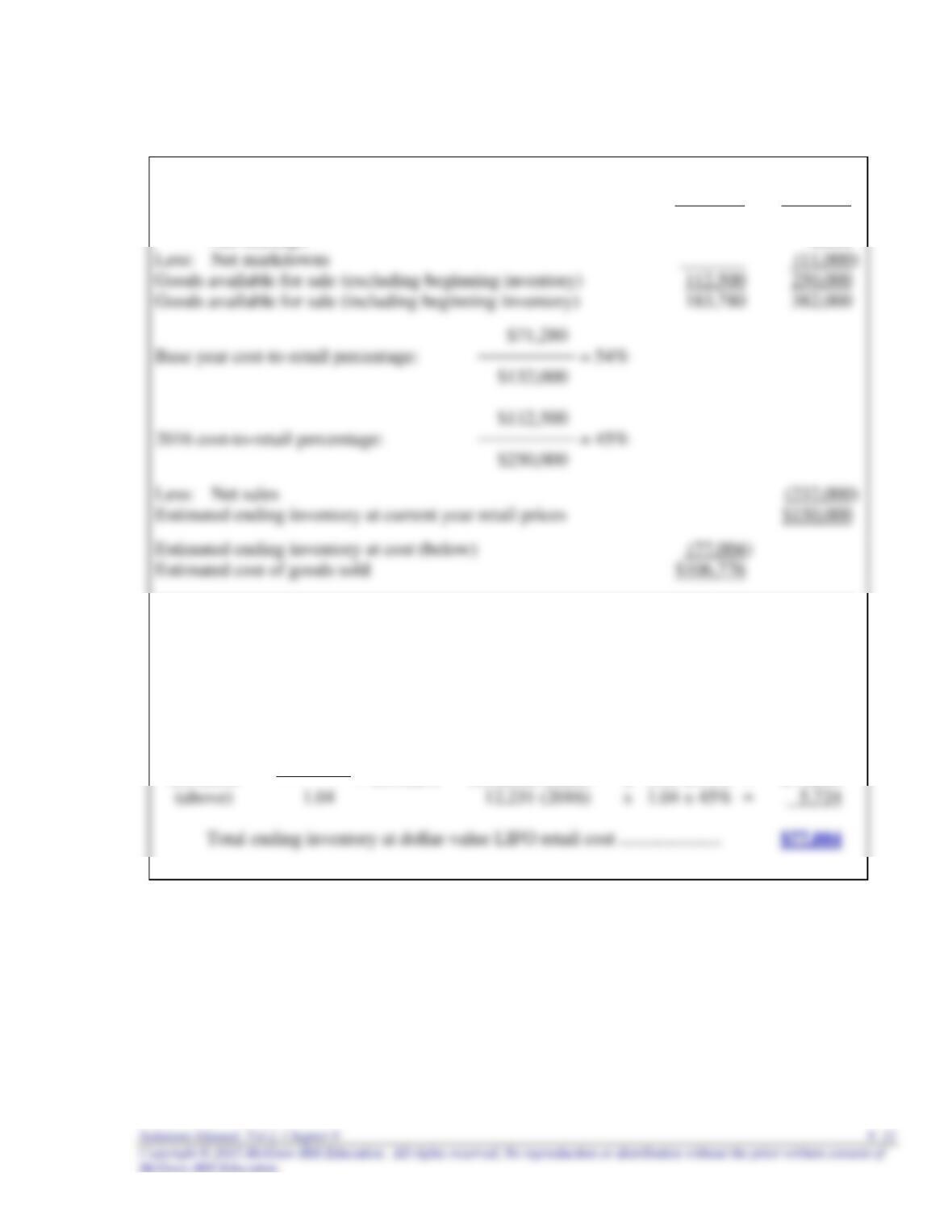
Net purchases:
Using LIFO, the beginning inventory is excluded from the calculation of the cost–to–
retail percentage:
Cost of goods available (excluding beg. inventory)
Cost-to-retail percentage =
Net sales:
The cost-to-retail percentage can be calculated as follows:
Cost
Retail
Beginning inventory
$21,000.00
$ 35,000
Net markups
Less: Net markdowns
_________
Goods available for sale
Less: Net sales
Estimated ending inventory at retail
Estimated ending inventory at cost (56.25% x ?) =
$17,437.50
Estimated ending inventory at retail is:
$17,437.50
= $31,000
Exercise 9–16
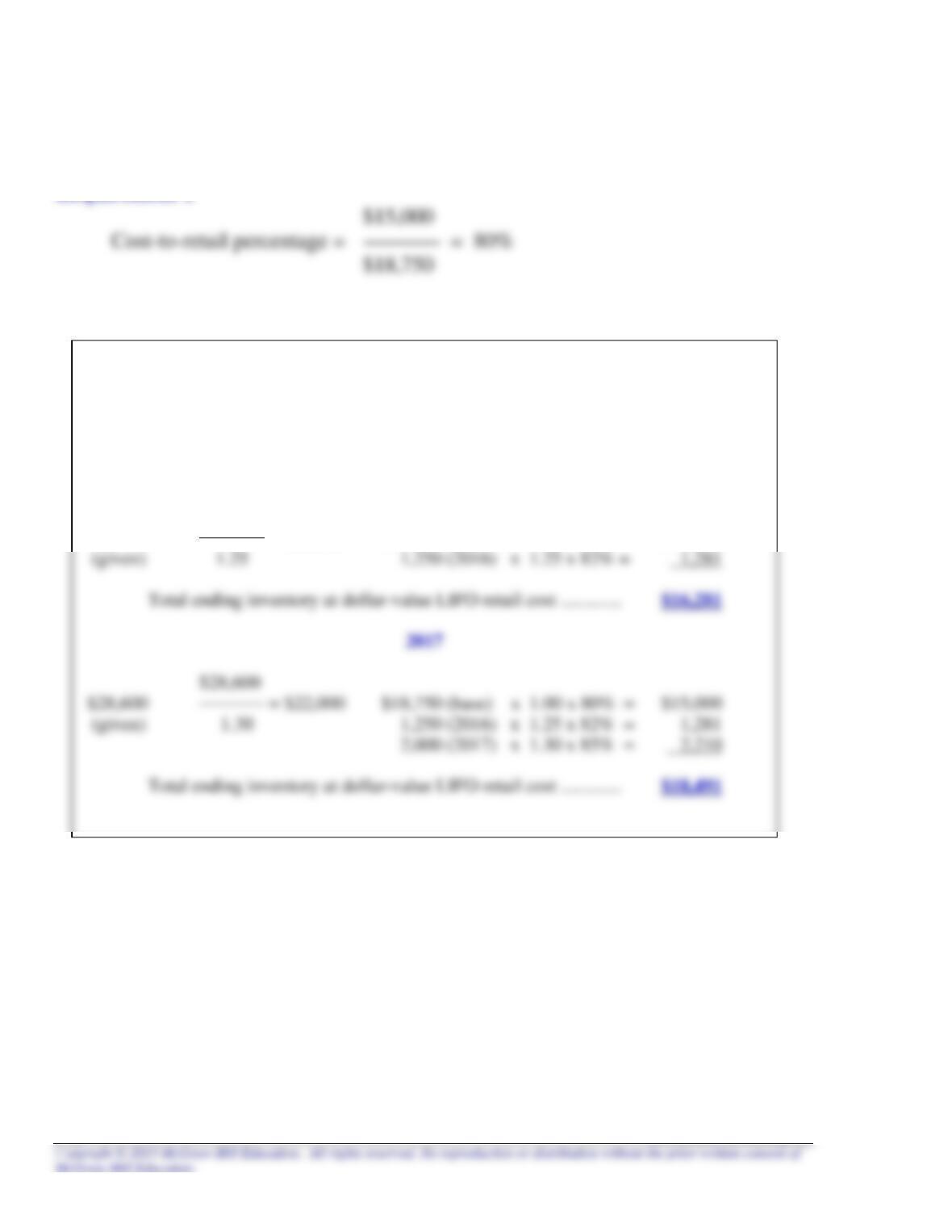
Cost
Retail
Beginning inventory
$ 71,280
$132,000
Plus: Net purchases
112,500
255,000
Net markups
6,000
Less: Net markdowns
Goods available for sale (excluding beginning inventory)
112,500
250,000
Goods available for sale (including beginning inventory)
183,780
382,000
Less: Net sales
Estimated ending inventory at current year retail prices
$150,000
Estimated ending inventory at cost (below)
Estimated cost of goods sold
$106,776
___________________________________________________________________________
Step 1 Step 2 Step 3
Ending Ending Inventory Inventory
Inventory Inventory Layers Layers
at Year-End at Base Year at Base Year Converted to
Retail Prices Retail Prices Retail Prices Cost
$150,000
$150,000 = $144,231 $132,000 (base) x 1.00 x 54% = $71,280
9–32 Intermediate Accounting, 8/e
Exercise 9–17
Requirement 1
Requirement 2
2016
Step 1 Step 2 Step 3
Ending Ending Inventory Inventory
Inventory Inventory Layers Layers
at Year-End at Base Year at Base Year Converted to
Retail Prices Retail Prices Retail Prices Cost
$25,000
$25,000 = $20,000 $18,750 (base) x 1.00 x 80% = $15,000
Exercise 9–18
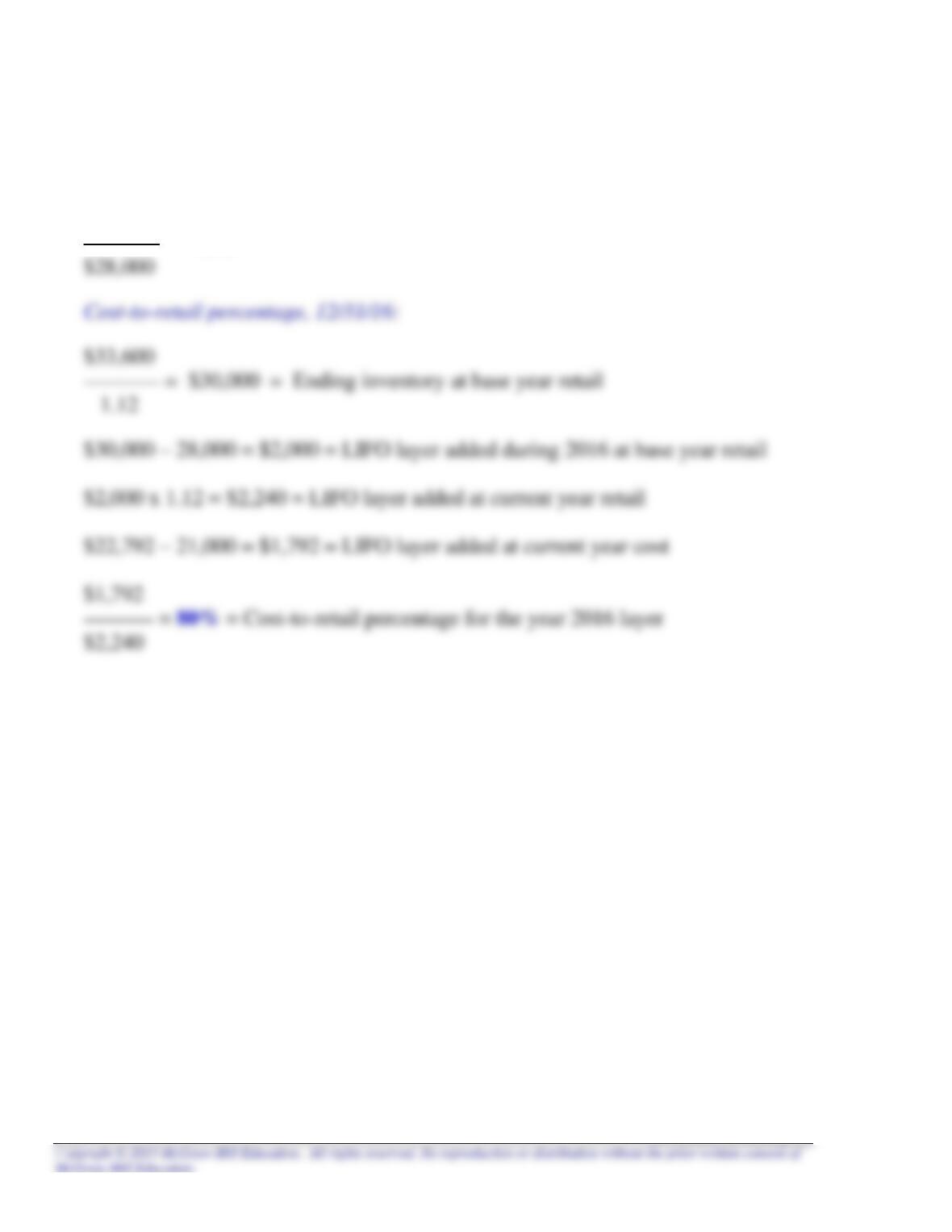
Cost
Retail
Beginning inventory
$160,000
$250,000
Plus: Net purchases
350,200
510,000
Net markups
7,000
Less: Net markdowns
Goods available for sale (excluding beginning inventory)
350,200
515,000
Goods available for sale (including beginning inventory)
510,200
765,000
Less: Net sales
Estimated ending inventory at current year retail prices
$385,000
Estimated ending inventory at cost (calculated below)
Estimated cost of goods sold
$275,400
Step 1 Step 2 Step 3
Ending Ending Inventory Inventory
Inventory Inventory Layers Layers
at Year-End at Base Year at Base Year Converted to
Retail Prices Retail Prices Retail Prices Cost
$385,000
$385,000 = $350,000 $250,000 (base) x 1.00 x 64% = $160,000
9–34 Intermediate Accounting, 8/e
Exercise 9–19
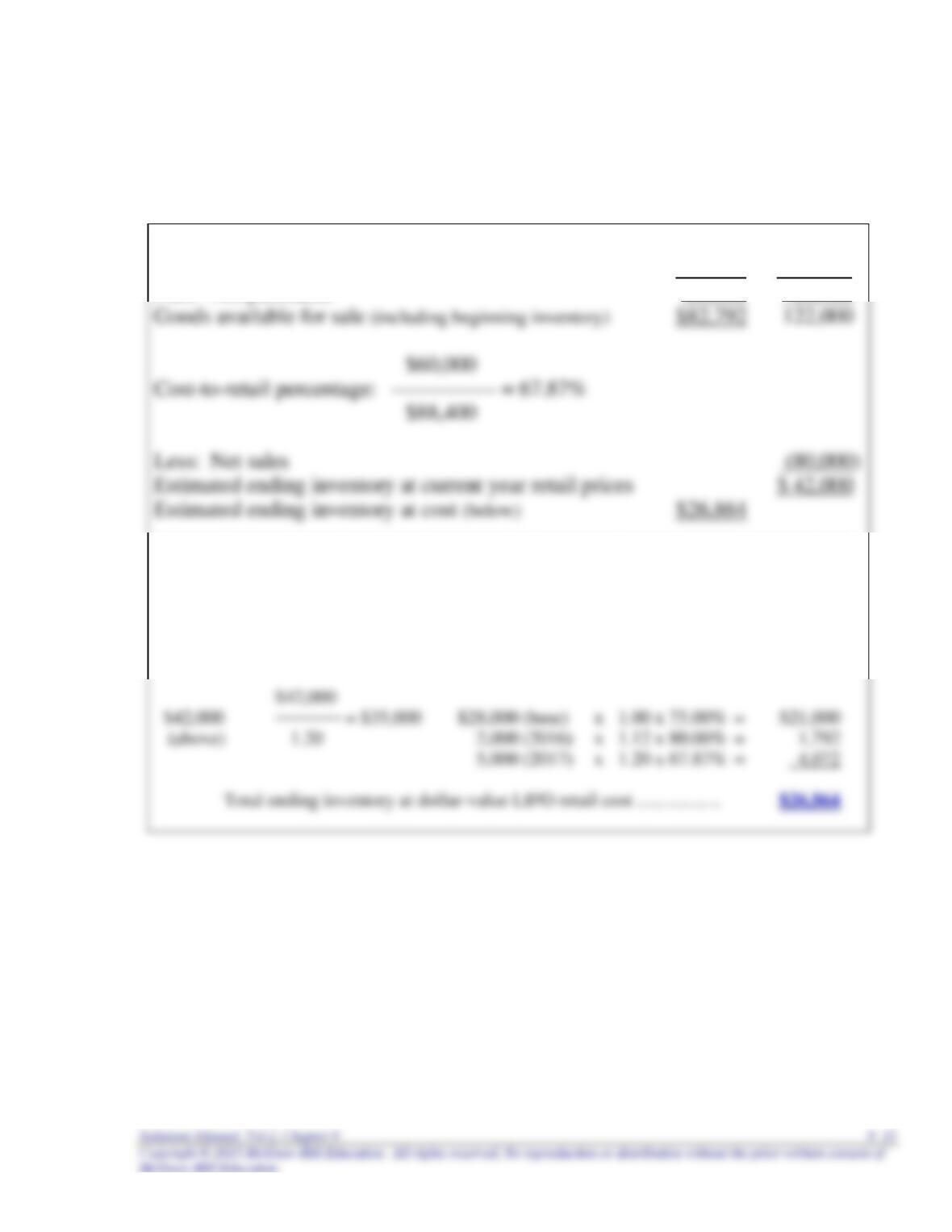
Cost-to-retail percentage, 1/1/16:
$21,000
= 75%
Exercise 9–19 (concluded)
2017 ending inventory:
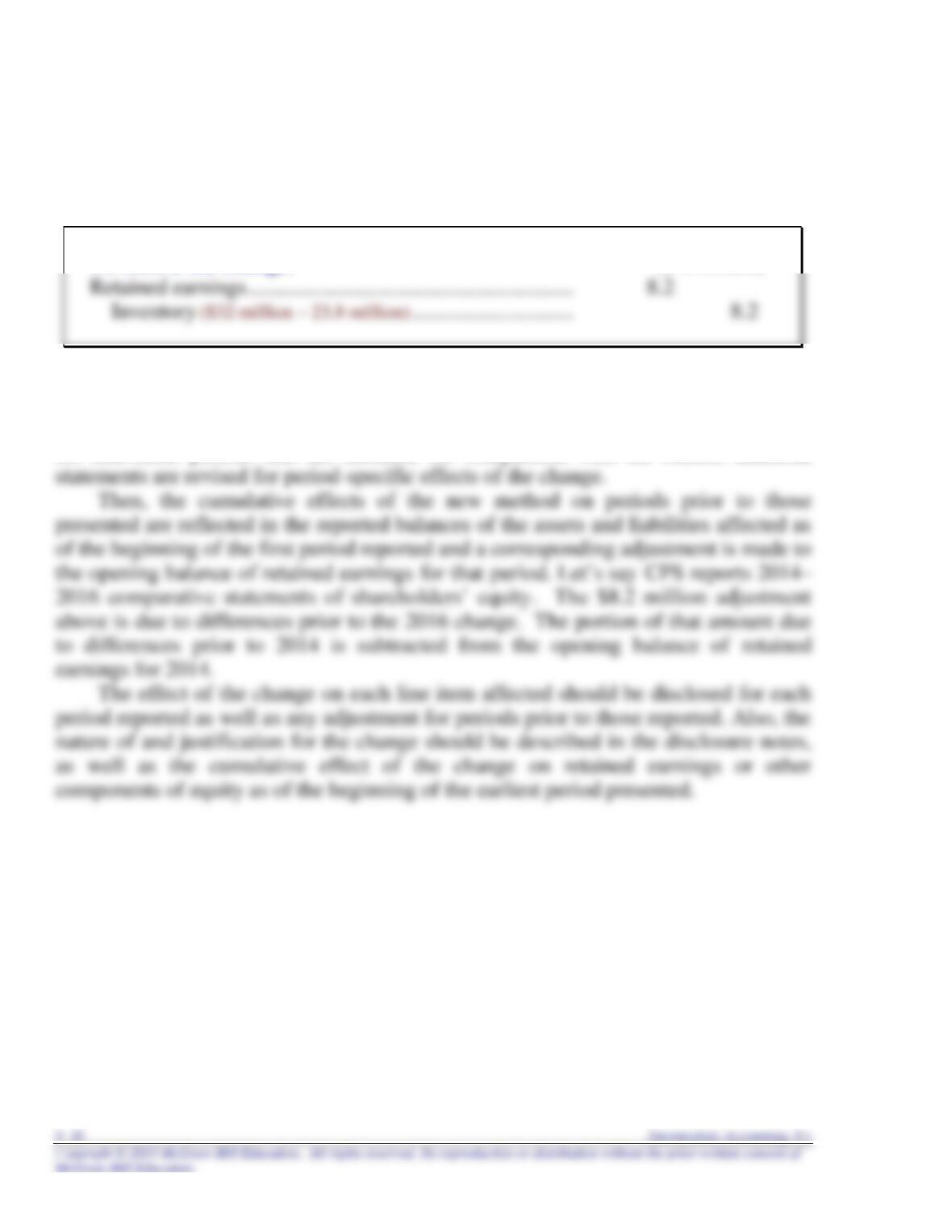
Cost
Retail
Beginning inventory
$22,792
$ 33,600
Plus: Net purchases
60,000
88,400
Goods available for sale (including beginning inventory)
$82,792
122,000
Less: Net sales
Estimated ending inventory at cost (below)
$26,864
___________________________________________________________________________
Step 1 Step 2 Step 3
Ending Ending Inventory Inventory
Inventory Inventory Layers Layers
at Year-End at Base Year at Base Year Converted to
Retail Prices Retail Prices Retail Prices Cost
Exercise 9–20
Requirement 1
To record the change: ($ in millions)
Requirement 2
CPS applies the average cost method retrospectively; that is, to all prior periods
as if it always had used that method. In other words, all financial statement amounts
for individual periods that are included for comparison with the current financial
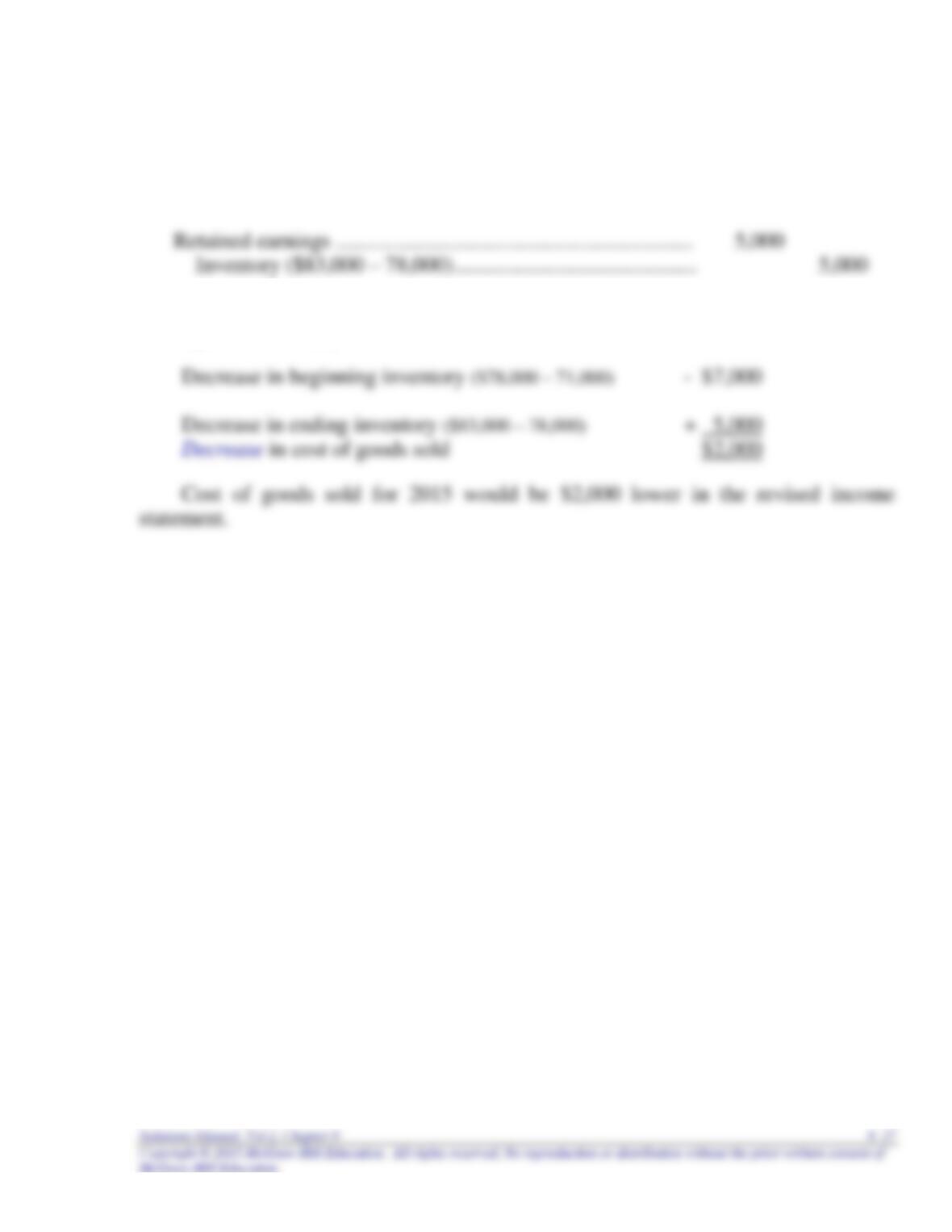
Exercise 9–21
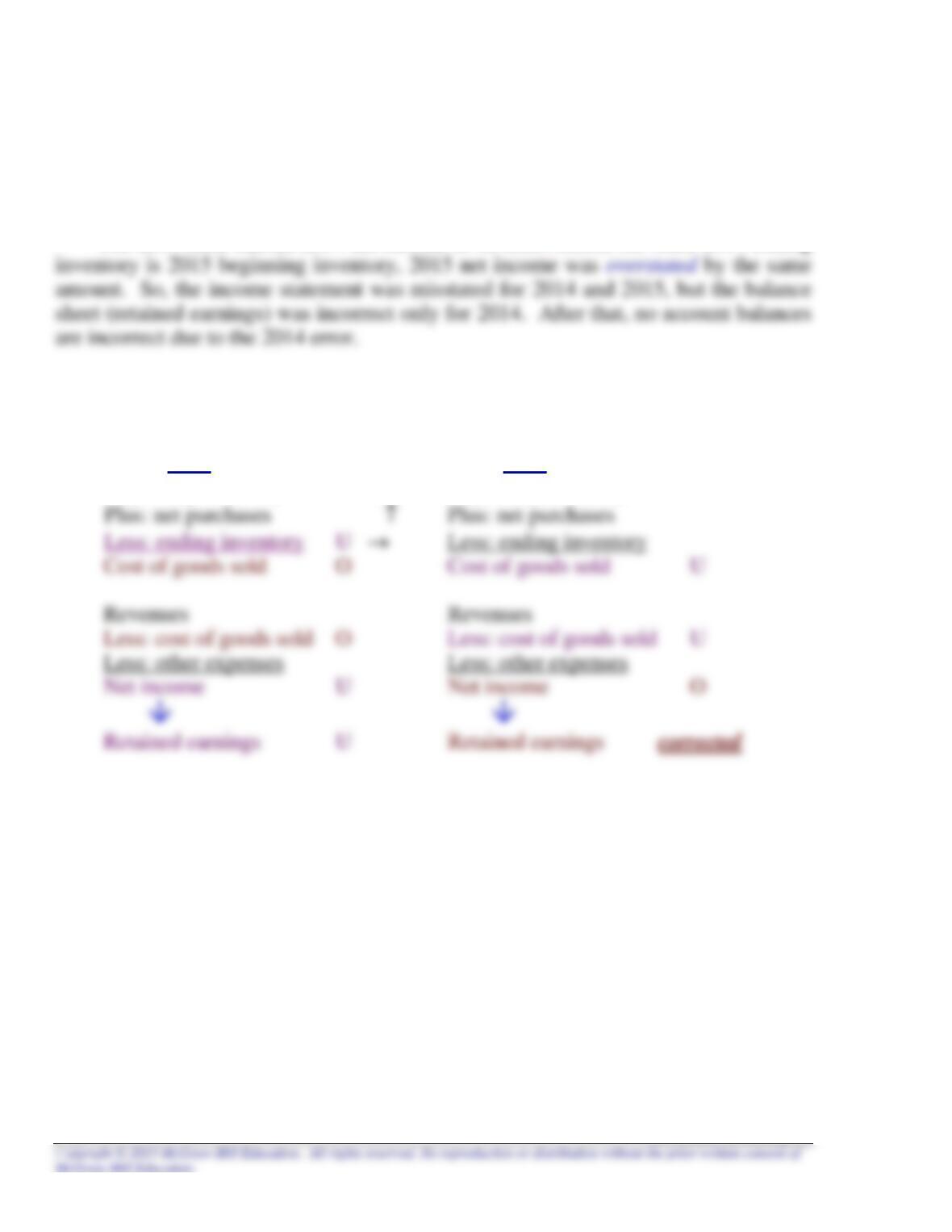
Requirement 1
Requirement 2
Effect on cost of goods sold:
9–38 Intermediate Accounting, 8/e
Exercise 9–22
Requirement 1
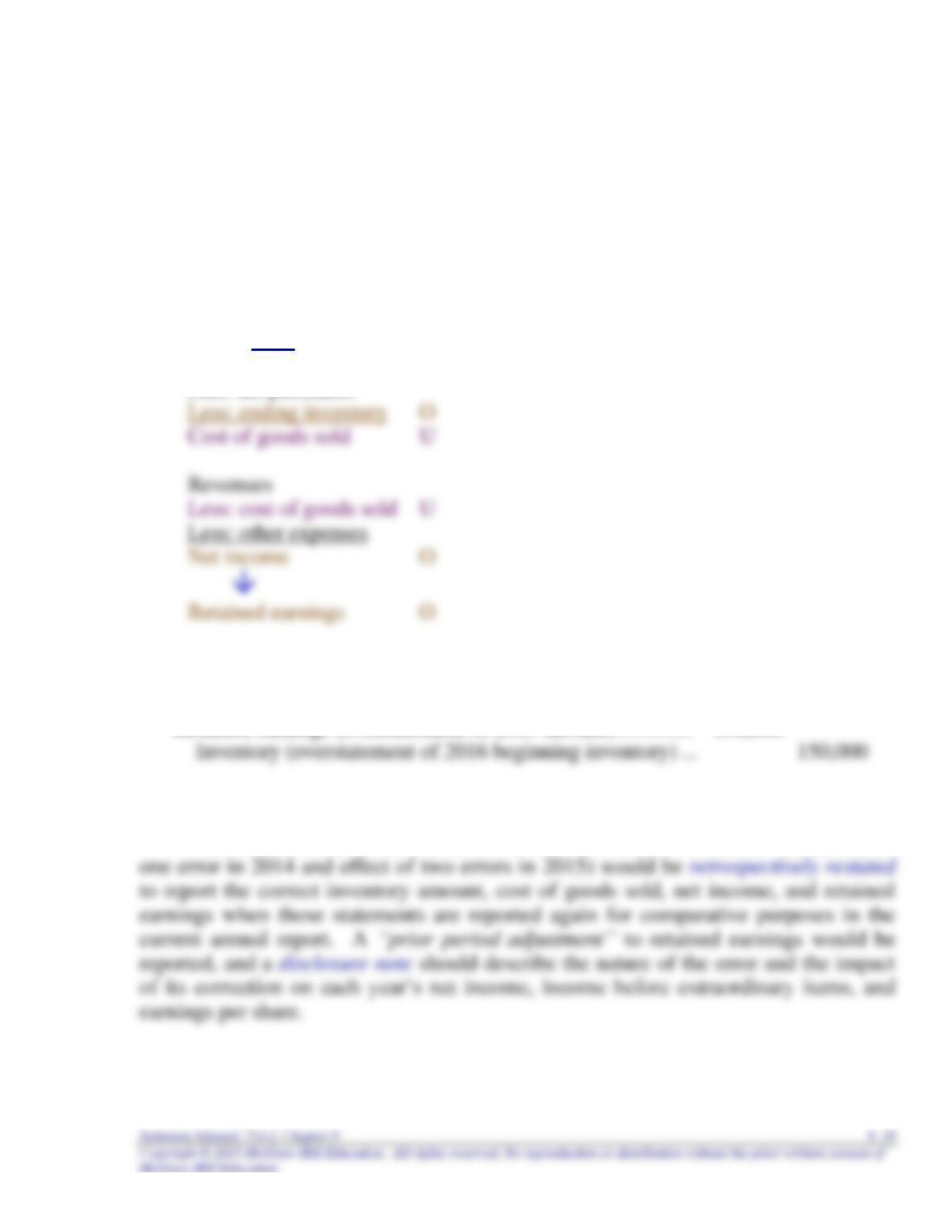
The 2014 error caused 2014 net income to be understated, but since 2014 ending
Analysis of 2014 ending inventory effects:
U = Understated
O = Overstated
2014 2015
Beginning inventory → Beginning inventory U
Exercise 9–22 (concluded)
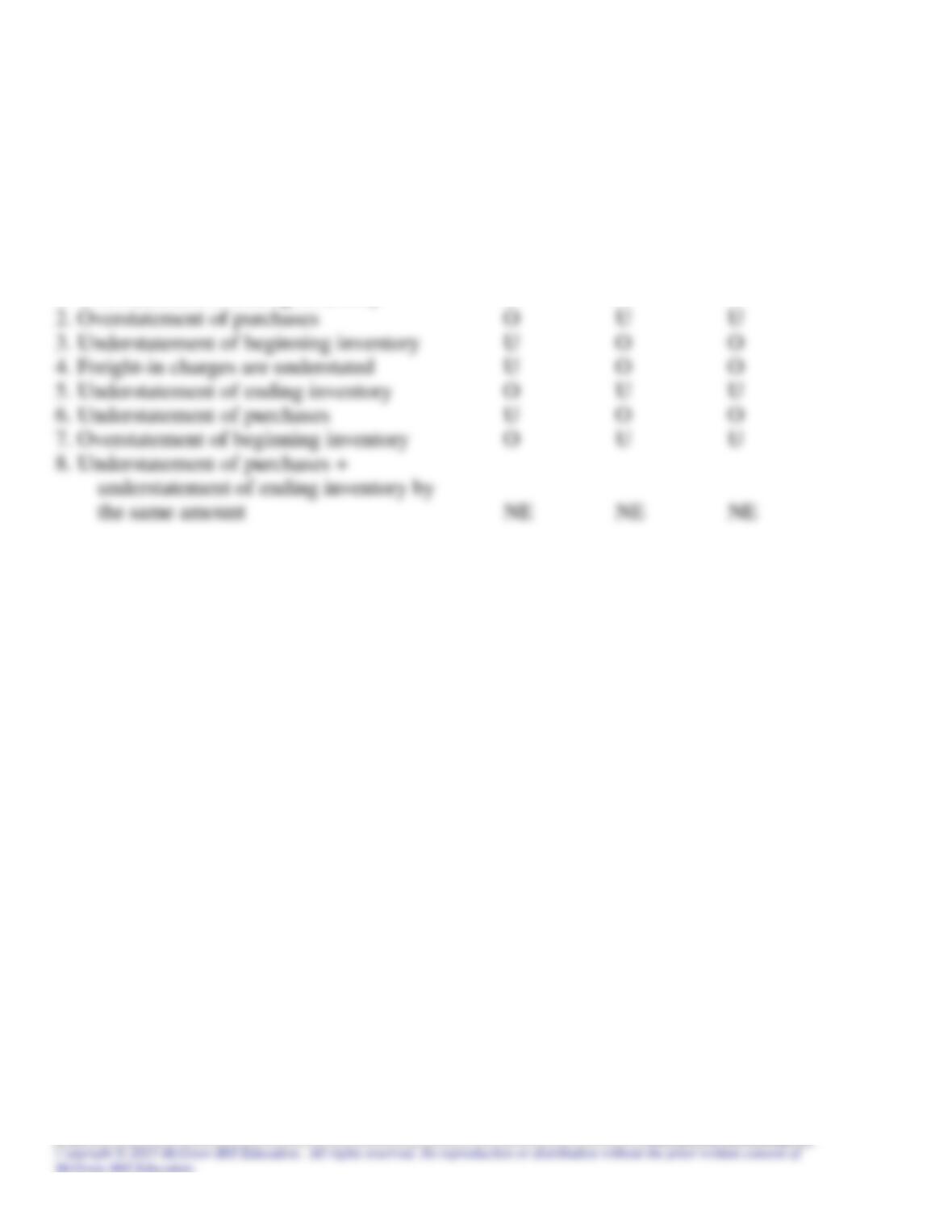
However, the 2015 error has not yet self-corrected. Both retained earnings and
inventory still are overstated as a result of the second error.
Analysis of 2015 ending inventory error effects:
U = Understated
O = Overstated
2015
Beginning inventory
Plus: net purchases
Requirement 2
Retained earnings (overstatement of 2015 income) ………….. 150,000
Requirement 3
The financial statements that were incorrect as a result of both errors (effect of
9–40 Intermediate Accounting, 8/e
Exercise 9–23
U = understated
O = overstated
NE = no effect
Cost of Net Retained
Goods Sold Income Earnings
1. Overstatement of ending inventory U O O