
CHAPTER 9
INVENTORIES: ADDITIONAL ISSUES
Overview
We covered most of the principal measurement and reporting issues involving the asset inventory
and the corresponding expense cost of goods sold in the previous chapter. In this chapter we
complete our discussion of inventory measurement by explaining the lower of cost and net realizable
value rule used to value inventories. In addition, we investigate inventory estimation techniques,
methods of simplifying LIFO, changes in inventory method, and inventory errors.
Learning Objectives
LO9-1 Understand and apply the lower of cost and net realizable value rule used to value
inventories.
LO9-2 Estimate ending inventory and cost of goods sold using the gross profit method.
LO9-3 Estimate ending inventory and cost of goods sold using the retail inventory method,
applying the various cost flow methods.
LO9-4 Explain how the retail inventory method can be made to approximate the lower of cost and
net realizable value rule.
LO9-5 Determine ending inventory using the dollar-value LIFO retail inventory method.
LO9-6 Explain the appropriate accounting treatment required when a change in inventory method
is made.
LO9-7 Explain the appropriate accounting treatment required when an inventory error is
discovered.
LO9-8 Discuss the primary differences between U.S. GAAP and IFRS with respect to the lower of
cost and net realizable value rule for valuing inventory.
Lecture Outline
Part A: Reporting—Lower of Cost and Net Realizable Value
I. Determining Net Realizable Value (T9-1)
A. Inventories are reported at the lower of cost and net realizable value.
B. The lower of cost and net realizable value approach to valuing inventory recognizes losses
in the period when the value of inventory declines below cost.
C. Net realizable value (NRV) is the estimated selling price of the product in the ordinary
course of business reduced by reasonably predictable costs of completion, disposal, and
transportation.
D. Under international financial reporting standards, inventory also is valued at the lower of
cost and net realizable value. (T9-2)
II. Applying Lower of Cost and Net Realizable Value
A. The lower of cost and net realizable value rule can be applied to individual items, logical
inventory categories, or the entire inventory. (T9-3)

9-2 Intermediate Accounting,8/e
B. Applying the rule to groups of inventory items usually will cause a higher inventory
valuation than if applied item-by-item because group application permits decreases in the
net realizable value of some items to be offset by increases in others.
C. Each approach is acceptable but should be applied consistently from one period to another.
III. Adjusting Cost to Net Realizable Value
A. If inventory write-downs are commonplace for a company, losses usually are included in
cost of goods sold.
B. When a write-down is substantial and unusual, GAAP requires that the loss be expressly
disclosed.
Part B: Inventory Estimation Techniques
I. The Gross Profit Method (T9-4)
A. The gross profit method is useful in situations where estimates of inventory are desirable:
1. In determining the cost of inventory that has been lost, stolen, or destroyed.
2. In estimating inventory and cost of goods sold for interim periods.
3. In auditors’ testing of the overall reasonableness of inventory amounts reported by
clients.
4. In budgeting and forecasting.
B. The gross profit method provides only an approximation of inventory and is not acceptable
for the presentation of annual financial statements.
C. The technique estimates cost of goods sold by multiplying net sales for the period by a
historical gross profit percentage and then subtracting this amount from net sales. (T9-5)
D. An estimate of ending inventory is then obtained by subtracting estimated cost of goods
sold from cost of goods available for sale.
II. The Retail Inventory Method (T9-6)
A. The retail inventory method estimation technique is similar to the gross profit method in
that it relies on the relationship between cost and selling price to estimate ending inventory
and cost of goods sold, thus avoiding the necessity to take a physical count of inventory.
B. The retail inventory method tends to provide more accurate estimates than the gross profit
method because it’s based on the current cost-to–retail percentage (the reciprocal of the
gross profit ratio) rather than a historical gross profit ratio.
C. The technique requires a company to maintain records of inventory and purchases not only
at cost but also at current selling price (retail).
D. In its simplest form, the retail inventory method estimates the amount of ending inventory
(at retail) by subtracting sales (at retail) from goods available for sale (at retail). This
estimated ending inventory at retail is then converted to cost by multiplying it by the cost-
to-retail percentage. This ratio is found by dividing goods available for sale at cost by
goods available for sale at retail. (T9-7)
E. The retail inventory method can be used for financial reporting and for income tax
purposes.
F. Changes in selling prices must be included in the determination of ending inventory at
retail. Net markups and net markdowns are included in the retail column to determine
ending inventory at retail. (T9-8)

G. An advantage of the retail inventory method is that the various cost flow assumptions (in
particular average cost and LIFO) can be explicitly incorporated into the estimation
technique. We can even incorporate an approximation of the lower of cost and net
realizable value. (T9-9)
1. To approximate average cost, the cost-to-retail percentage is determined for all goods
available for sale. Net markups and net markdowns both are included in the retail
column before the cost-to–retail percentage is determined. (T9-10)
2. A commonly used variation of the retail method often is referred to as the
conventional retail method. This variation approximates average lower of cost and
net realizable value by excluding markdowns from the calculation of the cost-to-retail
percentage. (T9-11)
a. By not subtracting net markdowns from the denominator, the cost-to-retail
percentage is lower.
b. The logic for using this approximation is that a markdown is evidence of a
reduction in the utility of inventory.
c. The lower of cost and net realizable value variation also could be applied to the
FIFO method but is not generally used in combination with LIFO.
3. To approximate LIFO cost in its simplest form, we assume that the retail prices of
goods remained stable during the period. With this assumption, we can compare
beginning and ending inventory at retail to determine what happened to inventory
quantity. (T9-12)
a. If inventory at retail increases during the year, a new layer is added.
b. If inventory at retail decreases, LIFO layer(s) are liquidated.
c. Each period’s LIFO layer will carry its own cost-to-retail percentage. Therefore,
beginning inventory is not included in the calculation of the current year’s cost-to–
retail percentage.
H. Other issues pertaining to the retail method
1. Freight-in is added only to the cost side in determining net purchases.
2. Purchase returns are deduced from purchases on both the cost and retail side (at
different amounts).
3. If the gross method is used to record purchases, purchase discounts taken is deducted
in determining the cost of net purchases.
4. If sales are recorded net of employee discounts, the discounts are added to sales.
5. Normal shortage is deducted in the retail column after the calculation of the cost-to–
retail percentage. Abnormal shortage is deducted in both the cost and retail columns
before the calculation of the cost-to-retail percentage.
Part C: Dollar-Value LIFO Retail
A. Using the LIFO retail method in combination with dollar-value LIFO (DVL) is referred to
as the dollar-value LIFO retail method.
B. DVL retail improves on LIFO retail by first determining if there has been a real increase in
inventory quantity by eliminating any price changes before comparing beginning and
ending inventory at retail.
C. After determining year-end inventory at current retail prices, DVL retail employs a three–
step approach. (T9-13)
1. In step 1, the ending inventory at current retail prices is converted to base year retail by
dividing by the current year’s price index (relative to the base year).
2. In step 2, ending inventory at base year retail is then apportioned into layers, each at
base year retail.
3. In step 3, each layer is then converted to layer year cost using the layer year’s price
index and cost-to-retail percentage.
Part D: Change in Inventory Method and Inventory Errors
I. Change in Accounting Principle
A. Changes in inventory method, other than a change to LIFO, are accounted for
retrospectively. This means reporting all previous periods’ financial statements as if the
new inventory method had been used in all prior periods. (T9-14)
1. The first step is to revise prior years’ financial statements.
2. The second step is to create a journal entry to adjust book balances from their current
amounts to what those balances would have been using the new inventory method.
B. For changes to the LIFO method, accounting records usually are inadequate for a company
to calculate the income effect on prior years. (T9-15)
2. A disclosure note explains the nature of the change and justification for it, the effect of
the change on current year’s income and earnings per share, and why retrospective
application was impracticable.
II. Inventory Errors
A. If an inventory error is discovered in the same accounting period that it occurred, the
original erroneous entry should simply be reversed and the appropriate entry recorded.
B. If a material inventory error is discovered in an accounting period subsequent to the period
in which the error is made, any previous years’ financial statements that were incorrect as a
result of the error are retrospectively restated to reflect the correction. (T9-16)
1. Incorrect balances are corrected.
3. A disclosure note describes the nature and the impact of the error on income amounts.
Appendix 9: Purchase Commitments (T9-17)
A. Purchase commitments are contracts that obligate a company to purchase a specified
amount of merchandise or raw materials at specified prices on or before specified dates.
B. Purchases made pursuant to a purchase commitment are recorded at the lower of contract
price or market price on the date the contract is executed.
C. If the contract period is contained within a single fiscal year:
1. If market price is equal to or greater than the contract price, the purchase is recorded at
the contract price.
2. If market price is less than the contract price, the purchase is recorded at the market
price.
D. If the contract period extends beyond the fiscal year:
1. If the market price at year-end is less than the contract price for outstanding purchase
commitments, a loss and corresponding liability are recorded for the difference.
PowerPoint Slides
A PowerPoint presentation of the chapter is available in the Connect library.
Teaching Transparency Masters
The following can be reproduced on transparency film as they appear here, or

LOWER OF COST AND NET REALIZABLE VALUE
➢ Inventories are reported at the lower of cost and net realizable value
(NRV).
➢ NRV is the estimated selling price of the product in the ordinary
course of business reduced by reasonably predictable costs of
completion, disposal, and transportation.
➢ These costs could include things such as sales commissions and
shipping costs. Companies often estimate these “costs to sell” by
applying a predetermined percentage to the selling price.
The Collins Company has five inventory items on hand at the end of 2016. The year-end unit costs
(determined by applying the average cost method), current unit selling prices, and estimated costs to
sell for each of the items are presented below:
Selling Estimated Costs
Item Cost Price To Sell
A $ 50 $100 $15
For each item we first compute NRV, selling price less estimated costs to sell, and then compare it
with cost. The item is valued at the lower of these two amounts.
Inventory
Item Cost NRV Value
A $50 $85* $50
*$100 – 15
Illustration 9-1
T9-1
INTERNATIONAL FINANCIAL REPORTING STANDARDS
Lower of cost and net realizable value. You just learned that in the United States
inventory is valued at the lower of cost and net realizable value. International
standards also value inventory this way.
However, there are some differences between U.S. GAAP and IFRS in this area.
IAS No. 2 specifies that if circumstances indicate that an inventory write-down is no
longer appropriate, it should be reversed. Reversals are not permitted under U.S.
GAAP.
T9-2
9-8 Intermediate Accounting,8/e
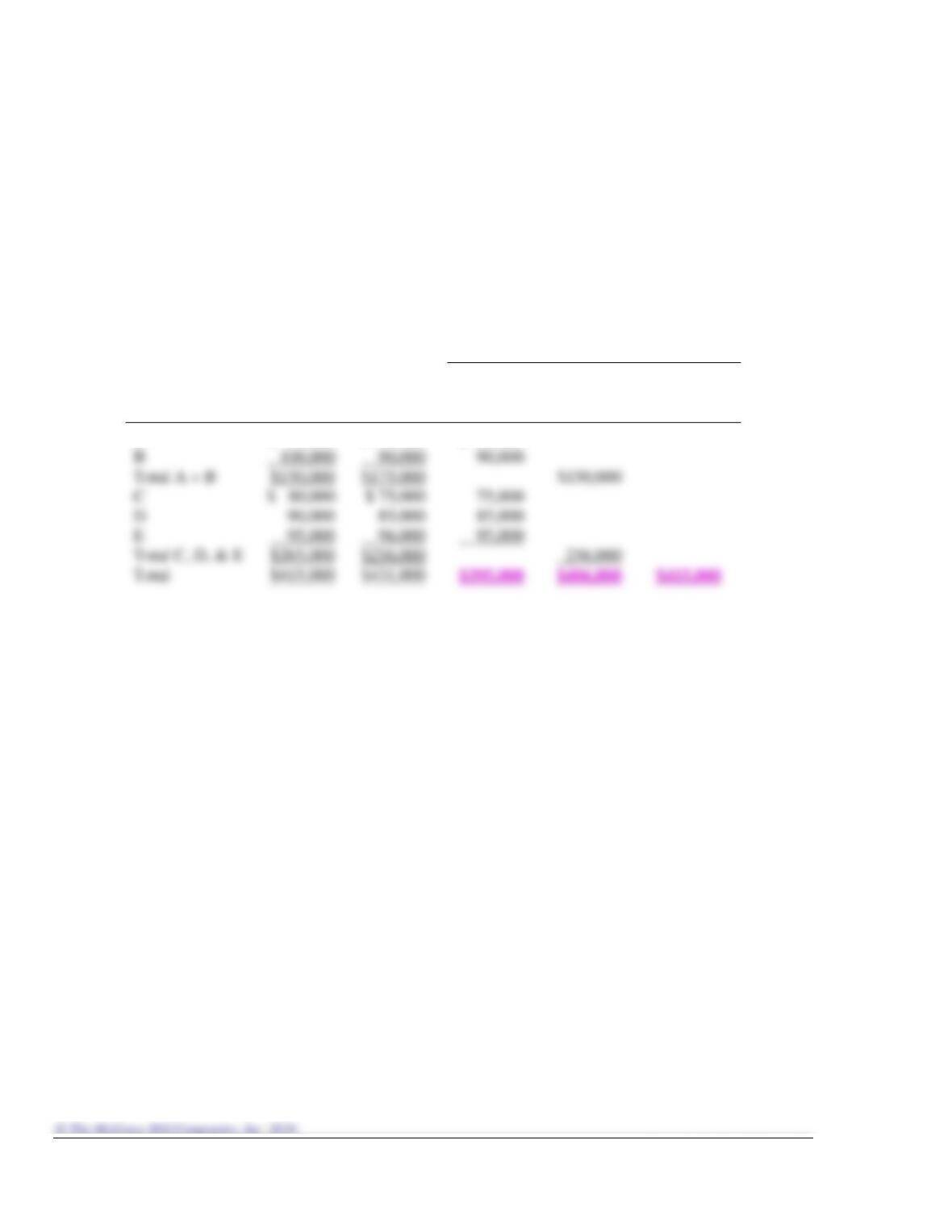
APPLYING THE LOWER OF COST AND NET
REALIZABLE VALUE RULE
➢ The lower of cost and net realizable value rule can be applied
to individual items, logical inventory categories, or the entire
inventory.
Lower of Cost and NRV
Item
Cost
Net
Realizable
Value
By
Individual
Items
By
Product
Line
By Total
Inventory
A
$ 50,000
$ 85,000
$ 50,000
Total A + B
$150,000
$175,000
$150,000
D
E
95,000
96,000
95,000
Total
$415,000
$431,000
Illustration 9-2
T9-3

THE GROSS PROFIT METHOD
➢ The gross profit method is useful in situations where
estimates of inventory are desirable.
► In determining the cost of inventory that has been lost,
stolen, or destroyed.
► In estimating inventory and cost of goods sold for
interim reports, avoiding the expense of a physical
inventory count.
► In auditors’ testing of the overall reasonableness of
inventory amounts reported by clients.
► In budgeting and forecasting.
➢ Provides only an approximation of inventory and is not
acceptable for the preparation of annual financial statements.
➢ Estimates cost of goods sold by multiplying the period’s net
sales by a historical gross profit percentage and then
subtracting that amount from net sales.
T9-4
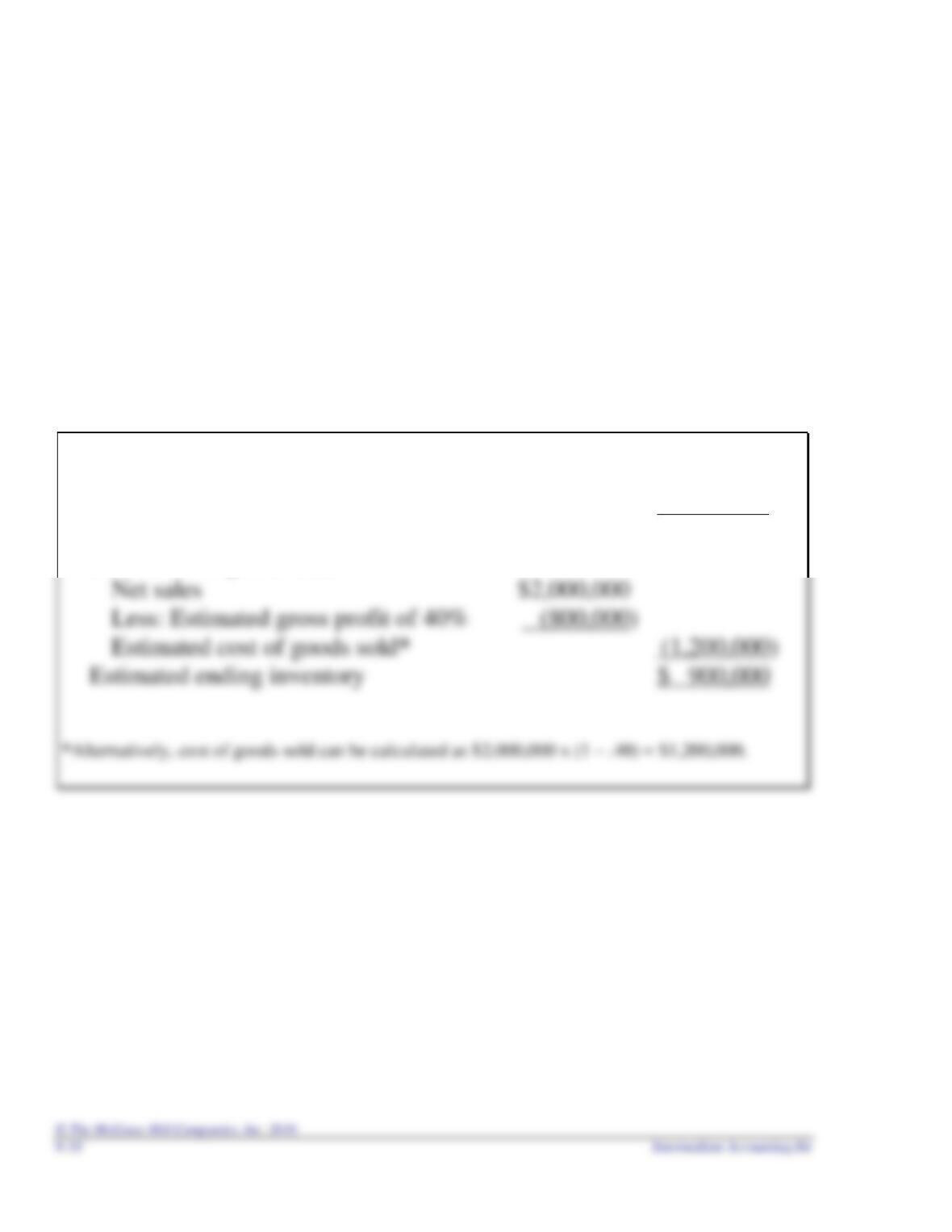
GROSS PROFIT METHOD ILLUSTRATION
Southern Wholesale Company began 2016 with inventory of
$600,000, and on March 17 a warehouse fire destroyed the entire
inventory. Company records indicate net purchases of $1,500,000
and net sales of $2,000,000 prior to the fire. The gross profit
percentage in each of the previous three years has been very close
to 40%.
Beginning inventory (from records) $ 600,000
Plus: Net purchases (from records) 1,500,000
Goods available for sale 2,100,000
Less: Cost of goods sold:
Illustration 9-3
T9-5

THE RETAIL INVENTORY METHOD
➢ Similar to the gross profit method, the retail inventory method
relies on the relationship between cost and selling price to
estimate ending inventory and cost of goods sold.
➢ Ideal for high-volume retailers selling many different items at
low unit prices.
T9-6
9-12 Intermediate Accounting,8/e
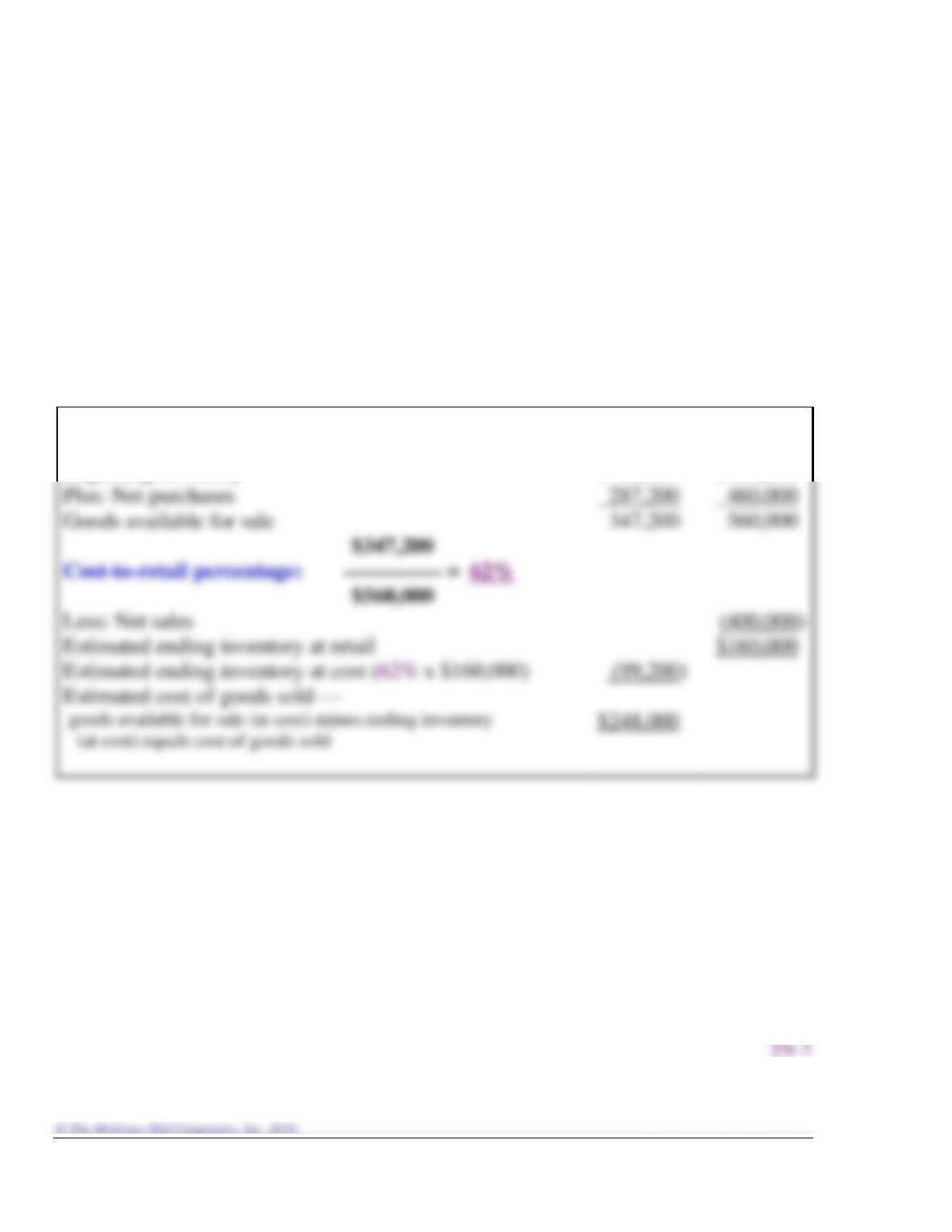
RETAIL INVENTORY METHOD ILLUSTRATION
Home Improvement Store’s bank has asked for monthly financial
statements as a condition attached to a loan dated May 31, 2016.
To avoid a physical count of inventory, the company intends to use
the retail inventory method to estimate ending inventory and cost
of goods sold for the month of June.
Cost
Retail
Beginning inventory
$ 60,000
$100,000
Plus: Net purchases
Less: Net sales
Estimated ending inventory at retail
$160,000
Illustration 9-4

RETAIL TERMINOLOGY
Initial markup Original amount of markup from
cost to selling price.
T9-8

9-14 Intermediate Accounting,8/e
COST FLOW METHODS
➢ An advantage of the retail inventory method is
that the various cost flow methods can be
explicitly incorporated into the estimation
technique.
Home Improvement Stores, Inc. uses a periodic inventory
system and the retail inventory method to estimate ending
inventory and cost of goods sold. The following data are
available from the company’s records for the month of July 2016:
Cost Retail
Beginning inventory $ 99,200 $160,000
Net purchases 305,280 1 470,000 2
Net markups 10,000
Net markdowns 8,000
Net sales 434,000 3
1 Purchases at cost less returns, plus freight-in.
2 Original selling price of purchased goods less returns at retail.
3 Gross sales less returns.
Illustration 9-8
➢ Net markups and net markdowns are included in the retail
column to determine ending inventory at retail.
T9-9
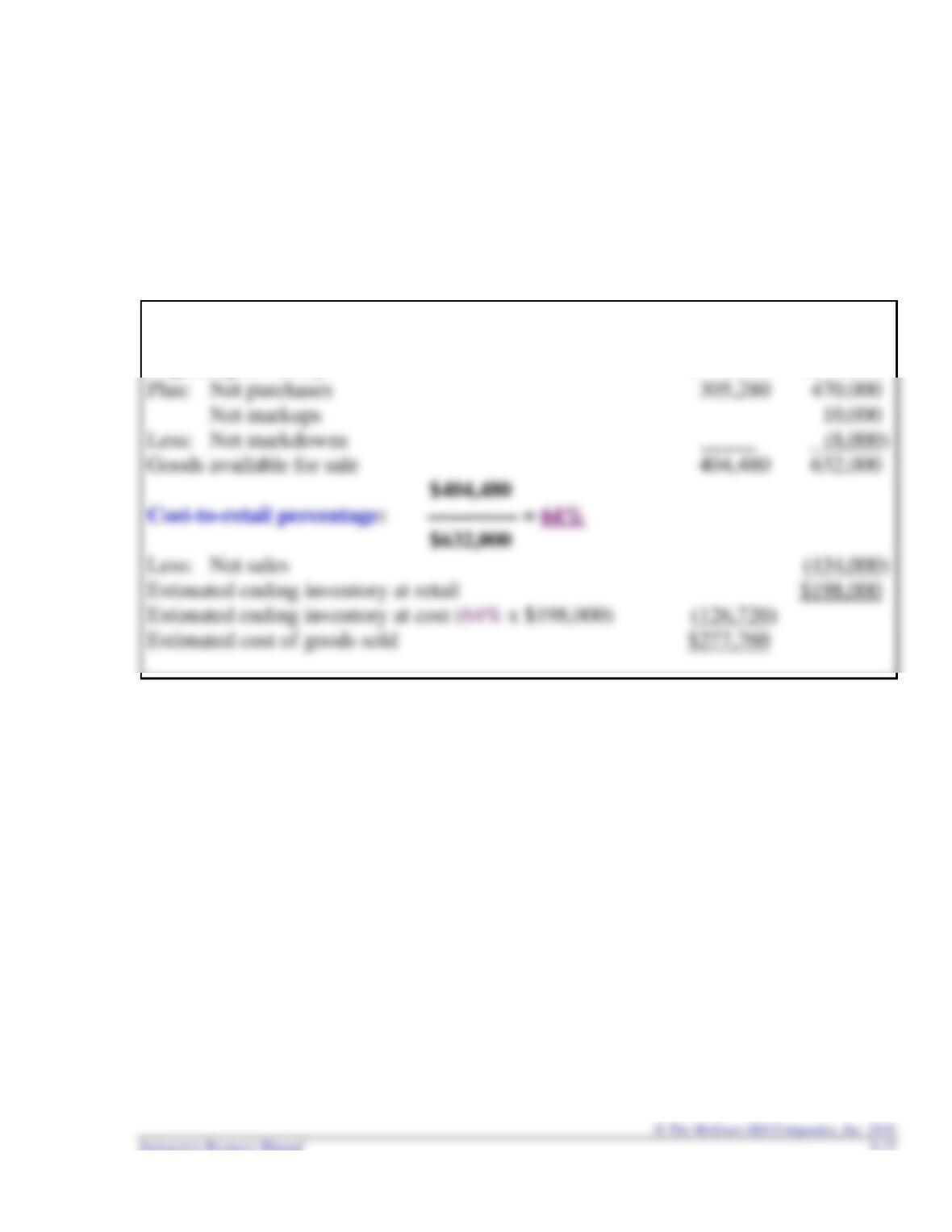
APPROXIMATING AVERAGE COST
➢ To approximate average cost, the cost–to-retail percentage is
determined for all goods available for sale.
Cost
Retail
Beginning inventory
$ 99,200
$160,000
Plus: Net purchases
Net markups
Less: Net markdowns
Goods available for sale
Less: Net sales
Estimated ending inventory at retail
$198,000
Estimated ending inventory at cost (64% x $198,000)
Illustration 9-9
T9–10
9-16 Intermediate Accounting,8/e
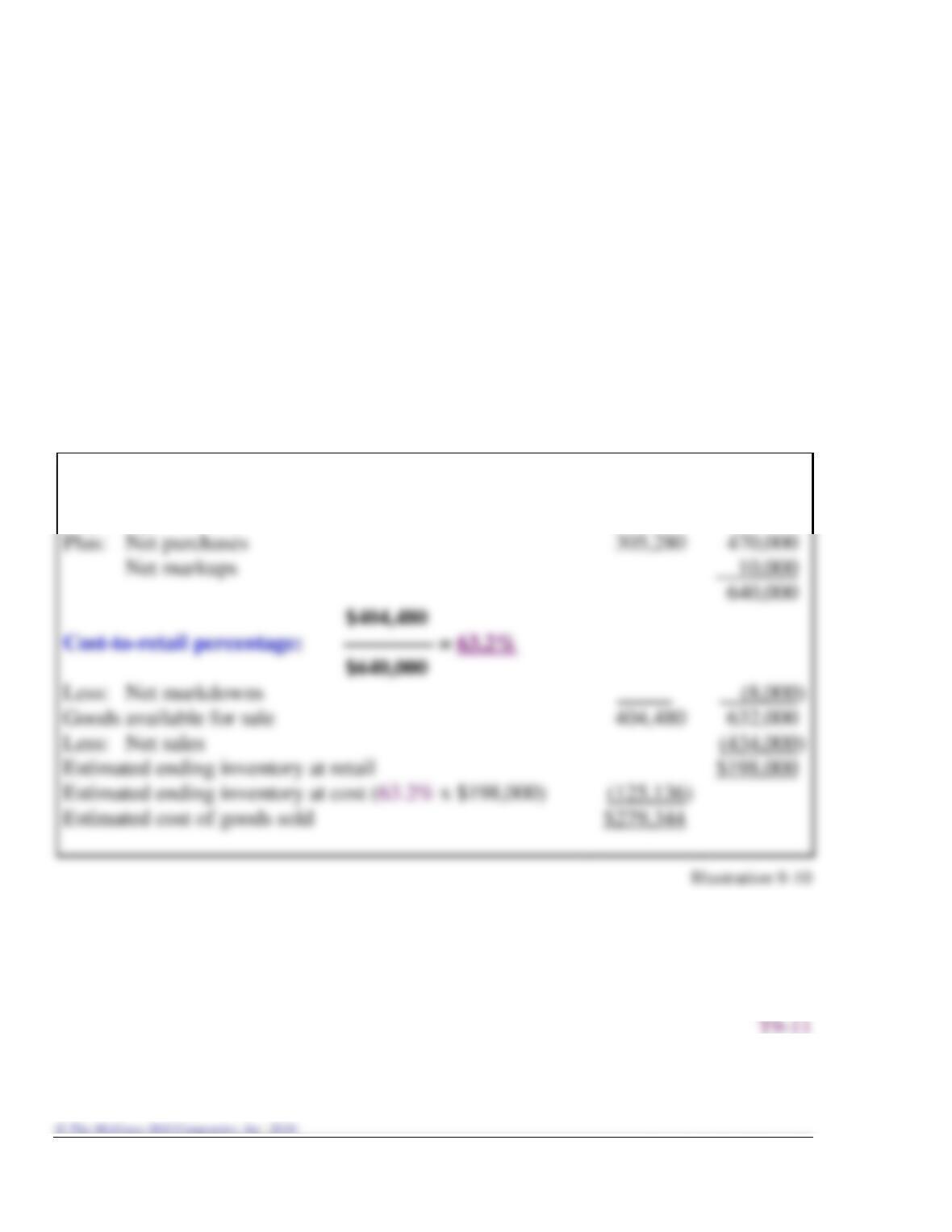
THE CONVENTIONAL RETAIL METHOD
➢ To approximate lower of cost and net realizable value,
markdowns are not included in the calculation of the cost–to–
retail percentage. They are subtracted in the retail column
after the percentage is calculated.
➢ The logic for using this approximation is that a markdown is
evidence of a reduction in the utility of inventory.
Cost
Retail
Beginning inventory
$ 99,200
$160,000
Plus: Net purchases
Net markups
Less: Net markdowns
Goods available for sale
Less: Net sales
Estimated ending inventory at retail
Estimated ending inventory at cost (63.2% x $198,000)
Estimated cost of goods sold

THE LIFO RETAIL METHOD
➢ In our illustration, the beginning inventory layer carries a
T9-12
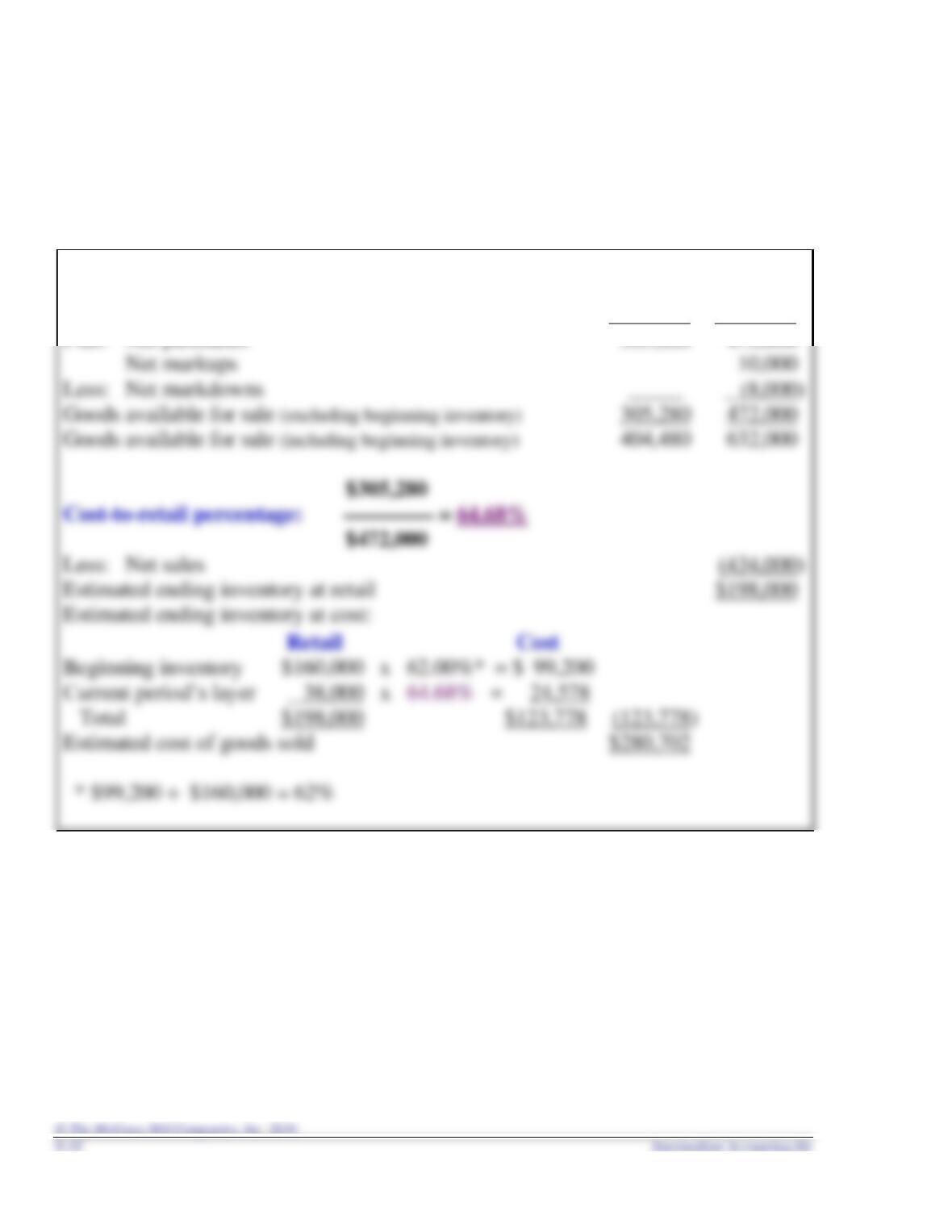
THE LIFO RETAIL METHOD
(continued)
Cost
Retail
Beginning inventory
$ 99,200
$160,000
Plus: Net purchases
Less: Net markdowns
Goods available for sale (excluding beginning inventory)
Goods available for sale (including beginning inventory)
Less: Net sales
Estimated ending inventory at retail
$198,000
Estimated ending inventory at cost:
Beginning inventory $160,000 x 62.00%* = $ 99,200
Estimated cost of goods sold
$280,702
Illustration 9-11
T9-12(continued)