PROBLEM 6.10
1. Purchase.
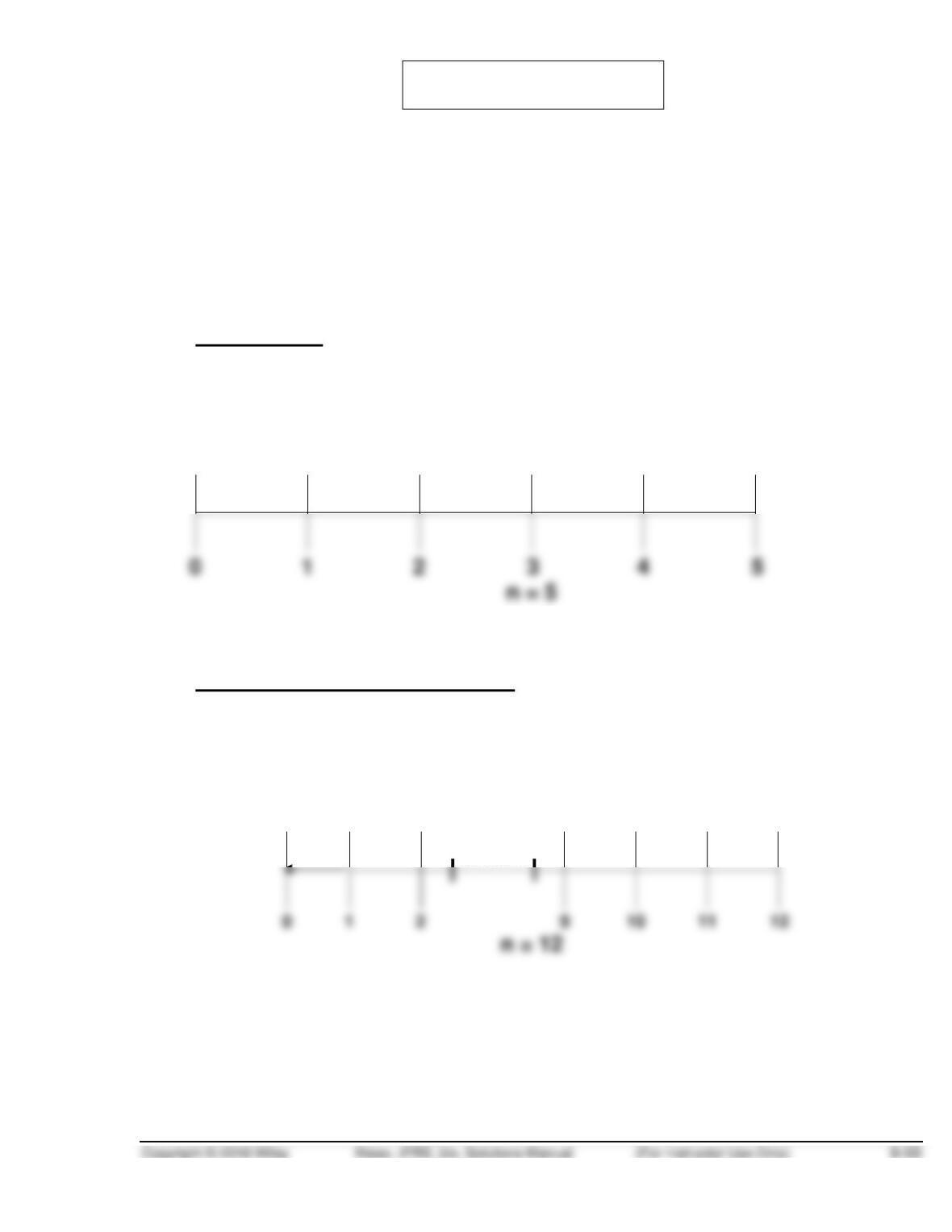
Time diagrams:
Installments
i = 10%
PV – OA = ?
R =
$350,000 $350,000 $350,000 $350,000 $350,000
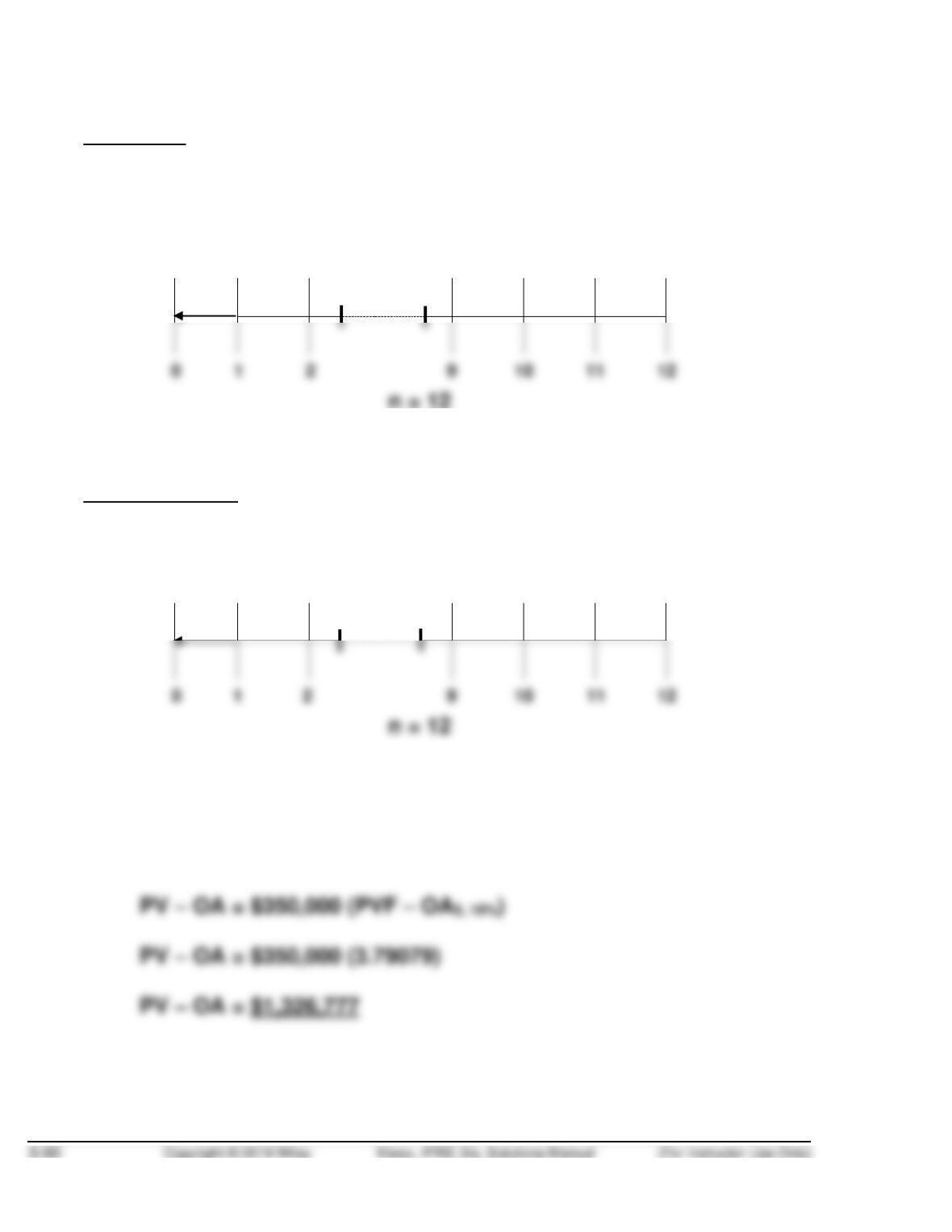
Property taxes and other costs
i = 10%
PV – OA = ?
R = $40,000 + $16,000
$56,000 $56,000 $56,000 $56,000 $56,000 $56,000
PROBLEM 6.10 (Continued)
Insurance
i = 10%
PV – AD = ?
R =
$27,000 $27,000 $27,000 $27,000 $27,000 $27,000
Residual Value
i = 10%
PV = ? FV = $500,000
Formula for installments:
PV – OA = R (PVF – OAn, i)
PROBLEM 6.10 (Continued)
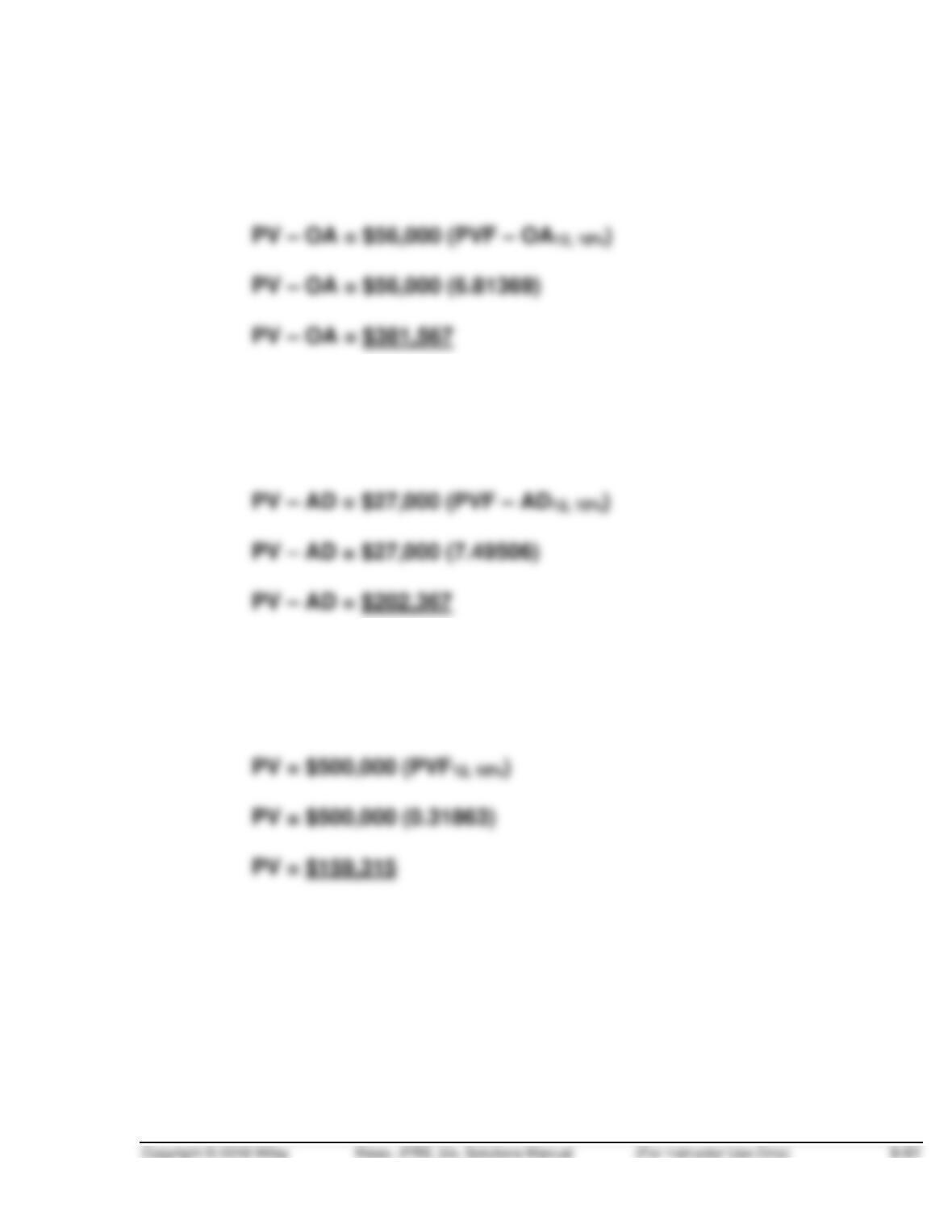
Formula for property taxes and other costs:
PV – OA = R (PVF – OAn, i)
Formula for insurance:
PV – AD = R (PVF – ADn, i)
Formula for residual value:
PV = FV (PVFn, i)
PROBLEM 6.10 (Continued)
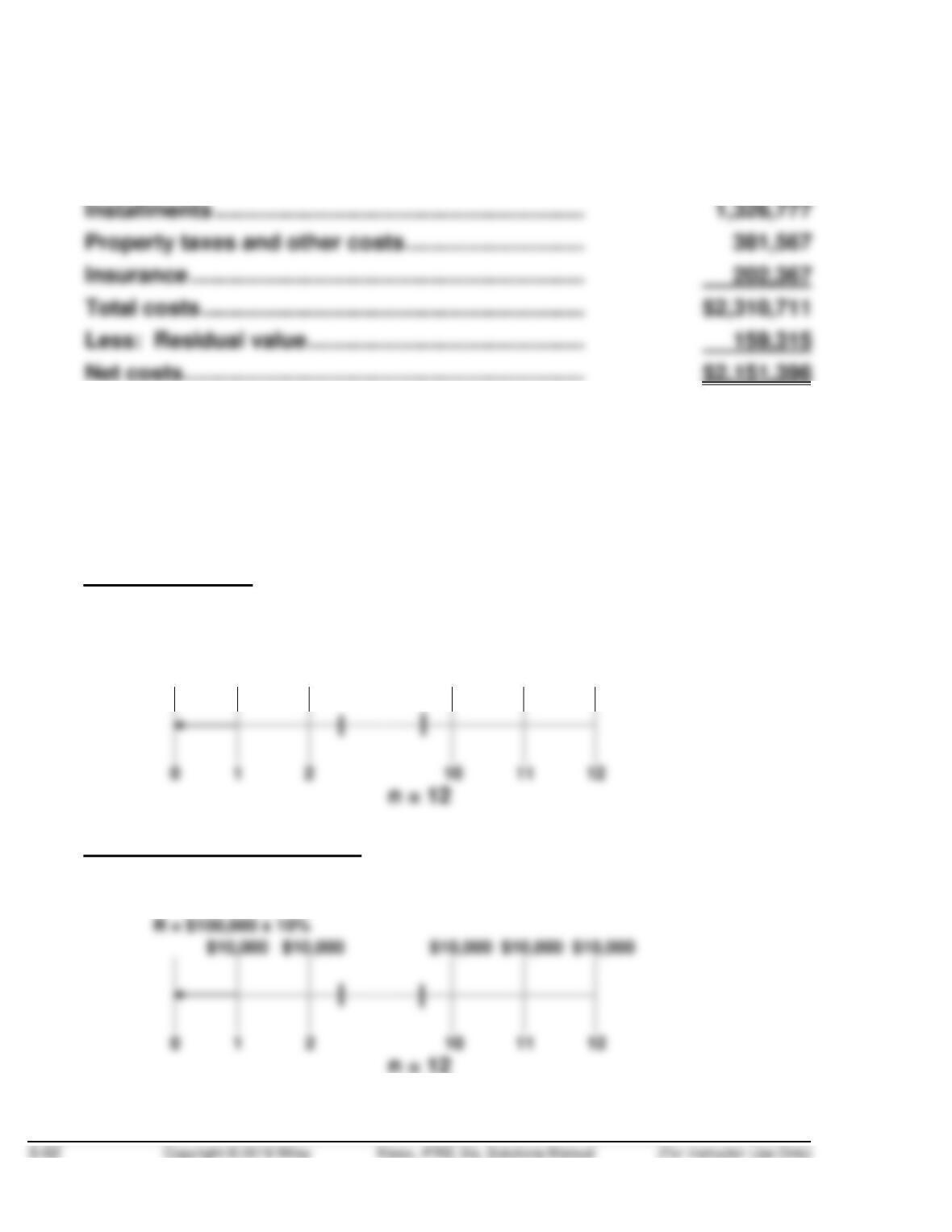
Present value of net purchase costs:
Down payment………………………………………………..
$ 400,000
Installments ……………………………………………………
Property taxes and other costs ………………………..
Insurance ……………………………………………………….
202,367
Total costs ……………………………………………………..
$2,310,711
Less: Residual value ………………………………………
159,315
2. Lease.
Time diagrams:
Lease payments
i = 10%
PV – AD = ?
R =
$270,000 $270,000 $270,000 $270,000 $270,000
Interest lost on the deposit
i = 10%
PV – OA = ?
PROBLEM 6.10 (Continued)
Formula for lease payments:
PV – AD = R (PVF – ADn, i)
Interest lost on the deposit per year = $100,000 (10%) = $10,000
PV – OA = R (PVF – OAn, i)
PV – OA = $10,000 (PVF – OA12, 10%)
PV – OA = $10,000 (6.81369)
PV – OA = $68,137*
PROBLEM 6.11
(a) Annual retirement benefits.
Jean–current salary
£ 48,000
X 2.56330
(future value of 1, 24 periods, 4%)
123,038
annual salary during last year of
work
X .50
retirement benefit %
Colin–current salary
£ 36,000
X 3.11865
(future value of 1, 29 periods, 4%)
112,271
annual salary during last year of
work
X .40
retirement benefit %
£ 44,909
annual retirement benefit
Anita–current salary
£ 18,000
annual salary during last year of
work
X .40
retirement benefit %
£ 15,169
annual retirement benefit
Gavin–current salary
£ 15,000
X 1.73168
(future value of 1, 14 periods, 4%)
annual salary during last year of
work
X .40
retirement benefit %
£ 10,390
annual retirement benefit
PROBLEM 6.11 (Continued)
(b) Fund requirements after 15 years of deposits at 12%.
Jean will retire 10 years after deposits stop.
£ 61,519 annual plan benefit
[PV of an annuity due for 30 periods – PV of an
X2.69356 annuity due for 10 periods (9.02181 – 6.32825)]
£165,705
£ 44,909
annual plan benefit
due for 15 periods (9.15656 – 7.62817)]
£ 68,638
Anita will retire 5 years after deposits stop.
£ 15,169
annual plan benefit
X4.74697
[PV of an annuity due for 25 periods – PV of an annuity
due for 5 periods (8.78432 – 4.03735)]
£ 72,007
£ 10,390
annual plan benefit
(PV of an annuity due for 20 periods)

PROBLEM 6.11 (Continued)
£165,705
Jean
68,638
Colin
(c) Required annual beginning-of-the-year deposits at 12%:
Deposit X (future value of an annuity due for 15 periods at 12%) = FV
Deposit X (37.27972 X 1.12) = £393,270
PROBLEM 6.12
(a) The time value of money would suggest that NET Life’s discount rate
is substantially higher than First Security’s. The actuaries at NET Life
(b) As the controller of STL, Buhl assumes a fiduciary responsibility to
the present and future retirees of the corporation. As a result, he is
responsible for ensuring that the pension assets are adequately
(c) If STL switched to NET Life
The primary beneficiaries of Buhl’s decision would be the corporation
and its many shareholders by virtue of reducing £8 million of annual
pension costs.
The present and future retirees of STL may be negatively affected by
If STL stayed with First Security
In the short run, the primary beneficiaries of Buhl’s decision would be
the employees and retirees of STL given the lower risk pension asset
plan.
PROBLEM 6.13
Cash Flow Probability
Estimate X Assessment = Expected Cash Flow Present Value
2020 $ 2,500 20% $ 500
4,000 60% 2,400
5,000 20% 1,000 X PV
Factor,
2022 $ 4,000 30% $1,200
6,000 40% 2,400
7,000 30% 2,100 X PV
Factor,
PROBLEM 6.14
Cash Flow Probability
Estimate X Assessment = Expected Cash Flow Present Value
2020 €6,000 40% €2,400
9,000 60% 5,400 X PV
Factor,
n = 1, I = 6%
€7,800 X 0.9434 = € 7,359
Residual
Value
Received
at the End
of 2021 € 500 50% € 250
900 50% 450 X PV
PROBLEM 6.15
(a) The expected cash flows to meet the environmental liability represent a
deferred annuity. Developing a fair value estimate requires determining
the present value of the annuity of expected cash flows to be paid after
10 years and then determine the present value of that amount today.
Cash Flow Probability
Estimate X Assessment = Expected Cash Flow
$15,000 10% $ 1,500
The value today of the annuity payments to commence in ten years is:
$ 64,269
Present value of annuity
Alternatively, the present value of the deferred annuity can be computed
as follows:
(b) This fair value estimate is based on unobservable inputs—Murphy’s
own data on the expected future cash flows associated with the
$ 23,600
Expected cash outflows
ordinary annuity for 10 periods at 5% (9.39357 – 7.72173)]
FINANCIAL REPORTING PROBLEM
(a) 1. Intangible assets, goodwill
For impairment of goodwill and other intangible assets, fair value is
determined using a discounted cash flow analysis.
(b) 1. The following rates are disclosed in the accompanying notes:
Retirement Benefits
Financial Assumptions
2016
Discount rate
Overall expected Note
Risk-free rate
Intangible Assets
Czech group
10.5%
India
17.2%
10.5%
Hungary
16.1%
Pre-tax discount rate
Panama
8.3%
FINANCIAL REPORTING PROBLEM (Continued)
Borrowings
Interest Rate Analysis
2016
2. There are different rates for various reasons:
(1) The maturity dates—short-term vs. long-term.
(2) The security or lack of security for debts—mortgages and col-
lateral vs. unsecured loans.
FINANCIAL STATEMENT ANALYSIS CASE
(a) Cash inflows of $375,000 less cash outflows of $125,000 = Net cash
flows of $250,000.
(b) Cash inflows of $275,000 less cash outflows of $155,000 = Net cash
flows of $120,000.
(c) The new estimates, following the impairment, indicate a much lower
net cash inflow. The estimate of future cash flows is very useful. It
ACCOUNTING, ANALYSIS, AND PRINCIPLES
ACCOUNTING
(a) $50,000 X (PVF – OA10, ?%) = $320,883
(PVF – OA10, ?%) = $320,883 ÷ $50,000
(PVF – OA10, ?%) = 6.41766
ANALYSIS
The note receivable consists of a fixed set of payments to be received.
PRINCIPLES
Regulators are commonly faced with the relevance–faithful presentation trade–
off. Many believe that fair value provides more relevant information because
RESEARCH CASE
(a) The components of present value measurement include the following
elements that together capture the economic differences between
assets (IAS 36, paragraph A1):
(a) an estimate of the future cash flow, or in more complex cases, series
(b) Accounting applications of present value have traditionally used a single
set of estimated cash flows and a single discount rate, often described
as ‘the rate commensurate with the risk’. In effect, the traditional approach
The expected cash flow approach is, in some situations, a more effective
measurement tool than the traditional approach. In developing a
measurement, the expected cash flow approach uses all expectations

RESEARCH CASE (Continued)
(c) When an asset-specific rate is not directly available from the market,
an entity uses surrogates to estimate the discount rate. The purpose is
to estimate, as far as possible, a market assessment of:
(a) the time value of money for the periods until the end of the asset’s