CA 4.7
(a) Separate Statement
Current Year
Prior Year
. . . income components . . .
Statement of Comprehensive Income
Net income ………………………………………………………………….
Unrealized gains …………………………………………………………..
15,000
(b) Combined Format
. . . income components . . .
Net income …………………………………………………………………..
$400,000
$410,000
Other comprehensive income
Unrealized gains ……………………………………………………………
15,000
(c) Nelson can choose either approach, according to IFRS. The method chosen should be based on
FINANCIAL REPORTING PROBLEM
(a) M&S uses a condensed format income statement. This format provides
highlights of a company’s performance without presenting unnecessary
detailed computations.
(c) M&S’s gross profit was £3,985.5m in 2015 and increased to £4,128.4m
in 2016. Gross profit increased in 2016 because Revenue increased
£244m while cost of sales increased only £101.1m.
(e) The directors believe that the underlying profit and earnings per share
measures provide additional useful information for shareholders on
the underlying performance of the business. These measures are
consistent with how underlying business performance is measured
internally. The underlying profit before tax measure is not a recognized
profit measure under IFRS and may not be directly comparable with
adjusted profit measures used by other companies. The adjustments
made to reported profit before tax are to exclude the following:
• Profits and losses on the disposal of properties or impairments of
• Fair value movement in financial instruments;
• Costs relating to strategy changes that are not considered normal
operating costs of the underlying business;
COMPARATIVE ANALYSIS CASE
(a) adidas’ 16.4% increase in revenues from 2014 to 2015 was greater than
Puma’s 10% increase.
(b) adidas had a discontinued operation in 2015, and Puma did not. Since
(c) adidas depreciation expense was 25.6% (£279 ÷ £1,090) of its operating
cash flow and was significantly lower than Puma’s 42.8% (€57.5 ÷
€134.5).
FINANCIAL STATEMENT ANALYSIS CASE 1
(a) Depending on the company chosen, student answers will vary. Given
the ready availability, the analysis for Nokia is provided below:
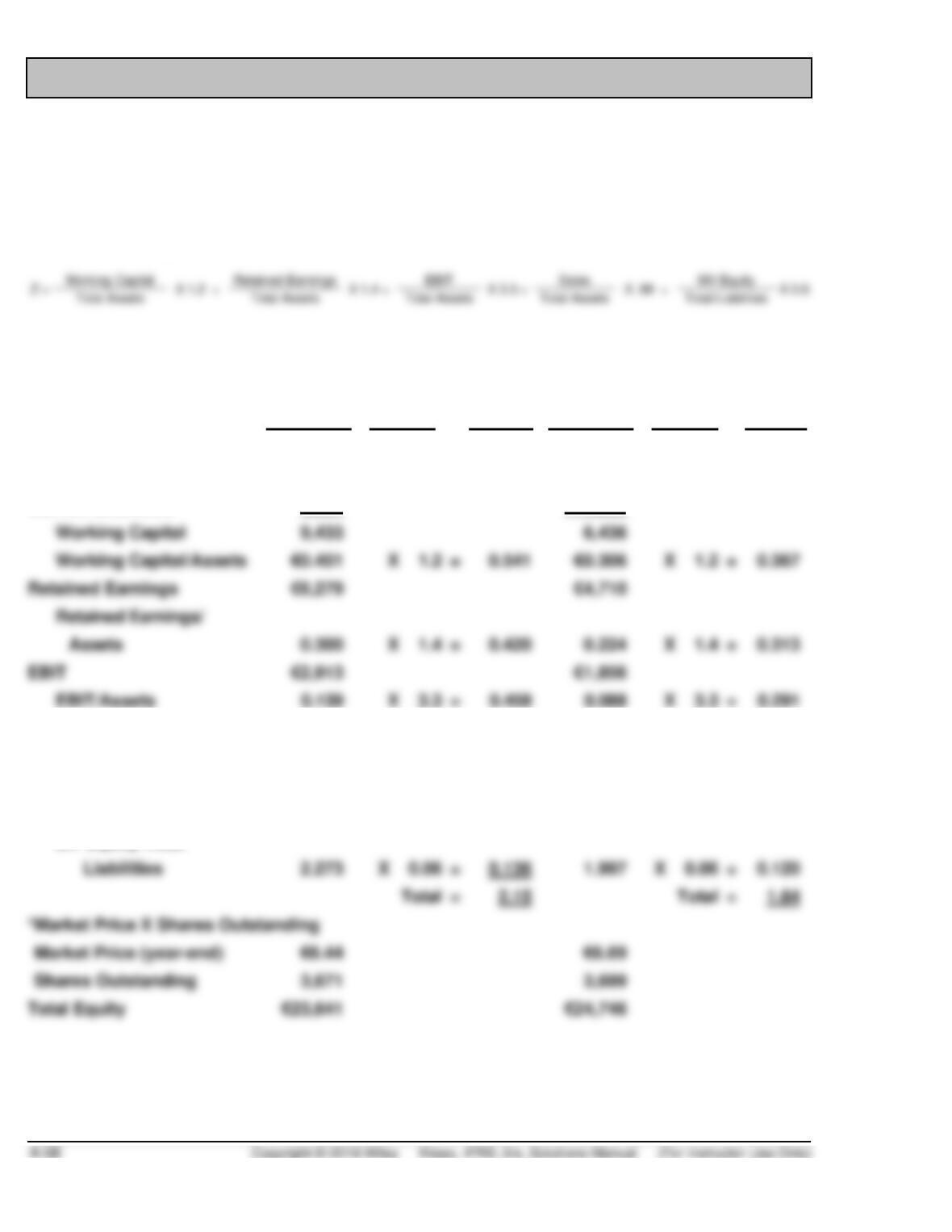
Z-Score Analysis
Nokia ($000,000)
2015
Weights
Z-Score
2015
2014
Weights
Z-Score
2014
Total Assets
€20,926
€21,063
Current Assets
15,824
13,724
Current Liabilities
6,391
7,288
Working Capital
9,433
6,436
Working Capital/Assets
X 1.2
=
X 1.2
=
Retained Earnings
EBIT
EBIT/Assets
X 3.3
=
0.088
X 3.3
=
0.291
Sales
€12,499
€11,762
Sales/Assets
0.597
X 0.99
=
0.591
0.558
X 0.99
=
0.553
MV Equity*
€23,641
€24,746
Total Liabilities
10,402
12,394
Liabilities
2.273
=
=
*Market Price X Shares Outstanding
Market Price (year-end)
Shares Outstanding
Total Equity
€23,641
€24,746
MV Equity/Total

FINANCIAL STATEMENT ANALYSIS CASE 1 (Continued)
(b) Nokia’s Z-score in 2015 has improved but is still below the cutoff
(c) EBIT is an operating income measure. By adding back items less
relevant to predicting future operating results (interest, taxes), it is
viewed as a better indicator of future profitability.
FINANCIAL STATEMENT ANALYSIS CASE 2
(a) Assumptions and estimates related to items such as bad debt expense,
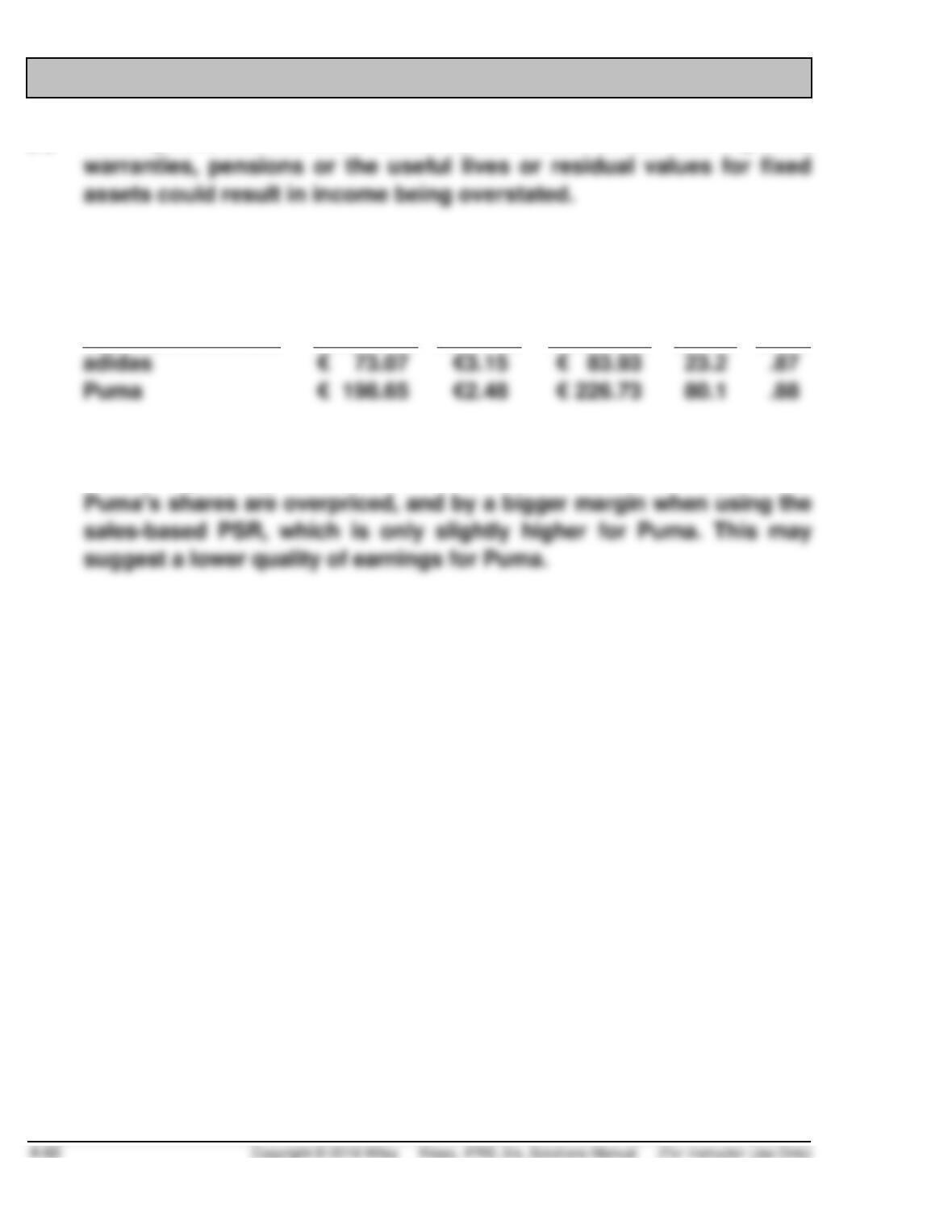
(b) See the table below.
December 31, 2015
Price
EPS
Sales per
Share
P/E
PSR
adidas
.87
Puma
.88
(c) Puma has a higher P/E relative to adidas (almost 4-times). But Puma’s
PSR is slightly higher than that for adidas’. Thus, it would appear that
ACCOUNTING, ANALYSIS, PRINCIPLES
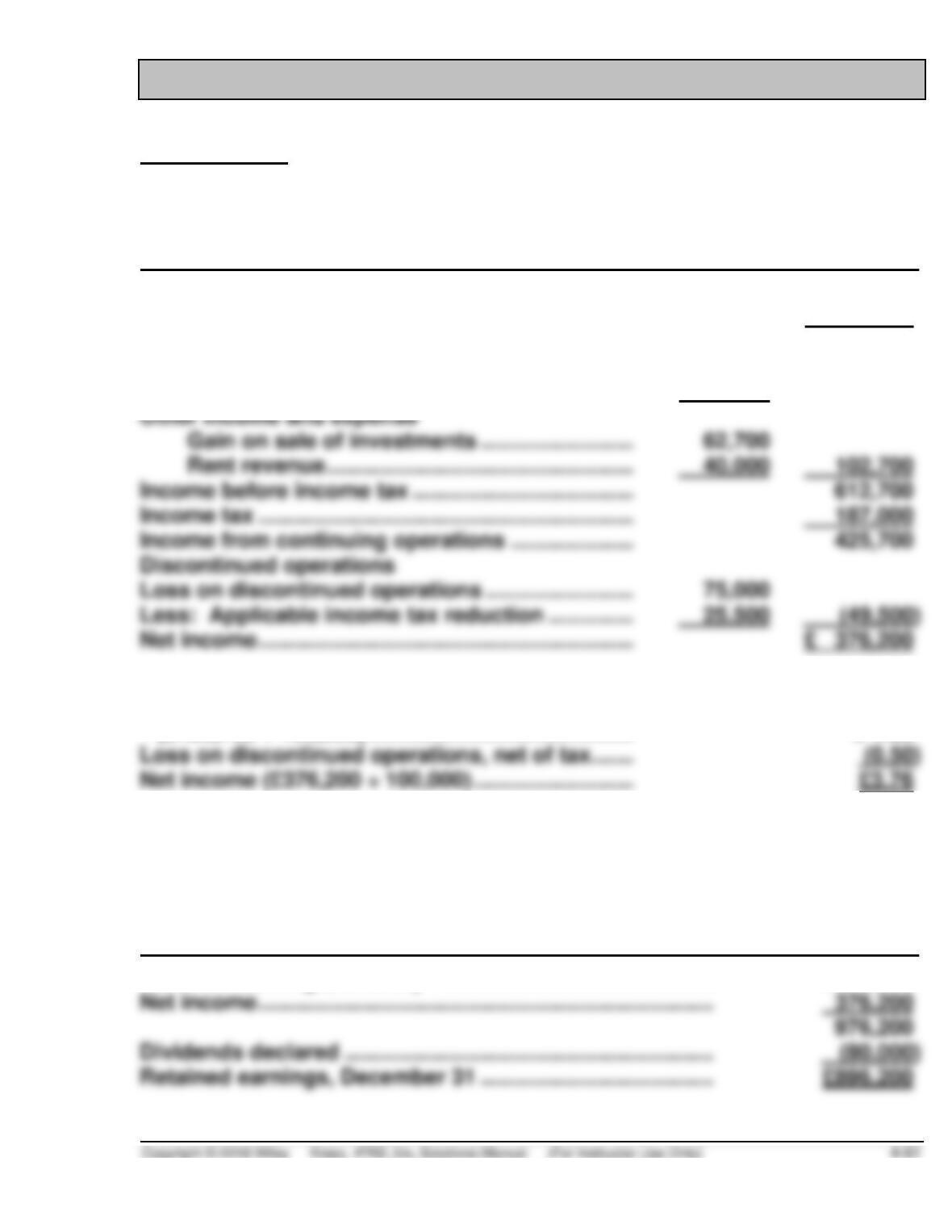
ACCOUNTING
COUNTING CROWS LTD
Statement for the Income
For the Year Ended December 31, 2019
Sales revenue ……………………………………………….. £1,900,000
Cost of goods sold ………………………………………… 850,000
Gross profit …………………………………………………… 1,050,000
Selling expenses …………………………………………… £300,000
Administrative expenses ……………………………….. 240,000 540,000
Earnings per share*:
Income from continuing operations
(£425,700 ÷ 100,000) ……………………………………. £ 4.26
*Rounded
COUNTING CROWS LTD
Statement of Retained Earnings
For the Year Ended December 31, 2019
Retained earnings, January 1 …………………………………….. £600,000
ACCOUNTING, ANALYSIS, PRINCIPLES (Continued)
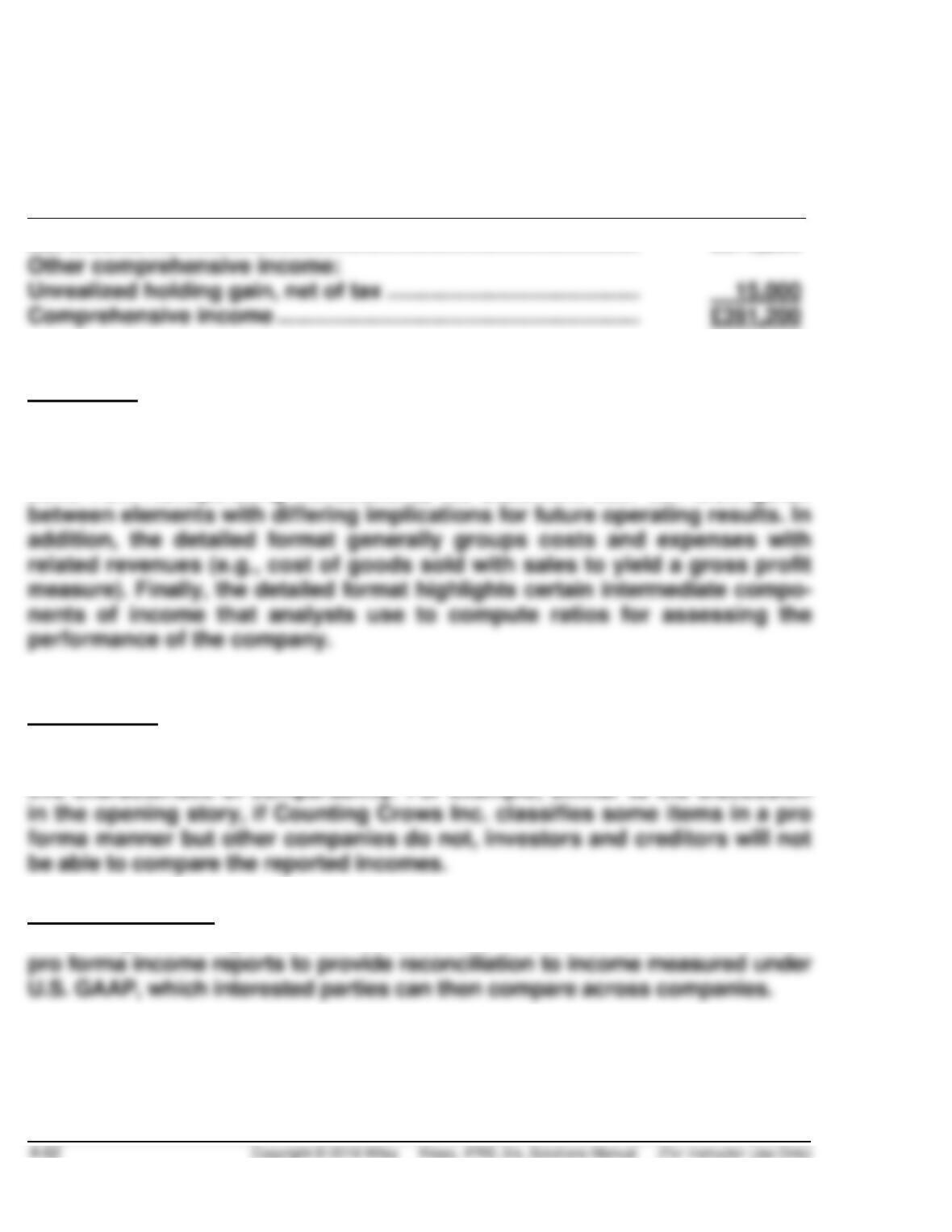
COUNTING CROWS LTD
Statement of Comprehensive Income
For the Year Ended December 31, 2019
Net income …………………………………………………………………….. £376,200
ANALYSIS
The detailed income statement recognizes important relationships between
income statement elements. For example, by separating operating transac–
tions from nonoperating transactions, the statement user can distinguish
PRINCIPLES
Pro forma reporting is inconsistent with the conceptual framework’s qualita–
Note to instructor: This is the reason the U.S. SEC issued Regulation G,
which requires companies that list securities in U.S. markets and that issue
RESEARCH CASE
(a) International Accounting Standard 1, Presentation of Financial Statements
addresses the statement of comprehensive income reporting. This
standard was issued in September 2007 and includes subsequent
loss’ and of ‘other comprehensive income’ (Paragraph 7).
(c) Paragraphs 85 and 86 provide the rationale for presenting additional
information: An entity shall present additional line items, headings and
Because the effects of an entity’s various activities, transactions and
other events differ in frequency, potential for gain or loss and predict–
ability, disclosing the components of financial performance assists
users in understanding the financial performance achieved and in
making projections of future financial performance. An entity includes
additional line items in the statement of comprehensive income and
RESEARCH CASE (Continued)
(d) When items of income or expense are material, an entity shall disclose
their nature and amount separately (Para. 97).
Circumstances that would give rise to the separate disclosure of items
of income and expense include:
a. write-downs of inventories to net realizable value or of property,
plant and equipment to recoverable amount, as well as reversals
of such write-downs;
GAAP CONCEPTS and APPLICATION
4.1. There is no U.S. GAAP in this area, except the SEC does require
4.2. Bradshaw should report this item in “Other revenues and expenses.”
4.3. As in IFRS, U.S. GAAP provides for two possible reporting formats for
4.4 (a) Some of the differences are:
1. Units of currency—Campbell and all U.S. companies report in
dollars and earnings per share in dollars and cents. International
Some similarities are:
1. Campbell appears to use a function-of-expense approach. It may
provide additional nature-of-expense information in the notes.
(b) Campbell reports no discontinued operations in 2016, but does report
earnings from discontinued operations in 2014. The “Earnings from
discontinued operations” or gain or losses are an example of a non-
recurring item. As in IFRS companies’ income statements, these items